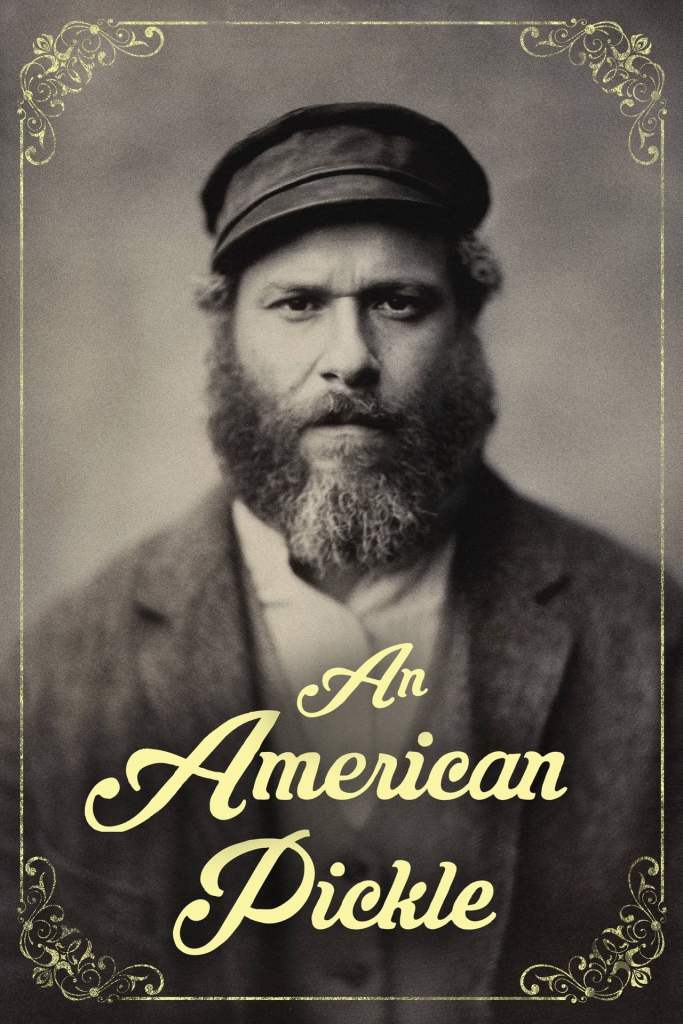
Thanks a lot Zac. You know, once in awhile my buddy recommends something decent, but more often than not I am reminded that we do not share tastes in movies. An American Pickle was his latest recommendation. I usually steer clear of Seth Rogen films (the only one that I can recall truly liking wasn’t even a comedy: Boyle’s/Sorkin’s Steve Jobs), and this movie hasn’t changed my mind. In this one, he plays Jewish Russian immigrant Herschel Greenbaum, who’s come to America with his pregnant wife to escape persecution. He falls into a pickle vat at work one day and the brine keeps him preserved for 100 years, awakening finally in present day Brooklyn. Herschel is united with his only living family member, great-grandson Ben (also played by Rogen). Ben’s parents are dead, but he seems to have left them on bad terms, as he doesn’t want to discuss family events with his ancestor. Ben’s been struggling to find success with an app he’s been building for 5 years, but Herschel immediately finds success and popularity in the pickle business. Jealous and angry, Ben tries to sabotage Herschel at every turn. There are chuckles, mostly from Herschel’s learning curve adjusting (or failing to adjust) to this new world, as he butts up against social media and changes to societal norms, but chuckles is all it elicited from me. Far too predictable, not funny enough to stand up to the great comedies, and not enough heart to cross into solid drama territory. ★★

Violet, starring Olivia Munn, is a very interesting movie. The title character is a woman struggling with inner demons in her everyday life. Successful professionally, she is hounded by an inner voice that tears her down at every step, and continual thoughts belittling her, which show up as written script across the screen. When Violet gets really frazzled, the screen fades to red as the conversations around her fade out, indicative of Violet pulling away from those around her. The film follows along as she tries to reconnect to old friends, stand up for herself at work, and find love, all while everything in her mind and body keeps telling her that she isn’t good enough. There’s a lot going on on screen, and the near-incessant dialogue can make it tough to really focus on what is happening. Thus, I can’t say much for the acting performances, because I found it hard to really center on the characters for any length of time, but the film is very different from your usual dramas. I think it is definitely worth watching, for a new viewing experience if nothing else, but not sure it is all that memorable. ★★★

The Bombardment (original title The Shadow in My Eye) is a Danish film detailing a horrific event near the end of World War II. The German gestapo have a base in Copenhagen where they interrogate and torture local underground resistance fighters, and Allied spies have been urging the British to take the target out. The first half of the film will test your patience, where nearly a dozen or so various characters are introduced, ranging from the resistance, some British Royal Air Force pilots, a conflicted Danish civilian who’s enlisted in the German occupying army, a nun at the local school who is searching for signs of God in these awful times, and a trio of young friends at the school. I get that the filmmaker wanted to flesh these characters out, but it did take a really long time to get to the meat and potatoes. When the bomber planes take off from England, the events will hit you hard. On their way to bomb the gestapo headquarters, one of the planes clips a tower and crashes into the school. The two ensuing bomber raids see the smoke, and mistakenly think the school is the target. With the atrocities of the war in Ukraine in full view, we are easily reminded that these mistakes happen in war, but that doesn’t make them any easier to swallow, and maybe more so when they are done by “the good guys.” Though I’m sure Operation Carthage is still taught and remembered in Denmark, I’d never heard of it, and I’m not ashamed to admit I was moved to tears. ★★★★

Dumb, dumb, dumb. Bad Luck Banging or Loony Porn is a cumbersome title for a cumbersome movie. It’s labeled as a comedy-drama, but it’s more of a dark satire. Emi is a good teacher at a well-to-do school, but she’s in hot water after she and her husband make a sex tape, which gets uploaded to the internet. The parents at the school are calling for her job, but the school is trying to do its due process, knowing that Emi has been good at her job. The movie is made up of three parts. The first is mostly just Emi walking around town, while the camera catches scenes of vulgarity or explicit advertisements all around her. The middle section steps away from Emi and is just a bunch of tiny segments, a montage of sorts, about society and its norms and taboos. The final section is the school meeting that night, where Emi sits in front of all the parents to learn her fate. There’s a lot of ridiculousness at the meeting, including a parent who insists on showing the sex tape on her tablet to all present, just so “they know what they are talking about.” The fathers obviously love it, but then go on to talk about how terrible Emi is. Stupid movie, which I ended up fast-forwarding through large chunks after the monotony set in. ½
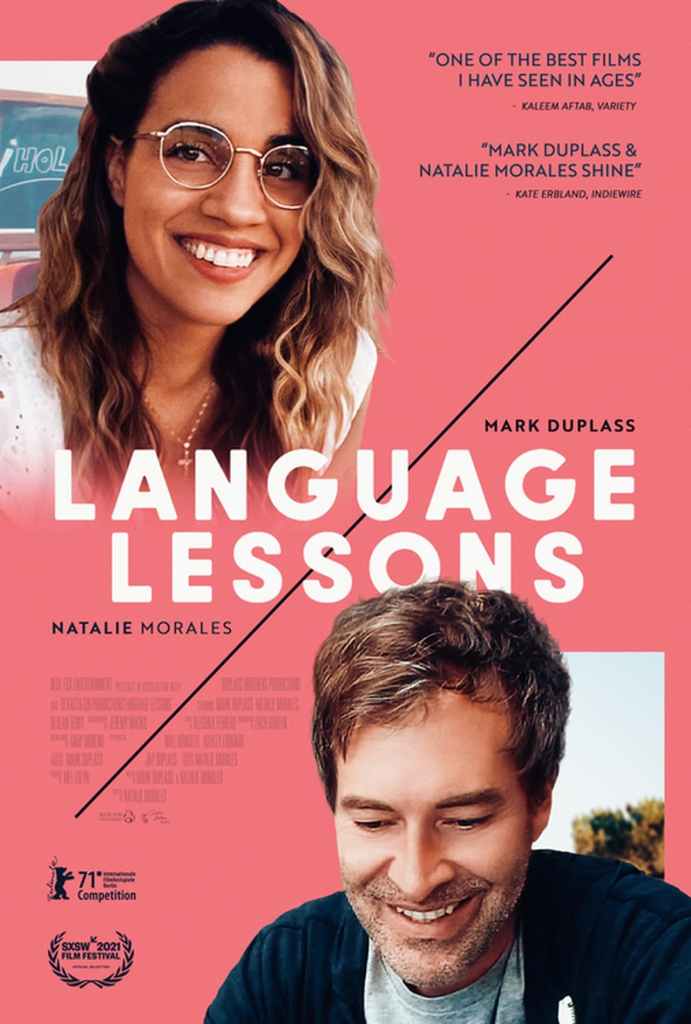
Language Lessons is a small indie film with only two characters: Mark Duplass as Adam, and Natalie Morales as Cariño (the two co-wrote the screenplay as well, with Morales taking director duties). Adam has just been gifted 1000 Spanish lessons from his husband Will, sort of as a prank, but also because the couple is very wealthy and look for creative presents to give each other. Cariño is the Spanish teacher, who will give Adam once-a-week online lessons for the next couple years from her home in Costa Rica. On the morning of their second lesson though, Adam’s screen comes on to show him laying in bed, despondent. Adam tells Carińo that Will died in an accident last night, and since he took care of everything from finances to housework, Adam has no idea where to begin. Over the course of the film, Adam and Carińo form a strong friendship. At first, she helps him through his grief, but later, he is able to return the favor when Carińo starts going through her own struggles. It’s kind of a genius way to make a film in the early COVID era, as the two characters are never in the same room (it was shot during the pandemic lockdown), and we only see them when they are talking to each other via Zoom/Facetime. Production aside, it’s a very nice movie too. Nothing groundbreaking, but it’s a tender, well-acted film about finding your way back to life. ★★★½
- TV series currently watching: Silicon Valley (seasons 3+4)
- Book currently reading: Relentless by RA Salvatore























 Jons Movie Takes