
I usually don’t review the shows I watch, but I think Hal & Harper (an 8 episode miniseries) is worth saying a few things about. Written and directed by (and starring) Indie film darling Cooper Raiff, it follows the lives of the eponymous siblings (Raiff is Hal, Lili Reinhart is his 2-year-older sister Harper). Their story unfolds in an unhurried, sublimely emotional way. We know early on that they lost their mother (for a long time, we don’t know how or why) at an early age, when Hal was going into first grade and Harper into 3rd. They are thus raised by their newly single father, an unnamed “Dad,” played by Mark Ruffalo. We initially don’t think much of Dad’s fatherly skills, as he is curt with the kids and doesn’t exhibit much in the way of parenting knowledge (in present day, he apologizes to his adult kids for making them grow up too fast, and his comment leads to the adult actors playing their younger selves in a very Indie way), however, you do learn as subsequent episodes continue that Dad did the best with what he had, as he was fighting his own depression and the loss of his loving wife. In the present day, Dad is having a baby with his (much younger) girlfriend and has told Hal and Harper that he is selling their childhood home, so that brings up all kinds of emotions to the twenty-something adults. These two, with their lifetime baggage of fearing the loss of loved ones, have never been able to find lasting relationships with others and have become very codependent on each other, with Hal often sleeping on Harper’s couch and each turning to each other whenever they dump their newest partner (often in fear that the relationship was getting “too real”). Wonderfully heartfelt series, you’ll laugh and cry (I did both within seconds of each other in the last episode), and told so extremely well. Highly recommended, and probably one of those series you’ll return to again and again for its emotional depth. ★★★★★
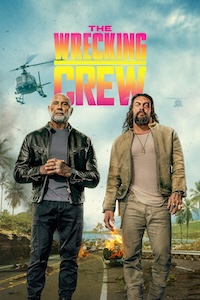
The Wrecking Crew is one of your typical straight-to-streaming action films, albeit with a couple bonafide stars in the leads (Jason Momoa and Dave Bautista). Name recognition notwithstanding, there’s a reason this one was straight-to-streaming. James and Jonny are two estranged brothers and their father, Walter, was recently killed via a hit-and-run in their home state of Hawaii. James (Bautista) lives there still, but Jonny (Momoa) left years ago and has had little contact with either his brother or father in years. He initially isn’t even going back for the funeral, but when he is attacked in his home in Oklahoma by some Japanese Yakuza thugs, seeking a package he may have purportedly received from Walter before his death, Jonny suspects there’s more to this than meets the eye. He heads to Hawaii and starts digging into his dad’s death, while James does the same. Lots of action ensues, which is the best part of the movie (including a pretty dynamic, if completely implausible, bridge scene where they are shot at by a flying-over helicopter). The mystery behind Walter’s death isn’t all that intriguing, and outside of the action scenes, the movie is pretty boring, though there are some good one-liners between the fighting brothers. ★★½
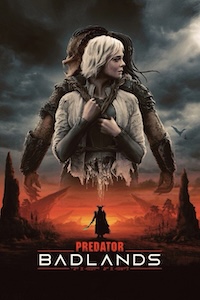
Predator: Badlands is the newest in the franchise, though can be watched as a stand-alone film too. Dek is a runt in his Yautja (the predator species) clan, and in a society that favors strength, he should have been killed as a child. Still, his older brother has trained him to become a decent fighter, to the point that Dek wants to earn his right to carry the predator’s cloaking device. When he declares his intentions though, the brothers’ father kills the eldest for insolence, while Dek gets away before he too can be murdered. Dek finds himself on the planet Genna, a hostile world where every living creature, including the plant life, is out to kill you. Dek is on the hunt for the monstrous Kalisk, a beast so deadly that even Dek’s clan is afraid of it, since that trophy will finally earn him some respect. On his hunt, Dek picks up to would-be friends: an android synth named Thia (cue the Alien franchise crossovers, as she’s on the planet on a mission from Weyland-Yutani), and a local monkey-like creature that Thia names Bud. Together, the trio hunt the Kalisk, even as Thea’s former team of deadly synths also seek the same prize. Writer/director Dan Trachtenberg, who also helmed Prey and Predator: Killer of Killers, has this franchise on solid footing again, can’t wait to see where they take it next. ★★★★

Sentimental Value is the latest from Norwegian director Joachim Trier, and it’s been getting plenty of acclaim in the last year. It stars Stellan Skarsgård (showing no signs of slowing down) as Gustav, a one-time acclaimed director whose drinking has derailed his career, and he’s having a hard time getting movies financed these days. He’s written a new one though, that he thinks has potential to be great, if he can get it made. Semi-biographical, it is about a woman who commits suicide, as Gustav’s mother herself did when he was a child of 7. Gustav wants his daughter Nora, herself an acclaimed stage actress, to play the lead role, but she is not interested. Nora and her sister Agnes are estranged from their father after he walked out on them and their mother when they were little girls, and he always seemed to put his career before being a father. It is their mother’s recent death that brought the family back together, and stirred up all kinds of feelings. As luck would have it, a film restrospective about Gustav’s films has intrigued American actress Rachel Kemp (Elle Fanning, proving that she can do it all; she was in the above Predator film as Thia). Rachel is an up-and-coming star, and she is chomping at the bit for a serious dramatic role, and thinks Gustav’s new film is just the ticket. She signs on, which gets Netflix interested in financially backing the picture, and so they begin. But there is still family healing to be done, and the result is movie magic. Be patient with this movie. Absorb every word, every nuanced movement by the actors. It builds without you realizing it, until a powerful conclusion. One of the best movies I’ve seen in a long time. ★★★★★
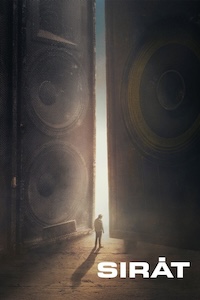
From wiki: As-Sirāt is, according to Islam, the bridge over which every person must pass on the Yawm al-Qiyamah (“Day of Resurrection”) in order to enter Jannah (“Paradise”). Whether you want to take the film Sirāt as narrative or allegory, it is definitely Luis’s journey to make. At the beginning of the movie, he and his son Esteban are searching the deserts of Morocco for news of missing daughter Mar. A large group of Bohemian-esques are throwing a rave in the middle of the desert, and Luis is there looking for Mar. After a couple days, soldiers arrive to break up the party, telling Europeans that they must go home, as war is breaking out in the area. A group of free-thinkers break off from the others and head back into the desert, and Luis gives chase, hoping they’ll lead him to his daughter. They tell Luis that there’s to be another rave soon, and let Luis and Esteban tag along. Islam says As-Sirāt is thinner than a strand of hair and as sharp as the sharpest knife, and danger lies everywhere for Luis on his path. He will face hardship and anguish, with no guarantee of paradise in the end. While I was watching the movie, and even as it neared its end, I was thinking, “What the hell even is this?” But there’s no denying its emotional punch, whether you want to take it as allegory or fact, of a man going through hell to reach (maybe?) something new on the other side. Awesome soundtrack too, that keeps the tension ratcheted up throughout. ★★★½
- TV series recently watched: A Knight of the Seven Kingdoms (season 1), Breaking Bad (season 5)
- Book currently reading: Paul of Dune by Herbert & Anderson
















 Jons Movie Takes