
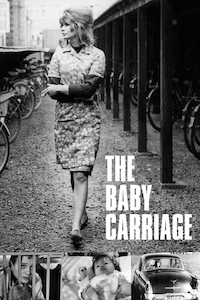
Today, looking at some works of a couple Swedish directors who got their starts (behind the camera, at least) in the 1960s. Bo Widenberg had already been critical of the more traditional narrative films coming out of Sweden, particularly those of Ingmar Bergman (how dare he?!), so his pictures were tagged with the label of the Swedish New Wave after their French counterparts. His first film, 1963’s The Baby Carriage, isn’t completely “new wave,”, but it’s OK. Britt is a young woman without a lot of prospects, and seems uninterested with life. She sleeps with her boyfriend Robban and gets pregnant, and when she tells him about it, he flies away faster than a hawk. Her mother urges her to end the pregnancy, but Britt decides to keep the child, perhaps as the one thing in her life she has control over. As her pregnancy progresses, Britt starts hanging out with a guy named Bjõrn, who comes off as snobbish and pretentious. Britt overlooks these faults, as she so desperately wants him to be “the one” after her experience with Robban. She doesn’t see Bjõrn for what he is until nearly too late. In the end, Britt needs to discover who she is and who she wants to be. I think the film tries a little too hard to be new wave, with a jazz soundtrack that doesn’t always fit as well as it does in Elevator to the Gallows. ★★★

Widenberg went with a more traditional narrative film with his next, Raven’s End. Taking place in the 1930s against the backdrop of the rise of Hitler in Germany, Anders (same actor as Bjõrn above, Thommy Bergendahl) wants to be a writer but doesn’t know if he’ll ever get there. He’s from a very humble background; his father is an alcoholic and long unemployed, drinking or gambling away his family’s income, and his mother barely scrapes by as a laundress. When a publisher in Stockholm sends an invite to Anders to come talk about a submitted work, Anders is elated and thinks he’s finally done it, only to have his hopes dashed when his book is ultimately rejected. Anders laments that he has no experiences outside of his provincial life, nothing of interest to write about. What’s funny though is that there is history and life around him, if he were to just stop and pay more attention. In the end it may not be enough. Good story. ★★★½

A few years later, Widerberg made Elvira Madigan, based on the life of a young woman who lived in the late 19th century. At the beginning of the film, we meet Elvira and her boyfriend Sixten. The two are obviously madly in love, and the film paints this picture of an idyllic carefree life, the kind where you get lost in your love and nothing else matters. Only, some things should matter. We are told early on that Sixten has deserted from the military and faces harsh jail if caught. 20-ish minutes into the movie, we also learn that Elvira (real name Hedvig, as Elvira was her stage name) was a renowned circus tightrope performer who ran away from home and her career to be with Sixten. OK, lovers do crazy things, but when we later learn that Sixten left his wife and two young children too, things start to feel a little murky. The couple bounces from hotel to hotel while on the run, leaving whenever someone recognizes them (their story is all over the papers) or whenever the bill comes due, as their finances are dwindling. When they get so hungry that they start eating flowers and grass, they finally realize that their love alone cannot sustain them, and make a suicide pact. On the surface, you think that Widerberg has abandoned his ideals since this seems like a much more traditional film, especially since it is based on a true historical story, but it was shot on a minimalist script, mostly improvised by the actors and with no rehearsals, so the director was still sticking to his guns, more or less. The movie became the director’s first international hit. ★★★★
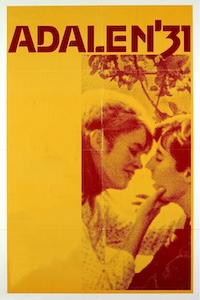
Three decent-to-good films and then a clunker. Ådalen 31 is based on a true story again, but gets far too political for my tastes, and comes off as preachy. It follows a moment in Sweden in 1969, an event that is still infamous to this day in that country. The primary business in the town of Ådalen is a sawmill, but the workers there have been on strike for months, and the owner is getting tired of it. He brings in new workers from out of town, which gets the townsfolk riled up, and they attack the scabs. To protect them and his industry, the owner calls in the military, and in a stroke of insanely back judgement, the military shoot at the protesting townspeople, killing 5 including a teenage girl who was just a bystander. Terrible day in Swedish history? Absolutely. Do I need to have it hammered down my throat how bad capitalism is and how good Sweden became under the socialism that followed? Naa, I’m OK. ★½

After that hack job, I moved on to a different director, Widerberg’s contemporary Mai Zetterling. She started as an actress (first role was actually Bergman’s first film as a writer, 1944’s Torment) but moved behind the camera by 1964’s Loving Couples. Kind of a misleading title, because the couples in this film are anything but traditional, and the setting is certainly not wholesome. It takes place in a maternity ward in 1914. Three women are there: Angela, Agda, and Adèle. Through flashbacks, we get the stories of these three women, whose lives are all interconnected, and what brought them to the ward. Angela comes from money though she feels her wealth as a burden at times. Her father died when she was a little girl, leaving her this fortune, and others tried to manipulate her over the years. She’s in the ward to give birth. Adèle once had money too, but when her father died, he left her and her mother destitute from gambling debts. As such, Adèle grew up bitter at the world and has become a hateful person. She’s in the ward waiting for her body to expel the stillborn child inside her. The last is Agda, who was born poor and later became a maid in Angela’s household, but she always found joy in life, though her marriage (and non-traditional pregnancy, as we learn) were more pragmatic. Very intriguing story with lots of tangents that all come together in the end for a complete picture. Relationships intertwine, to the benefit of some and detriment of others. It’s a film you have ride out to the end to see how it all fits together. ★★★½

Night Games was the director’s next film in 1966, and has a seriously messed up theme. Jan is engaged and has brought his fiancee Mariana to his childhood home, a sprawling estate. In flashbacks, we see Jan and the chaotic household he grew up in. His mother was Irene, a wealthy socialite always surrounded by sycophants, and with a revolving door for a boyfriend/sometimes husband. Irene cares only for physical pleasure and ignores her son Jan (unless he is bringing her joy at that moment in time). The only real attention Jan gets is from his grandmother, who unfortunately is losing her mind. As such, Jan grows an oedipus complex for his mother. In the current timeline, the longer he stays in that home, Jan begins to take on characteristics of his deceased mother, especially her hedonistic lifestyle. In the end, he must decide which path in life he wants to follow. Not sure I particularly liked the movie too much, but it is a fascinating story. A funny anecdote: when the film was to be shown at the San Francisco International Film Festival, an adult Shirley Temple (in her late 30s at that point in time) was to be on the jury, but resigned, calling the film “pornography for profit.” It is far from pornographic but definitely is stark in its portrayal of Jan’s and Irene’s unhealthy relationship. ★★★

The Girls was Zetterling’s first (and arguably only) hit, though it took decades to be recognized as such. It bombed when it came out in 1968, despite an all-star cast (Bibi Andersson, Harriet Andersson, Gunnel Lindblom, Gunnar Björnstrand, and Erland Josephson). A meta film before its time, it stars its trio of ladies as actors in a traveling performance of an ancient Greek play: Lysistrata by Aristophanes, about women who withhold sex from their husbands in an attempt to force them into a peace treaty during the current war. In a tale of life imitating art, we see that the actresses are continually subjected to sexism, even from other women, who think these ladies should be home “taking care of their babies and husbands.” If they have a family at home and good looks (heaven forbid when that starts to go with age), then they should have everything they need to be happy, and there’s something wrong with them if they want something more. The more times change, the more they stay the same. There’s some subtle surrealism too, like one scene where one of the girls is trying to get her point across, but the only time men start paying attention is when they are all transported to a lounge and she starts taking her clothes off in front of them. The movie does have some grandstanding (including one scene where a woman is literally grandstanding) but that all-star cast is all on top of their game, and it is as timely today as it was in the 60s. Loses a little steam in the final third of the picture, but overall still great. ★★★★
- TV series recently watched: Dutton Ranch (season 1), The Agency (season 2), Enterprise (season 2)
- Book currently reading: The Winds of Dune by Herbert & Anderson


