Today we go back to one of the most famous actors of the silent film era, Charlie Chaplin. To anyone who hasn’t seen a movie or two of his, for thinking it is outdated, you are missing out. Probably the best pantomime actor of all time, but also an incredible director and writer as well. Though we shouldn’t condone his personal transgressions (he impregnated and married several woman much younger than himself, including a couple teenagers), he is without a doubt one of cinema’s greatest of all time.
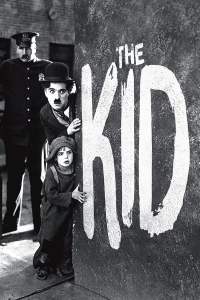 Chaplin broke down a lot of barriers with his film The Kid in 1921. To this point, he had become famous making 2 and 3 reel shorts with his Tramp character, but he wanted to make a full, feature length film. When he was told it would be impossible to keep the comedy going for that long, he replied that the film would also have a drama element. We take it for granted now, but at this time in film (and radio, and theater), comedies and dramas were kept apart, as producers thought the audience would be confused if you joined them. In The Kid, the Tramp becomes a surrogate father to an abandoned child and raises him as his own. Always poor (as Chaplin’s Tramp always was), the duo have several adventures, but always manage to rely on each other in the worst of times. Very funny but also very endearing, the film clearly shows Chaplin was ahead of his time.
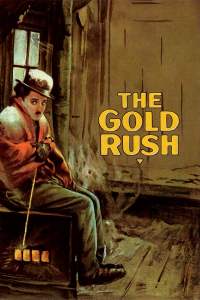 The Gold Rush, from 1925, may be Chaplin’s favorite movie, and he is on record for saying it was the one he most wanted to be remembered for. Most of Chaplin’s silent films were created spontaneously; he would have a general idea for the movie, but the film with develop during shooting (and re-shooting) until it made a cohesive whole. Not so for The Gold Rush, which was fully written before he started filming. It is also the only silent film that he later “converted” to sound, releasing (in 1942) with narration replacing the intertitle cards, and a new musical score. It even won a couple Oscars upon the re-release. I watched the original silent film though, and really enjoyed it. The Tramp finds himself in the great north, swept up in the search for gold with hordes of others. Along the way, he finds a close comrade, fights off a villainous murderer, falls in love, and ultimately becomes rich. Chaplin is at his comedic best, but the film is also chuck full of adventurous tension and unrequited love, and you are truly pulling for the little guy from the very beginning. If you are going to watch any Chaplin film, watch this one.
 As forward-thinking as Chaplin was in his writing, he resisted “talkies,” probably because he had become so famous in his silent films. City Lights came out in 1931, four years after The Jazz Singer broke “the sound wall,” but Chaplin stayed the course for the silent era. Another comedy-drama, in this one, the Tramp falls in love with a blind girl. He uses his friendship with a rich man (who only recognizes Chaplin’s character when he is rip-roaring drunk) to get money to support the girl, ultimately finding a way to pay for an operation for her to regain her sight. In doing so though, he is accused of theft and sent to jail. When he emerges months later, he tracks down the girl, who only recognizes him when she touches his hands in the final scene. Maybe even more heartwarming than The Kid, City Lights showcases Chaplin as an actor with decades of experience behind him, and coming into his own as a director.
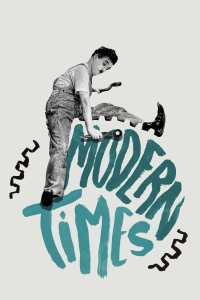 Chaplin’s last use of the Tramp character, and his last silent film, was Modern Times in 1936. Released nearly a decade after sound make its way to the cinema, it is a fitting farewell. Ostensibly about the Tramp falling in love with a poor girl and being unable to support her in a down economic time (and his own laughable inability to hold even a menial job), the film really satirizes the changing world as a whole, and the movie industry in particular. Obviously under a lot of pressure to move to sound films (though he had full creative control through his deal with United Artists), he thumbs his nose at his naysayers by making a clever, funny movie with virtually no dialogue. When the Tramp opens his mouth and sings a song in the final minutes of the film, the words are just gibberish, yet still we laugh.
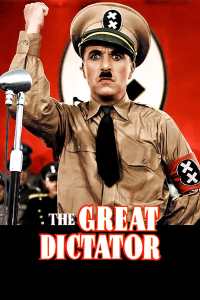 Chaplin’s first sound film came in 1940, The Great Dictator. Very controversial at the time, it satirizes Hitler (called Adenoid Hynkel here), with Chaplin playing both him and a Jewish barber concurrently. Hynkel is portrayed as a petulant child, a bumbling idiot with a temper. He makes rash decisions that his advisers need to keep talking him out of. The barber is a regular joe trying to get by in a crazy world, but he is able to avoid persecution for having saved a Tomainian (German) officer during the first World War, an officer who went on to be high up in the government. Through a crazy turn of events at the end of the film, the barber is mistaken for Hynkel and finds himself on the podium addressing a mass of military and citizens. Here, Chaplin comes out of character, faces the camera, and gives an impassioned speech for people to fight fascism and dictatorship, a speech that seems to mean as much today as it did in 1940. Look it up and read it, or better yet, watch the film.

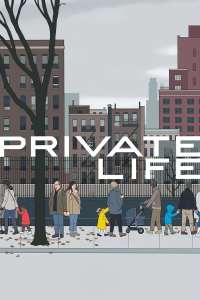 Starting today with a great film that, I think, can hit very close to home for a lot of people in our country, on a subject very often not talked about. Private Life is about a couple in their upper 40’s who have waited, possibly, too late to decide they want to have children. Richard (Paul Giamatti) and Rachel (Kathryn Hahn) have all ready done several cycles of IUI and are now moving on to the more expensive IVF. At the same time, they are exploring adoption and surrogacy, but so far are finding dead ends and disappointment everywhere. When it becomes clear that Rachel can’t provide enough viable eggs, a niece steps forward to offer one of her own, against her mother’s wishes. But even this doesn’t seem to go well. I’m not telling if you’ll find a happy ending here or not, but you will find fantastic performances by all actors involved, and a truly special movie that explores all aspects of the frustration over infertility, including family problems, the drain on the relationship and sex life, the stigma that follows women who have problems conceiving, and everything else.
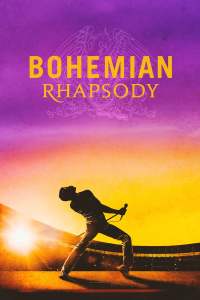 Telling the story of Queen’s rise to stardom from humble beginnings, culminating in their triumphant concert at Live Aid in 1985, as well as Freddie Mercury’s personal struggles, Bohemian Rhapsody features a standout performance by Rami Malek as Mercury. I write this the day before the Oscars, so I don’t know yet if he won, but he is certainly deserving. Though the movie is just OK (not bad, not great), Malek IS Mercury for those 2 hours, and not just because of the dental prosthetic he used to help get him the look. Those biopics where the actor disappears and the muse is all we see are the ones that stand out to me, and this fits the bill. The film tries to do its best to show all of the members of Queen, and continually drives home that the band was a family as a whole, but make no mistake, this is Malek’s film and he commands the camera in every scene, just as Mercury did in life.
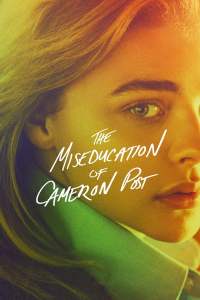 The Miseducation of Cameron Post stars Chloe Grace Moretz as Cameron, a high school girl in the early 90’s, found making out with a girl in a car outside of their homecoming, and then sent to a gay conversion therapy center by her Christian parents. There, Cameron is continually questioned by adults and other teenagers as to why she has feelings for girls, and why she is the way she is, and who did this to her, but Cameron doesn’t know why. She faces the questions the same way someone would ask why the sun comes out every day: just because it does. At the same time, she does make friends among those that are forced to be there, who aren’t trying to “get better.” The film depicts some of the downright ridiculous things that go on in these camps (Maybe Cameron likes girls because she has a masculine name? A boy getting his hair shaved off by a teacher for letting it grow too long.) and some of it is hard to watch, especially a devastating moment near the end. A powerful line comes in the last 10 minutes when a person asks Cameron if she is being emotionally abused here, and her reply is, “How can a place that teaches you to hate yourself not be emotionally abusive?” Moretz has all ready made a ton of movies at her young age (just 22 right now), and she’s had both hits and misses. I’ve always found her to be at her best in the smaller, independent films she’s done, and she shines here again.
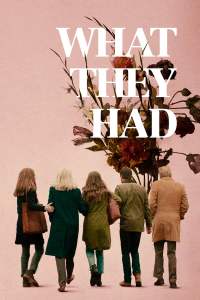 What They Had is about a family clinging to things that just aren’t there anymore, no matter how much they wish it were so. Bitty clings to her daughter’s college education, though the daughter hates school. Bitty is also clinging to her 20 year marriage, which is perfect on the surface but miserably lonely to her. At the center of it all is Bitty’s parents Norbert and Ruth. Ruth is suffering from dementia but Norbert is clinging to the memory of how things were, and refuses to let her go to a care facility, despite her becoming increasingly more dangerous to herself. Bitty’s brother Nick is the pragmatist who sees everything as it truly is. The film is about a lot of things, much can be taken from it, but perhaps what I took the most is the traps we can fall into in our closest relationships. It is easy to play a part, because it is safe, expected, and comfortable, but perhaps not always the best for us. Great work by all four leads, Hilary Swank, Michael Shannon, Robert Forster, and Blythe Danner.
 I tried to like Suspiria, even though I think lead actress Dakota Johnson can’t act her way out of a paper bag. It has an interesting premise and I really wanted to get into it, but I could only make it 1 hour and 8 minutes before tossing in the towel. The setup takes place in 1970s Berlin, at a famous dance school, with newly arrived Susie there to take the world by storm. A former student has just mysteriously gone missing, after having spewed crazy stuff about witches and rituals about the school to a psychiatrist. Great start, unfortunately a suspenseful thriller should have both suspense and thrills, and this film just seemed to be spinning its wheels. There were a couple good moments, and some grisly scenes that will leave even a horror film connoisseur squeamish, but if there’s not enough after an hour, I’m not sticking around for the rest. The movie is based on an Italian classic which is highly regarded, so maybe I’ll give the original a go sometime.
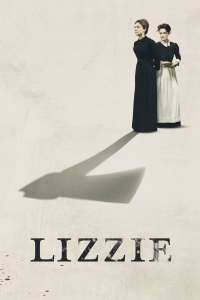 The infamous axe murders of 1892, which became tabloid fodder and spurned a fun little rhyme, are depicted in the film Lizzie. Lizzie Borden and her sister Emma were adult women living in a very strict home with their father, step-mother, and a housemaid, Bridget. After enough backstory is developed, the murder of the parents goes down, and Lizzie is tried for their murder. The film does a good job of showing all the flaws of the father, his molestation of Bridget and metal abuse of his daughters, providing motive of the killing for several people. The acting is superb, especially from Chloe Sevigny as Lizzie and Kristen Stewart as Bridget. I don’t know how historically accurate the film is, but I enjoyed it; it is a good character-driven film perfect for lovers of period dramas, with a bit of quiet suspense thrown in.
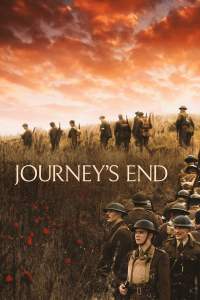 Sometimes fantastic acting makes the film, and sometimes it just isn’t enough. For some odd reason I couldn’t connect with Journey’s End, which is lauded by critics but did little for me. It follows a company of British soldiers as they take their place in a trench, right on the front lines in World War I. They must spend 6 days here before they are swapped out again, and all know that a German attack is imminent. They also know that no reinforcements are coming, and they are supremely outnumbered at this front. The movie is mostly about the comradery of the soldiers, faced with certain death in an impossible situation. Their fear is palpable through the screen, but honestly I was bored for much of the film. Maybe I just wasn’t in the mindset today, but for a war film, I expect more than 20 or so minutes of real action.
 A Bag of Marbles is a French film following a Jewish family in Paris during the Nazi occupation of World War II, and specifically, the two youngest boys, Jojo and Maurice. When the father sees the writing on the wall that German forces will start rounding up the Jews, he separates the family and tells everyone to meet up in southern France, which is occupied by Italy and thus less antagonistic to Jews. Jojo and Maurice go on quite the adventure but do arrive their safely. Unfortunately the peace is short lived before they must separate again and continue to hide. Over the following years, the two rely on each other while always seeming to be one day away from being caught, and constantly hoping for news from their parents or older brothers. Amazingly, I found out during the end credits that it was based on a true story, though I’m sure it was a similar story for many who survived that terrible moment in our history. Fantastic film about an incredible story.
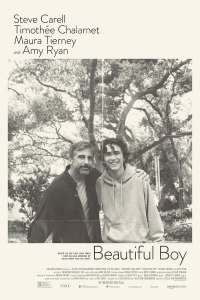 Another tremendous film is Beautiful Boy, and also based on a true story. This one features tour de force performances by Steve Carrell and Timothee Chalamet as a father and son. David Sheff seems powerless to help his son Nick overcome his drug problems. The movie is nearly non-linear, with frequent jumps back in time, both short and long, to show Nick’s gradual descent into full-on addiction. David reminisces about the care-free, loving little boy Nick used to be, and can’t wrap his head around how Nick came to be in this predicament. In and out of rehabs, nothing seems to work. Even surviving an overdose doesn’t turn Nick’s life around. As a viewer, we see all of the pain this is causing David, and I kept rooting for Nick to find peace. Unfortunately as the movie goes along, we aren’t sure if we’ll get the Hollywood ending or not. More heart-breaking than heart-warming, it is one of the powerful films I’ve seen in awhile.
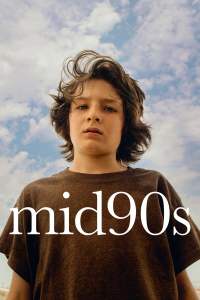 Final film today is mid90s, a coming-of-age film taking place in the era it advertises, which so happens to be my own. However, as a goody two shoes, I didn’t participate in most of the activities portrayed in this film. Written and directed by Jonah Hill, this movie has plenty of humor, but none of which detracts from the unabashed look at the want, or need, for acceptance among others at one of the most critical points in a person’s development. Stevie is a 13 year old, small for his age, who has no power in his personal life and no friends in his circle. He is bullied by his much older brother and suffocated by a single mother. Stevie finds friends in a local group of skaters, and is introduced to the world of drinking, marijuana, and sex. A very raw film, I was uncomfortable with the portrayal of Stevie, mostly because he looks so young, but the movie does (I think) accurately show the experiences of many that grew up in the 90s, even if it differed from my own. I totally understand the human need for a sense of belonging, and I couldn’t help but be reminded of a scene in Good Will Hunting, where Robin Williams’ character says, “Why does he hang out with those retarded gorillas as you called them? Because any one of them, if he asked them to, would take a bat to your head. That’s called loyalty.”
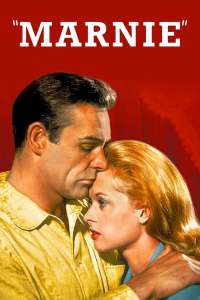 Today I’m going to look at the last 5 films Alfred Hitchcock made. There are some good ones here, but generally they aren’t as well known as those that came before. We’ll start with Marnie, which came out in 1964, a year after The Birds. This one stars Tippi Hedren (also from The Birds) and a young Sean Connery, who at this point had only been James Bond for 2 films so far. Marnie is a kleptomaniac who bounces from company to company, staying only long enough to learn how to get into the safe and rob them blind, and in turn send the money to her secretive and hidden mother. She is finally caught by Connery’s character, Mark Rutland, but rather than turn her in, he decides to try to reform her, because he has fallen in love with her. The movie plays out as a psychological thriller, due in part to Marnie’s irrational fear of thunderstorms and the color red. Mark digs into Marnie’s past to try to find what drove her to be what she is, to a great conclusion. The ending makes the movie here; there are good scenes building to it but overall a fairly average film until then. There were moments when I rolled my eyes for the density of Mark and the one-sidedness of Marnie, but I did enjoy it at the end.
 Hitchcock followed with Torn Curtain, starring Paul Newman and Julie Andrews. Newman had obviously made plenty of films, but this was just Andrews’ 4th film, including her two big hits, Mary Poppins and Sound of Music. The eponymous curtain refers to the iron curtain, to which Sarah finds her fiance Michael is headed after receiving a mysterious message. She follows, and finds that he is renouncing his American citizenship to join East Germany, purportedly because the US government had shut down his research as a rocket scientist. Really he is there to find out what a German scientist (and by extension the USSR) knows about anti-missile systems, important info in the Cold War environment. What ensues is fantastic Hitchcock-ian paranoia, in a high stakes espionage setting. This film got some rough reviews upon its release in 1966, calling it tired and typical Hitchcock, but I enjoyed it. Though Alfred’s movies were probably feeling a bit old fashioned by 1966, with the French New Wave in storm and New Hollywood also getting ready to unleash, that doesn’t make it a bad film.
 Topaz came next, and kept with the Cold War setting, and based on the real-life Martel affair in 1962. Here, a man and his family defect from Russia to the USA. As a former high ranking member of the KGB, the man is grilled by our government for information about Russia’s involvement with Cuba. This info leads to a big brouhaha between the embassies and countries of USA, Russia, Cuba, and France. Sounds interesting, but unfortunately Topaz may be the dullest Hitchcock film I’ve ever seen. The humorous banter is flat – almost as flat as the acting – and the film crawls through scenes that never seem to reach a satisfactory conclusion. Worse, the plot shifts a couple times, leaving you feeling like it is just meandering along without cohesion. There are moments of tensity, such as when we see conversations taking place but we can’t hear what is being said, thus not knowing if there is a double-cross or some other secret being exchanged, but these don’t lead to any thrilling moments, and other moments that are meant to create tension fail to do so.
 After years in Hollywood, Hitchcock returned to England, and to the serial killer theme, with Frenzy in 1972. London is at the mercy of the neck-tie killer, who is raping women and then strangling them with a necktie. Blaney is an average man who is struggling with finances and bouncing from job to job, when his ex-wife becomes one of the necktie killer’s victims, and Blaney becomes suspect number one. No one believes his side of the story except his girlfriend Babs. We learn the identity of the real killer before too long, but have to watch him continue his misdeeds for awhile longer, to the detriment of Blaney. Hitchcock terror in a new age, since he can push the bar a little further in the 70’s than he could in previous films, including the first shots of nudity in any of his films. And we get some classic macabre humor in a scene or two as well. I liked it as a whole, though once we knew where it was headed, the ending dig drag on a little long for my taste.
 Hitch’s last film was Family Plot in 1976. It centers around two couples. Arthur and Fran are a pair of high-game robbers, fresh off a kidnapping/ransom that has yielded a huge diamond. Blanch and George are running a con involving Blanche pretending to be a psychic. Blanche has been approached by a wealthy older woman to find a long-lost nephew, the sole living family member who stands to inherit a fortune, and this quest presents a great mystery for the first 45 minutes of the film. Once the identity is found, the movie morphs into more of a suspense. In fact, a great scene with Blanche and George hurtling down a curvy road with his brakes out is as tense as it gets, and I held my breath throughout. How our 4 main characters are connected becomes apparent before too long, and the rest is a fun ride. It’s a good send-off for Hitchcock. His health was failing, and while he was working on a new script right up to the end, he died of kidney failure in 1980.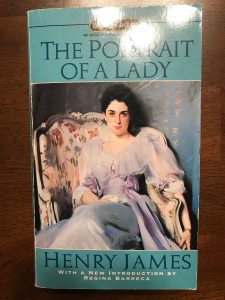
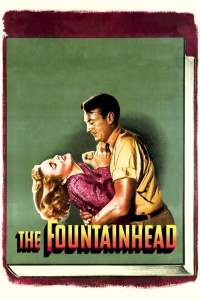 Rarely does a movie live up to the book it was based on. I read Ayn Rand’s The Fountainhead a little while ago, and absolutely loved it. When the film version was made in 1949, they obviously had to cut a lot of material (the book was over 700 pages, while the movie clicks in just under 2 hours), but they made the right decisions, and the film faithfully conveys the intent and character of Rand’s work. Gary Cooper portrays Howard Roark, a determined and self motivated architect who will only design and build modern buildings to his own standard, and will not compromise even if it means losing a commission when he is all ready struggling financially. The world tries again and again to tear him down and force him into compromising his ideals, but he refuses, and finally is able to overcome. A brilliant film with outstanding acting. I urge you to see it so you can fall in love with the story, and then go read the book for the more detailed attention to the characters and struggle that only it can portray.
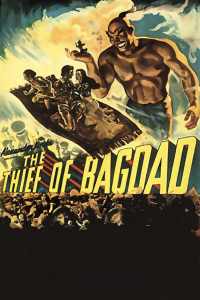 The Thief of Bagdad from 1940 (and the original from which it was based, in 1924) is a major influence for the Disney Aladdin film, though the Aladdin character is split up into two people in this film. The movie is about Ahmad, the young sultan of Bagdad, whose kingdom is stolen from him by his vizier, Jaffar. With the help of a local thief, Abu, Ahmad flees to the city of Basra, where he sees and immediately falls in love with that city’s sultan’s daughter, the princess. Jaffar ultimately comes to Basra to marry her too, and uses his sorcerous powers to win over the sultan there. Many adventures follow, including, of course, a genie and a flying carpet. It is an enchanting film, with some heavy hitters behind the camera, including producer Alexander Korda and directors Michael Powell and Ludwig Berger, among others. It won a few awards at the Oscars, mostly relating to its cinematography and special effects, for its use of blue screen (first in the business) in detailing the giant genie, the carpet and magic horse flying around above the city, etc. There is a touch of the wide eyes over-acting (by today’s standards), but that can be forgiven for the day it was made, and the whole presentation is still beautiful.
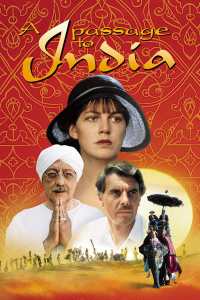 A Passage to India was David Lean’s last film, from 1984. The director who brought us Lawrence of Arabia and The Bridge on the River Kwai (and my personal favorite, Brief Encounter) faithfully adapts
 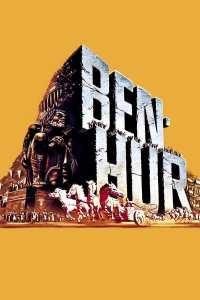 How can a purported movie lover make it to age 39 without having seen Ben-Hur? I finally remedied that this weekend. The grand epic from 1959 starring Charlton Heston is a movie that takes place in the time of Jesus Christ, and while He is a secondary actor usually off-screen, this film obviously follows Ben-Hur, a local Jewish aristocrat. Ben-Hur accidentally kills a Roman governor and is sentenced to slavery in a ship’s galley, and so sets off a chain of events that leads to one of the most heralded films of all time. In no way could I write a short synopsis of a 3 ½ hour film, so instead, I’ll wow you with the stats of its production (lifted from wikipedia). Pre-production of over a year, 8 months of shooting (12-14 hours a day, 6 days a week), followed by another 6 months of post-production. 10,000 extras, 200 camels, and 2500 horses. The wardrobe staff alone consisted of 100 fabricators, and another 200 artists and workman made all the statues and ornamental architecture. It had the biggest budget of any film before it, and the largest sets. And amazingly, it all paid off. When it was done, it ranked # 2 for highest grossing films of all time (behind Gone With the Wind). Adjusted for inflation, it still ranks # 14 in domestic gross to this day.
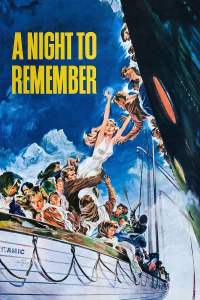 Up last is a titanic film that can give DiCaprio’s a run for its money. A Night to Remember was released in 1958, and while it wasn’t the first film about the failed ship, it was the most accurate at its time. Unlike the newer release, it doesn’t create a single over-arching story to follow, but instead charts the paths of a dozen or more crew and passengers before and during the disaster. In fact, some scenes seem to lifted straight from this film to James Cameron’s movie. Starting a day or two before boarding, we see various people prepare and then depart, then the crash with the iceberg, and then the sinking and aftermath. It also follows the Carpathia, which came to look for survivors, and the California, which ignores the SOS calls though it was just 10 miles away, a fact not shown in the newer film. Why and how it sank is pretty much the same as it was shown in Cameron’s film, with the exception that it does not show the ship breaking apart, a fact not fully accepted in 1958 when this movie was made. Otherwise, extremely accurate, well shot, and supremely engaging, in glorious black and white.
 The newest remake of The Predator isn’t the worst high budget action film, but it may very well be in the discussion. That’s not to say it is a terrible movie. It doesn’t take itself too seriously, has some OK humor, and plenty of bodies getting ripped apart with copious amounts of gore. But for all that, it is pretty dull. In this film, a quasi-sequel of the Predator films that have come before, humans have realized that they are being harvested by this alien race, and being visited more often because the aliens know that our planet is on its last legs. They have used our DNA to breed an even bigger super soldier. The body count goes way up as the movie goes along, but even at less than 2 hours, you may wish you were one of the casualties before it is finally over. Unfortunately, it made enough money overseas that we’ll probably see (another) sequel.
 The Equalizer 2 follows the original 2014 film, bringing Denzel Washington back to mete out more justice. I was a big fan of the first, but this one unfortunately grew dull after awhile. Robert McCall is pulled into an investigation when a long-time friend is murdered in Belgium, seemingly as part of a cover-up as she was on the case of a separate killing. The plot devolves into the worst action film tropes, including when a single man is able to take out a group intent on his death because they are determined to come at him one at a time. I found the film most entertaining in the first half, before the plot really kicks in, when McCall is just mindlessly killing evil-doers in fantastic ways. Denzel is always arresting on screen, but that is really the only reason to watch this film.
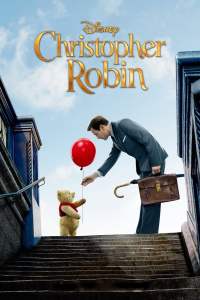 I enjoyed Christopher Robin more, maybe because I’m a sucker for films that hearken your childhood without being melodramatic. Winnie the Pooh’s favorite boy is all grown up and has forgotten his childhood friends (who are most definitely not make believe) until one day, when Pooh shows up at his house in London. At first, Christopher Robin tries his best to brush Pooh off, as he has an important work presentation to prep, but he is roped in to a little adventure to help Pooh find Eeyore, Tigger, and all the others. Lots of humor (from Ewan McGregor as Robin as well as all of his fur-friends; their banter is delightful) and a heart-warming plot. A great family film which stresses the importance of living life for those that really are most important in your life.
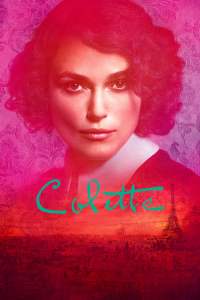 Colette is a fantastic character-driven film about the famous eponymous writer in late 19th century France. Keira Knightley plays Colette, a woman from a small town who is thrust into fame through her work. Her husband Willy (Dominic West) has a name for writing but no talent of his own, and hires ghostwriters to supply him with novels to publish under his own name. His extravagant lifestyle though leaves them always on the edge of poverty, so rather than pay others to give him books, he coerces Colette to write for him. Her semi-autographical books about a strong, independent woman with homosexual tendencies, named Claudine, become huge hits. Over time, each of them find separate lovers to satisfy themselves, and Colette grows more animus of Willy. Ultimately she must decide if she can continue to live under his heel or not. Knightley and West are equally extraordinary in this important story of a woman’s independence.
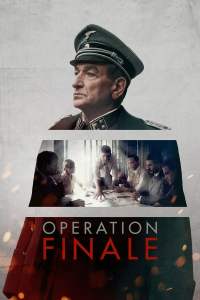 Operation Finale is like if the films Munich and Argo had a baby, but unfortunately it doesn’t live up to either of those 2 great movies. It is based on the true story of the hunt for Nazi war criminal Adolf Eichmann, the so-called “architect of the Holocaust,” who fled Germany at the end of the war to hide in Argentina. Israel sends a team to capture him and then quietly flee Argentina with him, so that he can stand trial. The investigation and kidnapping of Eichmann, in a country with plenty of Germans still sympathetic to the Nazi cause, is often gripping cinema, but the film doesn’t reach the heights it set out to. There is however superb acting by veterans Oscar Isaac and Ben Kingsley, and their face off against each other is as good as it gets.
 Jons Movie Takes