
 I didn’t set out to do this on purpose, but ended up watching 5 films in a row that all featured subjects involving people on the fringes of society, mostly the poor but also the disenchanted. Mobile Homes is about a family eking out an existence beyond the fringe. Ali and her boyfriend Evan are total white trash, subjecting her son Bone to a life he should not be a part of at any age, much less the 8 years he has. They bet on cockfighting, Evan has Bone sell drugs, and they float from motel room to motel room with nothing permanent in their lives. One night Evan hits Ali and she and Bone run for it, spending the night in a mobile home under construction. The next day they meet the contractor building the homes, Robert. Robert allows them to stay, offering Ali and Bone some normalcy for perhaps the first time in Bone’s life, in exchange for Ali working around the site. Their short-lived idyllic setting is put to the test when Ali spots Evan’s van, and she can’t help herself but to accept him back. As bad a mother as Ali is, Evan cares for nothing but himself. It’s a tough film to watch; even the opening scene when Ali is trying to get Bone into a shelter, basically to abandon him so she and Evan can do their thing, and the receptionist tells her that Bone just walked out the door, Ali isn’t dismayed at all, quipping, “He knows how to get home.” That sets the table for the kind of people that make up this little trio. I liked the film all right, and I think Imogen Poots is really good as Ali, but the camera work doesn’t do her any favors to show off her talents. Like a lot of independent films these days, they have too much “shaky camera syndrome” in an effort to make it feel “real.” Decent film for indie movie lovers.
 Savage Youth is another better-than-average indie film, and apparently based on a true story (though I admit I didn’t look up any info on it to verify). The first 20 or so minutes introduce us to the half dozen main characters, a group of young 20-somethings that are acting like a lot of kids these days. There’s a rough-and-tumble guy, his artistic girlfriend, her slutty friend, a closet gay man who acts tough around his friends, and, on the other side of town, a pair of black brothers who can’t escape the color of their skin to succeed in life. But just because most of the characters seem a little aimless, don’t think that the movie itself doesn’t have an endgame. It builds quietly but surely to a tremendous climax. Like a lot of low budget films, there’s a mixed bag of acting chops in this one. Some are really great, others not so much (there’s definitely some over-acting here and there), but the quiet tension and slow-building suspense get you past the rough patches, and I really enjoyed this one too. Bring your patience, there’s not a lot of “action” to carry the story, but some of the performances are really quite good, especially the subtle styles of Grace Victoria Cox as Elena and Tequan Richmond as Gabe.
 We the Coyotes (retitled Anywhere With You upon release in the USA) follows a young couple, Amanda and Jake, as they move to LA for a fresh start, but mostly to escape Amanda’s disapproving parents, who see Jake as a loser/floater/stoner with no ambition. Amanda has a job interview lined up and they are planning on staying with her older sister for a few days until they get established, but a family fight leaves them without a place to stay, and the job doesn’t pan out. Later in the day, their car gets towed and they spend all the rest of their cash on getting it back. Broke and homeless on their first day in the city, they have no options. Amanda is portrayed by Amanda Saylor, better known as the snotty daughter in the first few seasons of Homeland, the girl everyone loved to hate. She’s just not very good, and shows the same perplexed looks now as she did on that show 7-8 years ago as a kid. The film is as aimless as its characters, and the ending is just dumb, because (SPOILER) they get super excited that Jake unexpectedly lands a minimum wage job and Amanda becomes a “manager” for a homeless local musician. Yay, we can afford to stay in LA! Really?
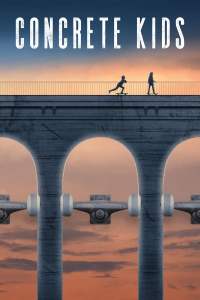 Concrete Kids is about a couple kids (no older than 10 it seems) who set off across LA over night to reach the Staples Center by morning for a silly contest where the winner gets $1000. Edison is from a solid middle class family and is doing it for the adventure of it, but Sage comes from a poor family and really wants the cash to prevent being evicted. The beginning felt pretty cliché, skateboarder kids and all. I don’t know why I thought I’d like this one; I hate child actors, because they usually deliver their lines like they are reading a book in front of class and their mannerisms seem forced because (nearly always) they are just doing exactly what an adult told them to do. Those observations are true here again, but the film isn’t terrible. It is mostly about Sage (who, as a poor kid, is exposed to a lot more than his friend) opening Edison’s eyes to the world around him, warts and all. Edison begins by being scared of everything from the bus to the metro to the plentiful homeless around the city, but comes out of his shell as the night progresses. However, Sage isn’t the only one with problems, and Edison’s come to light at the end. Fairly ho-hum film, nothing to get too excited over.
 Little Woods takes place in a small town in North Dakota and follows two sisters, Ollie and Deb, who are at a crossroads. Ollie is just getting done with her probation after having been arrested crossing the border with Canada with a backpack full of prescription drugs. She had been going up there to buy, and giving pain pills to their dying mother and selling the rest for cash on the street. Though she’s the one with the record, sister Deb is really the trouble child. Ollie was just doing what she needed to do to take care of mom, but Deb has one child already, another on the way, and the father is a drunk and a dead beat. Deb’s been living out of a trailer under threat of eviction, and the family house that Ollie is staying in now that mom has passed is also back due on taxes and mortgage. With money due on the house and no prospects of a decent job on the horizon, Ollie agrees to make one more drug run to get them in the clear. At the same time, Deb decides to have an abortion, but since they can’t afford it in the states, she will go north with Ollie and have it done in Canada. The film was marketed as a western (not really, though it does take place in the back woods of the northern frontier) and thriller (not really again, though at times it has a quiet suspense), it is more of a family drama. I thought it was just all right, not worth a second viewing, but the two leads, Tessa Thompson and Lily James, both give stellar performances. Thompson has gained traction in the last five years with roles in Selma, the Creed films, and as Valkyrie in Avengers (and a good part in the HBO Westworld show). James too is on the rise lately after parts in Baby Driver, the latest Mamma Mia sequel, and Yesterday. However, both are better in this film than anything I’d seen before. It is worth watching once for their performances alone.
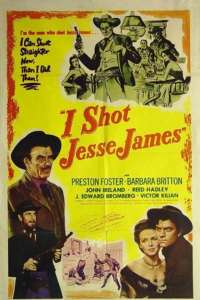 Samuel Fuller is a director whose raw, often low-budget films were not thought very highly of early in his career, but who gained esteem later. His style is more visceral and was even called crude in their day, but they are definitely compelling films. His directorial debut was I Shot Jesse James, released in 1949. Unlike Dominik’s film The Assassination of Jesse James By the Coward Robert Ford (tremendous film by the way, see it if you haven’t), the actual killing isn’t the big climax, in fact, the murder goes down fairly early in this one. The movie follows Bob Ford. He wants to get out from under the bounty on his head, and sees an opportunity to kill his best friend, Jesse James, to get the clemency offered. He wants freedom to marry his girl, but she no longer loves him, something everyone is well aware of except for Ford himself. When the governor denies him the promised $10,000 reward for James’ death, Ford strikes out to find money to marry somewhere else, first in his infamous traveling show detailing the murder of James, and then in a silver rush in Colorado. Fuller is finding his footing here, but some of the trademarks he would use throughout his movies, like extreme closeups and raw characters that are very un-Hollywood like for their day, are already present. For my tastes, Fuller’s off to a great start.
 I was pleased to find Vincent Price starring in Fuller’s second film, The Baron of Arizona. This is loosely based on a true story, the story of a man named James Reavis who tried to swindle the government out of the territory of Arizona before it became a state, and he very nearly succeeded. In the film, Reavis has a plan from the beginning, and is as thorough as he can be to bring it to fruition. Knowing that the government will continue to recognize land grants issued in the west by the Spanish and Mexican governments, he finds a parentless girl to doll up as an heiress. After setting her up with a governess, he heads to Spain. There, he spends years infiltrating a friary until he is a welcome member, at which point he gains access to their original records of land grants issued by King Ferdinand VI. He forges a document there, and does so again at a copy in the house of a collector and government official in Madrid. With everything in place, he returns to Arizona to marry the girl he left behind, who is now a grown woman. The rest of the film plays out with the US government trying to poke holes in his claim. The film feels different than his first and later movies, more like a traditional Hollywood western, but still has some of Fuller’s stylistic character. Price would later say this one of his favorite roles. Perhaps that is because it is very different from many of his other films, but you can tell he is having a good time here, and is fantastic in the role. I very much enjoyed this one.
 Pickup on South Street shifts to the hustle and bustle of urban New York. A noir film, it begins right away following a thief named Skip McCoy as he robs a young attractive woman on the subway. It turns out Candy was carrying in her wallet a splice of film that held something very much wanted by her handler, her ex-boyfriend Joey. Joey tells Candy that the film held trade secrets from his former employer that he was going to sell for a lot of money, but like a lot of films made in the early 50’s, the real bad guy is the communist party. They want that film, and the rest of the movie features a race against time, with the cops, Candy, and Joey all trying to get to Skip to get their hands on that film. Murder, fist fights, and hard language (for its era) all combine into a thoroughly gripping and tense film. Skip is an unlikely hero, as rough-and-tumble as they get. He does despicable things but Fuller does all that he can to get us to like him, and does a good job of it. I thought Fuller’s raw style was great for the previous westerns I’d seen, but it seems even more perfect for a noir. Great flick.
 These last 2 films are probably more typical of the type Fuller would become famous for. They are certainly much more shocking than the previous ones. Aptly enough, the first one is Shock Corridor. It’s about a journalist named Johnny who is obsessed with winning a Pulitzer. He thinks his most sure-fire bet is to solve a murder at a local mental hospital, and to do so, he gets himself admitted by convincing his girlfriend to pretend to be his sister, a sister that he has been making sexual advances to. This gets him in the door, but he has to keep up appearances while there, all while locating the three witnesses to the crime and getting them to come out of their insanity just long enough to drop a clue to help him solve the case. Each of the three is definitely certifiable: one thinks he is a Confederate general in the civil war, another (a black man) thinks his is a leader in the KKK, and the third behaves like a child. As Johnny gets closer to the answer, he gets further from his own personal ties to sanity. The film is much more raw than Fuller’s earlier pictures, and very edgy for 1963, dealing with subjects you didn’t see much of back then.
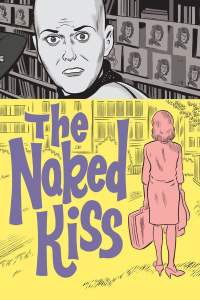 If you think a sharp look inside a mental hospital would shock the high minded in the 60s, it has nothing on The Naked Kiss. Kelly is a prostitute on the run from her pimp, and finds herself in hiding in a small town. She’s only there for a minute when she runs into a police chief named Griff, who recognizes her for what she is immediately, and wants her out of his quaint little town. She stays anyway, renting a room nearby and beginning to volunteer at the local children’s hospital. Kelly meets Grant, a wealthy man and Griff’s best friend, and the two fall in love despite Griff’s objections. Kelly tells Grant about her past and he doesn’t seem to care, but he has his own dark secrets. Kelly walks in on Grant molesting a little girl, and he admits that he loves Kelly because they are both deviants and can share their sicknesses together. A disgusted and enraged Kelly kills Grant, but then is sent up for murder charges by Griff, who doesn’t believe her story. Despite all the good she’s done in her short time in the town, finding people to come forward to speak for her, now that her past is all over the papers, becomes an impossible task. Gritty and unflinching, this film was obviously way ahead of its time. Constance Towers is incredible as the (now cliché) hooker with the heart of gold, and the story, direction, and camera work are all top notch. Great classic film.
 Fast Color is a very non-traditional superhero kind of film. There’s no big bad guy to kill and no earth-shattering special effects (though the understated effects that are there are done very well); instead, it is about the personal journey of a person with special powers. Ruth (Gugu Mbatha-Raw) has just escaped a government facility where they were guinea-pigging her. We see quickly that she causes regional earthquakes, but learn later that other powers are present in the women in her family, and always have been, specifically, the power to take objects apart molecularly and put them back together. Ruth and her family are surviving in a world that is dying around them. Water has become scarce; it never rains anymore, bodies of water are a thing of the past, and even a jug of water to use for bathing is more expensive than a night at the motel. Ruth reunites with her daughter just as the government’s goons narrow in on them. The film is measured and moves slowly, which normally isn’t a problem for me (see Aniara that I review next), but it doesn’t fit well here for some reason. Mbatha-Raw is very good as Ruth (I liked her a lot in Belle a few years ago too), but Lorraine Toussaint as Ruth’s mom Bo was honestly a bit over the top and didn’t mesh with the other actors. The film does have a fine, stirring climax, but it felt like an age to get there.
 Aniara shows how a slow burning film should go. A Swedish film, it takes place in the future where our Earth is dead and people are moving to Mars, though as a cold planet, it isn’t much better. The trip is to take 3 months, but the cruise ship-like Aniara is damaged by debris early on, and has to jettison their fuel rods, leaving them adrift. They are hurtling away from Earth with no way to steer or change speed in the inertia of space. The captain announces that they will use a celestial body’s gravity to slingshot around and return home, but it will take 2 years. However, an astronomer on board knows there is no such body on their course, and that they will never make it back, and she spreads the news, causing panic. The main story of the film follows a woman named MR, who runs an AI-powered virtual reality shop named Mina. Mina reads the minds of the people that visit her and gives them peaceful views of Earth before it was destroyed by its own inhabitants. However, with news spreading that they are stuck in space, people are depressed and angry, leading to Mina becoming the same, and she kills herself, ending the program. As the last haven for people to escape the monotony of their lives is gone, conditions on the ship deteriorate. Years go by, some good, but mostly bad. After 4 years, a probe is picked up on sensors heading their way. Not big enough to be a rescue shop, but hopefully carrying new fuel rods, the captain spreads lies that they are going to be saved. When the probe arrives 2 years later (6 years in), the crew finds it isn’t fuel, and may not even be human made. I cannot say enough how much I loved this movie. It is a real look at what makes up the good, bad, and ugly of humanity. So many aspects are explored, such as love and hate, hope and despair, religion and cults, birth and suicide, etc. Don’t watch if it you like Hollywood movies with pretty endings, but do watch if you like a profoundly moving film where the journey is just as important, if not more so, than any ending you can imagine.
 Dark Phoenix may be the last movie in the X-Men film series before it rides off into the sunset (we’ll see if the long-delayed New Mutants ever gets released or not). The series will get rebooted and brought into the juggernaut that is the MCU in the coming years. Unfortunately it may go down as the worst of the series, and that’s saying something when you consider Origins: Wolverine. It’s the re-telling of the Phoenix storyline, first seen in X Men: the Last Stand. We see young Jean Gray first come into her parents, the same day she accidentally kills her parents and is brought to Professor Xavier’s school to join the X-Men. Years later as an adult, she and her team encounter a space anomaly which, instead of killing Jean, is absorbed into her, further strengthening her already considerable powers. She doesn’t immediately use her newfound strengths for good. The movie is thrilling for the first 20 minutes, and just when I started to wonder where all the bad reviews came from, the cracks started to appear. Sophie Turner does a great job of putting all those years of bad-assery learned on Thrones to good use, and she makes for a solid Jean Gray, but the movie just isn’t very good. Some truly fantastic actions scenes aren’t enough to blanket shoddy dialogue, cheesy throw-away lines, and a paper-thin plot. Every piece of cliché dialogue you can imagine makes an appearance, some more than once. It’s a dull thud of a movie, only really watchable for die-hard fans.
 Going to state up front that I know nothing about Pokemon, and went into Pokemon: Detective Pikachu completely blind. I was too old to play the card game or the cartoon series when those were big, never played the Nintendo video games, and only played Pokemon Go for like a week when it first came out, to see what the craze was about. I think I would have enjoyed this movie more (or at least, all the little easter eggs that seem to be laid throughout) if I knew some of the backstory. It follows a young man whose father recently died, and he inherits his father’s pokemon, a pikachu voiced by Ryan Reynolds. The duo goes on a hunt to solve the mystery of the man’s death, and end up going up against a big corporation with a lot to hide. I bet fans of the series find plenty to love here. There were some decent moments and Reynolds’ delivery is always good for some laughs, but the film was a bit boring for me.
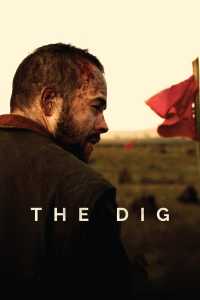 In The Dig, man, Callahan, returns to an abandoned family home in Northern Ireland and starts to fix up the place. He immediately confronts an older man, McKenna, coming out every day to dig holes on his property. Turns out Callahan has just been released from prison, having served many years for killing the older man’s daughter. McKenna has been digging in hopes of finding his daughter’s body, but Callahan was blackout drunk at the time of the deed, and doesn’t remember where her body is. Callahan is wracked with guilt, and McKenna can’t stand his guts for obvious reasons, but the two begin to dig every day together, and are fed meals and water from the surviving daughter, Roberta, who has been by her father’s side all these years. In the small town, Callahan is also hounded by the local citizens, even the local police officer, who don’t appreciate him being back. The film unfolds as a mystery/quasi-thriller. Our murderer wishes he could remember the events of that night, but they just never come, and his anguish grows with every swing of the shovel. Its a film about obsession and, hopefully by the end, redemption. I wasn’t a big fan of the twist that came in near the end, but the denouement was satisfying enough, and overall, I enjoyed the quiet, tense film.
 Rafiki follows two young women: Kena is an athletic tomboy who is treated as “one of the guys,” and Ziki is the polar opposite, who dresses up and goes dancing with the girls. However, the two have an immediate physical attraction to each other, in spite of each of their political parents running against each other for local office. This attraction is very dangerous in Kenya, where being gay isn’t just socially persecuted, but is still criminally punishable. Kena need look no further for evidence than the local openly gay man, who walks around getting called names and, every now and then, sports new bruises and scrapes from being beat up. When others start to notice Kena’s and Ziki’s growing relationship, there are explosive consequences, even from their own families. The film was unsurprisingly banned in Kenya due to its nature, but has received acclaim elsewhere. As a whole I thought it was just OK, good but not spectacular. Samantha Mugatsia is very good in the lead as Kena though; this is an actress that I hope can find future roles to show off her chops to a bigger audience.
 All Creatures Here Below features a couple recognizable faces as its co-leads, neither of which have been the main attraction before, to my knowledge. Gensan (David Dastmalchian, in Ant-Man, among other things, and also the writer of this film) and Ruby (Karen Gillan, Nebula in MCU and the hot action girl in the new Jumanji films) are a couple living in poverty and with no prospects. When both lose their jobs in a short amount of time, they each make decisions that send them down an unalterable course. Gensan attends a cock fight and ends up killing a man for his winnings, and Ruby kidnaps the neighbor’s baby. Gensan is the brains but he is quick to anger, Ruby has maternal instincts for the baby but honestly isn’t very bright. With money and a baby, they head out on the lamb, driving cross country. If that’s not dark enough for you, it gets pitch black before the end, in more ways that one, with twists no one would see coming. It’s a powerful film (I admittedly was pretty emotional at the end), with a pair of people who do terrible things, but ultimately are painted as a tragic couple living with the hand life has dealt them. Like Rafiki, the leads, and in particular Dastmalchian, are really allowed to shine.
 The Public is written and directed by, and stars, Emilio Estevez. It has other recognizable faces such as Jena Malone, Michael K Williams, Alec Baldwin, Christian Slater, and Jeffrey Wright. Estevez plays a man named Stuart Goodson, the head librarian at the Cincinnati Public Library. He is liked by his staff and the patrons of the library, including many of the city’s homeless who come there every day in the winter to stay warm. There is one particularly bad cold spell going on at the moment, and the city’s shelters are full, leaving people out in the cold, literally freezing to death at night. When one of the homeless men organizes his fellow to occupy the library one night in protest of the city’s lack of shelters, Goodson sides with them, and spends the night talking to the cops and the city prosecutor. Throughout the evening, we learn Goodson’s story, and some of the others’ as well. The film shines a light on the plight of the homeless, including the personal struggles many of them face with mental illness. It brings up good points, but the film itself feels roughly made and suffers from poor writing, and isn’t nearly as gripping as it could be. Not a bad film, but very average.
 The Third Wife is proof that a great story and superb, subtle acting can create magic in the most unlikely of places. From first-time director Ash Mayfair, this Vietnamese film was made on a low budget, which you could never tell from the beautiful cinematography thanks to today’s available technology (and an eye for the sublime, obviously). The title refers to May, a 14 year old girl who has become the newest wife to a local landowner. May quickly sees how the politics of the house lay out: of the two older wives, the one who has given sons to the husband is definitely higher up on the totem pole than the wife who has only had girls to this point. May prays to give birth to a son, and becomes pregnant soon enough. The house is full of secrets too, apparent when May sees wife # 2 (the one with daughters) sleeping with one of her husband’s sons in the woods. May herself feels no physical attraction to her husband, and instead we learn she is attracted to wife # 2 as well. This little love quadrangle gets murkier when the son takes his first wife, but refuses to lie with her because of his secret love for his for the popular wife # 2. After such a soft-spoken film throughout, don’t expect an explosive conclusion or anything, in fact, it is almost frustratingly enigmatic, but it is a beautiful film, especially visually.
 Papi Chulo follows Sean (Matt Bomer), a weatherman in LA who is put on leave when he has a breakdown during the telecast. He’s been upset because he was dumped by his long-time boyfriend 6 months ago, and he still hasn’t moved on. When he needs to paint his deck, he hires a local Mexican immigrant named Ernesto (Alejandro Patino), who speaks as much English as Sean does Spanish, which is almost nothing. However unlikely though, the two begin to develop a friendship. He continues to pay Ernesto every day, but mostly just to hang out with him: to hike, to go to gay parties, etc. Lots of humor, even dark humor, like when Sean is complaining about what he is scared of, which is mostly mundane things, and when he asks Ernesto what he is scared of, he replies, “Immigration authorities.” We wouldn’t know Ernesto’s thoughts at all if it weren’t for his daily calls home to his wife, which are some of the funniest moments as he explains the zany things he’s been doing with Sean. A revelation in the final third of the film really starts to put things in perspective, and turns what is a decent movie into a very good one. There were some uncomfortable moments for me involving some sequences after this bombshell, where I didn’t know if I should laugh at Sean’s situation or feel bad for the tragedy he’s found himself in. Bomer is great as a depressed, nearly hopeless man unwilling or unable to move on. I found the journey of the film better than the ending, which was a bit cliché, but still a pleasant experience.
 Juliet of the Spirits was Fellini’s first film in color, and he uses it to beautifully showcase the dream world that he so often puts in his films. This one follows Juliet (Giulietta Masina), a woman devoted to her husband, but otherwise lonely and maybe even depressed. After a seance with her friends, she begins to be visited by spirits, in particular, Iris and Olaf. They both seem to be trying to tell her something, though the masculine Olaf is more forceful. Shortly after, Juliet begins to suspect her husband of cheating, and hires an investigator to follow him. As the investigator is working, Juliet becomes friendly with the neighborhood wild girl, Suzy, who admits she sleeps with anyone and lives life to the fullest. Hanging out with Suzy seems to awaken more spirits for Juliet. Juliet, who married the first man to come along and never lived a life on her own, is starting to feel independent for the first time in her life. When the investigator comes back with news that, yes, her husband is having an affair, Juliet is saddened, but no longer demure, and goes to confront the woman. By the end, Juliet seems to have found peace for herself, and does not need a man’s happiness to give her joy. It’s a good film, a little out there with the blending of dreams and real life, but it was hard not to root for Juliet to finally break free of the upbringing that chained her to be a timid little housewife (even if film does suggest that if she would just a bit of a floozy, she’d be a lot happier).
 Fellini is one of three directors in the anthology piece Spirits of the Dead, from 1968. All are based on stories of Edgar Allen Poe. The first stars a young Jane Fonda, and is directed by her then-husband, Roger Vadim. In medieval times, the young and beautiful Frederica has inherited a large estate. She only lives for physical pleasure, and treats people poorly. However, she genuinely falls in love with her cousin, Baron Wilhelm, who lives a simple life on land nearby. When he rebuffs her, she has his stable burned down, and in the ensuing blaze, Wilhelm dies trying to save his horses. That same day, a black horse comes to Frederica’s castle, and she believes it to be Wilhelm’s spirit returned to her. She leaves her old life behind and finds joy with the black horse, and decides to die in flames with him when lightning sets her fields afire. The second tale, directed by Louis Malle, stars Alain Delon as William Wilson, an all-around terrible person who is haunted by a man of the same name. Every time Wilson does anything bad, the other Wilson is there to turn him in, landing him in trouble his whole life from childhood to an adult. Finally the two spar after a masquerade party, and the evil Wilson kills his doppleganger with a knife. When the mask is removed, Wilson sees his own visage. Faced with the knowledge that he is crazy and has “killed himself,” Wilson jumps from the tower to finish the deed. Onlookers rush to to the body, to find him dead from the fall with a knife in the stomach as well. The final vignette comes from Fellini, and of course, it is the most dream-like. A declining, alcoholic actor arrives in Rome to shoot a new film. Immediately upon his arrival in Rome, he begins having visions of a little girl, playing with a ball, that he names as the devil. At an awards ceremony later, his hallucinations grow worse. After the ceremony, extremely drunk, he gets into his new ferrari and speeds off, driving around all night. Eventually he comes to a downed bridge, and sees the girl and her ball on the other side. He speeds towards it, but crashes, becoming decapitated. The segment ends with the girl forgoing her ball and picking up the head. Honestly I enjoyed the first two pieces a lot more than the third, which just seemed like the ravings of a madman. Overall, a decent, if ultimately forgettable, film.
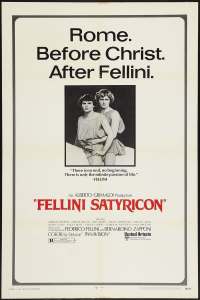 Fellini Satyricon, from 1969, is both more and less cohesive (a tighter story and better characters, but crazy, insane images of a culture on the decline) than the director’s short in Spirts of the Dead, and it is one wild, fun ride. It is based on Satyricon by Petronius, a Latin piece written in the first century. To try to give it even a short synopsis here would not do it justice. Based around two brothers, Ecolpius and Ascyltus, a whole lot happens in the movie’s 2 hour length. There are wild adventures, death, curses, bizarre weddings, stories-within-stories, and the death of Caesar. Fellini uses the debauchery and setting of ancient Rome to make a film as gaudy and dream-like as any he had ever done. It is easy to see the inspiration in this film for some of Pasolini’s films that would shortly follow in the early 1970’s, but while I didn’t care for those films as much (Decameron, Canterbury Tales, and especially Salo), I did like Satyricon. It is a bizarre, colorful trip from beginning to end.
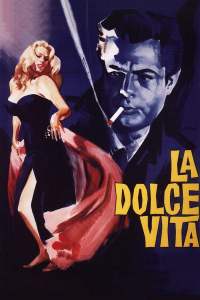 La Dolce Vita was Fellini’s biggest hit. Released in 1960, it won the Palme d’Or at Cannes that year, and was a huge box office smash. (When it came to the states in 1961, it was still the 6th highest grossing film of the year, subtitles and all.) It follows Marcello (Marcello Mastroianni), a celebrity news journalist, and his wayward life among the stars. Marcello spends his days aimless, and his nights partying among the elite, sleeping with its various women from rich Italian heiresses to American movie stars. His girlfriend wants him to give up the lifestyle and choose to stay with her alone; she dreams of having a house and family away from the noise of Rome, but Marcello doesn’t seem to want anything else. If you are expecting Marcello to find redemption by the end, don’t hold your breath, this is not a film with a sweet ending. But it is a fantastic movie, loaded with poignant moments that leave you pondering its meaning long after it is over. From Marcello’s memories of an absent father, to his best friend’s murder-suicide of his family after talking about the constraints his home life in contrast to the “glamorous” lifestyle of their other friends, to a seemingly chance encounter with a girl at a restaurant which may be more fate than chance. The film paints a stark picture of a society that glamorizes celebrities who are undeserving of the fascination the public gives them. This may sound ho-hum today, but consider this movie was made 60 years ago. When watching the film, I thought many times of the idiocy of these rich and famous people, getting drunk at parties and carrying on like college kids without a care for tomorrow.
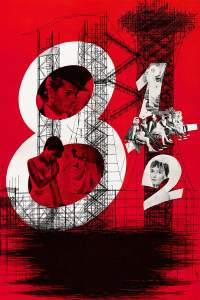 If La Dolce Vita was Fellini’s biggest commercial hit, 8 ½ is arguably his the most critically acclaimed one. Released in 1963, it is widely regarded as one of the best films ever made, and still finds itself on top 50 lists to this day. It has often been called the greatest film about making a film. The film follows a famous director, Guido Anselmi (Marcello Mastroianni, in perhaps my favorite role I’ve seen so far, next to A Special Day), as he prepares to make a new movie. However, for someone who wants to make a picture, he doesn’t seem like he wants it very much. He is dragged around here, there, and everywhere, pulled in a million directions, by the producer, potential actresses, his wife, his lover, set designers, etc. Most have questions that he keeps putting off; in fact, it seems he is completely unready to make this movie. While a very expensive set is being built out in the country, Guido is vague about all details, even to the producer. He privately admits to himself and us viewers that he thinks he is a fake, an impostor, who maybe isn’t as talented as everyone thinks he is. Yet, at the same time, he is extremely narcissistic, daydreaming that all women want to be with him, and thinking he is fooling his wife about his extramarital affairs. Near the end of the film, during screen tests for actresses (all of whom are dressed like his friends and family, a clue that the picture is becoming autobiographical), one of the actresses sees Guido immediately for the man he is: a person who doesn’t know how to love, and only takes from people, never giving. This movie is tremendous, fantastical as you’d expect from Fellini, but also, very real and grounded in the emotion and turbulence of a famous director surrounded by sycophants, with he himself perhaps being the worst of them. It won Fellini his third Oscar for Best Foreign Language Film; he would win a fourth 11 years later, the most ever won by a director in this category.
 The Best of Enemies is awfully paint-by-numbers, but it is a nice film, based on some true events. The community of Durham, NC, is right in the thick of the civil rights movement. Local activist Ann Atwater (Taraji P Henson) has been bullishly fighting for equality for years, to the distress of the local chapter of the Klu Klux Klan, and especially its leader CP Ellis (Sam Rockwell). When a fire burns half the local black kids’ school, the black parents get the attention of the NAACP to let their kids be integrated into the white school. They send a mediator to hold a charette to get both sides talking to each other. The mediator (Bill Riddick, played by Babou Ceesay) does the best he can to get the white and black members of the community to open communication, and real discussion takes place, but the sticking point of school integration remains a hard case to win for Atwater. CP thinks he is on the side of right and he has a just cause, but when he sees the other folks in the KKK put pressure on the more liberal white members on the panel to vote against segregation, he begins to have doubts. The film is predictable and maybe even guilty of being heavy handed, but it is still stirring. Henson is good, and Rockwell is great. I’ve been a fan of his for a long time, and it’s nice to see him finally get some recognition over the last couple years.
 I gave Mortal Engines a chance despite horrible reviews, because it falls in my wheelhouse of geekdom: sci-fi post-apocalyptic. Should have listened to the reviews. Despite some decent computer graphics, its a real bore, with some truly eye-rolling dialogue. The film takes place in the far future when civilization has nearly wiped itself out in world war. People have survived by literally making their cities mobile, traveling around on huge metal wheels. This has given rise to “municipal darwinism,” where larger cities overtake and “consume” smaller cities for their resources. One of the biggest and meanest cities around is London, whose citizens cheer whenever they destroy a smaller city. A young woman named Hester seems bent on killing Valentine, the head of historians of London, supposedly because he killed her mom when she was a child. Hester wounds Valentine, but he survives, and sends a cyborg out to hunt her down. The crazy level just goes up from there. There is one scene where just about every piece of imaginable bad dialogue is uttered within the same conversation: “You sure you want to go on? There’s no going back.” “I have to, I don’t have a choice. I have to do this for my mother.” Unfortunately that’s not even the worst of it. A cast full of no-names except for Valentine (Hugo Weaving, who as we know, doesn’t have the best track record), and while Hester (Hera Hilmar) is passable, the bulk of the rest are downright awful.
 Sobibor is a Russian film, based on the true story of an uprising at the Nazi Sobibor extermination camp during World War II. I’m not a World War II historian and unfortunately I’d never heard of Sobibor, and I think it doesn’t get the attention of the more infamous camps at Auschwitz and Treblinka. The film takes place over a 2 week time period in 1943, beginning with the arrival of a fresh train of detainees. The Jews are separated, with those able to work put in one group, and the others sent immediately to be gassed. In the camp, there is an underground without a leader. Many look for ways to escape, but attempts are always thwarted, and not only are those who made the attempt killed, but as punishment, the Germans kill 1 out of 10 prisoners in the camp. Finally, a Jewish-Russian prisoner in the camp agrees to use his military training to plan an escape, but he insists that the whole camp be freed, not just those willing to participate in the coup. It sounds very daring, and the film does a decent job of showing the insurmountable odds facing our heroes, but unfortunately it just isn’t a great movie overall. I never felt really attached to most of the characters, and there’s a fine line between eliciting grief from the viewer (see Schindler’s List) and beating them over the head with images, practically screaming at us, “Doesn’t this disturb you!” For me, it didn’t reach the heights that the filmmakers wanted.
 High Life, from director Claire Denis, stars one of my favorite actors of today, Robert Pattinson. And that’s not because I was a Twilight fan, but if you haven’t seen his independent film work in the last 5 or so years, you’re missing out. He’s good here again, even if the film is a bit lackluster. The film starts with just him and a baby girl on a spaceship far from earth, and systems are starting to fail. The other crew are dead, but we don’t know why. Before long, we learn that it was a penal ship sent out on a mission to attempt to harness energy from a black hole. On board, one of the criminals is a former doctor, and she’s made it her goal to produce a viable fetus from artificial insemination despite the radiation of space. So far, her experiments have failed, with no babies born alive, and just dead woman to show from the experiments. How Pattinson’s character came to be alone with a baby is left for the final half, where we learn the fate of the rest of the crew. The film starts very mysterious, and I don’t mind films that are purposefully obtuse in the beginning (many art films are), but when they ultimately spoon feed you all the answers, the original mystery is left feeling stale. This film could have been really good, and has plenty of good moments, but for the reasons I’ve mentioned, it never gets great. How often do you watch a movie and wished it was longer? I think this movie left a lot unexplored, and it really could have been something.
 The best comedies have a heartfelt story too, and into this category falls Late Night. Katherine Newbury (Emma Thompson) plays an aging late night television host whose best ratings are far behind her. She’s facing getting the ax by the network execs, who want to replace her with the newest, hottest comedian. Of course she doesn’t want to go, but somehow she needs to find a way to reach a new generation of viewers. Enter Molly Patel (Mindy Kaling), initially only hired to help diversity in the all-white male crew of writers for Newbury’s show. Molly has no experience in comedy or writing, but she knows what the younger crowd wants. The show starts doing better, but a catastrophe of Newbury’s own making strikes before the end of the season, and it looks like nothing will help save the show. Ultimately the movie becomes about what is most important in life, professional success or personal relationships. I generally don’t re-watch comedies, because often the jokes (for me) are only funny the first time, but this one is both funny and emotional, and I’d probably watch it again.
 Chantal Akerman was a Belgium filmmaker who made films from the 1970s until her death in 2015. I’d never seen anything from her before, so up today is some her earlier pieces from the 70s. First is a silent, experimental film called Hotel Monterey. For those that can bring your patience with you, this is a beautiful, sometimes haunting picture. The whole of the film (about an hour long) is long, sometimes panning shots around the hotel in New York. The building is old and dated, and the camera examines everything from long, dark hallways; to rooms (with or without inhabitants); to its dingy basement. An early 12 minutes are devoted to a continuous shot of the elevator going up and down, stopping at various floors, to see the doors open to people or empty halls alike. It’s an avant-garde film for sure and not for everyone. I usually steer away from these kinds of pictures (I can not get into Stan Brakhage despite several attempts) but I was enthralled by this piece. Some of the slow, creeping walks down tight hallways give a Kubrink Shining kind of vibe, several years before that film was made. Beautiful shots throughout, and it’s amazing how a quiet, unmoving camera can either elicit tension or peace, depending on the view and/or the mindset of the viewer.
 Je tu il elle (I You He She) was Akerman’s first feature film, released in 1974, and stars herself in the lead role. Julie is a young and depressed woman, living in a small apartment. After trying to change the things she has control over (painting the room twice, moving all the furniture around, then removing it all except the bed, and finally just lying naked on the floor), she writes letters to herself, then edits and revises them. She hints through narration that she’s waiting for something, but what, we do not know, and most likely. When she finally runs out of sugar, her only sustenance, she gets dressed and leaves, with the feel of a finality that she is not coming back. She hitches a ride out of town with a trucker, who provides food in exchange for sexual favors. Ultimately, Julie ends up at a woman’s house, obviously her former lover, with their breakup being the reason for Julie’s depression. The two have sex, during which Julie holds her partner so tight, it looks like she will never let go. Julie gets up in the morning, grabs her clothes, and walks out. Throughout the film, we never hear Julie speak to anyone with whom she comes in contact, her voice is saved only for narration to us as the viewers. It’s a slow burn of a film, doesn’t move much faster than the silent documentary described above, but it is rewarding for those with the endurance to sit through it (even if the sex is a bit too gratuitous for my tastes).
 News from Home is just what it sounds like. This documentary is a series of shots by Akerman around New York, where she lived for awhile. In the busy city, Akerman focuses on visions of solitude and loneliness within the greater hustle-and-bustle of the metropolis. In voice-over throughout, she reads letters sent from her family back in Belgium. The letters are exactly what you’d expect from a mother who misses her child in a time before the internet. She begs for her daughter to write more often, tells her how Dad is doing, warns her to be careful in dangerous New York, etc. I see and talk to my parents regularly, but even I felt homesick with the letters oozing love and warmth, in stark contrast to the lonely video of the cold, uninviting city. The mom’s a bit passive aggressive, sometimes more than a bit, but you can tell she loves her daughter. An achingly beautiful film, and a fantastic time capsule of 1976 New York.
 By now, I’ve realized Akerman has a thing for telling stories about single women living in a man’s world. That’s the nuts and bolts of Les rendez-vous d’Anna (The Meetings of Anna) too. Anna is a filmmaker who travels around Europe for work, and she must have the kind of face where people just want to tell her their problems, but no one seems to care much what she wants. Everyone seems to tell Anna all their woes, while she listens silently. First a man in Germany with whom she has a one-night stand, lamenting the state of his divided country after World War II, then her friend Ida, who talks about her terrible marriage, and then a stranger she meets on a train. It’s not all doom and gloom though, there are surprisingly funny moments too, like when Ida takes a break from bashing her husband to tell Anna she should marry her son, because women should marry. I enjoyed the first half, but the film really got good in the second, when it became clear that people aren’t just unburdening their souls to Anna, but are in fact just using her. She’s been going through life letting people say and do whatever they want to her. Even though she’s successful in her career, as a woman of the 70s, she has little power in relationships and no voice for her own desires. I’m dense, so it too me awhile to realize this (very late in the movie), but the film took on a whole new light upon this revelation. It moves at a slow pace, so it will test you, but a really great picture.
 Up last is Akerman’s most critically acclaimed movie, and the one that got me interested in watching these films of hers. Jeanne Dielman, 23, Quai de Commerce, 1080 Bruxelles (yes, that is a long title) has been lauded as a masterpiece since its release in 1975 on the art house circuit. It clocks in at over 3 hours long, and having seen 4 previous Akerman films, I came ready for lots of long, slow shots sans dialogue, and when there is conversation, for it to be deliberate and, perhaps, a bit meandering. Our main character is Jeanne. Extremely methodical, from the way she dresses (with hair perfectly coiffed) to how she cleans herself to the way she eats, you get the impression her routine is exactly the same every day. After a very staid dinner with her son (husband is 6 years deceased), she gets out her knitting, and I thought, “Of course she knits!” The movie begins in the middle of her routine, preparing said dinner for that evening, but then something unexpected happens. A man arrives, they retreat to the bedroom, come out an undetermined amount of time later, he pays her, and he leaves, saying, “See you next week.” Our little homemaker is turning tricks! The evening plays out, then the next day, when the doorbell rings again, to a new man. Same story. And that’s the first 90 minutes of this film, so we aren’t even half way through yet. Here, I did have a single doubt creep in. To this point, I was invested in the film, it sounds boring watching someone just going about their day, but I was fascinated. However, after her john left, I wondered if we were going to see the whole ritual again. But no, the camera thankfully skips ahead through the mundane events we already saw, and, in a change, we start to see cracks in Jeanne’s veneer. Even the camera lets us know this, by showing her kitchen from a different angle than we’ve seen before. Jeanne picks up a pot of food, and wanders around the house listlessly, like she can’t quite place where to go with it. She begins to repeat actions in an increasingly frantic manner. Her normally perfect hair is messy. Day 3 starts worse, with Jeanne forgetting to fully button her house coat when she puts it on, and then forgetting to turn off lights when leaving rooms, having to stop mid thought to return to do so. The viewer definitely gets a sense of foreboding, of impending catastrophe. Whether something does or not, you’ll just have to sit through 3 ½ hours yourself to see. I can see what the hype is about, this is a compelling film, but like all of Akerman’s stuff, be patient and let it come to you.
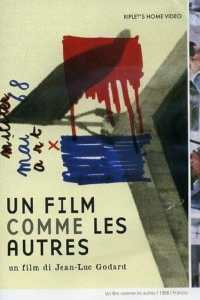 After his film The Weekend (which I really liked) in 1967, the man who became famous for ushering in the French New Wave in 1960, Jean-Luc Godard, decided he was done with traditional movies and started making political films. He teamed up with radical leftist Jean-Pierre Gorin to make a series of heavily Maoist pieces. The first was Un film comme les autres (A Film Like Any Other) in 1968. The whole film is just 5 mostly faceless people discussing the repression of workers and what to do about it. The small group is made up of workers and students, who have lofty ideals of things that should be done, but I couldn’t help but get a sense of nothing but a whole lot of talk going on. It comes off as very pretentious, just a bunch of intellectuals bitching about the wrongs of capitalism. There’s some arguing among the group, because the workers, who have to work for a living, push back against some of the more extreme ideas of the students who are way too idealistic. The film is passably interesting, but really just boils down to watching a one sided debate for 90 minutes.
 British Sounds is even more extreme. Godard isn’t pulling any punches anymore. It opens with a long side cut of workers in an auto plant putting together cars, and a voiceover talking about how repressed they all are, how they are just slaves working for the bourgeois, how much better their lives would be if they could work under communism instead of capitalism, etc. Then it REALLY started to lose me. The next scene has the camera focused on hall in a house, and narrates how if you think the worker is downtrodden, then the female worker is even more so. How they are exploited for their sex, can’t face equal treatment, and on and on. Hilariously, during the narration, a naked woman walks in and out of the screen. But I guess that’s not exploitation? Or are we being sarcastic? Whatever it is, like the first movie, the film is very condescending. By this point, I just wanted Godard to go back to making fun movies.
 Le Vent d’est (Wind From the East) is finally a bit better, at least it has a (loose) plot and feels more like a movie, albeit one with an agenda. Again, it is about the plight of the worker. There’s a strike going on at the local factory, where workers are demanding better conditions and higher pay. At various times, members of the both the workers (dressed as normal, everyday people) and the owners (dressed like English high society from the early 20th Century) are kidnapped by the other side. Over it all is a narration, sometimes about what we are seeing, but most often going off on separate tangents, such as railing against the state of traditional cinema, which is “run by the bourgeois.” In poking fun at traditional films, Godard breaks the fourth wall by showing his actors having their makeup applied during the scenes, or in one instance, having the actor lay down comfortably where he “died” and then splashing blood on him from off camera. We even see a scene when “production” is halted because pro-capitalist people hold the “anarchist” actors hostage. The whole thing is mildly amusing, but it never loses sight of its defense of Maoism, communism (even glossing over Stalin’s evils), and the predicament of the working class. The second half of the movie becomes a quasi-lecture/rant against moviemaking, and no one is safe. The main target is “Nixon Hollywood,” but the narrator goes on to target progressive filmmakers too, saying they don’t go far enough. Then we get a quaint little tutorial on how to make weapons and bombs at home. Good family flick.
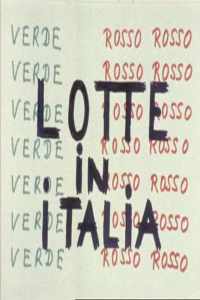 The next film is actually a good one. Lotte in Italia (Struggle in Italy) is about a girl coming to grips with her goals as a Marxist, and how to find a way to achieve those goals. The film is told with her telling her story to the camera in her native Italian, with an unseen narrator translating to French (and us English twerps reading the subtitles from the translation). She talks about her life as a student, and how she wishes life should be, and it isn’t before long that she realizes she’s a bit of a phony. She tells workers who want better wages to just strike, but doing so wouldn’t put food on the table for their families. She talks about independence from her parents, but returns to them when she needs money or a place to stay. She admits to the camera and to herself that she doesn’t have enough life experiences to achieve the sort of social freedoms she envisions, and her attempts to learn more have failed (for instance, she took a sewing job in a factory to talk to real workers about their struggles, but found that the grueling work and big deadlines kept her and them quiet and focused on their jobs). In the end, she seems to have a clearer picture of what she wants to attain for society, but seems no closer to reaching the goals. Her final thoughts are that even the film she is in, the medium to which she is speaking to the viewer, is owned by the bourgeois as a system of control. I genuinely liked this movie, more than the 3 previous, and though I obviously don’t agree with everything our girl was putting out there, at least it was more “real” than the previous showings.
 Finally comes Vladimir et Rosa. This movie starts with a narrator telling us we are going to watch a film, introducing the characters, what we are going to see, etc. They admit that this film was only made to raise money for a different project, but say that it is still worthwhile because it advances their cause. That argument is debatable. The film is loosely made as a response to the 1968 protests in Chicago after the Democratic National Convention (look it up if you want more info). Godard and Gorin themselves are in this film, Godard playing the accused, Vladimir, but also a policeman later, and Gorin is the judge, but also Vladimir’s friend Karl Rosa. Sometimes it seems the two are playing as themselves too. It boils down to their revolutionary ideas themselves put on trial, but Godard and team use it to show how stacked the system is against them. The whole thing is a jumbled mess: a bombardment on our senses with people talking over each other, half-assed ideas that aren’t explored, and pure propaganda. In the end, I enjoyed 2 of the 5 films from this period of Godard’s work, but not sure I’d rewatch any of them.
