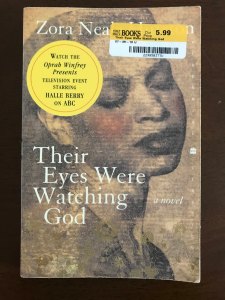
For my tastes, Zora Neale Hurston’s Their Eyes Were Watching God was a much better read than the last heralded book on my last. This is a short one, only about 200 pages, but has lots of depth to ponder for days after you finish it.
The book follows a black woman named Janie in the early 1900’s (the book was released in 1937), who is just 2 generations removed from slavery. Janie has lighter skin than many of her friends, the result of her grandmother Nanny being raped by her white owner to father Janie’s mother. Janie never knew her mother, who was in turn raped by her school teacher (which resulted in Janie) and ran off. Janie was raised by her grandmother Nanny. Nanny was old school and thought that marriage to a man, any man, is better than nothing, so she shoves Janie to an older man as soon as she is 15 or 16, promising Janie that she will grow to love him. When she doesn’t after a couple years, Janie leaves him, goes to the next town down, and marries another man, Joe.
Joe has big plans to build an all-black city in Georgia. He builds a store to supply the area, gets houses built, gets himself made Mayor, and builds a decent amount of wealth. He makes Janie work the store, but they have money and don’t have to struggle like many of the town’s residents. However, Janie eventually realizes that Joe doesn’t really love her, that he just uses her like others always have in her life. When Joe gets sick and dies, Janie doesn’t make much of an effort to go around in mourning, and it isn’t long before she heads out of town with a new beau named Tea Cake.
With Tea Cake, Janie is finally happy. She spent years with Joe and is no longer a young woman, but she still has her looks, and has a nice nest egg of cash to sit on. Tea Cake is a hard worker, and the two head to the Florida everglades for work harvesting beans. However, their love is short lived. A hurricane hits the area their second year there, and in the ensuing chaos, Tea Cake is bit by a rabid dog. As he descends into madness, he attacks Janie, and she defends herself by shooting and killing him. She is acquitted of his murder with a self-defense plea, and moves back to the city Joe built, to recount her life to her friend Pheoby, where the book both began and ends.
If it sounds like a fairly simple tale, it is. The meat of the story isn’t involved, but so many issues are raised and explored that you can get a great view of the life of a good majority of black people in the south in the early part of the 20th century, the kinds of things you just can’t learn in school. Janie is an intelligent women but she isn’t allowed to show it, and is just there to support the men in her life. As black people, Janie and her circle are forced to show deference to whites, but even within the black community itself, black isn’t always black, with lighter skinned people like Janie treated much differently than the dark black skinned people like Tea Cake. A very well thought-out book. Really my only criticism is the dialogue. Like a lot of novels from this era, Hurston writes the dialogue in the way that words were spoken by the uneducated people of her characters, so things like, “Ah gets tuh seein whose goings tuh be aht dere.” Going for authenticism, but for me, just makes it tougher to read. I usually read pretty quickly, but dialogue like this forces me to slow down and almost sound out the words so I can understand it properly. Hurston only does this on the dialogue to convey how her characters speak, and does not in the rest of her writing in the novel. In my opinion it doesn’t add to the realism of the book, but I understand the reasoning behind it, and that is really my only quibble. A very good book.
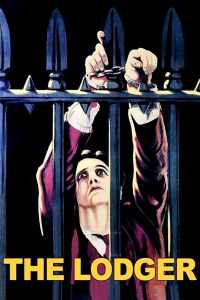 Going to look at some of Hitchcock’s perhaps lesser known films today, including two from the silent era (yes, Hitchcock made several silent films). First up is The Lodger: A Story of the London Fog, from 1927. This was Hitch’s third film, and his first psychological thriller, obviously the genre he is most famous for. Daisy is a cute young blonde at a time when that is not such a good thing. A serial killer known as “the Avenger” is Jack Ripper-ing it up around London, targeting fair haired women. When a witness finally spots him and describes him as a tall young man hiding his face in a long scarf, just such a man shows up at Daisy’s house, requesting to stay in the advertised open room. The new lodger moves in, and in Hitchcock-ian humor, begins to ominously tell Daisy how beautiful her blonde hair is, and promising to “get her real soon” when they play chess, while carefully reaching for the fireplace stoker (only to move the coals around of course). When he quietly stalks out the night of the next murder, and Daisy’s mom notices, he becomes suspect number one. If you know Hitchcock at all, you know all ready if he is really the murderer or not. A little slow to get going, and a little slow in the latter third as well, but ultimately a fun, early slice of Hitchcock thrills.
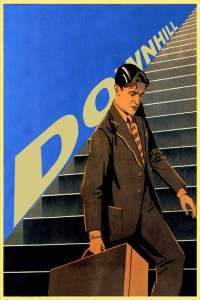 His next movie was Downhill, released the same year, and starring the same lead actor (Ivor Novello). In this dramedy, Roddy Berwick is a man with the worst luck in women. It begins at an exclusive all-boys school, where he takes the fall, protecting his best friend, and says it was he that got a local shop worker pregnant. Roddy gets expelled from school and cut out of his affluent parents’ inheritance. A little while later, he is scraping by as an actor and falls in love with the lead, but he only gets her attention once he has inherited 30 thousand pounds from his deceased godmother. They marry, but aren’t together long before she wipes out his money on lavish purchases and leaves him for another man. It doesn’t get any better any time soon for old Roddy, as he becomes a cheap gigolo in Paris. The film has funny moments, but ultimately there’s nothing to write home about. If any other director had done it, this is the kind of film that would have been lost to time, and maybe it should have been. Not terrible, but not memorable either.
 Sabotage came out in 1936, adapted from a work of renowned writer Joseph Conrad. The film opens with a deliberate blackout in London; an act of sabotage has cut power everywhere for a few minutes. Mrs Verloc and her husband Karl run the local cinema, and while Mrs Verloc holds of the perturbed crowd wanting their money back, Karl sneaks in the back, it being implied that he was behind the power outage. We soon learn that he is being paid by a group of shady men, to what purpose we don’t know yet, but what’s more, is they are under surveillance by Scotland Yard. A bigger, more dangerous event is planned by the group, with the help of a bomb maker. As the day approaches, Hitchcock ratchets up the suspension. Lot of trademark Hitchcock camera closeups and slow pans to create unease. I didn’t much of this movie for a good portion of it, but the ending is very good.
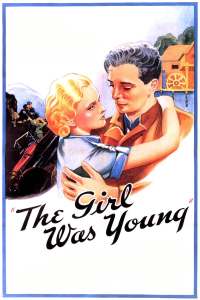 He followed the next year with Young and Innocent. It starts well enough: there’s a fight between two people during a storm, and the next morning, the woman washes up on shore, the victim of a strangling by a raincoat belt. The first man to find her is the prime suspect. Robert knows he’s innocent, but to prove it, he needs to find his stolen raincoat out of town, to show the belt used was not his. He is aided by the chief police constable’s daughter Erica, who reluctantly believes he didn’t do it. The duo dash off to the countryside and unfortunately, the film reverts to an almost-comedy romp. There are good moments, but definitely not one of Hitch’s best. The lead actress is great as the irresolute heroine, and the camera loves her, but that may turn out to be the only memorable aspect for me. Unfortunately a fairly boring movie.
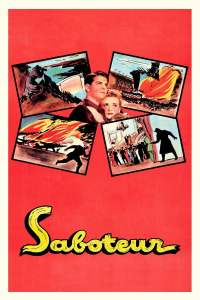 Saboteur is one of Hitch’s early Hollywood films, and was released in the early days of America’s involvement in World War II. An aircraft factory is destroyed in a fire, and a man dies in the blaze. The man’s friend, Barry, is suspect number one, but Barry knows he is innocent, and he has a single clue to follow to attempt to prove his innocence before the cops can catch him. As the mystery unravels, he finds a plot to undermine the country, with further sabotages planned. Of course there’s a girl that Barry gets tangled up with too. This is pure Hitchcock through and through, so if you are a fan, you’ll love it, and if not, you’ll think the plot is a little too much like the more popular North by Northwest that would come later.
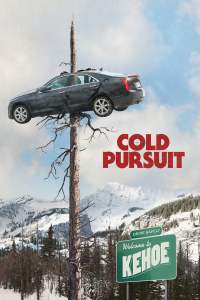 Cold Pursuit is a genre-defying, black comedy/action flick starring Liam Neeson as Nels Coxman, a snowplow driver outside Denver. When his son is killed, Nels goes on a rampage to kill those responsible, who turns out to be a big-time drug dealer in Denver. Nels starts with the local dealers and works his way up the food chain, but along the way, a rival drug gang of Native Americans becomes involved when there is confusion among the bad guys on who is doing the killing, and the body count continues to rise steadily. All of the characters are purposefully wild caricatures, creating many of the funny situations. Gruesome deaths accompanied by belly laughs? I’m in! Not a deep film and not really a great one, but it is entertaining enough for a single viewing.
 Peterloo is extremely well detailed, beautifully shot, and a huge bore. I wanted to like this one, by director Mike Leigh, so much so that after I first gave up (45 minutes in), I tried to pick it up again the next day, but to no avail. The film is about the lead up to the real Peterloo massacre, when the British government militia stormed into protesters, killing some and wounding a bunch more. Despite sets and costumes that are more detailed than anything I’ve ever seen before, the movie is just too dull. It really is just (wordy) speech after speech after speech, all about the same topic, which is, reform of the government and representation for the working class. I generally enjoy period dramas, but this one is tough to get through. I wasn’t able to finish it unfortunately, maybe you’ll have more patience than me.
 Just as Peterloo is a movie I should have liked but didn’t, Under the Silver Lake is one I probably should loathe, but don’t. In fact, I found it extremely entertaining. This one stars Andrew Garfield as Sam, a quirky young man without direction in life. He meets a girl he instantly likes, but when she doesn’t show up to meet him the next day, Sam enters a crazy world of drugs, mystery, and conspiracy theories. As the film proceeds, it seems the more Sam learns, the further he gets from answers. Sam’s investigations include deciphering puzzles in popular song lyrics and puzzling over the map on the back of a cereal box, all while avoiding a serial dog killer in the area and a more sinister monster known as the Owl Monster. This is one of those films where the ride to the end is just as important as the finish itself, and don’t come expecting it all to wrap up in a tidy bow, which probably explains why online reviewers give this film either 1 or 5 stars, with almost nothing in the middle. You’ll either love it or hate it, but if you just like good filmmaking, I think you’ll be in the former group with me.
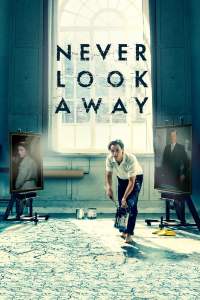 If you want to be moved, if you want to feel wonder like that of a child again, Never Look Away is a masterpiece. A German film directed by Florian Henckel von Donnersmarck, it tells the story of Kurt Barnert (inspired by real-life artist Gerhard Richter). Beginning in 1937, Kurt is a young boy, heavily influenced by his beautiful aunt Elisabeth. She talks to Kurt about art and freedom, just before she is diagnosed with schizophrenia and put in an institution. First she is sterilized so as to not spread mental illness to her children, and then, with World War II kicking into high gear, she is killed through a gas chamber so the Nazi party can free up hospital beds for wounded soldiers. The doctor that signed off on Elisabeth’s and other patients’ deaths is spared an execution after the war, when he saves the life of a Russian officer’s wife during her rough childbirth. The film picks up in the later 40’s, as East and West Germany are splitting. Kurt has survived the war and is a young man going to school to be an artist. This constitutes the first hour of so of this 3 hour long film, but to give more away would be a grave injustice. Go see this one, it will move you to tears and to cries of joy. Probably the best film I’m seen in awhile.
 In my mind, Avengers: Endgame was a proper ending to the first part of the Marvel saga, but the series does continue on now, and the first movie of the new set of films continues the adventures of Spider-Man in Far From Home. If anyone feared that the “new” films would lose something after Endgame’s conclusion need not worry. Far From Home is supremely fun and action packed. Young Peter Parker, having been brought back from the snap in the last film, which the people of Earth are calling “the blip,” is living in a world still coping with disappearance, and reappearance five years later, of half the world’s population. Peter doesn’t want the mantle of world hero and prefers to remain “your friendly neighborhood Spider-Man.” But danger still finds him. On a class trip to Europe, Spider-Man fights foes while dealing with the emotions (and crushes) that come to all teenagers, while also coming to terms with the loss of his own personal hero, Tony Stark. The series isn’t slowing down, and continues to produce at a high level. I can’t wait for the announcements for where Marvel goes from here.
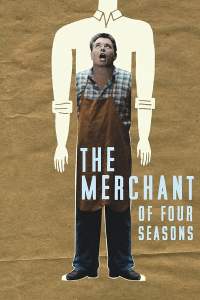 The Merchant of Four Seasons came out in 1971. It is about Hans, a man for whom life hasn’t given any breaks. He is a fruit vendor, a job for which his mother despises him (though as we see in flashbacks, she did so long before his career path was chosen). He is married to a woman, Irmgard, who is his polar opposite, a fact driven home even by their statures, with Hans being short and stocky and the slim, tall Irmgard towering over him. Though life itself doesn’t seem to like Hans, the viewer does, because he is portrayed as a likeable “everyman.” When he has a heart attack though, and the family needs to hire someone to push the fruit cart around town, even the veneer of happiness Hans tries to eke out at home is ruptured. At times throughout this film, I found myself thinking it wasn’t very entertaining as a picture, because events just sort of happened without any sort of meaning, almost like I was watching a modern day reality show following the everyday life of an average man. But as the film drew towards its conclusion, I realized the brilliance of this movie. Fassbinder does an amazing job of fleshing out Hans, and the viewer knows him through and through by the end, warts and all. By the end, I ached for the way Hans’ life turned out. Loved the movie.
 The Bitter Tears of Petra von Kant was Fassbinder’s big breakout in 1972. Petra is a wealthy clothing designer, but her money hasn’t bought her happiness. She lives alone with only a maid, Marlene, whom von Kant bosses around in a degrading manner. One evening, Petra meets Karin, a young and shallow beauty, and Petra instantly falls in love. Petra showers Karin with everything she wants, but 6 months later, Karin admits she was only using Petra for the lifestyle and does not love her. She moves out, leading to a severe depression in Petra, which is only abated by help from her family. For much of this movie, I was wondering where all the praise for this film comes from. It didn’t seem to be getting anywhere fast, and whole conversations go nowhere (Karin and Petra spend what seems like 15-20 minutes discussing trivialities like their favorite subjects in school), but then the ending came. Absolutely stunning, and from that, the whole film is painted in a new picture. A fantastic character study in both sadism and masochism, love and hurt, and ultimately, what can bring happiness. Going to have to watch this one again.
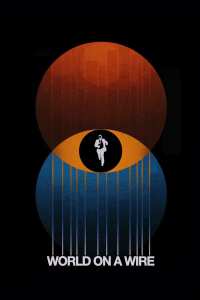 25 years before The Matrix depicted people living out their lives unknowingly inside a computer program, Fassbinder brought us the same in World on a Wire. Fred Stiller is the technical director of a computer program called The Simulacrum. Devised as a way to predict human needs in the future, the Simulacrum is full of programs who think they are human, going about their lives in a virtual space. Stiller’s predecessor was a man named Vollmer, who died suddenly. Stiller isn’t on the job for long when he notices the head of security, Lause, has also disappeared suddenly, but more peculiarly, no one in the company remembers him. While investigating Lause’s disappearance, it isn’t long before Stiller begins to question his own existence. Part neo-noir and part science fiction, World on a Wire is a great mystery that opens up questions about the meaning of life. It’s a bit long at 3 ½ hours (it was originally a 2 part miniseries), but it is well worth the trip, and far ahead of its time in 1973, at a time when computers don’t even resemble what they’re capable of now.
 By the time I got to Ali: Fear Eats the Soul, I was really warming up to this director. This one does not start slow, but gets you right into the meat of the film. This film is about race relations, and on a larger scale, how the general public can turn on minority groups. In it, a widowed older lady, Emmi, falls in love with a young black man from Morocco, Ali. At this time in Germany, Arabs were looked down by society in much the way that black people were in America, and both Ali and Emmi are very lonely, Ali because of his race, and Emmi because of her dead husband and grown, absent children. They find love in each other, but over time, Emmi’s attitude towards Ali harshens to be more like her friends’ attitudes towards him, leading to strife in their relationship. A good film to open your eyes to problems that existed in the 60’s and 70’s and still exist today. Chuck full of tidbits that really stand out, like Emmi’s neighbors gossiping that she isn’t a “real” German because of her Polish last name from her first husband, and how she is alienated from her coworkers when her relationship with Ali starts, but gets back in their graces when the company hires an immigrant from Yugoslavia, someone new they can ostracize. The film (and much of Fassbinder’s output in this era) was inspired by the work of director Douglas Sirk, and this film in particular by All That Heaven Allows.
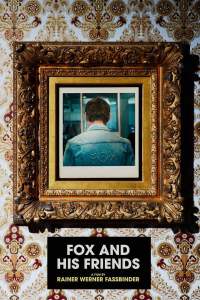 Fox and His Friends isn’t as “deep” as the four previous films I watched, and is a much more direct film. Franz (nicknamed Fox and played by Fassbinder himself) is a working class gay man who wins it big through the lottery, winning 500,000 German marks. He never cared much for money and it doesn’t seem like his cash flow is going to change him, until he gets swept off his feet by a swindler, Eugen. Eugen sees an easy target, and after telling his boyfriend they need to take a break for awhile, he woos Franz and starts milking him for all of his fortune. They buy a modern apartment, furnish it extravagantly, and pump money into Eugen’s family’s failing business. Franz doesn’t realize what is going on until he is broke and dumped, going back to his sister’s apartment with nothing left. Franz’s true friends, whom he dumped when he was running in high society with Eugen, are still hanging at the local bar. I liked Fassbinder’s other films more, but this one still features a very well written story and excellent direction.
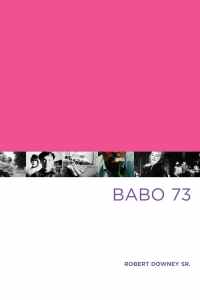 Just about everyone knows the films of Robert Downey Jr, most recently his big Marvel blockbusters, but I’d venture to guess not many know the films of his dad. Robert Downey Sr made some quirky, low budget films in his his career as a writer and director. Coming up in the 60’s, he made a name for himself in the independent, underground, counter-culture movement. His first feature film was Babo 73, which follows the president of the “United Status” (played by Andy Warhol film regular Taylor Mead), a man more keen on being left alone than actually running the government. He is advised by his “right hand man,” a fascist warmonger, and his “left hand man,” a pacifist communist, as their country bumbles through foreign relations with other countries and is later invaded by one of them. Goofy and downright “out there,” I still found it thoroughly entertaining. Not a minute goes by without a sight gag or word play that made me chuckle. It’s probably the silliest thing I’ve seen in a long time that I really enjoyed. Definitely not for everyone, and probably not even for me on a different day, but today it caught me at just the right time for a few stupid laughs at some hard hitting satire.
 A couple years later, Downey made his first hit, Chafed Elbows. This one follows Walter Dinsmore and his hilariously crazy adventures, starting with him leaving his lover before her husband comes home, and we immediately learn the husband is Walter’s father, because the woman is his mother. This incestuous relationship is perfectly normal in the upside-down world of Walter Dinsmore, as is pretending to be a cop and directing traffic in Times Square; dying and going to heaven, only to meet a not-so-virgin Mary and God, who appears to be a 12 year old Fidel Castro, who sends Walter back to earth; and other such zany escapades. Walter attracts the weirdest citizens, like a dirty sock sniffer and an “art collector” who makes Walter become a living piece of art for his collection, to go along with “dog on the floor” and “wife in the kitchen.” Totally irreverent, but man is it a hoot. I read online that the film was made for just $12000. It is mostly a series of 35mm camera still shots (developed at Walgreens!) and set to a narration. After 2 films now, I can see Downey’s nutty but entertaining style.
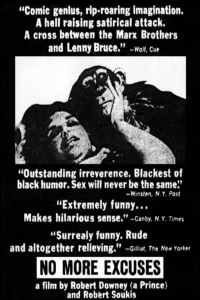 Downey continues his documentary-like approach in No More Excuses, which follows a handful of storylines. There is a Civil War union soldier who wakes up in modern New York, an infomercial where the speaker talks about the need to clothe our animals because of their indecency, the assassination of President Garfield, and regularly spaced throughout, interviews with people who go to singles bars and the growth of the sexual revolution. I still had chuckles, but the lack of a cohesive central figure to follow made it overall a tougher film for me to get into. Just not as good as the first two films.
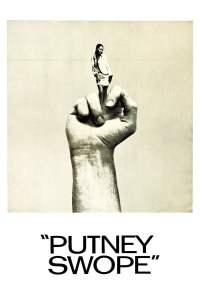 Downey’s most famous film is Putney Swope from 1969. Putney is the token black man on the board of an advertising agency. When the chairman dies and the board holds an impromptu vote for his replacement, everyone votes for Putney thinking no one else would vote for him. Swope fires all the old white guys and keeps a single token white man employed (who gets paid less than the black workers!), and the people Putney surrounds himself with all have their own agendas. At first, Putney tries to go straight with the company, refusing to work with companies who sell tobacco or alcohol, but greed turns him into a despot before the end. This satirical film holds nothing back, and no one is safe. Downey pokes fun at social norms, the government, hollywood films, religion, and, of course, race relations. It’s probably Downey’s most cohesive film and is certainly more polished than his previous efforts (thanks to a bigger budget), but it loses none of its bite.
 Two Tons of Turquoise to Taos Tonight (originally titled Moment to Moment), from 1975, isn’t so much a film as a series of sketches, what seems like 100 of them since most are just a minute or two long. Even the sketches don’t have stories to tell, it’s just a series of events and dialogue to elicit a laugh. It’s like watching SNL, with even smaller sketches, but even SNL usually has a point to their sketches. I don’t see a point in most of this film, and you would think that would kill its entertainment value, but like Downey’s other films, it is still very funny. It even has a couple familiar faces pop up, like Seymour Cassel of Cassavetes fame. This film was funded by some of Downey’s more famous admirers, including Hal Ashby, Norman Lear, and Jack Nicholson, and has a soundtrack put together by a younger David Sanborn. On another note, all female characters in the film are played by Downey’s wife Elsie (who did the same thing in Chafed Elbows).
 Arctic is an incredible survival film starring Mads Mikkelsen. An almost-unnamed man is barely surviving in the harsh arctic landscape, the seemingly only survivor of a plane which initially carried who knows how many. We don’t know how long he’s been there, but it is implied that is has been quite awhile. Finally he hears a radio signal of someone close, and spots a helicopter. When they see him, they attempt to land, only to crash themselves. The pilot dies but a woman survives, although she is comatose and only just hanging on. Our main guy hangs out for a couple days, in hopes a search crew will come looking for the helicopter, but no one does. Thankfully that helicopter was carrying some fresh supplies, including a detailed topographical map of the area, and our survivor plans a trek to a base a couple days away. He heads out across the harsh environment, carrying the helpless woman, whose condition is worsening, behind him on a sled. Along the way he faces hungry polar bears and a deteriorating winter. A harrowing film that proves you can have a gripping and tense movie with almost no dialogue to aid you.
 Wildlife is indie film regular Paul Dano’s directorial debut. It stars Jake Gyllenhaal, Carey Mulligan, and Ed Oxenbould as a family living in Montana in the 60’s. Seemingly the all-American family, there are problems under the surface. Jerry can’t hold a job, and Jeanette resents him for it. When Jerry abruptly announces he’s going to go off to fight the wildfires plaguing the area, Jeanette has a bit of a mid-life crisis, starting an affair with a local businessman. Jerry and Jeanette’s son, Joe, is witness to all of the craziness. Dano shows elements of his indie film acting career behind the lens, and there are bright moments, particularly with Mulligan’s and Oxenbould’s acting, but I’m not sure this is a great movie. There are several instances where it seems Dano is just trying too hard, such as several long, slow panning shots, which happen with enough frequency that it becomes a bit much by the end. Still, a solid first film.
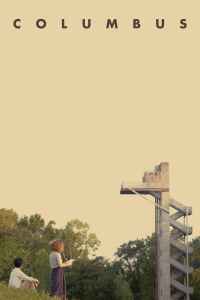 Columbus follows a young woman, Casey (Haley Lu Richardson), a recent high school grad working at the local library. She’s a bit of an architect buff and may have gone to college to study it, but instead has chosen to stay in the little town of Columbus, IN, to watch after her mom, a recovering meth addict. She was planning on seeing a well-known architect who was giving a talk at the local university, but he ends up in coma, and Casey meets his estranged son Jin (John Cho) who has come to be nearby. The two strike up a relationship, and explore their complex feelings about their parents. A fairly simple-sounding film, and it is for the most part. It has a really beautiful, quiet, slow-paced way about it, just like the small town setting it sits in. Even the camera work has this long view, “take it all in” kind of approach, with many scenes set up so we see our characters walk in and out of view, and not a lot of closeups. Sometimes whole conversations take place without any camera movement, placing emphasis on the scene in its entirety and not just the dialogue going on in front of us. Fantastic stuff for movie lovers, proving that richly detailed movies don’t have to be complex.
 On the Basis of Sex is a biography of the early career of Ruth Bader Ginsburg, with Felicity Jones in the lead role. It follows her struggles as a young law student, one of only a handful of women in the Harvard Law program in the 1950’s, and afterwards having a hard time finding a job as a lawyer in a profession dominated by men. The film then shifts to her life in the ’70s, where she is still fighting the system. It opens up when her husband Martin (Armie Hammer), a tax lawyer, brings to her attention a case where a man has been denied a tax deduction for a caregiver for his ailing mother because he is a man, because at the time, the credit could only be claimed by women. To this point, Ruth has been unable to undo laws that upheld sex discrimination, but now she sees a chance to fight one where a man is being discriminated against, and in doing so, prove that sex discrimination is unconstitutional, thus forever changing the landscape for women in the country. The criticisms of this film are mostly that it is too formulaic, and it is that, burdensomely so at times, but if a film’s purpose is to entertain, this one does that. It is emotionally moving in all the right spots.
 Us is the most recent thriller from Jordan Peele following Get Out from a couple years ago. In a similar fashion, he takes an outlandish, almost silly premise and makes it terrifyingly great. It begins in 1986, with a young girl going through a house of mirrors and seeing herself, a true copy of herself and not just a reflection. Years later as an adult, she and her husband bring their family to the same beach on vacation, and that night the town is attacked by twisted doppelgangers of all of its citizens. Not short on suspense and downright scary at times, it is a refreshing and delightful thriller, with a tremendous ending that doesn’t disappoint.
 I usually do 5 films in a set, but this time it will be 6, just because I have 2 sets of 3 films joined together by common threads, all directed by the great Italian director Roberto Rossellini. First up is a trio of films taking place during World War II. The first is Rome, Open City (Italian: Roma città aperta), which came out in 1945 and takes place in Rome during Nazi occupation in 1944. It follows the underground resistance movement, and does an amazing job of portraying the group of men and their wives and children as all walk the precipice of a knife’s edge, in constant danger of being found and incarcerated. The leaders of the movement are constantly changing their names, getting new forged papers, and moving from house to house to stay one step ahead of the gestapo. When one leader is finally found, due to a spurned girlfriend giving him up to the Germans, he is tortured violently, but refuses to give information. A tremendously tense and realistic film, from a director known for the realism in his films.
 Rossellini followed with Paisan (Italian: Paisà) in 1946, which took a neorealistic “behind the curtain” view of relations between American soldiers and Italian countryman at the end of the war. It is made up of 6 small vignettes, each written by a different writer (including famous names such as Pagliero and Fellini), with many of the actors being non-professionals, as was Rossellini’s style. The episodes include an army troop liberating a village right behind the retreating Germans; a black soldier discovering how poor the young, homeless Italians are living; a drunken soldier returning to Rome to hunt a girl he met previously but not recognizing who she’s become in his absence; a girl sneaking in to occupied Florence to find a lost love, but finding he’d been killed earlier in the day; three American chaplains finding peace in an Italian monastery; and a small American group working with Italian freedom fighters against the larger German force. The first few stories were better than the latter ones, but overall still a tremendous film that I really liked. We know Italy was on Germany’s side, but the film shows that many Italians were not in same mind with their leaders, and they often had a love/hate relationship with their American “saviors.” The film feels very real and doesn’t take sides; at various times, both Americans and Italians are painted as heroes and villains.
 The weakest of the three was the last, Germany, Year Zero (Italian: Germania anno zero). It follows a German family living under the rules and rations of the allied occupation just after the war, in bombed out Berlin. Just 13 years old, Edmund is the man of the house. His father is sick and unable to work, and his older brother has refused to register for rations or work, because he is afraid of prosecution by the Americans since he fought for Germany right up to the end of the war. Edmund goes out every day to lie and cheat to scrape together money for food and necessities. Along the way he bumps up against prostitutes not much older than himself, hoodlums and ne’er-do-wells, and pedophiles, but despite everything he tries, nothing helps his family’s situation. This film is a whole lot of nothing. I think I get what Rossellini was trying to say, but it’s just not very good. Way too melodramatic for a neorealist director.
 The next trio of films star acclaimed actress Ingrid Bergman. After being moved by some of Rossellini’s pictures, she wrote him a letter asking to be in his films, and so started a relationship that was a huge scandal in the USA (she gave birth to Rossellini’s son before divorcing her previous husband in 1950). (*Quick note: I watched the English language versions of these films. Stromboli and Europe ’51 were released in both English and Italian. Stromboli in particular was shot completely front to back twice, so that producer Howard Hughes could own a negative for release in the USA, and Rossellini could own a negative for release in Italy.) The first film is Stromboli, which came out in 1950. It is about a Lithuanian refugee stuck in an internment camp after the war, and her only way out is to marry an Italian and go with him to his home on the small volcanic island of Stromboli. She finds the island harsh and its inhabitants harsher. She doesn’t know the language and knows less about their customs and beliefs, and she seems unable or unwilling to acclimate. I never found attachment to Bergman’s character. As an actress, she seems out-of-sorts in this kind of film. Coming from a traditional Hollywood background where directors tell her where to stand and how to deliver lines, the neorealist Rossellini would use his scripts as only a guide, allowing his (often) non-professional actors to improvise and go-with-the-flow. You can tell by watching, this is not Bergman’s forte. Still, the camera loves her, as it always did. A fairly average film for my tastes.
 Europe ’51 is much more of a traditional film than Stromboli, and it makes for a better experience. Irene Gerard is a wealthy, bourgeois American living in Rome. Though they have every physical need met, her son seems depressed and eventually kills himself. Seeking answers to what would lead him to this, Irene is influenced by her communist friend Andrea to start volunteering to help poor families in the area. This leads to Irene working, to the consternation of her husband and wealthy friends. Full of lines like, “I’m only happy when I’m working to support my fellow man” and “It’s not fair that I have everything I could need and people out there have nothing” and “We must free the exploited worker and bring an awakening,” it starts to feel like pure propaganda. However, Irene, who has all ready rebuffed her capitalist friends, rejects communism now too, and only finds personal joy in helping people for its sake alone, in an almost religious manner (the final scene in fact casts her as a saint). A good film, even if at times I felt I was watching Rossellini’s pompous ideas being spoonfed to me.
 In Journey to Italy, Alex and his wife Katherine travel to Naples to sell a villa they’ve inherited from Katherine’s recently dead uncle Homer. Realizing early in the film that they no longer love each other but have stayed together all these years for convenience, they grow increasingly more spiteful to each other as the film progresses. Katherine is strong and independent, preferring to go by herself to see museums and the countryside. Alex seems to like to have someone depend on him, and begins an affair with a young woman who walks with a cane. As the film goes along though, the estranged couple start to miss each other, but whether their marriage can be saved is left up to the big reveal in the end. A very enjoyable film, and well acted by Ingrid Bergman and George Sanders in the leads.
 Rocketman is the recent, highly rated biopic about the life of Elton John. It follows his rise to stardom but doesn’t shy away from his shortcomings, even if it does try to place the blame for all of them on his terrible parents. Taron Egerton is fantastic as the man himself, and will probably get an Oscar nomination for the work. He portrays Elton as a boisterous public figure with a shy and unconfident private life. The film plays out as a biography/musical, with many of his big hits making appearances, even if in just short piano form here and there. Elton John’s fans will certainly find plenty to love, but even the casual moviegoer will root for John to find success in his personal life to match that of his professional career by the end. Brilliantly acted and directed, with colorful music and scenes, it’s a great flick.
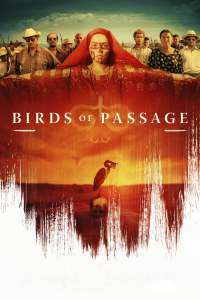 Birds of Passage is one of those deep, emotionally involved films that I’d probably really dig on another day, but for whatever reason, I couldn’t appreciate it much on this first viewing. It follows a Wayuu (Native American ethnic group) village in northern Colombia from the 60’s until the early 80’s, as they become involved in the drug trade. Rapayet initially just gets into it as a way to make money quickly to pay the dowry for a woman he wants to marry, but when Rapayet’s friends and family fall in love with the inflow of cash, greed becomes more powerful than family ties. The filmmakers used professional actors in the leads, but filled out the families with real Wayuu people and the film has a life-like, documentary kind of feel to it. This is a film I’ll probably visit again in the future, when I’m in the mood for deeper contemplation and true art as film.
 Dragged Across Concrete, from writer/director S Craig Zahler (whose other credits include films I love including Bone Tomahawk and Brawl in Cell Block 99), is a quietly intense crime thriller. Two cops (Mel Gibson and Vince Vaughn) play loosely with the rules and are suspended for roughing up a suspect. To pay the bills, they hatch a plan to rob the crooks, so to speak. Following a tip, they trail a team who are obviously planning something, but no one knows what. When that something becomes a bank robbery, and one that goes south with dead bodies, the disgraced cops end up in a shoot out with the robbers, with the winners taking home the stolen gold. Like Bone Tomahawk, this is a slow burn and some of the “action” almost seems like an afterthought to the story of the film. It takes great actors to pull off a movie like that, and Gibson, Vaughn, and the others here are up to the task. I really enjoyed this one.
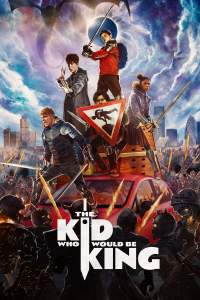 The Kid Who Would Be King is a modern re-telling of the classic sword in the stone tale. Alexander is a chubby, picked-on, 11 year old when he finds Excalibur buried in stone on a construction sight. He pulls it and, aided by a quirky teenager Merlin the wizard, makes knights of his classmates, to face a coming evil intent on taking over the world. The film is very well done and has humor and action a-plenty, however the story has been done a time too many and felt stale. It is geared towards kids, but I’m not even sure a younger generation would appreciate this one. Not a bad film, and I enjoyed putting the story in modern times, but overall just a little too ho-hum for me, even if the final, glorious battle is certainly exhilarating.
 Finishing out this set with the Disney re-imagining of Aladdin. I went it to this one expecting what I got from the live version of Beauty and the Beast, which was I thought a good movie, but not quite as good as the cartoon that was one of my childhood favorites. I was pleasantly surprised by the new Aladdin. While it doesn’t have the spectacular Robin Williams, is still a thoroughly enjoyable film. The story is much the same, though it does have a modern twist with Jasmine not seeking a man to be her sultan, but instead wishes to go against the rules and lead as a female sultan. The sets and costumes are as colorful as their cartoon origins, the songs are equally as fun, and Will Smith as the genie brings his own style of humor which is good enough. The role of Naomi Scott in particular as Jasmine is perfect. A fun family film which, while not replacing the original, acts as a worthy companion piece.
 Jons Movie Takes