Quick takes on The Iron Claw and other films

About Dry Grasses is the newest from Turkish director Nuri Bilge Ceylan. Having seen most of his movies, I knew I was going in for a long, introspective film, but this one is far different from most of his other offerings. For one, it has a ton more dialogue, in fact there are few scenes that aren’t just people talking to each other (though we still get a couple moments of the camera giving us a wide look at the starkly beautiful surroundings too, in true Ceylan style). The movie takes place in remote Anatolia where Samet works as a teacher. From Istanbul, where he returns to in the offseason, Samet hates everything about where he works, and he isn’t shy about telling people so. Honestly he’s a condescending jerk, belittling coworkers, friends, and even students for living in this backwater tiny village where most will be born, live, and die, without ever venturing out. Very egotistical, Samet expects to be the center of attention wherever he goes, which leads to the trouble he gets himself into. First, there is an allegation of misconduct at the school from two students against himself and his friend Kenan, another teacher. Samet is able to deduce that the accusations come from a girl, Sevim, he had befriended (though the viewer definitely sees grooming aspects in his prior dealings with her). Sevim seems to be upset over a love note she had written that the school confiscated and Samet ended up with. He doesn’t give it back when she asks for it, and thus she goes to the school with these accusations of improper conduct. The egotistical Samet obviously thinks the note was about him, but of course it was not. He and Kenan are able to weasel out of the case when the education board finds his and Kenan’s stories more believable than Sevim and her friend’s, but that is not where the film ends. We still get a whole story about a woman in a neighboring village, named Nuray. Nuray and Samet go on a blind date, but he isn’t interested (again, because she’s from a small town with seemingly no aspirations for more), until, that is, Kenan becomes interested in her. Then of course Samet, who always has to be on top, pursues her as well, to a devastating conclusion. Sometimes it is hard to get behind these movies where the main character is so despicable, but it is a gripping film where you find yourself hanging on every word (or subtitle, as the case may be). Merve Dizdar won Best Actress for her role of Nuray at last year’s Cannes, and she is indeed spellbinding. The film’s 3+ hour runtime made up almost entirely of dialogue in another language will turn away some, but it is great stuff. ★★★★½ 

Irena’s Vow is based on a play, which is itself based on the true story of Irena Gut Opdyke, a Polish woman who hid 12 Jewish people during the second world war. Irena is portrayed by Sophie Nélisse (who successfully forayed into the war before, a decade ago as the eponymous Book Thief as a teenager), a nurse who is horrified early in the war when she witnesses a German officer take a baby from a Jewish mother and throw it to the street headfirst, killing the child and then shooting the mother. At the time, Irena is working as a servant in a household, with a number of Jewish workers who do odd jobs in the basement for the German soldiers. When word comes down that all of the Jews will be shipped out, she can’t let them come to harm, and makes the decision to save them. Irena is able to become the sole housemaid to a powerful German major, and secrets the Jews to the expansive house’s basement. Over the next couple years, Irena and her hidden friends live on a razor’s edge, for fear of being found out, as the major hosts parties, and other hidden Jews in the area are found. You can obviously see how it came from a play, because some stuff doesn’t work as well as a movie but would play very well on a stage, but Nélisse is fantastic in the lead role. While similar stories have been told (and better), it is still extremely moving knowing that this one really happened. ★★★

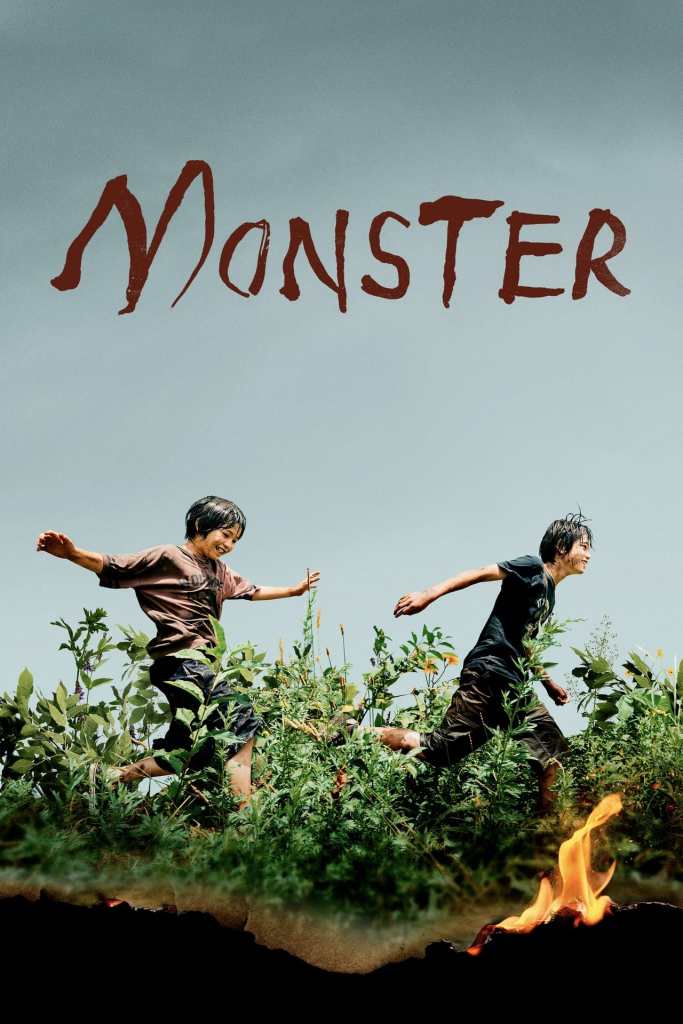
Monster is the latest from Japanese director Hirokazu Kore-eda. I’ve enjoyed quite a few of his films, and was ready for a treat. The film is told in three parts, each from the perspective of 3 of its main characters, and begins with Saori Mugino. A single mother to fifth-grader Minato, she is growing increasingly perturbed with her child’s school when he starts being withdrawn, and Saori suspects he is being bullied. The truth is even worse, as it seems that Minato has been the target of one of his teachers, Hori. Hori and the school seem pretty ambivalent to Saori’s appeals, until finally one day Hori pushes Saori down some stairs, which finally leads to the school firing the teacher. The second part is from Hori’s view, and obviously it paints a much different picture. The viewer learns that Hori seems to be the bully, picking on a boy in class, Yori, who is much smaller than the other boys. Hori begins to suspect there’s more to the store though, setting up the final viewpoint in the film, Minato’s. Obviously the truth is more complex than either Saori or Hori guessed, and the film builds to a wonderfully ambiguous (in a good way) ending that will satisfy. The film is great for creating a sufficient mystery to the viewer, as I really had no idea who was really right in all this until the big reveal. The only problem is that reveal comes at about the halfway mark when we start getting Minato’s view. For the next 40-ish minutes, I just wanted to speed ahead to see how it all ended, even though the filmmaker was creating a beautiful scene of Minato’s life during all that. I want to give it more stars because the first hour was exceptional, the last 15 minutes was exceptional, but that middle section just started to drag. ★★★½

Walk Up comes from Korean director Hong Sang-soo, and is the second of his films I’ve seen. Wasn’t a huge fan of the first, and this film seems to suffer from the same issues for my tastes. The film begins on a film director named Byung-soo, whose films are beloved by critics but don’t seem to have made him much money. He and his adult daughter are visiting an old friend named Ms Kim, who owns an apartment building. She gives them a tour of the building, including a restaurant on the second floor and a painter’s apartment on the third, and the trio share a meal and have a fairly mundane conversation. At one point the dad goes off to get more wine, and the daughter begs Ms Kim for a job, as, despite appearances, she is estranged from her dad and wants to create her own life. The next scene jumps ahead a month, and Byung-soo is visiting Ms Kim again. The daughter was hired, but quit and left unexpectedly since then, and the two adults talk about that and other things. This time they eat at the restaurant and talk with its owner, Sunhee. Sunhee and Byung-soo hit it off, much to Ms Kim’s chagrin as she seemed to have eyes on him herself. In the next scene, Byung-soo and Sunhee are living together in the building, but here it starts to get a bit weird. At one point, Byung-soo is talking about how he’s gone vegetarian for health, and in the next scene, he’s wolfing down meat. Later, he is alone in the apartment and goes and lays down on the bed, but in the next room, we hear him talking to Sunhee. I was confused, but the only thing I can guess is there was some kind of alternative universe thing going on. Whatever it was, I couldn’t make much sense of it, and the whole thing didn’t really seem to have an overarching plot or theme. Two strikes, director. ★½

The Iron Claw is based on a true story and tells the tale of the Von Erich family, a troupe of pro wrestlers who continually faced tragedy. Retired wrestler Fritz Von Erich has raised his four sons harshly (a fifth son died young in a freak accident) to carry on his footsteps, even if they didn’t want to. Kevin and David are wrestling and starting to gain a name for themselves, but Kerry only got into wrestling when his dreams of competing in the Olympics was derailed when the USA boycotted the 1980 games in Moscow, and youngest son Mike is more interested in music than wrestling. This leads to his father openly calling out his manhood and telling him he is the least favorite of his sons. In a household where father’s approval is the end-all-be-all, this is like God telling you that you aren’t good enough. [Minor spoiler if you don’t know the story of the family.] The family curse follows them all though, with each son coming to a terrible end by the end of the movie, until only Kevin is left standing, hoping to escape his father’s shadow and live his own life. Remarkable performances by Zac Efron (who really bulked up to be Kevin), Jeremy Allen White, and Mindhunter’s Holt McCallany as Fritz, with a compelling story and a hero to root for. I was pleasantly surprised. ★★★★

  • TV series recently watched: Star Trek (season 2)
  • Book currently reading: A Crown of Swords by Robert Jordan

Quick takes on 4 Louis Malle classics

I’ve got a quartet of films from French director Louis Malle, two in French and two in English, starting with The Lovers. This was his followup to his breakout Elevator to the Gallows (and in fact was released later that same year, in 1958), and has the same star, Jeanne Moreau. She plays Jeanne Tournier, a wealthy socialite living in a mansion in rural France, whose husband Henri runs a newspaper. Jeanne is bored with her life, and though her husband loves her, he works a lot and is always away. She has taken to going to Paris frequently to hang out with her friend Maggy, and has caught the eye of polo star Raoul. When Jeanne begins to suspect that her husband is having an affair, she gives herself permission to pursue Raoul too. Finally though, Henri, becoming suspicious himself, invites Maggy and Raoul out to their house for dinner one evening, much to Jeanne’s chagrin. To make matters worse, her car breaks down on the way home from Paris, ensuring that Maggy and Raoul will arrive before her. Jeanne is able to thumb a ride with middle class worker Bernard, who espouses on the drive all of the things that are wrong with the wealthy class and their inane way of life, and while Jeanne should feel attacked, she finds herself attracted to this young man who doesn’t have a care in the world. When they arrive to the mansion, Henri invites Bernard to stay for dinner too, setting up a much different ending than you may have expected. Wonderful story that flips the script on you, and a fine performance from the eye-catching Moreau who sucks you in to her outlook on life. ★★★½

Funny enough, the other star from Gallows, Maurice Ronet, is in 1963’s The Fire Within, and plays a man named Alain. Alain is from France but was living with his American wife Dorothy in New York until 4 months ago, when he came back home to get sober at a health clinic in Versailles. The film opens with him waking up after an evening with another woman, family friend Lydia, who is about to go back to New York for work but who promises not to tell Dorothy of their tryst. Alain doesn’t seem to care much if Dorothy learns or not, as she hasn’t checked in on him while he’s been away, and he feels their life together is over. Alain begs Lydia to stay with him in France, but she refuses. If she knew how dire it was for Alain, she may have changed her mind, because he is ready to end his life, something he promises to himself he will do the next day. On that fateful day, we follow Alain as he revisits the bars he used to hang out in and the friends he had. They all remember the drunken Alain, and recall stories about when he was the life of the party, but he is a much different person now. He continually asks these old friends to stay with him, but they have each moved on to different things in life and are unable or unwilling to drop everything and help Alain out. It’s a dark and gloomy movie, and a pretty bleak outlook if are looking for hope in humanity, but damn if it isn’t still entirely engrossing until the very last scene. ★★★½
This is going to be a much longer review than my typical quick takes, as I have a lot to say about My Dinner With André. Written by its two stars (and really the only two actors in it, except for short lines by the staff at the restaurant) Wallace Shawn and André Gregory, the movie is almost entirely one evening at a fine restaurant in New York as two old friends catch up. The actors play fictionalized versions of themselves, and in fact was conceived as a way for real-life André to relate his experiences traveling the world. The premise is simple (and the movie itself deceptively simple too): Wallace is a playwright and sometimes actor in New York, who enjoys a simple life. If he has a cup of coffee and a newspaper waiting for him in the morning, then it will most likely be a good day. He recently ran into André, who was crying openly on the street after having just watched an Ingmar Bergman film, and quipped to Wallace, “I could always live in my art, but not in my life.” They agreed to meet for dinner, and that is where Wallace is heading at the beginning of the movie. In Wallace’s theater circles, there had been rumors of André’s eccentric life after having walked away from the business a few years prior. Wallace, who likes to keep to himself, is dreading the dinner, but reluctantly goes. He is in for a wild night, but more so are we the viewers. As Roger Ebert wrote in a review in 1991 upon revisiting the film (he was a huge fan too when it first came out, calling it the best film of 1981), the two characters “are simply carriers for a thrilling drama–a film with more action than “Raiders of the Lost Ark.” André has stories to tell, of Tibet, and the Sahara, and of being buried alive, and bringing a Japanese monk to live with him in New York with his family. Common threads are throughout though, which slowly come together as the evening progresses: we as a people have become numb, lost, and isolated from each other and from living life in general. To Wallace, who likes his isolation, this is as perplexing as an alien society, but André’s stories do move you to want to be better, to explore our world, and to remember to “smell the roses” and connect with our loved ones on a real, personal level. They even wax philosophical, with André believing in fate and the powers of the universe bringing things together, whereas Wallace only wants to believe in science. André tells his stories as a storyteller would hundreds of years ago; you could replace the dinner table with a campfire and have the same feeling of awe. A movie like this reminds me that you don’t need action scenes or love interests to grab your attention (in fact, they touch on that subject too, the current state of theater and entertainment). By the 30 minute mark of this 2 hour film I found myself leaning forward and hanging on every word, and am not ashamed to say I was moved to tears a couple times before the end too. Just from two guys talking. The movie also reminds me that I probably give 5 stars out far too often, as a film like this is miles above so much else that is out there. One that I could watch again and again. ★★★★★

By all accounts I should have enjoyed Vanya on 42nd Street, but I could not get into it at all and finally gave up about an hour in. I’m going to blame it on the source material, a late 19th century play, Uncle Vanya. The film came about after the actors, including André Gregory and Wallace Shawn from the above movie, as well as Larry Pine, Brooke Smith, and Julianne Moore, were getting together workshopping the play around New York. They’d meet in abandoned theaters, parks, or each other’s apartments, anywhere, just to read lines and get to understand better this famous play. Louis Malle attended one such get-together and proposed the idea to film it. The film begins with the actors meeting each other on the street in front of an old abandoned theater, and they come inside. With no warning, the play starts; it begins with a simple conversation and took me a couple minutes to realize they were now inside the play and not just actors talking to each other. I won’t recap the play because I didn’t stick around long enough to know how it all came together, but obviously the idea was to strip away the costumes and audience and props and just focus on the words, so it is all dialogue again. While the performances are fine, I could not get into the story and it all felt a bit too contrived. Unfortunately this was to be Malle’s last film, he would die a year later in 1995 from cancer. ★½

Quick takes on 6 classic international films

Up today are a set of international films released by the Criterion Collection in Martin Scorsese’s World Cinema Project, an important group that looks to preserve and restore films from around the world that are in danger of of being lost (as a side note, a lot of these restorations have been funded by the George Lucas Foundation, who spends beaucoup bucks restoring old films; he’s not just “the star wars guy”). First up is Sambizanga, from the country of Angola and released in 1972. Based on a true story, it documents the story of Domingos Xavier, an African man working in the capital city of Luanda under white Portuguese business owners, but who secretly meets people who are planning an uprising against their colonizers. When he is arrested, pulled from his house without explanation to him or his wife Maria, she sets out to find who took her husband and why. Maria was unaware of his political actions, and just wants her husband back. The police stations give her the run-around, always saying he’s not here, so go check that one over there. There’s good political commentary here, as Maria notices a loss of cultural self in the busy city centers, and points out men born in Angola who betray their neighbors for the white man’s money. Domingos’s friends and fellow organizers quickly realize why he was taken, and get the word out to be on the lookout for him. For a long time, we don’t know where he ended up either, until the final 30 minutes when we learn his fate. What happened to Domingos, and the outrage over it, was one event that led to the uprising he wanted, Angola’s war of independence, which they achieved in 1975. An important film about an important moment in the history of that country, but not exactly my cup of tea. The actress who played Maria is alright, but all of the actors are non-professionals (often not my favorite, as readers of my blog know) and though the story is good, the delivery of it left me wanting more. ★★½

Prisioneros de la tierra (known in the USA as Prisoners of the Earth or Prisoners of the Land) has similar themes but is more of a traditional narrative story. Released in 1939 and taking place in 1915, it is about the near-forced labor made by Spanish colonizers in Argentina in the early 20th century. Kohner is a foreman of a lumber operation, and he gets local laborers indebted to him in local bars through drinking and/or betting, and uses those debts to force them to work for him. These workers, called the mensú, or “paid monthly,” are darker skinned descendants of local populations and are looked down upon by Kohner and the other wealthy white people in the area. One mensú is Podeley, who will not be cowed by Kohner and his ilk. Unfortunately for him, he and Kohner both have eyes for the lovely Andrea, the daughter of a doctor brought in by Kohner to treat illnesses in the workers (not for any love of them, just to keep them on the line working). Unbeknownst to Kohner, Andrea’s mother was half mensú, and she doesn’t see the class difference that others do. There doesn’t seem to be much that sets this film apart from a plethora of others like it, until the end of the film. It has an explosive and violent final act, the likes of which you didn’t see in Hollywood films in the 30s. It completely flips the script, and I did not see it coming (though maybe I should have if I’d been playing closer attention). ★★★½

Now we’re talking. Chess of the Wind (and the story behind how it was almost lost for good) is the kind of film the WCP exists to save. From Iranian director Mohammad Reza Aslani, the film follows a household in the aftermath of the death of its wealthy matriarch. Two people seem to have equal claim to the money left behind: her daughter Aghdas, and her husband (Aghdas’s step-father) Hadji Amoo. The two have obviously never liked each other, and while Hadji Amoo seems to have the best legal standing to get the money and estate, Aghdas will not go down without a fight. Other key players are Hadji Amoo’s adult nephews Ramezan and Shaban, hangers-on who also have eyes for a payday. Ramezan is engaged to Aghdas, but it is apparent to all (and maybe even to Aghdas) that he just wants money, and Shaban has cozied up to Aghdas’s young maid Kanizak. Greed will make people do terrible things, and everyone in this film is only seeing dollar signs. Aghdas conspires with Ramezan to kill Hadji Amoo, and they stuff his body in a large tub in the cellar, but afterwards, people around town remark how they’ve seen him here and there. When Aghdas and Kanizak go down in the cellar, they can’t find the body. Is he not dead, or is he a ghost? Great suspense and the sound and dark interiors of the house (where nearly the entirety of the film takes place) add to the tense feeling permeating through the film. This movie was shown just once in Iran before the 1979 revolution, after which it was banned (for many reasons) by the new government, and thought lost. The director’s son found the original negatives in a junk shop in 2014, saving this tremendous film. ★★★★½

I couldn’t connect with Muna Moto, a mid-70s film from Cameroon. Shot in black and white and with an almost documentary-like feel, it begins in the end. Ngando is at the wedding celebration of a woman named Ndomé. At the party, he grabs her young daughter and runs, being pursued by her and the other villagers at the party. We then get a flashback, and learn that Ngando is a poor man but he works hard, and hopes to save enough money to use as a dowry to marry his girlfriend Ndomé. The two are very much in love, but her family is insistent on a traditional dowry, and Ngando doesn’t have it. He goes to his wealthy uncle Mbongo, but when the uncle sees Ndomé, he gets an idea of his own. Mbongo already has 4 wives, three of his own choosing as well as Ngando’s mother, who married Mbongo after her husband’s death, as is custom in the area. None of the 4 have given Mbongo a child, so when he sees the young Ndomé, he thinks this is his chance to finally procreate. He supplies the dowry, and the wedding date is set. Ndomé will not go as the virgin he wants though, and begs Ngando to give her a child, so they can share a child even if they will not be married. Thus setting up the ending/beginning of the film. Obviously a critique of traditional customs against a changing society, the film is done well but I just wasn’t engaged in it. It slows down to show local dances and/or events going on, which adds to the documentary feel, but which have nothing to do with the movie, and while interesting, I’m not usually a doc kind of person. ★★

Two Girls on the Street is a Hungarian film from the late 30s, following two women each overcoming personal disaster. Again dealing with issues that Hollywood Code prevented, the film begins with Gyöngyi, who is pregnant from her wealthy boyfriend but suddenly discarded as he chooses to marry someone else. She loses the child, and to try to leave her shame behind, moves to Budapest and finds work in a band (she plays the violin). Walking the streets one night, she comes across Vica, a very young woman who happens to be from the same hometown. Vica doesn’t have the education and “proper upbringing” that Gyöngyi has, and is working as a bricklayer, but facing constant harassment from the predominately male workers. Vica is attracted to the lead architect of build site, but the young and naive Vica panics when he makes a move on her. Gyöngyi finds her distraught, and takes her home to her place. Together, the two women work to improve their situation, first writing home to Gyöngyi’s father to ask for money (he agrees, missing his daughter after all this time) and then moving to a better part of town. Gyöngyi enlists a friend to educate Vica, and starts to see the younger woman as the daughter she never had. Gyöngyi sees a future for Vica, if they can evade the past that haunts them, but unfortunately they stumble upon the architect. He doesn’t recognize them, and he and Vica start dating, much to Gyöngyi’s chagrin. The movie has a great story for much of its length, but bogs down in the end. It makes these great, ahead-of-its-time criticisms of sexism and the wealthy elite, and then takes everything back in the end when Vica just falls in love with him and gets herself elevated to his status. Decent, but could have been great. ★★★

The final film today, Kalpana, is an interesting movie from Indian dancer Uday Shankar, older brother to famed sitarist Ravi Shankar. Uday plays a version of himself, Udayan, who is striving to promote pride in the actions and people of India. To that end, he is wanting to open a cultural center that will teach dance, among other schools of thought, because he thinks that universities have strayed too far from India’s heritage roots, and students are only learning “book knowledge” with no learning of the history of their own people. While Udayan is gaining financial support along the way (while also telling off some high-and-mighty people who have become “too westernized”), there is a love triangle story going on as well. While off learning his craft, Udayan meets a woman named Kamini and the two start a relationship, but he later meets a dancer named Uma, a woman Udayan has had visions of in his dreams. Kamini is immediately jealous of Uma’s and Udayan’s instant connection, and fate seems to be on their side no matter what Kamini does. The story is told with many fantasy, dream-like moments, and pulls heavily from India’s lore. There’s lots of dance numbers, as you’d expect, either furthering the story with a tale to enhance what is going on, or as an interlude. Everything is very entertaining, so much so that I’ll forgive the over-acting from these non-professional actors. The exotic feel of the Indian dance helps a lot, and it feels like you are sharing Udayan’s dream. ★★★½

Quick takes on The Promised Land and other films

I’m (still) a sucker for these superhero films, so despite Madame Web getting lambasted by everyone (including its own actors; Dakota Johnson has stated she hasn’t bothered watching it herself) I gave it a go. It starts out well enough. In 1973, a woman and crew are exploring the jungles of Peru in search of a spider whose bite is supposed to provide mythical healing properties. She hopes to use it to heal the world’s sicknesses, but when they find a specimen, one of her crew, Ezekiel, kills her and steals the spider for himself. The woman’s unborn baby is birthed at her deathbed by a tribe who honors/worships the spider. Flash forward 30 years, and the baby has grown up in New York. Cassandra is a paramedic who lives alone when she starts having eerily prescient visions whenever a catastrophe is about to occur. An older Ezekiel lives in the city too, and with the spider’s bite, he shares those powers. He’s been having a vision of an older version of himself being killed by a trio of female superheroes, so he goes out to find them and kill them while they are teenagers. Cassandra comes across these girls on the subway one day, and her visions of Ezekiel attacking them on the train leads her to saving their lives and escaping in time. Until this point, not too bad, but here the film starts to fall off the rails. Why does Cassandra’s visions continually allow her to save herself and her new young friends, whereas Ezekiel can’t tell when anything is about to happen despite having his powers longer? Cassandra is dodging hits and explosions left and right but Ezekiel can’t get out of the way of a speeding car? And you can tell that Dakota Johnson is just mailing it in by the end of the film, not even bothering to look interested. This is the second Sony Marvel bomb in a row, and even the one before that wasn’t all that great. Since there is no chance in hell they’ll give these characters back to Marvel/Disney, here’s hoping they right this ship at some point. ★½

Thunder also had a promising start, but wasn’t able to keep it all together by the end, at least for my tastes. Elisabeth was the second daughter born on a rural farm in Switzerland but sent to a convent at the age of 12 to become a nun, after her parents birthed their fourth daughter in a row. That was the last she heard of her family until now, 5 or 6 years later, when she receives news that her older sister Innocente has died (a little on-the-nose for that name, as you’ll see). Her family has called Elisabeth back home to help work the farm. She is curious as to what happened to Innocente, but her inquiries are met with silence, and her mother says “that daughter’s name is no longer spoken in this house.” Elisabeth is able to discover that Innocente was sleeping around with many of the young men in the village, and it all makes sense once Elisabeth finds Innocente’s hidden diary. In a society that revolves around church and God, Innocente claims to have found God in the ecstasy of flesh, and didn’t care what others thought about it. She pursued men at a time when that was more than just taboo, it was forbidden, leading villagers to say the Devil had her. Elisabeth finds herself following her sister’s footsteps, and begins pursuing 3 young men too. This will lead to dire consequences for her, but of course in that day and age, only the women faced persecution for such acts, and the men would only get a slap on the wrist and told to say their prayers. I get what the director was trying to say, but it honestly didn’t make much sense. Elisabeth had devoted her life to God (even if it wasn’t her choice in the beginning) and to throw that all away in a very sudden manner, because of a sexual awakening of whatever you want to call it, didn’t ring true. Very fine acting from up-and-comer Lilith Grasmug in the lead role, who also was spotted in a great film I saw earlier this year, The Passengers of the Night, but the plot just falls apart under scrutiny. ★★

Turtles All the Way Down is based on a young adult book and makes for a fine drama, touching on a subject not often explored. Aza is a 16-year-old struggling with severe OCD, nearly debilitating. She is obsessed with germs and bacteria, even the thought of the digestive bacteria in her own stomach doing its thing makes her break out in a sweat. Her best friend is Daisy, a free spirit and the source of the comedy in the movie. The town is abuzz with the recent disappearance of wealthy investor Russell Pickett, who was under investigation for shady business deals. There’s a $100k reward offered for news about Russell, and Daisy coerces Aza to get involved for the money. Aza once went to summer came with Russell’s son Davis, and the two bonded over the recent death of one of their parents (his mom, her dad). Though it has been a few years, they immediately step back into that familiarity, but this opens up new challenges for Aza. With her fear of germs, the thought of kissing another person fills her with anxiety. At the same time, Aza must confront her friend Daisy when she discovers that Daisy has been painting Aza in a not-favorable light on an online blog she writes. The first half of the film is light-hearted and funny, with Daisy providing much of the laughs, and while the middle third of the movie is a bit bumpier, it comes out well in the end, even if it finishes up a bit too perfect. It is refreshing to watch a coming-of-age sort of film these days that isn’t covered in sex and presents a decent message. ★★★
Ordinary Angels is based on a true story and stars Hilary Swank and Alan Ritchson. In Louisville in 1993, Sharon is a go-getter and a people person but always ends up self-destructing, unable to kick her drinking problem. It has ruined her relationship with her adult son, but she finds a new purpose when she reads an article in the local paper about a 5-year-old girl, Michelle, who’s just lost her mother and is herself in dire need of a liver transplant. Sharon takes it upon herself to start a fundraiser at her work (she’s a hairdresser) and comes up with over $3k in one day. When she barges in on Michelle’s home, with Michelle’s father Ed, and sister Ashley, she is thanked for the help but told no more aid is necessary. The proud Ed doesn’t want a handout and likes to keep his personal life private, but Sharon will not be dissuaded, especially when she learns that the family is nearly $500k in debt due to all of the medical bills for Michelle and the lengthy illness her mother went through before death. For the rest of the movie, Sharon puts those people skills to work and is able to make miracles happen, until the only thing keeping Michelle from getting her liver is her spot on the donor list, and even that is only an obstacle to be beat. Swank and Ritchson are solid in the leads, and though the movie is a bit (or, more than a bit) heavy handed, you can’t help but tear up in the end. Little Michelle is just too cute not to root for. Usually I reserve big ratings for movies that I’d watch again, and while this isn’t necessarily in that category (I think the emotional heft will lose something on a second viewing), I recommend it for anyone looking for a good family film. ★★★★


A Mads Mikkelsen film in his native Danish? Sign me up! The Promised Land is very loosely based on a true story, with a highway full of liberties taken from what I can find, but it is a very good story. Mikkelsen plays Ludvig Kahlen, a retired soldier who worked his way up to captain though hard work, in a time when generally only high born were given a rank that high. Kahlen is no noble, being the bastard son of a maid, the product of rape from her lord. Kahlen knows how to fight to earn anything in this world, and his next goal is taming the Jutland heath, an inhospitable land between Denmark and Germany where kings and lords have been trying to harvest for generations, to no avail. Kahlen has an idea though: potatoes, which can grow anywhere as long as he can find some kind of soil amongst all the dry brush and sand in that region. He gets the lords at court to promise him a noble title with lands and a manor, if he can produce a sustainable harvest on the heath. It will not be easy, as he faces outlaws, mid-18th century prejudices and superstitions, and a local magistrate who sees the heath as his own land, no matter what the King says, and the little pissant will stoop to any misdeed to foil Kahlen’s pursuit. Against all odds though, Kahlen does have help, from others in the bottom of society, including a married couple who ran away from the magistrate’s cruel household (on pain of torture and death if they are discovered) and a Romani girl who was going to be sold by her former traveling companions. It’s a great film with twists and turns, and a determined hero to root for. ★★★★½

Quick takes on The Boys in the Boat and other films

I was excited for Asleep in My Palm for several reasons: its an indie film about a family living off the grid (I tend to like these kinds of movies), it stars Tim Blake Nelson (who never disappoints), and it was from a first time writer/director (I have a soft spot for these, in this case, Blake’s son Henry Nelson). The trifecta doesn’t let me down, with a tremendous movie bolstered by top-notch actors. Single father Tom and his 16-year-old daughter Beth (relative newcomer Chloe Kerwin in her first starring role) aren’t just off the grid, they are completely invisible, to the government and even to society. They sleep in a temperature controlled storage unit, living off what they can steal and sell. Tom has one contact, an eccentric young 20-something who talks too much and acts as his fence,, but Beth doesn’t even have that; she has no contact with anyone in the world outside of her father and the nice gas station attendant where they use the restroom and buy snacks. Tom, suffering from obvious PTSD and a disdain for the establishment, likes their situation, away from everything and everyone, but Beth is at an age where her eyes are opening to all of the things she is missing in life, and is no longer willing to just take her father’s word that nothing is better outside of their storage unit. When Tom gets stuck out one night, Beth ventures out on her own and ends up hanging with college kids from the local university. A fairly benign evening, the sort that any college kid goes through a hundred times a semester, but for Beth it is a whole new world. But that’s not the end of the story. When Tom gets in trouble and startling revelations are made, the carefully crafted world he has created for Beth comes crashing down. A wonderful film that shines a light on people living on the fringe of society, with a heart wrenching ending that will stick with you.  ★★★★★

The Beekeeper is the polar opposite of the above artsy film, which you can guess based on the fact that its star is Jason Statham. He plays Adam Clay, a seemingly peaceful beekeeper renting a barn from a retired schoolteacher. The woman invites Clay to dinner one evening, but when he arrives, he finds her dead by suicide. Earlier that day, the woman had fallen victim to a cyber attack which wiped out her savings as well as the $2 million charity fund she managed. Clay decides to seek vengeance for the one person who ever treated him well, and he has the skills to do it. Turns out a beekeeper isn’t just one who harvests honey; Clay is a former member of a super-secret international military unit whose only mission is to keep balance in the world and root out evil and corruption. Long retired, he still has his skills, and nothing is going to stop him from finding the “evil queen” at the center of this hive of villainy, the group that is preying on innocent people and stealing all that they have. There’s some off-the-wall plot twists, unbelievable gun and fist fights, but damn if it isn’t all entertaining. Sit back, turn off your brain, and let the violence wash over you, and you’ll enjoy it enough, as I did. ★★★

The Boys in the Boat, directed by George Clooney, is based on a book, which is itself based on the true story of a men’s rowing team that came together to compete in the 1936 Olympics. In early 1936, Joe Rantz is a student at the University of Washington, but struggling to pay his tuition. The Great Depression is still in swing, and Rantz lives alone in an abandoned car in a shanty town, his mother having died and his father abandoned him; Rantz has been on his own since 15. There are no jobs to be found. When Joe hears that the school is putting together a new JV team and will pay the men who make the team, he tries out. Obviously during a depression, many show up during tryouts, vying for just 8 seats in the boat. Joe has never rowed before but is willing to do anything to keep himself in school, and he works hard to make the team. The coach (Joel Edgerton) sees something in Joe, and as the team comes together and start winning tournaments, they capture the imagination of a nation, a team of hard-working every-men who go up against Ivy League students whose families aren’t struggling. When it comes time to qualify for the Olympics, the coach makes the unpopular opinion to enter the JV squad instead of the Varsity, knowing that they have a won’t-quit attitude. Very stirring film, especially when they do get to the Olympics in Berlin and go up against Hitler’s German team. A little rote at times maybe, and there aren’t any surprises, but it is an entertaining film with emotional heft. ★★★½

Tótem is an emotional film too, but it’s a very different kind of emotion. Rather than the intensity of a competition, we have the sorrow and trepidation of an impending death. Sol is a 7-year-old on the day of her father’s, Tona’s, birthday. Her dad has been living at his father’s (Sol’s grandfather’s) house so that his sisters can help care for him, as cancer has ravaged his body. They have hired a caregiver too, but have run out of money to pay her, and are basically out of money for any future treatments, even to ease Tona’s pain. Everyone knows this will be Tona’s last birthday, so they are throwing a big party, inviting all his friends, and all of the family is turning out. In the beginning, the camera follows Sol (her mother/Tona’s wife is at work) since we know she is losing her father, but she’s not the only one losing someone. Everyone at the party is losing a brother, a son, or a friend, and we get a glimpse into how each person is dealing with that. It ventures towards stream-of-conscious style, especially during the day leading up to the party that night, as people are just going about their business in the house, but you feel the the weight of Tona’s presence in the bedroom down the hall the entire time. And even with the sadness everywhere, there are still moments of brevity, humor, and life. ★★★½

I tend to enjoy the quiet dramas out of China, which always seems to churn out contemplative, moving films. The Breaking Ice follows some of that formula, but unfortunately is much too all-over-the-place to reach the heights it should have. The film follows a trio of young adults but begins with Haofeng, a man from Shanghai who is in northeast China near the North Korean border for an old friend’s wedding. Haofeng doesn’t partake in the festivities and ducks out early, instead joining up with a tour group going through the city. The tour guide is Nana, an attractive young woman who takes an instant liking to the quiet and subdued Haofeng. He is shy and very obviously depressed, always walking off to be by himself, but Nana continually ropes him back in. The two go out that night for some drinks, and tag up with Nana’s friend Xiao. Xiao is a cook in a restaurant and sees his young life as a failure, as he didn’t apply himself in school and has no great outlook on future prospects. He has a crush on Nana, but she only sees him as a friend. The trio party it up that night, causing Haofeng to miss his morning flight, so he stays around for the weekend. The film follows these three for those couple days, and we learn where each came from and about their hopes for the future. Should be great, and some reviewers really thought it was, but for my tastes it never comes together all the way. I don’t mind that there isn’t a satisfying conclusion in the end, but I almost wish the film had been longer for some more diving into the psyche of each of these three. Lost potential on this one. ★★½

  • TV series recently watched: Constellation (season 1), Superman: The Animated Series (season 2), Star Wars: The Bad Batch (season 3), Star Wars: Tales of the Empire (series)
  • Book currently reading: A Crown of Swords by Robert Jordan

Quick takes on 6 Bruce Lee films

I don’t think I’d ever seen a Bruce Lee film all the way through, so it was time to rectify that. Bruce Lee bounced between USA and Hong Kong in the 60s in pursuit of an acting career, but it wasn’t until his first leading role in 1971’s The Big Boss that he started to take off. He plays a Chinese man who has moved to Thailand for work, moving in with family to work at an ice factory. Unfortunately the head of the factory has a shady business: hiding heroine in the ice. When a few workers find out, they are killed and their bodies hidden. Lee’s character is promoted to foreman in an attempt to keep him off the pursuit of his missing friends, but he doggedly keeps asking questions, and when the factory owner sends thugs to silence him, Lee answers with his supreme martial arts skills. The movie gets repetitive after awhile with the constant “where are my friends” and the reply “oh I’ve got the police looking into it” that goes on for way too long, but the fight scenes are good, as you’d expect. Nothing too remarkable as a whole, but it is a start, and at the time the movie was very successful (over 1/4th of the entire population of Hong Kong went and saw it). A star was born. ★★½

Lee cemented his reputation the next year in Fist of Fury. He plays Chen Zhen, a martial arts student in Shanghai. His teacher, master Huo Yuanjia, has suddenly died. Huo preached peace, never to pursue combat, and to only use martial arts as a form of exercise and mental relaxation, but those tenets in his school are put to the test when a rival Japanese martial arts school starts flexing in the area. Chen is not about to let his beloved master be belittled and goes over to the Japanese school to rough up their students. It gets worse when Chen learns that Huo was killed by those rivals, by poison. It all leads to a big epic fight, with Chen taking on the entire opposing school, and an big battle against its master in the end. The action is constant and quick, with only minor breaks here and there for the story, and Bruce Lee dominates the screen. Much better overall film, that is exhilarating from beginning to end. It was a huge hit, made on a budget of $100k and making $100 million. A young Jackie Chan can be spotted as an extra in Huo’s school, and apparently was a stunt double for the rival school’s headmaster during his big fight against Chen in the final confrontation. ★★★½

The Way of the Dragon goes in a different direction than the above movies, unfortunately to worsening results (until the end, more on that later). You can tell from the opening scenes that this one is going for more of a comedic angle; in fact, it takes nearly 30 minutes until we really know the plot. Tang Lung (Lee) arrives in Rome and spends awhile getting into high jinks, like accidentally ordering 5 bowls of soup in a restaurant and ending up in a hotel room with a prostitute, all because he doesn’t speak the language (which is, apparently even in Italy, English). Finally he ends up in a restaurant owned by his uncle, who called home to Hong Kong asking for help. Tang is there to act as protection against some thugs who have been scaring off customers to the restaurant, trying to force the owner to sell to a wealthy developer. Tang is there to act as muscle and fight the thugs off, eventually working his way to the head honcho to keep the baddies away for good. Pretty tame movie until, all of a sudden, the bag guy makes a phone call for America’s best fighter to take on Tang. Showing up: Chuck Norris, in his very first film role. Suddenly this movie got good. I’d give it 1 1/2 stars until the final fight, but who doesn’t love Lee vs Norris, and in the Colosseum no less?! ★★★

Here’s the big one, 1973’s Enter the Dragon, a movie both famous for being hailed as one of the best martial arts films of all time, and infamous for being Lee’s last fully filmed movie before his untimely death at age 32 (it was released one month after his death). The first of these films in English, Lee plays a martial arts instructor in Hong Kong recruited by the British intelligence to infiltrate a martial arts tournament on a remote private island. The tournament is held every 3 years by a shady character named Han, who the British believe is involved in human trafficking and drugs, but they need proof, thus Lee’s involvement. They entice him with the news that Han’s bodyguard, O’Hara, was responsible for Lee’s sister’s death. Lee signs up, and enroute meets others going to the island for fame or fortune: Roper, a former soldier with a gambling problem, and Williams, an American Vietnam vet. On the island, Lee gets to work sleuthing around (I definitely got James Bond spy vibes) while kicking ass in the games. This movie has it all: outstanding nearly non-stop action, conflicted characters, and a devilish bad guy complete with a prosthetic hand where he can attach vicious tools of torture. I think even if the mystique of Lee’s death hadn’t surrounded the release, it still would be considered one of the best (it nabbed $400 million at the box office, an eye-popping number today, much less in 1973). Since it is irrevocably entwined with Lee’s sudden death, the legend has grown even more. ★★★★★

Lee had started filming Game of Death before the offer for Enter the Dragon. Upon his death, changes to the plot were made and it was later finished with doubles and stand-ins, and released in 1978 (actually, very little of the original footage was used, after the changes to the movie). Lee (and, mostly, his stand-ins) plays a version of himself, an actor and martial artist named Billy Lo, who has recently hit it big in Hollywood. He is being coerced to join a big crime syndicate, but with his fame and fortune, he doesn’t see the upside and continually declines. As payback, a thug shoots Lo in the face during filming one day, and everyone thinks Lo is dead (in a tasteless scene, they show Bruce Lee’s actual funeral and body/coffin as Lo’s cover). Instead, Lo did survive, and he plans his revenge. Lo makes the trip to the enemy’s encampment and works his way up to the boss. Literally up, as the finale has Lo climbing floors with a video-game like boss at each floor before he can move on to the next one. Honestly the movie is really rough. The scenes where Bruce Lee is inserted are so obviously fake and the re-used footage from his past movies stands out like a sore thumb. His stand-ins are always hidden in shadow or wearing thick sunglasses (even in a dark restaurant!) to try to keep up the illusion. The ending is really the only good part, and those are the scenes that Lee filmed before his death. His climb up the tower, battling villains on every level, including a towering Kareem Abdul-Jabbar, are as thrilling as any fight in Lee’s oeuvre. But, at the same time, those scenes only give a glimpse of what may have been. ★★

Should have stopped going to the well before Game of Death II. Another film culled from stock footage, it isn’t even a sequel to the above film, sharing only the name of the main character. This Billy Lo isn’t a movie star, but is a well respected martial artist. Honestly I was a bit lost in this film. It was something about a friend of Billy’s dying, and then he chasing down the friend’s daughter. It’s hard to follow because they tried to fit in as many old scenes of Bruce Lee as they could, and tried to get dialogue to match his lips, so most of it doesn’t make any sense. About 35 minutes in, Billy Lo dies (queue more scenes of Bruce Lee’s funeral) and his younger brother Bobby Lo goes on the hunt for Billy’s killers. I thought, maybe the film will get better now, when not trying to pigeonhole stock footage of Bruce into every scene. But no, without him, there’s really no reason to watch. The dialogue, if anything, gets worse, and I only lasted 20 more minutes before quitting. ½

  • TV series recently watched: Curb Your Enthusiasm (season 12), True Detective (season 4)
  • Book currently reading: Starlight Enclave by RA Salvatore

Quick takes on Rebel Moon 2 and other films

Reviews of Vietnamese film Inside the Yellow Cocoon Shell are squarely divided, with critics lauding it (it won the Caméra d’Or at Cannes) and regular moviegoers calling it a slog. It is slow, I’ll give you that, but anyone that says it has no meaning isn’t paying attention. It opens in Saigon, where two motorcycles have collided head-on. The driver of one is killed instantly; the driver of the second, a woman named Teresa, is mortally injured and later dies at the hospital. Remarkably, her passenger, 5-year-old son Dao, walks away from the crash without a scratch. Teresa’s brother-in-law Thien claims her body and takes it back to the rural village they came from, to be buried with family. Thien is the main character, a man without a compass in life, struggling to find meaning, even when there is meaning all around him, if he would just open his eyes to see it. Thien asks around town for the whereabouts of his brother, who abandoned Teresa and their son, and during his search, Thien is confronted time and again with the faith of those around him. He talks with an old man who fought against the Vietcong during the war, who claims he only survived through the grace of God. Thien runs into an old flame, who has since taken vows to become a nun, and flat out asks her why, seeking answers that have thus far eluded him. There’s even a “good Samaritan” episode when Thien’s motorcycle breaks down on the side of the road. Throughout it all, there are depictions of Jesus and reminders of Teresa’s faith. There’s a very profound moment about halfway through where Dao asks Thien where is heaven, since people keeping talking about it in relation to his mom. Thien starts by painting a rosy picture, but then honestly admits that he too is looking for faith, before returning to a more simplistic, happier definition for the young and hurting Dao. Thien so badly wants to have faith, but maybe doesn’t know how. Of course, that is just about the definition of faith. It is a very languid film (and clocks in at 3 hours) so bring your patience, but to dismiss it as meaningless is a mistake. ★★★½

Out of Darkness is an interesting film that I really enjoyed. It takes place 45000 years ago, following a sextet of people who are arriving to a new shore in the beginning of the film. These are early men, scared of their own shadow (they refuse to approach forests for fear of the demons that live there), but they do have an adventurous spirit and are obviously seeking something better than they had in their old land. However, they are unable to find food in the bleak landscape, and begin to starve. Things turn worse one night when an unseen scavenger grabs the youngest, a 10- or 11-year-old boy named Heron, and takes off. Heron’s father Adem pursues, but the chase leads them into the woods. Adem blindly runs in, and the rest of the crew reluctantly follow. Things get creepy, mostly because these people don’t know what is what (they think an animal den, with its scattered bones and meal leftovers, is a demon pit) and there are some jump scares, but the plot of the film takes an intriguing turn when we learn what is really stalking our protagonists. The film was advertised as a horror film, which maybe turned some viewers off expecting something different. It’s got some thrills but isn’t really what I’d call a horror movie, more of an adventure film with some light scares. And there’s even a lesson to be learned in the end, by those that survive to see it. ★★★½

Driving Madeleine is a very lovely movie out of France. It follows (mostly) a day in the life of taxi driver Charles, who is at a rough moment in his life. His marriage is rocky, mostly over stress about money. Charles works long days and nights driving his taxi, and one day, takes a fair that will take up his whole day. Madeleine is 92 years old, born before “the war” (World War II), and needs to be taken across town to a senior care facility, which she views as a march to her death. She gets in the car and immediately starts regaling Charles with the story of her life. At first, Charles is annoyed; he just wants a quiet drive to get paid. However, he gets wrapped up in Madeleine’s fine story-telling, about her first kiss as a teenager to an American soldier during the war, her abusive marriage later, and so on. Along the drive, she keeps asking Charles for pit stops and detours to see places she knew from years ago. At first, Charles is exasperated, but Madeleine has led an incredible life, and as she tells of it, Charles comes to realize what is really important, and becomes a better person for it by the end. This movie will tug at the heartstrings, mostly from Madeleine’s amazing and, at times, tragic life, but we root for Charles by the end too. ★★★★

Article 370 is a (sort of) true story about the political climate in Kashmir, India, in the late 2010s. When India gained independence in 1947, the states of Jammu and Kashmir were given special status, basically their own government and flag, because the people were mostly Muslim (and leaned towards the newly created Pakistan) but the government was Hindu (and thus pro-unified India). This film picks up in 2016, as tension in the area has been ratcheting up. Terrorists, backed by Pakistan, have been brewing trouble and gaining new followers among the younger generation, so the Indian government has decided it is finally time to bring Kashmir back into their fold. The movie follows many government officials on both sides of the debate, but in particular a special forces agent named Zooni. Zooni does it all in this film, from hunting terrorists to digging for lost documents in dusty libraries to confronting heads of state. She’s an all-around badass. The movie is a little overdramatic, but is certainly interesting, teaching me something about recent history in a part of the world I sadly know very little about. Not one I’d care to watch again, but it did get me on the google for a couple hours researching stuff. ★★½

Going into Rebel Moon 2: The Scargiver, I wasn’t expecting much. After 20-30 minutes, when I was (almost reluctantly) enjoying it, I chalked it up to just being better than my initially low expectations, after the disaster of the first film. 20 minutes after that, when I really started liking it, I had to admit there was more to it than just a gloomy presumption going into the movie. It picks up right where the first film ended, with Kora and her band of small team returning to the farm village to protect it from the Imperium forces, who will be returning for revenge. Her ragtag group of ex-soldiers have to train the villagers to fight seasoned warriors in just 5 days. After the setup, we get right to the big, final battle, which takes fully the second hour of this movie. It is visually dazzling and completely engaging. Don’t get me wrong, this movie still has its issues: lots of cliches, some outlandish plot elements, and you have to suspend belief a couple times to get through more-than-a-couple moments, but it is still a whole lot of fun. I think as a whole, these 2 films would have been better as 1 longer picture, with a good amount of editing to trim the fat, but this second film at least delivers, and gives me hope for more (it does set up future installments). Still, it is getting lambasted by reviewers, but in the words of Nick Hexum, f*k the naysayers cause they don’t mean a thing. ★★★★

  • TV series recently watched: Star Trek (season 1), Shogun (series)
  • Book currently reading: Starlight Enclave by RA Salvatore

Quick takes on The Crime is Mine and other films

Talked to a good friend and movie buff the other day, who couldn’t believe I hadn’t seen American Fiction yet, one of his favorite movies last year. Gotta say, it is a great one. Equal parts drama and good old fashioned satire, it stars Jeffrey Wright as Thelonious “Monk” Ellison, a college professor and author, but who can’t get his latest book published. Publishers are wanting “black fiction” that sells, and the fact that Monk is black isn’t enough, as his books don’t race to the lowest racial stereotypes; case in point, the newest lauded bestseller is new author Sintara Golden’s “We’s Lives in Da Ghetto.” Frustrated with the system, and almost as a joke, Monk takes the pseudonym Stagg R Leigh and writes “My Pafology,” based on the fake Stagg’s “real life” in prison and on the streets. To Monk’s surprise but no one else’s, publishers swoon over it and want to turn it into a movie, even before it comes out, and they don’t shy away even when “Stagg” changes the name of the book to simply “Fuck.” Outstanding satire on our society’s views on racism, especially on how black men and women view themselves, but it doesn’t just stick to Monk’s views either. When he gets a chance to meet and talk with Sintara, we see that she put a lot of work into her book and does have a story to tell. It’s not all jokes though, there’s a whole side plot involving Monk’s family dealing with the deteriorating health of their mom, who has advancing Alzheimers, and the pain of hidden family secrets from decades ago. The drama enhances but doesn’t take away from the comedy though, which is hilarious throughout, but with some hard-hitting poignancy here and there too that will definitely make you think. ★★★★½

The Zone of Interest also received a lot of attention on the awards circuit this past season. A German language film, it tells a fictionalized tale of Rudolf Höss and his family as they lived in an idyllic house just outside Auschwitz during World War II. Höss, the commandant of the concentration camp, goes about his life throughout the film, and it only shows his interactions with wife, family, and friends, never taking the cameras inside the camp. Höss and his wife Hedwig fight, like all couples do, while their kids play, get into trouble, or have swim parties with friends. Of course, the elephant in the room is the camp on the other side of the wall, where you can see the glow from the incineration chambers at night, hear the pop of guns near-constantly, and the occasional wails of anguish. But of course, what we don’t see is that in the camp, they can probably hear the squeals of delight from Höss’s kids, who seem completely oblivious. It’s a stark movie, and has a powerful ending that is completely open to interpretation, but not sure the film is all that great at anything other than giving the viewer the heebie-jeebies. It almost wants you to feel sorry for Hedwig when Höss isn’t listening to her marital complaints about not spending enough time at home, and then later she makes a crack about sending their house servant to the furnaces when she messes up. Will make you feel icky for sure. ★★★

Bob Marley: One Love is a biopic about the man, covering a pivotal moment in his career for a couple years in the late 1970s. At the beginning of the film, Marley is already a big star, and he is using his influence to preach peace in his home nation of Jamaica. The right and left wing parties in the country are at each other’s throats, a conflict that has even brought about violence in the streets, but Marley is pleading for peace between the sides. Two days before a planned concert though, Marley and his friends are targeted in an assassination attempt by one of the political parties, who felt that Marley was cozying up too much to the other faction. No one is killed, and rather than deter Marley, it only strengthens his resolve. In order to bring attention to the country’s problems, Marley embarks on an international tour, first to London where he and his band finish up a new album, but with the ultimate goal of performing in Africa to inspire his ancestors’ people there. Much of the movie is heavily music based, with us hearing many of Marley’s popular tunes throughout. Big fans may find plenty to love, but for me, it started to distract after awhile, because a (long) tune or performance would break up the action of the film and grind the story to a halt. Fine performance from Kingsley Ben-Adir as Bob Marley, and I did come away from the film with a better understanding of what made Marley tick, but it’s not all that memorable of a film. ★★½

I thought I’d find a diamond in the rough with low budget film (with no recognizable faces) The Stolen Valley, but unfortunately it is about the worst kind of action drama you can find. It follows two women, Navajo descendent Lupe and a rough-and-tumble nomad named Maddy, who come together through fate to embark on an adventure. Lupe’s mother is deathly sick with cancer, and Lupe sets out to find her mother’s ex-husband, who owns land in a nearby valley. Lupe is hoping to beg for money for her mother’s treatments. Along the way, she stumbles on Maddy, who seems to know every bag guy in the state, and she agrees to help Lupe on her path in exchange for a payout. I very nearly gave up on this film just 20 minutes in, after Maddy ends up in the backroom of a business with some hoodlums whom she owes money to. Literally every line of dialogue dropped was a cliche, like, “You walked into the wrong place,” and “Get in (the car) if you want to live,” and, “They won’t stop until they kill us both.” One golden oldie after another. I pushed on to see how it all was going to end, but even the plot twists in the second half were overworked. My eyes were starting to hurt from rolling so much. The acting is as bad as you could expect, though newcomer Briza Covarrubias as Lupe wasn’t (always) bad. Can’t say the same for any other character in the film. One star because I did stick around to the end, but maybe that’s just on me. ★

The Crime is Mine is a delightful French comedy with a throwback kind of feel, which makes a bit of sense as it is based on a 1930s play and takes place in that era. Maddy and Pauline are a pair of friends who are broke, months behind on rent and living without water and power in their apartment. Maddy is a bad actress and Pauline is a poor lawyer, so they don’t have much in the way of prospects either. Fame falls in their laps when a wealthy film producer is found dead of a gun shot, and Maddy was the last to see him. She is suspect number one by the hilariously bumbling police, but rather than refute the flimsy evidence (and the viewer definitely thinks she didn’t do it), Maddy pleads guilty, while Pauline scripts a trial worthy of a film production, à la Chicago. They are able to get Maddy set free based on self defense against the groping producer, and Maddy is famous. All could be wrecked though when the true murderer, a silent film era has-been named Odette (played by the always perfect Isabelle Huppert) shows up and wants a cut of the fame, or at least the profits. From the beginning, I got a French New Wave kind of vibe, with its fast dialogue and quick camerawork, but there’s “too much” of a narrative story for a New Wave film. Still, has a classic feel and is supremely entertaining and very, very funny. ★★★★

  • TV series recently watched: Black Knight (series), The Reluctant Traveler (season 2), Ripley (series)
  • Book currently reading: Dragons of a Lost Star by Weis & Hickman

Quick takes on Ferrari and other films

Finally got around to seeing Anatomy of a Fall after it won tons of awards this past season, and it’s a great film, well worthy of the praise. In a picturesque chalet in the French Alps, author Sandra is being interviewed by a reporter when their conversation is interrupted by super-loud music in the attic, where Sandra’s husband Samuel is doing some work on the house. Samuel is obviously doing it on purpose, and Sandra is perturbed. Her friend leaves, and shortly after, so does the couple’s son Daniel, who takes the dog for a walk. When Daniel, who is blind from an accident years ago, returns home, he literally stumbles upon the body of his father, lying dead in the snow in front of the house. Daniel screams for his mom, and Sandra comes running out. Over the next few days, she is interviewed by police, who don’t immediately believe her story that Samuel must have fallen out the window from the attic, and when it comes to light that their marriage was rocky, she becomes a prime suspect. The rest of the movie plays out as a courtroom drama, with neither Sandra nor Samuel looking completely innocent in the problems with their marriage. Ultimately, the film doesn’t give you any hard answers; I kept going back and forth on whether it was an accident or murder. The unspoken but glaring hints that are dropped in the final scenes paint a whole new picture on it all too. Great film with absolutely terrific acting. ★★★★½

Unlike the above film, Disney’s Wish was a much-maligned release last year, so I was in no rush to see it, and unfortunately, the critics were right about this one too. It tells the story of a magical kingdom known as Rosas, where the king, Magnifico, has magical powers. When people come to his kingdom, which is an idyllic place with few problems, they must give up their one wish in life. The person giving up their wish forgets it once Magnifico has it, so they don’t remember what they longed for. Once a year Magnifico chooses someone to restore their wish to. Of course, he’s the one deciding, so it is only wishes that he thinks would be for the good of the kingdom. 17-year-old Asha is interviewing to become Magnifico’s apprentice and hopes to persuade him to restore her 100-year-old grandfather’s wish. What she learns though is Magnifico isn’t as benevolent as the people think, hoarding his power and only choosing to restore wishes that don’t threaten him. With all of her heart, Asha wishes on a star, and the star comes down to her. Magical things start happening around her, and Magnifico, who feels magic being used, is threatened. It all leads to a good ol’ good vs evil battle in the end. It’s a very interesting premise, but poor execution and a paper-thin plot with no twists or surprises dooms this movie. Unremarkable and forgettable songs, and humor that my 2-year-old granddaughter may laugh at, but no one else will. The only real redeeming factor is the beauty of its animation, but that’s to be expected these days, and it doesn’t make up for all of the film’s flaws. ★½

If there was ever a true revisionist western where the “good guys” are anything but, The Settlers is it. Taking place in Chile in the late 19th century during the Selk’nam genocide (look it up, pretty dark time in that country), there is currently a land grab going on, and those with the power are the ones getting the land. The government has given a swath of country to a man named José Menéndez, who wants it reclaimed from the indigenous people as well as settlers from other countries who have moved in to the territory. Menéndez charges British expatriate MacLennan with finding a path to the ocean for his roaming sheep herds, and MacLennan picks two to accompany him: American mercenary Bill and Chilean mestizo (of mixed local and European heritage) Segundo. Segundo is quiet and unwilling to butcher the locals en route, but Bill and MacLennan have no such inhibitions, but the indigenous people will not be the only danger. The land grab has brought crazy people (literally insane, it seems) from all over the world, and lets not forget, there’s a genocide going on too. The film does an excellent job of capturing the bleakness of a land without law and order, where no thought is given to fellow man and people only care for their own personal advancement, told from the viewpoint of the resigned and powerless Segundo. Excellent film, if you can stomach it. ★★★★

Ferrari, the newest from award-winning director Michael Mann, stars Adam Driver in the title role as Enzo Ferrari. It takes plays in the late 50’s, a couple decades after he started his racing car company. As he says it, he sells cars to finance his race cars, not the other way around like his competitors, but Ferrari is in financial straits, as they just don’t sell enough vehicles. He is betting heavy on the upcoming Mille Miglia, Italy’s premier distance road race, in order to entice new investors without having to sell portions of his company to people who will want some control over it. On a personal level, Ferrari is at a crossroads too. His wife Laura (Penélope Cruz) owns half the company but they are on the outs, and she is fed up with his womanizing. His longtime mistress, Lina (Shailene Woodley) is pressuring Ferrari to publicly acknowledge their 10-year-old son Piero, a fact that all of the city knows except for Laura. As the big day approaches, Ferrari has to balance his separate family lives with his business, and keep everything afloat. The film finds the perfect balance between drama and thrills, provided by the pedal-to-the-floor thrills of the race. I was totally into it from the very beginning, rooting for Ferrari (despite him being egotistical and bombastic to everyone except Lina) and hoping he could find a way to keep it all together. ★★★★

  • TV series recently watched: Superman: The Animated Series (season 1), Turn of the Tide (season 1)
  • Book currently reading: Dragons of a Lost Star by Weis & Hickman

Quick takes on Kwaidan and other Japanese films

I’ve got a set of Japanese films up today, some older, and a couple newer, starting with 1956’s Crazed Fruit, directed by Kô Nakahira. The film follows a young straight-laced man named Haruji, who, for the summer, is hanging out with his older brother Natsu and Natsu’s friends. The crowd tends to hover around an “ultra cool guy” named Frank; he has American looks to go with this American name, though his parentage is never given, and in general, they are a bunch of teens with raging hormones out looking for love. Haruji, being a bit more staid, doesn’t care for the group much, but he is attracted to a young woman in the area named Eri, so he tags along as a way to see her. Eri and Haruji start dating and he falls head over heels, but she’s got a secret: she’s married to an older American. Natsu finds out, and uses the threat of exposing her to get Eri to sleep with him. Just wait until Haruji finds out! The movie starts slow but really gets going in the second half. It reminded me a bit of the classic 80s teen movies à la John Hughes, but was obviously very risqué for its depiction of a post-war teen society in Japan, an upcoming generation who didn’t care for the traditions that previous generations held so dear, and who saw the free-wheeling, caution-to-the-wind American culture as the wave of the future. ★★★½

After recently watching a very good (and long) film from director Masaki Kobayashi, I found a couple more. Kwaidan is an semi-horror anthology film of 4 segments, each dealing with ghosts or spirits. In The Black Hair, a samurai leaves his loving wife to marry another, in order to advance his position, but his new marriage is unloving, and he longs to return to his original wife. When he is finally able to, many years later, he finds the house dilapidated, except for his wife’s room where she is still waiting for him. But she may be as dead as the house… In The Woman of the Snow, two men are caught out in the snow, where a snow spirit kills one but spares the second. She does make him promise to never tell a soul about her, a secret he keeps for many years, while he gets married and has kids, but a slip-up one day ruins his idyllic life. Hoichi the Earless tells of a blind musician who unknowingly is brought to a ghostly hall every night to serenade the long-dead spirits of a long-ago war. When the priests try to protect him from the dead, they end up doing more harm. The last segment, In a Cup of Tea, is the purposefully-unfinished story of a tale-within-a-tale, a writer chronicling a samurai haunted by a malevolent spirit inside a tea cup, which may come to haunt the writer too. Each one of these tales is entirely gripping, with gorgeous hand-painted sets (apparently filmed inside a plane hangar, the largest space they could find to accommodate the big sets). Coming off some big hits, Kobayashi was newly signed to studio Toho and they invested in the film heavily; it was the most expensive film ever produced in Japan at the time. And it is a lovely, scary, tense journey from beginning to end, a true masterpiece. It won a prize at Cannes in 1965, and was nominated for an Oscar here in the states. ★★★★★

Kobayashi followed up in 1967 with Samurai Rebellion, its attention-grabbing English name since samurai films played well here, though in Japan its original title was more akin to Rebellion: Receive the Wife. The original title better conveys what the film is, not really an action film (though there is plenty of that before the end), and more of a family drama, and a taut one at that. In Edo Japan, Isaburo Sasahara (the incomparable Toshiro Mifune) is head-of-household and one of the Aizu clan’s premier swordsman. Isaburo follows his lord in all things, but fights back a bit when the lord commands Isaburo’s son Yogoro to marry the woman Ichi. Ichi is the former lord’s mistress and even bore him a son, but she fought back against him one day and he now wants her gone. Isaburo has long been in a loveless marriage himself, and doesn’t want to see his son follow suit, so they give some pushback but ultimately agree, in order to keep the peace. Thankfully, Ichi is nothing like what her reputation told, and is a loving wife who gives Yogoro a daughter, Tomi. Turns out Ichi only made a scene at court when the lord’s eye wandered to another, and she didn’t want to be with him anyway. All seems settled until the lord’s eldest son gets sick and dies, setting up Ichi’s son to be the new heir. It would not be proper for the heir’s mother to be married to a vassal, so she is called back to court. Yogoro will not see her go, and this time, Isaburo will not just acquiesce to the lord, setting up a standoff. Really great film, and I’d like to rate it higher, but unfortunately it does really drag at times, with characters constantly repeating themselves (over and over again) so that some 5 minute scenes turn into 15, for really no reason at all that I can tell. Still, a very enjoyable film about standing up to the abuses of power. ★★★½

After a few classics, thought I’d turn to more modern films, so finishing with a couple from director Hirokazu Kore-eda. I’ve seen a trio of his more recent films and liked them all (especially Shoplifters and Broker, but also his French film The Truth), so today I’m going back to some earlier films, starting with 1998’s After Life. If you tend to cry at movies, bring a handkerchief to this one. It opens at a school-like building, with counselors wrapping up last week’s visitors (having sent all 18 “on their way”) and discussing this week’s 22 newcomers, assigning a third of them to each of 3 caseworkers. As the new people are being interviewed, we learn that this place is a sort of way station for the newly dead. Over the course of the week, each person has to choose one memory from their life, the only memory that each will retain, to relive for all of eternity. The counselors are there to guide them to this moment in life, and by the end of the week, the crew and actors will reenact that moment on a film stage for the newly departed. After the person sees this newly created moment based on their memory, they are able to move on. The memories the people choose are as varied as humans are from one another: an old lady picks an early memory of cherry blossoms raining from trees when she was 9, a child who died at 1 recalls warm sunlight through the window while their mother was nearby, a middle-aged woman recalls a dance she did as a little girl, etc. Some have a hard time picking one out of so many good memories, while others have difficulty finding one good memory out of a lifetime of mundane moments. One young man flat out refuses to choose a memory, and hints that he didn’t lead a good life and is just thankful that there isn’t a hell waiting for him. Told almost as a documentary as the counselors interview and get to know these people waiting to move on, the viewer takes a trip through those cherished moments in lives, some of which may seem insignificant at the time, but which leave lasting impressions. And what of those counselors themselves? By the end we learn their stories and why they have not advanced to what is next. As touching a film as you will find, if you are loves movies (and don’t mind subtitles), it doesn’t get any better. ★★★★★

Finished a string of really good movies with Kore-eda’s Still Walking. This is a quiet, subtle family drama, with an almost Ozu-like feel. It takes place (mostly) over one day, on the 12-year anniversary of the death of Junpei Yokoyama. The family gets together every year on this day to remember his life cut short in a drowning while saving a friend. The father, a retired doctor named Kyohei, wanted someone to take over his family medical clinic, and while the popular Junpei was headed in that direction before his death, surviving son Ryota went in a different direction. Ryota is a disappointment in his father’s eyes in more ways that one, going into an unpredictable field (art restoration) and marrying a widow with a child (historically a no-no in Japan). Also at the house for the day is Ryoto’s sister Chinami and her unassuming husband and kids. The glue in the family, as is the case for most families, is their mother and Kyohei’s wife Toshiko, whom everyone acquiesces to. Ryota feels the weight of lost dreams, walking with a hunch around the house though straightening when he is outside, and the family constantly tells fond stories of Junpei, even when memories are wrong and it was actually Ryoto who did some of the deeds now credited to Junpei. And whereas Ryoto’s old room has become storage, Junpei’s remains much as it did all those years ago. Some family drama comes to light throughout the film, but there are no significant revelations or “gotcha” moments ever; it stays strictly a realistic film about how a sudden death can change the course of an entire family. Outstanding, understated movie that won’t necessarily move you while you are watching it, but one that will leave an impression long after it ends. ★★★★

  • TV series recently watched: Mr Robot (season 4), Mindhunter (season 2), The Completely Made-up Adventures of Dick Turpin (season 1), The Brothers Sun (series), The Walking Dead: The Ones Who Live (series)
  • Book currently reading: North and South by Elizabeth Gaskell