Quick takes on 5 Chaplin films

The other four films below are Charlie Chaplin’s final pictures, and are “talkies,” but you can’t write about Chaplin without having a silent film, can you? So we’re starting with one of his most acclaimed, 1928’s The Circus. Through a serious of outrageous events, Chaplin’s famous Tramp character finds himself on center stage in the big top, where his clueless but endearing antics bring cheers from the audience. The ringmaster is forced to give him a job to keep the crowd happy, but Chaplin seems ill at ease when told to be funny on purpose. At the same time, the ringmaster’s cruelty to the pretty young horse rider raises the Tramp’s ire, and he uses his clout to force the ringmaster to treat her better. Unfortunately, the Tramp’s love for her isn’t returned, and she sets her eyes on the tall, dark, and handsome tightrope walker. Chaplin tries his own turn on the tightrope to try to win her back, to more hilarity. It’s a wonderfully fun film, and I laughed harder than I have in awhile, while cheering for the Tramp to find happiness. The genius of Chaplin is felt throughout the film, and I loved the ending. MINOR SPOILER : As the circus packs up and moves on, the Tramp is invited to go with, but he stays behind, standing in the circle where the big tent stood, all alone. You can’t help but see the similarity to the world and its new sound films moving away, and Chaplin standing tall with his love of the silent era. Brilliant stuff. ★★★★½

Chaplin did a big 180 on 1947’s Monsieur Verdoux, a black comedy which is much darker than any of his previous films. Taking place in the early 1930’s, he plays Henri Verdoux, a French serial killer who lures old widows with flowers and bad poetry, only to murder them and make off with their cash. However, he may be a criminal with a heart, as it seems that his motive is to make money for his wife and child, who live alone on an estate paid for by Henri’s deeds. His wife, who doesn’t know about Henri’s “other life,” whispers that she’d rather be poor and have him close, but Henri enjoys his hunts. He wasn’t also so, as he only settled into his current life of crime after losing his 30-year job as a banker. Henri is a cold blooded killer, but also capable of extreme acts of kindness, like then he feeds and gives money to a poor woman stuck out in the cold (he had intended to murder her too, but was touched by her life story). Though there are plenty of serious moments in this comedy/drama, the laughs are frequent and big. The only problem is Chaplin has a bad habit of looking into the camera, maybe from his long silent career where he’d glance at us, the audience, as a way of making sure we were in on the gag. In the more serious moments, it’s off-putting, just because we aren’t used to it in serious dramas. In the end of the film around 1937, Henri gets on a soap box (very much like the finale in The Great Dictator) and tells those around him, and us viewers, his take on the definition of evil, and in a world on the cusp of yet another world war, how little difference there can be between a good person and a bad. The film does have some lulls but overall it is still a very enjoyable picture, and kudos to Chaplin for stepping outside his comfort zone for a very different picture. ★★★½

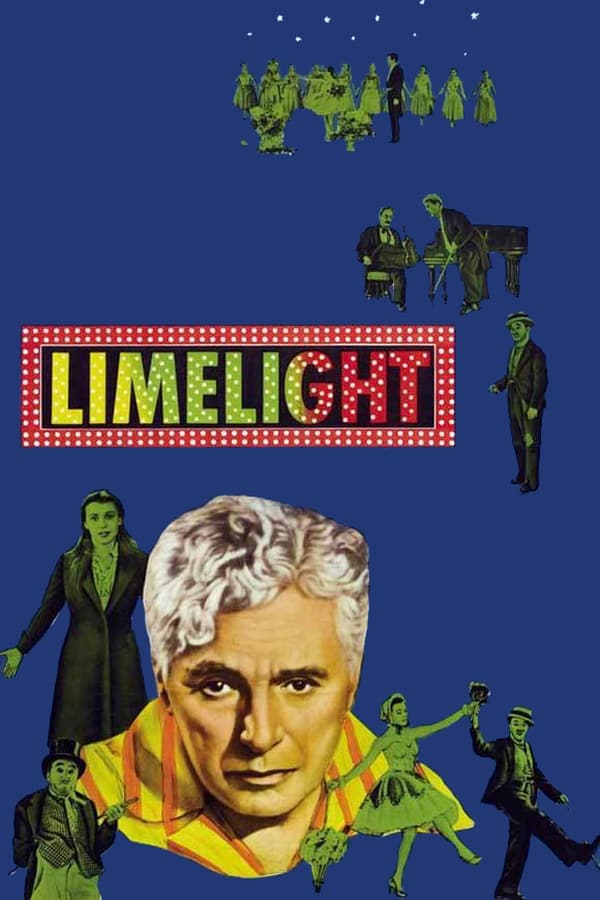
Though there are still 2 more films to see, Limelight is clearly Chaplin’s “swan song” and is often labeled as such. It is a very personal film for him, about a comedian, Calvero, whose best days are clearly far in the rearview mirror. A former star of the vaudeville stage, Calvero has let alcohol derail his life, and he hasn’t kept up with the changes in trends either. The beginning of the film finds him living in a rough boarding house, where he (almost accidentally) saves a woman from an attempted suicide one night. Terry is a young and beautiful woman, a trained ballet dancer, who suddenly has been beset by nerves and can no longer dance. Doctors assure Calvero that it is purely psychological, so he slowly nurses Terry back to health, both physically and mentally. During this course, she falls in love with him, though Calvero is obviously much older. When she is able to take the stage again, it is her turn to nurse him, boosting his confidence as only she can. Unfortunately, Calvero is a pragmatist if nothing else, and he doesn’t want cheers just because of who he is or his former reputation; he wants to really be funny again, and even we don’t know if he is capable of that again. It’s a heartwarming (and heartfelt) film about an entertainer struggling with self-doubt, wandering if time and the crowds have passed him by. Through Calvero, Chaplin takes it all in stride, with his typical humor and wit. There are some lagging moments, but overall, it’s a beautiful film. As an aside, there’s a great long cameo by “the other” greatest silent film comedian, Buster Keaton. ★★★★

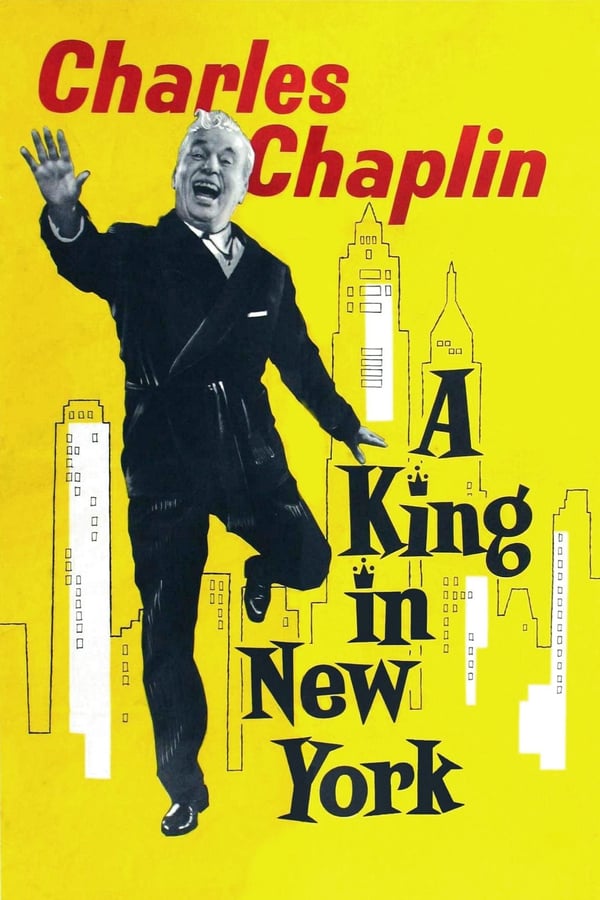
After his previous film, and tired of being pursued by the House of Un-American Activities Committee, Chaplin left USA for good and settled in Europe. His next film was made in London, and pokes at the system he just fled. A King in New York is so completely different than any other Chaplin film I’ve seen, and not in a good way. Chaplin plays a deposed king, Igor Shahdov, who’s barely escaped his home country on the eve of a revolution. After his former prime minister stole the entirety of the country’s wealth, Shahdov is broke, and scraping by as an immigrant in New York. He becomes enamored by a precocious and brilliant 10-year-old named Rupert (played by Chaplin’s own son Michael), who himself is under the watchful eye of the government because of his parents’ ties to communism. Through Rupert, Shahdov sees that not all is rosy in America, with McCarthyism poking into everyone’s private lives. In the 1950s, freedom isn’t quite as free as advertised. Many of Chaplin’s films have political undertones, but nothing is hiding in the shadows in this one; that didn’t turn me off per se, but the film just isn’t funny either. There’s some chuckles here and there as Shahdov is bemused by the rampant capitalism and consumerism in the USA, but light chuckles is all it elicited from me. It’s a very dull film unfortunately. ★

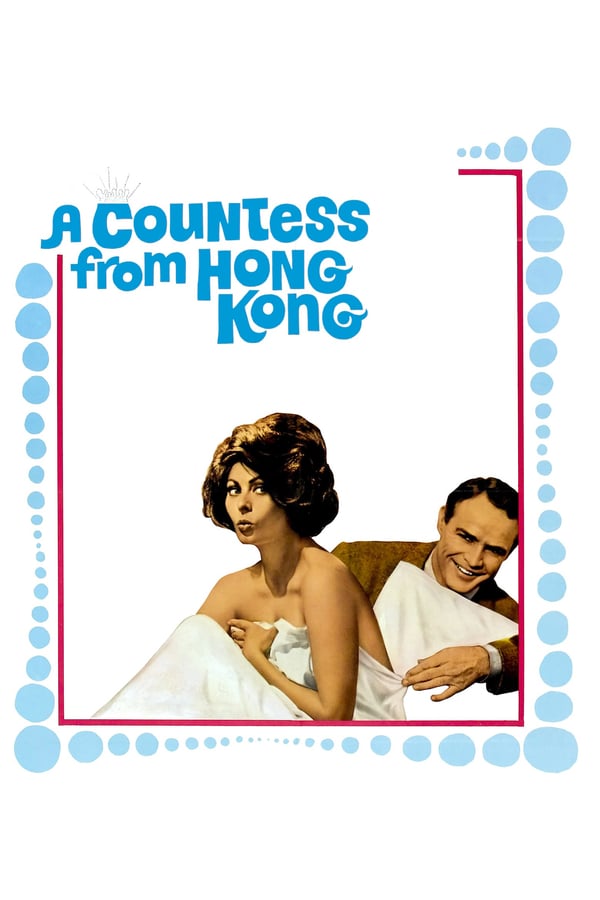
A Countess from Hong Kong was Chaplin’s last film, released in 1967 (and also his only color picture). As he often did, he was writer, director, and composer for the music, but for a change, he was not the star; in fact, he only has a cameo. The leads are non other than Marlon Brando and Sophia Loren. After the Russian Revolution and, later, World War II, many Russian countesses and baronesses are stranded in Hong Kong with no way to return home. One such is Natascha (Loren), who is desperate to get away from Hong Kong. She sneaks aboard a boat bound for America, and ends up hiding away in the closet of US ambassador Ogden (Brando). The times being what they are, and Ogden being who he is, he does not want a scandal, but Natascha has nowhere else to go. Ogden tries to keep her a secret as long as he can, but frequent guests to his rooms from friends, fellow emissaries, and the press provide for plenty of humorous antics. The film provides Chaplin’s customary wit, but honestly it’s not that great of a picture. Brando seems to brood through too much of the film, like he has more important things to do, but Loren does shine in all of her scenes. A very average picture, and unfortunately it does not meet the high water mark Chaplin set in his earlier career. ★★½

Quick takes on 5 films

The Girl with a Bracelet (La fille au bracelet) is not about a girl with a new piece of jewelry, but about her new ankle monitor. Arrested at 16, with her trial now commencing at 18, Lise is accused of murdering her best friend Flora. Flora was found dead of multiple stab wounds, after Lise had spent the night and (supposedly) left the next morning before Flora awoke. The problem is, there’s a preponderance of evidence against Lise, and nothing to support her cries of innocence. To make matters worse for her in the public eye, she seems cold and dispassionate during the proceedings. Even her parents seem to doubt her story. As the trial plays out, it becomes not just a trial of her guilt or innocence of murder, but also her sexually promiscuous lifestyle, with both Flora and a range of boys, something her parents were very much not aware of. This gives them even more doubt, and the viewer is left wondering with them and everyone else if Lise is as innocent as she says. The film is OK I guess. It provides more questions than answers, and since Lise is so cold, having shut herself off from what is going on, the acting comes off as dry and wooden. The ending left me unsatisfied, and I’m more patient than most. ★★

The Grizzlies is actually a decent sports film, and exactly what I was wanting when I watched the awful Safety a bit ago. This is a solid inspirational sports film, about a young teacher trying to make a difference. Russ, a history teacher, has taken a job in the far north of Canada in the remote village of Kugluktuk. He immediately is hit by the complete lack of drive by the high school students; life is rough, not only because of the harsh environment, but because the teenagers are expected to contribute to their families survivals through working and hunting. The stress has created highest suicide rate in the nation. Russ tries to motivate them through tough love, but he receives push back from the kids as well as their parents, who see him as just another white man from the south who doesn’t understand their ways. When Russ sees the teens staying up late and drinking together, because there’s nothing else to do, he decides to start a lacrosse team, just to keep them occupied. His experiment is a success, but he isn’t able to save everyone. Though movies like this have been done a hundred times, this one is based on a true story, and it is a fine, uplifting tale, with strong performances by the cast led by Russ (Ben Schnetzer, from The Book Thief and Pride). ★★★

Sylvie’s Love is a very nice love story, with an old-fashioned feel, and not just because it takes place in the 1950s and early 60s. Robert is a young, promising jazz saxophonist, walking down the street in New York one day when he spots Sylvie working in her dad’s record store. He is immediately smitten, and walks in to get a job there. They have instant chemistry, but Sylvie is unfortunately engaged. From a high society black American family, Sylvie’s parents know what it took to get to their station and Sylvie is expected to marry a promising man to keep them there. A poor musician doesn’t fit into that equation. The movie plays out over the next half decade or so, with Robert and Sylvie floating in and out of each other’s lives. This film is about as family friendly as a modern drama can be; except for one racy love scene, it’s an endearing love story. Outside of that scene and the color of the main actors’ skin, this film could have come out 70 years ago. I’m not a big fan of the ending, as it didn’t answer the main question Sylvie was struggling with throughout the picture, but it is still a nice film. The highlight is Tessa Thompson as Sylvie, who has proven time and again her abilities as an actress. ★★★½
Elizabeth is Missing is a well done made-for-tv movie about an elderly woman fighting dementia. Maud is old and still living on her own, with help from her daughter and a maid a couple times a week, but her memory is slipping. Maud gets help with notes taped around the house like “lock the door when you leave” and “Tuesday – garden with Elizabeth”. It is this last note that starts the film, as Maud heads over to her best friend’s house to help with her garden. While digging, Maud finds half of an old beauty compact, which reminds of her of a time 70 years prior, when a teenage Maud’s older sister Sukey went missing. Maud and Elizabeth set a date to meet again, but when it comes, Elizabeth doesn’t show up. This leads to Maud trying to find out what happened to her friend, while also reliving moments surrounding Sukey’s sudden disappearance all those years ago. Unfortunately, Maud’s disease begins progressing quickly, leaving her (and the viewer) more and more disoriented as the film goes along. It’s a nice mystery in both time frames, and Glenda Jackson’s performance as a frustrated Maud is top-notch, which is expected from a woman with Oscars, Emmy’s, Golden Globes, and Tony’s under her belt. The ending is a bit over-the-top as is often the case for TV dramas, but the film as a whole is very touching and emotional. ★★★½

Buoyancy is an eye opening film about the very real problem of modern day slavery in the waters off Thailand. Chakra is a 14-year-old who is tired of toiling for his parents in a poor farming village in Cambodia. Lured by the promise of wealth by working in a factory in nearby Bangkok, Thailand, Chakra abruptly leaves his family and joins a human smuggler who gets people across the border for a $500 fee. Without money, Chakra is told he’ll have to work to pay off his fee, but the world awaiting him is anything but what he envisioned. Instead of a factory, Chakra finds himself on a fishing boat, under the direction of a cruel master who has no qualms about killing “workers” who aren’t pulling their weight. Chakra’s only friend is an older man who came across the border with him, hoping for money to support his family back in Cambodia. As Chakra gets used to the hard life on the boat, he is forced to become a man and meet cruelty with cruelty. The unfortunate fact of the film is that men and boys are forced into labor in the South China Sea every day, and the film is stark in its portrayal. Fantastic cinematography and better-than-expected acting (though maybe a bit stereotypical) create a very tangible, striking picture. ★★★★

Quick takes on 5 films

I must have watched a different Ma Rainey’s Black Bottom than everyone else. I don’t get all the acclaim. Based on a play (and it tells, as nearly all of it takes place on a single stage), it tells the story of a day when Ma Rainey, a famous 20’s blues singer from the south, is in Chicago to record an album. The story is of her and her band, their stories and past, as told in discussion amongst them. Like a lot of plays, not a lot of “action” in the story, and it is almost all dialogue. And I just wasn’t picking up what they were laying down. Yes, the performances by Viola Davis as Ma Rainey and the late Chadwick Boseman as her trumpeter Levee Green (in his last performance) are good, and exceptional in Boseman’s case (a sad reminder of what the world lost; should get serious consideration for a posthumous Oscar), but they can’t save the rather mundane, its-been-done-before story. There’s a lot of heartbreaking stories of what the black men and women were going through in their lives and growing up in the south, but it’s been done better in other films, and its depiction of white appropriation of the labor of black workers, and the men’s frustration at the system, is a bit heavy handed. It’s good, but not great. ★★★

Like the previous movie, Alone doesn’t bring anything new, but at least it is more fun. It is the tried-and-true story of a woman, alone on a cross country drive, who is kidnapped by a ruthless would-be-rapist, but manages to escape and (spoiler alert) make it out alive. That’s it in a nutshell. This is a super low budget film with a cast of exactly 3 (and only one recognizable face, the doctor from Silence of the Lambs all those years ago). Also has every cliche you’d expect from this genre; even the bad guy has those 80s frame glasses and a mustache right out of the creepster child molester handbook. But there’s a few good, exciting moments, and the female lead, Jules Willcox, while not having to show a wide range of emotions, is believable as the damsel in distress. And it was way better than that other Alone movie from this year. ★★★

I had to ignore the scathing reviews and see The Midnight Sky for myself. I’m a nut for slow-paced, dramatic sci-fi, and who doesn’t love George Clooney and Felicity Jones? After a cryptic title card telling the viewer that it is “3 weeks after the event,” we are introduced to Augustine Lofthouse, a scientist whose hypothesis about a life-sustaining environment on a moon circling Jupiter, named K23, has sent an exploratory mission there. Unfortunately this “event” on Earth is catastrophic, though we don’t know the full extent until much later in the film. All we know is everyone is evacuating very quickly, leaving just Augustine at a remote station in the Arctic Circle by himself, with a mission to make contact with the returning shuttle from their K23 mission. Unfortunately he isn’t by himself, as he finds a little girl who was inadvertently left behind. While Augustine and Iris continue to try to make contact with the space ship coming home, we slowly learn about what took place on Earth, as well as get to know those returning astronauts. Unfortunately the movie’s just not very engaging. The child accompanying Augustine is supposed to add brevity, but ends up just killing the supposed intensity of their situation, and for the crew on the returning K23 shuttle mission, there’s too much filler, which shows off the pretty special effects but does nothing for the story. And there’s no deep introspection here; Ad Astra or 2001 it ain’t. Very middling, unremarkable sci-fi flick. ★★½

I could just be letting my complete jonesing for a super hero flick cloud my judgement, but I absolutely loved Wonder Woman 1984. The sequel to the (surprise?) hit a couple years ago, and released on Christmas Day, this film brings Diana Prince from World War I up to the 80s. Currently working at the Smithsonian, her department identifies items from antiquity, and the newest acquisition is the Dreamstone. This item will grant 1 wish to anyone holding it, but at a cost. Not knowing this, there are some repercussions for the first 2 wishers. Diana longingly wishes for Steve Trevor (Chris Pine), her love that died at the end of the first film. Diana’s bookish coworker Barbara (Kristen Wiig), not knowing Diana is Wonder Woman but fully aware that she’s a badass strong woman, wishes that she was as beautiful and powerful as Diana. Both get their wishes, as Steve shows up with no memories past his death, and Barbara sheds her baggy sweaters for form fitting dresses, while also getting physically stronger. Unfortunately someone is aware of the power of the Dreamstone: businessman Maxwell Lord has been seeking the item for years, and when he gets his hands on it, he starts using it to set himself up as the most powerful person on the planet. The price paid for the granted wishes starts to take its toll, as Diana starts to lose her powers at the worst possible time. Great action and a story just strong enough, I enjoyed it start to finish. Probably my favorite of the DC film series yet. ★★★★½

The other film released on Christmas Day for streaming audiences is Pixar’s latest, Soul. Joe Gardner is a jazz pianist, and like a lot of musicians, he’s been teaching in the school system to get a paycheck, but his life-long goal has always been to play music for a living. After years of struggling, he’s finally had a chance to make a name for himself when a former student and professional musician calls him to sit in on a set with a big name saxophonist. Unfortunately for Joe, he falls into an open manhole cover in busy New York the day of the gig, and dies. Refusing to take the stairway to the Great Beyond, he instead finds himself at the Great Before, where new souls are given their personalities before heading to Earth. Trying to find a way to con his way back to his body in time for the gig that night, he becomes a mentor to a soul who’s never found their “spark” to go to Earth, despite being mentored by some of the great artists, philosophers, and geniuses in the history of the world. Their connection takes them back to Earth, but not in a way they would have planned. Like most Pixar movies, there’s plenty for kids and adults to enjoy. It is definitely family oriented, but many of the jokes will be way over young ones’ heads. Charming, heartwarming, and a solid message about what’s important in life, it’s the great family movie of the year. ★★★★½

Quick takes on 5 Tarkovsky films

One director I’ve been wanting to see for quite some time is Russian Andrei Tarkovsky. I’ve read how his films can be very dreamlike or obtuse, and I tend to like pictures like that, with a lot of imagery. We’ll see how this goes!

Ivan’s Childhood was his first picture. It is about a young Russian boy named Ivan, who can’t be more than 10 or 12 years old, during World War II. He’s captured by Russian troops at the front with Germany. Lieutenant Galtsev tries to interrogate him to find out what he’s doing there, but Ivan won’t answer questions and says to contact “Number 51 at HQ” for orders. When Galtsev makes the call, he gets in touch with Captain Kholin. Kholin brings them all together and explains that Ivan is spying on the Germans across the front; he’s small enough to get in and out without getting caught (older Russian soldiers have been caught, and you can spot their bodies by the river with German signs hung around their necks as warnings). Kholin wants to end Ivan’s service and send him to military school, but Ivan wants to continue his own personal war, in vengeance with Germany for killing his mom and family. Privately, Kholin tells Gatlsev that Ivan has seen more tragedy than many grizzled veterans, and Tarkovsky does an amazing job of sharing his inner turmoil with us over the course of the film. This is a powerful picture, with amazing cinematography. When I finished it, I had to look up when exactly it was made, and it was 1962. I almost don’t believe that; this film doesn’t feel dated at all, and in fact, it could just as easily have been released last year and been viewed as a modern art film. Amazing movie, and we’re off to a good start! ★★★★★

Andrei Rublev is loosely based on the life of Rublev, a famous painter of Christian frescos in 15th century Russia. The movie depicts a half dozen or so vignettes, some seemingly unrelated at first, and deal heavily with Rublev trying to stay true to his moral code and faith in God. Already gaining a name for himself when the movie begins, Rublev tries to control his pride of his work and stay humble, sometimes with the help of those around him, as fellow monk Kirill is extremely jealous and tries undermine Rublev. A few of the scenes show Rublev’s striving towards a Godly live, such as when he encounters a pagan ritual one night, with naked commoners dancing in the forest and swimming in the river. There are also plenty of hardships along the way, as in when Rublev’s party is attacked by a local lord when they don’t do as he asks, and several have their eyes put out. Like in the previous film, the camera work here is incredible for 1966. There’s (I think) a lot of symbolism that I didn’t always pick up on my first viewing, but I’d be willing to go back and watch it again sometime down the line. Though at 3+ hours long, it won’t be too soon! It’s a rich and rewarding film, a bit Dostoevsky-like in its sermon-ish approach, but that’s not a bad thing. The only real issue I had was there’s some graphic violence during the raiding of a village, and especially some animal cruelty scenes (apparently this garnered a log of critique upon its release). The film wraps by switching from the black-and-white it has been all along, to color, to show off Rublev’s actual work, and it is beautiful indeed. The film’s depiction of religion, the Tatars invasions, and general poor views of authoritative figures got the film censored in the Soviet Union, but internationally, critics clambered for it after the success of Tarkovsky’s first picture, leading Russia to reluctantly release it. ★★★★

Tarkovsky’s next film was Solaris in 1972, based on a book by Polish author Stanisław Lem (which was also the source of Steven Soderbergh’s 2002 version starring George Clooney). Though it mostly takes place on a space station, Solaris is less science fiction and more introspection, not too dissimilar in feel from Kubrick’s famous 2001, which preceded it by just 4 years. In the film, a psychologist, Kelvin, is sent to a remote space station orbiting the ocean world of Solaris. The station has been in orbit for decades while the crew continues to dwindle over time, many having returned to Earth over the years, leaving just 3 on board currently. Before leaving, Kelvin spends a day with his dad, as well as interviewing a former pilot on Solaris, Burton, who had returned many years ago after suffering from hallucinations on his assignment. Kelvin goes to the station, and immediately upon arriving, is struck by its poor condition; it seems no one is doing maintenance or upkeep, and it is slowing falling apart. On his first day there, he learns that the one crew member he knew, Gibarian, has just committed suicide, and the 2 remaining members, Snaut and Sartorius, are withdrawn and secretive. There are also fleeting glimpses of others on the station, who Snaut and Sartorius seem to ignore. When Kelvin sleeps that first night, he is awakened by a woman in his room. The woman is Hari, Kelvin’s former wife, which is obviously impossible. She doesn’t know how she got there, and is paralyzed with fear whenever Kelvin leaves her presence. Snaut finally comes clean, and says that Hari, and the others on the ship, are called “guests,” and they are people created from the crew members’ memories by the planet. More than just visions though, they seem to be very real, though they cannot die, healing very quickly from injury and even returning to life if killed. Yes, this creates a tight, thriller-like atmosphere around the halfway point of the film, but the movie doesn’t delve too much in the science-y “how come?” questions, instead focusing on the ramifications of having loved ones created from our memories. Things they consider is what makes us human, if not our thoughts and emotions, and also looks at the ideas of happiness, identity, and of course, love. Pretty deep stuff, but glorious in its depiction. I mentioned 2001 earlier, and while both offer deeper meanings for life, 2001 is cold by comparison; Solaris is full of emotion and ache. For me, this was the kind of movie that, as soon as it was over, I wanted to start it back from the beginning again. ★★★★★

Next up is 1975’s Mirror. I went into this one with a bit of trepidation, as I’ve read things like “frustratingly enigmatic” and “stream of consciousness.” If you’ve been reading my blog for awhile, you’ll know I generally dislike SoC in writing (for example, NOT a fan of Miller’s Tropic of Cancer). But for whatever reason, this film stuck with me. There is no real narrative to follow, but that doesn’t mean there isn’t a story. It is told by an aging poet named Alexei, possibly on his deathbed, as he looks back at key moments in his life. In particular, we see spots of him as a child living on a farm in rural Russia with his parents, later as a teen with a single mother after the dad left, and then as an adult with a divorced wife and child of his own. The movie jumps around between these timelines, and also interspersed throughout are dreams or images he is having. Though non-linear, the scenes definitely have a flow, and there are some beautiful, transcendental kind of moments here. Tarkovsky paints the events in the past as definitely from memory and not necessarily “as they happened,” for instance, he uses the same actress to play both Alexei’s wife and mom. He admits to his ex-wife that when he pictures his mom as a younger person, he sees the wife’s face. I’ll leave interpretation of that up to the licensed psychologists, but what a great film. I feel like it’s a puzzle that needs to be put together, but I do worry that if I were to watch it a dozen times, I wouldn’t get any closer to enlightenment. I’m giving it 3 1/2 stars, which is a lot higher than I would normally give a film of this type, and if I watched it again, would probably rate higher. ★★★½

Alright Andrei, you finally got me. I could not get into Stalker, supposedly his masterpiece, but even I have my limits. I love the premise: in some far-future dystopian time, there is a cordoned off area known as The Zone. We learn as the film progresses that this area had some calamity visit a couple decades ago, whether that be a war, alien invasion, or something else. Whatever happened has left it completely unlivable, with abandoned buildings and the remnants of war (high caliber guns, tanks, etc.) strewn about, all being overtaken by vegetation. Yet people enter, because in the middle of the The Zone is The Room, where supposedly anyone who enters has their desires fulfilled. A group of people (Stalkers) knowledgeable about the changing dangers of The Zone lead would-be wealth-seekers and people without hope through The Zone and to The Room. Sounds great doesn’t it? Unfortunately this film is slower than slow and will test even the hardiest of patiences. The plot revolves around the lead, simply called Stalker, leading two strangers, Writer and Professor, into The Zone, and the movie is mostly their dialogue about why people seek out The Room, and their motives. The visual landscape is great. Shot on location at abandoned factories and power plants, it has a forgotten world kind of feel, strangely foreboding as it was filmed 7 years prior to the Chernobyl disaster which would create its own abandoned Exclusion Zone. But those views were the best part of the film for me. Stalker would be Tarkovsky’s final Soviet film; he would leave the country to do a film in Italy in the early 1980’s, and another afterwards in Sweden, and never returned. I hope to visit his last 2 films before too long. ★½

Quick takes on 5 Almodóvar films

Awhile back I saw Pedro Almodóvar’s latest, Pain and Glory, and absolutely loved it. Having not seen any of his other films, I’m going back to some of his earlier stuff, starting with 1986’s Matador. It’s about a former celebrated matador named Diego, now retired after a goring has left him with a limp in one leg, and he runs a bullfighting school. On the side, he’s a serial killer. Stay with me for a second. One of his students is Angel (a young Antonio Banderas), who’s a bit of a mama’s boy, living under her strict religious eye. When his manhood is questioned by Diego, Angel tries to prove his worth by raping Diego’s young, hot model girlfriend Eva. The attempted rape doesn’t go over so well as Angel ejaculates early before penetration. Wracked with guilt though, he goes to turn himself in to the police station. When Eva laughs it off and refuses to press charges, Angel instead admits to a couple unsolved murders (of Diego’s doing). Stepping in to defend Angel is another beauty, a sexy lawyer named Maria. Unbeknownst to all, Maria is also a serial killer, and her motives become clear later on in the film. It’s a wild ride, and most of it is good. As the police and our two killers circle each other, there are some great moments, however, the film is dragged down by some weird deus ex machina stuff in the end. There’s also lots of gratuitous sex scenes, which do nothing to advance the plot or develop our characters, and seem to have been thrown in by a young director trying to push the envelope. Still, there’s enough here to see where Almodóvar could grow from. ★★½

Women on the Verge of a Nervous Breakdown is incredible. A true screwball comedy with a dark undertone, it follows a woman named Pepa who’s just been dumped by her older boyfriend Ivan. Pepa and Ivan are both TV actors, and Ivan’s been having a long affair with Pepa, against his wife Lucia. The movie takes place over 2 days, as Pepa tries to track Ivan down, apparently to give him a piece of her mind, but he continually evades her. Meanwhile, a host of zany characters parade through, in a series of amazing coincidences. A wild cab driver who only plays mambo music and offers reading material to his fares; Ivan’s stuttering son Carlos and his domineering fiancée Marisa; and Pepa’s friend Candela, who’s become mixed up white Shiite terrorists intent on hijacking a flight to Stockholm. And Ivan’s crazy wife Lucia. And some bumbling cops. The layers are on this film just keep going, and it all weaves together deliciously well. I laughed out loud throughout. The movie was a smashing success, putting Almodóvar on the international stage. It was nominated for Best Foreign Language Film at the Oscars, and won 5 Goya Awards (Spain’s version of the Oscar). ★★★★★

Tie Me Up! Tie Me Down! stars Antonio Banderas, and was his breakout role. Seen in both of the films reviewed above, as well as 2 other earlier Almodóvar films, this one brought Banderas international acclaim. He plays Ricky, a young man who has just been let go from a mental institution, partly due to his sexual prowess with the female director and nurses. Unfortunately he is anything but mentally stable, and has a John Hinckley Jr thing for Marina, a former porn star turned actress. Once free, Ricky heads straight for Marina’s latest movie set. He follows her home, where he forces himself into her room and takes her hostage. Instead of immediately assaulting her, he starts telling her that he is only there to get her to fall in love with him, so they can get married and raise a family. He only roughs her up a bit when she tries to scream, but otherwise fulfills her every need, while evading her worried sister Lola, who keeps coming around to check on the supposedly missing Marina. Almodóvar’s take on Stockholm syndrome, this movie starts out great, with laughs, intrigue, and thrills, but it dies in the second half. Banderas is fantastic as the likable bad guy, and Victoria Abril as Marina shows a fantastic range, but the movie is awfully sexist looking back on it in as a view from 2020. ★★★

All About My Mother returns to a woman as the central character, and again Almodóvar hits it out of the park. Manuela is a nurse and single mother to her 17-year-old son Esteban. Esteban has always been curious about his father, who died before he was born, but Manuela has never told Esteban about him. She promises to later that night, the day of Esteban’s birthday, but he is tragically killed in a car accident before Manuela can. Afterwards, we learn that the father is alive, a secret Manuela kept all of her life. She goes to find him in Barcelona, to give him the news. She isn’t able to find him, but does find old and new friends, and is able to be a mother to them. Agrado is a transgender prostitute who gets beaten up in her work; Rosa is a nun in a predicament, with a baby on the way after having gotten pregnant from non other than Manuela’s ex; and Huma is a talented actress with codependency issues with her partner. Manuela nurses them all back to health in their own ways, while grieving through the loss of Esteban. There’s some brevity here and there, but this film is a straight forward drama, and a damn good one too. All of the women give top-notch performances, lead by Cecilia Roth as Manuela, Marisa Paredes as Huma, and Penélope Cruz as Rosa. A story about caring, forgiveness, acceptance, growing as a human being, and moving on from heartache and loss. ★★★★½

Talk to Her, from 2002, is a beautiful, almost lyrical film, which is fitting as it revolves around a dancer, though one that we never see perform. The movie opens at a performance where two men, strangers, are seated next to each other. Benigno is a nurse who works at a coma ward, and particularly cares for a young dancer named Alicia, who’s been in a coma for a couple years. He talks to her, reads to her, tells her about movies he’s seen and dance performances he’s attended. The man seated next to Benigno that night is Marco, who shortly thereafter starts dating a female matador named Lydia. A couple months later, Lydia is gored badly and also ends up in a coma, in the same ward as Alicia. Benigno recognizes Marco from that one evening, and the two form a friendship. We learn in flashback, as Benigno relates his story to Marco, that he was obsessed with Alicia before the car accident which put her in the coma, watching her practice at the dance studio across from his apartment. This obsession lands Benigno in major trouble in the final third of the film, but just when I thought the picture was running off the rails, it is brought back beautifully before the end. It’s a touching film about love and friendship, and I loved the way it unfolded for the viewer. ★★★★★

Quick takes on 5 Éric Rohmer films

Éric Rohmer was an influential director who came up late in the French New Wave. He first gained attention for his Six Moral Tales, a series of films about relationships. Four of those are reviewed below (the first 2 were shorter films, which I watched but did not write about), in addition to his heralded film The Green Ray.

La collectionneuse (The Collector) was released in 1967. It is about a trio of people vacationing at a large beach estate on the French Riveria. Adrien is there to relax, having seen his fiancée leave for a prolonged trip to London. Adrien and his friend Daniel are supposed to have the place to themselves, but find that they have an unwanted third, Haydée. Haydée is just hanging around, after having slept with the house’s owner before he left. Adrien wants to enjoy morning swims in the sea, going to bed early, and no drama, but the young and sexy Haydée has a different man over every night and keeps the household up with her amorous noises. Adrien can’t help himself but be attracted to her, but refuses to give in to his desires, and instead devises a set of tests to make sure Haydée really likes him, or if she just wants to add him to her “collection” of lovers. He gets Daniel to sleep with her, and later, an art collector and business partner of Adrien’s as well. I think the character of Haydée was done very well; Adrien keeps trying to paint her as a slut, but if he would just stop and listen, he would see that she is trying to seek a partner in life just like everyone else, in her own way of course. Adrien’s narcissistic attitude is tough to bear at times, especially at the end, but it all comes out OK, for everyone involved. Though was this on purpose, or merely by chance? A very well written picture. ★★★½

I really shouldn’t have liked Ma nuit chez Maud (My Night at Maud’s). I’m a “story” kind of man and love a good plot I can sink my teeth into; this film has none of that. But what it does have is an extremely engaging delve into the complexities of a man and what is important to him in finding a partner. Jean-Louis is a loner with few (any?) close friends, but he seems to know what he wants in a life partner, if he can only find her. While not especially devout, he’s attending Catholic mass one day when he is smitten by a pretty blonde woman, and tries to follow her afterwards until he loses her in traffic. Later that day, he runs into an old high school buddy, Vidal, and is roped into going with him to a girl’s apartment to hang out. The girl is the epynomous Maud, and she spins Jean-Louis’s head right around. She challenges his way of thinking about religion and moral beliefs vs finding love, fate vs chance, etc. She’s everything that he shouldn’t want in a partner, but her sexual allure is more than Jean-Louis can take. He ends up staying the night (chastely sleeping at the edge of the bed, as far away from Maud as he can be, because she delights in stating she can only sleep nude). The next day, he by chance runs into the blonde from church again, and so his adventures continue. Virtually no story to follow, or at least, not one that can’t be told in 2 sentences, but the film is more about the philosphical discussions that take place between Jean-Louis and Maud on that long night, and their repercussions for his life moving forward. As I said, I shouldn’t have enjoyed this one, but I did. Incredible film, just have the patience to sit back and dig into the enlightening conversations. ★★★★

Le Genou de Claire (Claire’s Knee) is very similar to My Night at Maud’s, in that the dialogue between two central characters carry most of the film. In this one, Jerome is vacationing at Lake Annecy when he runs into an old friend, Aurora, who is a writer. Aurora is staying at another friend’s, Madame Walter’s, house, and she invites Jerome over. He meets Madame Walter and her 16-year-old daughter Laura, and the perceptive Aurora sees that Laura is instantly smitten by the older, rugged Jerome. As such, Aurora proposes making Jerome her guinea pig in an experiment, to see if Laura will profess her love if egged on. Jerome is hesitant at first, not only because of Laura’s age, but because he is engaged to be married, but he relents and has fun with it. Laura does take the bait eventually, though nothing untoward happens, but shortly thereafter, the eponymous Claire (and her infamous knee) come into the picture. Claire is Laura’s step-sister from their parents’ previous marriage, and whereas Laura is a bit awkward and gangly, Laura oozes sex appeal. Jerome is enraptured by her long legs, and wants to shift his game from Laura to Claire, but Claire isn’t interested. Maybe because I just saw the previous film and I wasn’t ready for a similar one right away, I didn’t get into this film as much. Still interesting, but it hasn’t aged well, what with the whole grooming young girls thing, which was very off-putting. And yet again, the male lead is very narcissistic, but at least this time, Aurora is there it knock him down a peg. ★★★

L’Amour l’après-midi (literally Love in the Afternoon, but also called Chloe in the Afternoon) is the best one yet. In this one, Frédéric is a busy worker at day and a homebody at night, deeply in love with his wife Hélène, with a child at home and another on the way. The idyllic life, and Frédéric is happy with it, until Chloe shows up unexpectedly one day. Back in his college days, Frédéric and Chloe ran in the same circle of friends, and Chloe was dating one of Frédéric’s good friends (and there are whispers of the poor guy ending up in a very bad emotional state after the break-up). While Hélène is fairly boring (supposedly one of the things Frédéric likes about her), Chloe is strong willed, sexy, and commanding. Frédéric’s head starts spinning with the possibilities, as the two start hanging out in the afternoons during his lunch breaks. Unlike the other films, which revolve around the male as the dominant figure, Chloe is most certainly in control of this relationship. She keeps leading Frédéric along, tantalizing him and getting him to come around to the idea of an actual affair and not just flirting. The final decision is Frédéric’s to make, but does he? It’s a great film. Though Hélène’s character is unfortunately very one-dimensional, Chloe and Frédéric are fantastic, and the movie offers a lot of discussion about faithfulness in marriage and the definition of true love. ★★★★½

The final film today came in another series Rohmer did, called Comedies and Proverbs. Unfortunately it seems I saved the worst for last. Le Rayon vert (The Green Ray) is a complete and utter snoozefest. It’s about a woman, Delphine, who’s just getting over a break-up and had a girls’ vacation planned with a friend, but the friend drops her to go hang with her new boyfriend, and Delphine is left alone in Paris. The film follows her as she goes from place to place seeking something to do, but for Delphine, the old adage of “wherever you go, there you are” holds very true. Delphine goes with a group to a villa, but she’s the only single there with a bunch of couples, and feels left out. She next heads to the Alps where her ex has a ski house that she’s been allowed to use, but she only stays a day since she doesn’t know anyone well. Finally, Delphine goes to the beach, and does make a friend with a Swedish woman, but the new girl is there to party and hook up, and Delphine wants something more lasting. The film is 90 minutes of people watching, and if I wanted to do that, I could go hang at a park and do it myself. There is a cute little ending relating to the Green Ray, referenced as a book written by Jules Verne, but it doesn’t make up for the rest of the picture. ★

Quick takes on 5 films

The Swerve is one of those hidden gems, with a relatively unknown cast, a first-time director, a tiny studio, and which took a couple years to finally find a path to release. Well worth it! I loved this film, about a woman, Holly (new-to-me Azura Skye) who is suffering from severe insomnia. She’s the modern-day working mom, a teacher, with two teenage boys (one involved in school activities) and a husband who works long hours while seeking a promotion at the local grocery store. This busy home and work life keep Holly very busy, so when she goes a few nights without sleep, things snowball quickly. I think the whole film only takes a week or so, but so much happens in that week! We learn about Holly’s strained relationship with her parents and younger sister, the “black sheep” of the family, and as Holly’s sleepless nights pile up, she begins to hallucinate. What’s great about the picture is that, like Holly, we as viewers don’t know what’s real and what isn’t. Skye’s character Holly is completely believable as a woman descending into almost-madness, in one of the better performances I’ve seen in awhile in a “newcomer” (though the actress has been around awhile apparently). Her husband Rob and sister Claudia are equally fantastic. I love finding movies like this. ★★★★

Major Arcana is another solid film made on a shoestring budget. It’s about a man (not sure I even caught his name?) who returns to his parents home after the death of his father. You get the impression that he left because of his mom, and his relationship with her is still strained. In fact, the dad left all of his land (52 acres) and house to the son, along with a sum of money, leaving his widow bitter. Our main character has been away for 4 years, doing odd jobs up the west coast and Canada, and learning how to work with his hands. More than anything, he’s been away to straighten out his life, and returns home thinner, sober, and more at peace than when he left. As part of his grieving/recovery process, he starts building a cabin out in the woods, felling the trees, cutting the boards, all by himself. Unfortunately, in this tiny backwater town, his old demons try to lure him back to his previous lifestyle, mostly in the guise of his ex-high school girlfriend. This is a quiet, somber film, with subtle but profound acting by lead Ujon Tokarski. The movie’s pace will test some viewers, but it is well worth the trip as a character study about a man moving past addiction. ★★★½

My run on small indy film hits comes crashing down to earth in Make Up, the first feature film from director Claire Oakley. There’s some great moments in here, but great moments don’t always come together to complete a great (or even good) movie. 18-year-old Ruth has just joined her boyfriend in working at a holiday park. It is the offseason, so the workers are tasked with maintenance on the empty park, doing mountains of laundry, and cleaning the campers where visitors would stay. Ruth and her boyfriend Tom share one such camper, and the very first day there, Ruth starts to think something’s up with Tom. She finds some long, bright red hairs in with his clothes, and what looks like the impression of a woman’s kiss on his mirror. Over the course of a few days, she also begins to hear strange sounds under her camper and out in the wind outside. She makes a few friends, notably the feisty Jade, who has a bad reputation among the workers, and Ruth also starts to have hallucinations (or does she?). The movie’s got a great, creepy vibe to it for a good chunk of the picture, but it flips on a dime in the end, and not in a good way. The finale isn’t completely out of left field, but let’s just say, it’s not great. It’s the first feature film from director Claire Oakley, and it has plenty to build on;  some of the camerawork and overall feel is quite good. Here’s to future endeavors. ★½

I’m really torn on I’m Your Woman, a new film starring Rachel Brosnahan. She stars a woman named Jean, who knows her husband Eddie is involved in organized crime, but no other details. Unable to have a baby to this point, Eddie shows up with a baby one day, to make Jean happy. That’s the last happy day for awhile, because shortly after, a man named Cal mysteriously arrives and tells Jean she has to leave, suddenly and without packing, taking only the baby and some cash around the house. Eddie did something to get the family into trouble, and the loyal Cal is trying to help Jean get away safely. At first hiding in a suburb until her cover is blown, and then at a secluded cabin, Jean unravels the mystery of what Eddie got himself into, and she has to become more than just a trophy wife. Much like director Julia Hart’s last picture, Fast Color, this movie plods along for a long time. It has a cool 70’s vibe and powerful music, which makes you think something big is just around the corner, but outside of a couple short scenes here and there, nothing really does until the last 20 minutes. Yes, that finale is great, and like Fast Color, I like giving the powerful lead to a woman, against the grain for this genre, but what a slow journey to get there. Brosnahan is great, and it’s worth watching for her alone. ★★½

Safety, to put it bluntly, straight up sucks. I’m a sucker for feel-good sports movies, but this movie, currently on Disney+, is just a poor made-for-tv flick, and is more Hannah Montana and The Suite Life than McFarland USA or Miracle. It’s a biographical film about a college freshman and Clemson football recruit, Ray, who struggles in his first year of school, because of problems at home. He’s a smart kid, but with the busy practice schedule of a division 1 football team and a full course load, he’s barely getting by. And that is before he is forced to sneak his 10 year old little brother on campus for a month, because his mom is in a rehabilitation program. That’s the first half of the film, at which point I checked out. The acting is rough, the dialogue worse, and the jokes are as hokey as they can get. Strictly kids fare, and even for that younger audience, there’s better stuff out there. ½

Quick takes on 5 films

We know fear can be contagious in a group. What if a person was certain they would die the next day, and that fear passed on to every person they discussed this with? That is the premise behind She Dies Tomorrow. Amy is a single woman and a recovering alcoholic, and she is absolutely positive that today is her last day on this planet. As she drinks the night away, she talks of her fear to her friend Jane, who tells her brother Jason, who tells his wife Susan, and so on and so on. Each person becomes convinced that they too will die the next day. The film becomes a story of people’s reactions to irrational fear, and what they do with that fear. Honestly it’s a silly movie. I guess it’s a psychological thriller, but I wasn’t thrilled. The acting outside of Amy (Kate Lyn Sheil) and Jane (Jane Adams) is pretty rough, and the characters are unbelievable. The film is super low budget, and while not a bad thing when there’s a good story and strong characters, this movie just feels amateurish. ★

The only thing good about The Broken Hearts Gallery is lead actress Geraldine Viswanathan (from Bad Education and Hala) (and Broadway legend Bernadette Peters, in a minor role). She’s fun, funny, charming, and the camera loves her. Everything else in this picture is a bore. Viswanathan plays Lucy, a woman who has a hard time moving on from past relationships. She keeps little mementos from all of her ex-boyfriends, from neckties to rubber duckies to shoe laces to nail clippings. When she loses her latest boyfriend and job in the same night, in spectacular social media viral fashion, she stumbles upon an idea: open her own gallery dedicated to the objects people need to finally cast off to emotionally move on from their ex’s. Her gallery space is on the balcony of a new friend’s, Nick’s, renovation hotel project. He seems to stay away from relationships with anyone, devoted to his dream of opening the hotel. Yep, you can see where this is going. Lucy is a hoot, but this is about as predictable as it gets, and unfortunately it doesn’t set itself apart from other films of the rom-com genre. ★½

In Out Stealing Horses, Trond (the incomparable Stellan Skarsgård) has just moved to an isolated house in rural Norway, content to spend time by himself after his wife died 3 years ago. One night he meets his new neighbor, Lars. As soon as Trond hears the name, he becomes troubled, and later that night as Trond lays in bed, we find out why. In flashback, we see Trond as a 15 year old with his dad at a cabin along the Norway/Sweden border. His dad apparently comes out here every year, but this summer, Trond is old enough to join for some father-son time, and the two do some logging. Trond befriends Jon, a boy who lives at a nearby farm. One day, Jon comes home from hunting and leaves his gun out, and Jon’s younger brother kills the youngest brother. The little boy who killed his brother: Lars. In present day, Trond immediately knows that the Lars he just met is one and the same; despite it being a common name in their country, he knows it in his guts. The rest of the film plays out as Trond and Lars carefully poke at each other, as there is obviously some secret that they prefer to keep buried, and in the past, we see how the rest of that summer went for 15 year-old-Trond and his dad. With World War II raging to the south, and jealousy and marital affairs raging in the woods, this is a very good, borderline great, foreign film drama. You might not like it if you want all the little storylines tied up in pretty bows by the end; the film feels very real and real life is not so tidy. But there are some beautiful moments of tenderness and heartache. Skarsgård is great, though the role is a bit heavy, and the character seems like he still hasn’t moved on from events that happened decades ago, which makes the current-day timeline a bit unbelievable at times. However, the story in the past is fantastic, and it does all blend well, with suspense built properly between the timelines. ★★★½

The Short History of the Long Road is an apt title for this film, which seems to go nowhere fast. It stars Sabrina Carpenter (in her first leading role) as Nola, a teenager who’s lived her life out of her dad’s van. Homeschooled and sheltered, she’s spent her life traveling from point A to point B, and they’ve never settled down anywhere. When her dad dies suddenly of a stroke, Nola gets behind the wheel with no seeming destination. It isn’t too long before the old van breaks down, but luckily it is close enough to a kindly mechanic, who allows Nola to work off what she owes for parts and labor. She then goes on a trek to find her mom, the woman who seemingly walked out on Nola just after she was born. It leads to some answers, though maybe not what Nola wanted to find. The film’s premise isn’t bad, though it’s been done before (and better), but, and this is as delicate as I can be, Carpenter just isn’t very good. We see 90 minutes of the same 3 facial expressions, and whether it is her acting or the paper-thin backstory, but I could never bring myself to root for her to find her balance in this world. She’s comes off as a spoiled brat who should know how to handle adversity, yet doesn’t. ★½

Finally, Christopher Nolan’s Tenet. I’ve been looking forward to this one for, what seems like, years, since I saw a preview in a theater a very long time ago. I love Nolan’s films, and went in with such high hopes, that I had to be let down. For the most part, I wasn’t. If you’ve seen the trailers, you know the movie deals with things going both forward and backward in time. The premise set up is this: there’s some person or some group in the future that is sending technology backwards in time. So far, it has been simple non-mechanical items like gears and bullets, and these items move backwards instead of forwards. You don’t shoot the bullet out of the gun so much as catch it in reverse. But the fear is that more advanced weapons can find their way back, and that whatever nefarious person in the future is doing it, may seek an armageddon-type event to end the world. Our unnamed hero, played by John David Washington, is recruited by a group called Tenet, who has tasked themselves with finding out where the weapons are coming from, for what purpose, and how to stop it. In typical Nolan fashion, that’s all I can say without giving away some of the fun. This movie is intense from the get-go, maybe a little too intense. After about 30 minutes of frenetic pacing and little plot development, I started thinking maybe I should wait for a hoped-for director’s cut to add about an hour onto the length, to better explain what’s going on. Unfortunately I don’t think it would help. The movie is, I think, too smart for its own good. The visuals are fantastic, that’s to be expected at this point from this director, but the film is very convoluted. There’s no way you can pick up on everything going on in one sitting, there’s just too much happening. They try to explain it in dialogue, but even the explanations come with twists and turns. It’s very good, and after a second (or third, or fourth) viewing, I may grow to like it more (I did after a couple extra viewings of Interstellar). But unlike Memento, The Prestige, or Inception, I wasn’t immediately blown away. ★★★½

Quick takes on 5 films

David Fincher’s latest picture, Mank, is brilliant, but it isn’t going to be everyone’s cup of tea. I went into this one a little blind, purposefully so after hearing about some Oscar buzz. I knew it was a behind-the-scenes look at the writing of Citizen Kane, often called one of the best movies ever made. The focus of the movie is screenwriter Herman Mankiewicz, a larger-than-life man portrayed perfectly by Gary Oldman. As the opening titles tell the viewer, RKO has just given carte blanche to Orson Welles to make his first film. Only 25 years old but already a star for his radio and theater work, Welles was ready to make the leap to Hollywood and just needed the right deal. He assembled just the team he wanted to make his first picture, including Mankiewicz as writer. Mank, as he’s called by his friends (and enemies) is an alcoholic who lets his mouth run too much, even when he’s sober. This hasn’t made him welcome in many circles, and his leash has been getting shorter, but Welles insists on him, knowing the talent is there. Mank is given just 60 days to write the script that would go on to become Citizen Kane, and the film Mank shows these 60 days as well as the 10 years leading up to it, so we know the writer’s mindset in what goes into his craft. Obviously you should see Citizen Kane before watching this, and it helps if you know some of the familiar names in Hollywood and politics of the mid 1930’s; names that pop up include Louis B Mayer (of Metro-Goldwyn-Mayer fame), Charles Lederer, Mank’s brother Joseph, Ben Hecht, and David O Selznick. News tycoon William Randolph Hearst, his mistress Marion Davies (a career-defining role for Amanda Seyfried), and political writer/politician Upton Sinclair all figure importantly in the film too. Though the picture delves hard into politics, which is going to turn off some people, I think it was important to the story, and it all fleshes out well. I think lovers of classic film will find plenty to like here. I have no idea how much of the film is factual, but I was enthralled the entire time. ★★★★½

What if music is your entire life, and suddenly you lose your hearing? That is the crux of the Sound of Metal, starring Riz Ahmed as Ruben, a drummer who very suddenly loses 80% of his hearing. A recovering heroine addict, who found sobriety with the help of his musical and life partner Lou (Olivia Cooke, whom I loved in Me and Earl and the Dying Girl), Ruben is thrust into the deaf community, fighting to stay sober and needing to learn not only how to communicate with others, but how to process the emotions he is going through. Ruben is able to find a group who helps people in his exact situation, led by a man, Joe, who lost his hearing in Vietnam and has battled alcoholism. However, Joe’s house rules include Ruben staying by himself (Lou cannot), and he must turn over his keys and phone, giving up contact with the outside world. Lou and Ruben were there for each other through each of their’s darkest days, so this emotional hit is almost more than Ruben can bear, but he does, and the rest of the film sets up his path to correcting his life. It’s a powerful film with a superb turn from Ahmed. As someone who listened to far too much loud music as a teenager and young adult, and now suffers from occasional tinnitus, this is a stark film showing the real consequences of these behaviors. The movie really puts us in Ruben’s head, sharing in his loss and frustrations, as he struggles to adapt without his ears in a world of sound. ★★★½

Summerland takes place mostly in the 1940’s in England, where a single woman, a writer named Alice, is living by herself in a tiny seaside village. Many children from London are being sent to rural communities for safety, as London is being bombed by the Germans. The reclusive Alice, who scorns (and is scorned by) the other villagers, unwillingly takes on a young boy named Frank. Frank’s dad is serving in the war, and his mom has remained in London helping with the war effort there. As Alice and Frank get used to each other, we see flashbacks to Alice 10 years prior, when she was in a relationship with a woman named Vera. It being the time that it was, such a relationship was obviously not accepted, so they eventually split, but Alice has never gotten over Vera. The film was ok, except for a wildly implausible final act that damn near ruined the whole experience for me. If anything, the film is just a bit too dull, and neither Lucas Bond (Frank) nor Gemma Arterton (Alice) really stand out. Based on her past films, I’d have to say Gugu Mbatha-Raw (Vera) is the best of the lot, but she’s only in about 10 minutes of film. It’s a fine enough historical drama, but nothing too remarkable. ★★

The Garden Left Behind is about a woman, Tina, living in New York. She faces prejudices everywhere she goes, because she’s trans and a Mexican immigrant too, so she gets the double whammy. She’s living in an apartment with her grandma, who doesn’t speak any English and still calls Tina “Antonio,” and doesn’t understand what Tina is going through. The movie revolves around Tina but also others in her circle: her friends, who are protesting the recent killing of a trans woman by police; Tina’s medical workers including her psychologist (played by Ed Asner); and a worker at the local convenience store, who is also struggling a bit with gender identity, but is scared to come out to his friends (or even himself). There’s a loose plot about Tina trying to raise money to begin her sex reassignment, as well as her sexual relationship with a man, but mostly the film just shows what people like Tina are living with in their day-to-day lives. Does the movie present a powerful and important message? Without a doubt. Does it make for a good movie? That’s debatable. I learned something, so that’s important, but I can’t say that I think it was a great film. Just a little too predictable, and its message is awfully heavy handed. ★½

Spontaneous is an interesting film with an (on the surface) absurd question. What if high school students started spontaneously combusting, blowing up in a puff of exploding gore that drenched those around them? I saw obvious correlations to school shootings, but this film turns into a lot more than that. The co-leads are Katherine Langford and Charlie Plummer (whom I just saw), as Mara and Dylan. Mara is the centerpiece, an irreverent girl who likes to put her middle finger up to the world and especially to authoritative figures. When seniors at the school start exploding, she uses humor to escape, and is genuinely funny. With the ever-present fear that there will be more and any day could be their last, classmate Dylan takes the opportunity to tell Mara that he’s had a crush on her for a couple years now. The two start dating, as more students start fantastically dying, and the government swoops in to try to find the cause. Equal parts gorefest, satirical comedy, teen drama, and with a splash of impending horror thrown in, this genre-defying film is a lot better than you might think. For one, the two leads are great; Plummer I’m quickly coming to expect great things from, but I’ve only seen Langford in supporting roles before, and she shines here when given the chance. The film turns into lesson in living life to the fullest, because you never know when it will end. Something we can all be reminded of from time to time. ★★★½

Quick takes on Fellini’s final films

I’m finishing off my journey through Federico Fellini’s filmography with his last 5 films, and it will mean I’ve seen all but 1 of his movies. Except for some standouts, like Amarcord, I generally liked his earlier stuff much more consistently, but I’m hoping for some gems here in the end!

Well, we aren’t starting off on the right foot. City of Women is overly long, downright silly, and honestly a pretty terrible movie, which is funny since it combines Fellini and (arguably) Italy’s most famous actor of all time, Marcello Mastroianni. It begins with his character, Snàporaz, on a train. He spots an alluring woman and makes a move on her, but she gets off at the next stop. He follows, and she leads him to a feminism seminar at a hotel in the middle of nowhere. The building is full of women hating on men, decrying fellatio, etc., the far end of the spectrum kind of stuff. The women eventually chase Snàporaz out, and he has further adventures in the countryside, including a run-in with a horny farmer and a car chase full of young lesbians. He ends up at a mansion owned by a man living on the other side of the coin from his earlier experience, a man who is celebrating tonight his 10,000 “exploit.” In fact, he has a shrine to all of the women he’s slept with. Oddly enough, Snàporaz’s wife is in attendance at the party. The whole film is strange and over-the-top, and has hardly a plot in sight. A major farce and nothing worth spending time on. ½

And the Ship Sails On righted the ship (as they say). After a slow start, this film was great. It takes place in 1914 on the eve of the first World War. Europe’s most celebrated opera singer, Edmea Tetua, has died, and it was her wish to have her ashes spread near the Mediterranean island of Erimo. A cruise ship is going to transport her remains, and all of her biggest fans have turned out, including aristocracy like counts and princes, as well as fellow singers and artists. The first hour of the film introduces everyone to the viewer, and there is a big cast. They all have weird idiosyncrasies, and after City of Women, I thought, “Here we go again…” But then the third day of the trip dawns. During the night, the captain of the ship took on a whole ship full of Serbian refugees, whose own ship was floundering. They were fleeing their country after the assassination of Archduke Franz Ferdinand in Sarajevo, the event which would ultimately start the World War, for fear of the impending doom. At first, the high class Italians don’t want to mingle with the refugees, but slowly the two groups come together, culminating in a party where everyone shares food, dances, and has a great time. Just when you think things may be good, an Austro-Hungarian battleship approaches, demanding the Serbs be handed over as prisoners. The ending is not expected, and beautifully sad. It’s a touching and endearing film about humanity, our differences and similarities, and the wrongs that come in separating by class. I’m giving it 3 1/2 for my first viewing, mainly because I was unprepared after the slow start, but will watch this one again one day and probably rate higher. It’s great social commentary from nearly 40 years ago, which is still timely today. ★★★½

Ginger and Fred brings back Marcello Mastroianni again, and pairs him with Fellini’s longtime wife, and star from his earlier films, Giulietta Masina. I adore her, she always had an infectious smile, and she hadn’t lost anything from this film and La Strada, made 30 years prior. The duo play a pair of entertainers who had a successful 15 year run imitating Ginger Rogers and Fred Astaire, but that was 30 years ago. They’ve been apart for decades, went their own ways, but are now being reunited to participate in a variety television program. Amelia is excited from the get-go, but Pippo is more reserved, and he seems to be holding something back. The first half of the film is a lot of jokes that Fellini throws at the state of television entertainment, of which he obviously held little regard. It’s a lot of outlandish, foppish fake celebrities doing stupid tricks to gain attention, not much different than what you can see on social media these days. Which is all the more stark when Amelia and Pippo, true entertainers, take the stage. Leading up to their show, as Pippo shows more anxiety, we learn what happened between the two all those years ago, and the consequences from it. It’s a delightful film, though a bit melancholy in the end, only because the page has turned on our star duo, and it doesn’t seem like that way of life will ever be felt again. Outstanding performances from both Masina and Mastroianni. ★★★★

Intervista (“Interview”) is a very interesting film, and one that you should only watch if you are very familiar with Fellini’s films. Since I’ve seen so many, I was well prepared. What makes this film different is, it is basically a film within a film within a film, and the lines between them blur quite a bit. Fellini, who plays himself, is making a film at the Cinecittà film studios in Rome. During production, he is being interviewed by a Japanese crew, who are making a documentary about Fellini and his film-making process. Throughout this process, Fellini and his friends are reliving moments and memories from their past, and here is where lines are really blurred. For instance, Fellini hires a young actor to play himself in these memories, and the actor takes over during stories Fellini tells to the Japanese interviewers. It can lead to some chaotic moments where I didn’t know exactly what timeline they were in, but it is a fun, wild ride. Fellini is also visited by actors from his previous films, most notably by the famous Marcello Mastroianni, who is at Cinecittà filming a commercial. Marcello and Federico ride out to the country to visit Anita Ekberg, and Marcello and her sit down to reminisce about their famous scenes in Fellini’s La Dolce Vita from 25 years prior. It’s maybe a bit self indulgent, but it is a very touching scene. Moments like this make the film and cover up some of the chaos found in other places. I consider Fellini one of my overall favorite directors, and I ate it all up. ★★★½

I’m a bit torn on The Voice of the Moon. I don’t think Roberto Benigni does a very good job in the lead role; he has that kind of face where you keep expecting him to crack a joke, but it’s not that kind of movie. But there are some great moments, mostly from the supporting cast. In the movie, Ivo has just been released from an insane asylum, and finds himself wandering a field at night under the stars and glow of the moon. He is drawn to a well, where he is recognized by a passerby and bluntly asked if he still has a thing for wells. Ivo can only shrug and admits to the viewer that he hears voices calling him there. That sets up a surreal, sometimes dreamlike picture, where Ivo isn’t the only one living on the cusp of sanity. Ivo finds a man living in a cemetery; once a successful musician, he decided that his oboe needed to be buried, and now he can’t live without it. Another man, Nestore, relates to Ivo his conquest of Marisa, the town hottie. In love (or at least in lust) with her for a long time, he finds that once married, he can’t handle her sexual appetite. Then there’s Gonnella, the former magistrate in town who was fired when he started getting caught up in conspiracy theories. Ivo listens to anyone who will tell him their stories, but his ultimate goal is the love of Aldina, a pretty young woman who seems to not know Ivo exists. These secondary characters are much more interesting than Ivo himself, who just sort of meanders along. I did enjoy the the bizarre ending (not giving that away!), but it’s a fairly forgettable movie. This was Fellini’s final film, released just 3 years before his death from a heart attack in 1993; he was 73 years old and had just celebrated his 50 year wedding anniversary with Giulietta Masina. ★★