
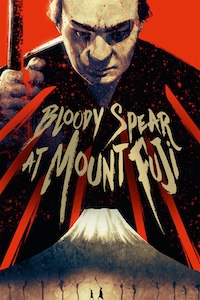
Bloody Spear at Mount Fuji follows a group of travelers taking the road to Edo, each with a story. Front and center is the samurai Kojuro and his 2 servants, Genta and Genpachi, the “spear man” as he carries his master’s weapon. Kojuro seems like a good master, but we soon learn that he becomes a mean and belligerent drunk when he’s had some saki. He’s going to Edo to marry. Also traveling the road is an orphan boy, Jiro, who takes to following Genpachi like a little lost puppy. There’s also a policeman, hunting a thief who’s been harassing travelers, and the policeman suspects Tozaburo, a shady, quiet man traveling by himself. We learn Tozaburo’s story near the end. A singer is traveling with her daughter, and an older man is trekking with his beautiful near-adult daughter Otane. This last couple also have a dark secret at their destination in Edo. Learning all of these tales, and the adventures the group has, is what makes this film. Great story that interweaves throughout itself, and I’m a sucker for a great story. Spoilers follow, you’ve been warned.. Turns out Otane’s dad is taking her to sell into prostitution, as the family is destitute, and Tozaburo is going to try to pay off his own daughter’s prostitution contract, as he sold her there years ago. When they arrive, Tozaburo learns that his daughter died 2 years prior, so he uses his money to cancel the contract on Otane, rescuing her from a similar fate. Kojuro picks a fight with the wrong people, getting himself killed with Genta, but a fierce Genpachi gets his vengeance. Jiro is left trailing after Genpachi, who tells him to get lost, having lost his faith in life. Brilliant film, though maybe not a high rewatchability factor, once you know how it all ends. ★★★½
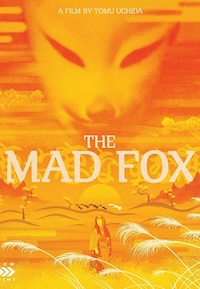
I liked the above film so much that I hunted down another from the same director (Tomu Uchida). The Mad Fox, released seven years later in 1962, is a period drama based on a bunraku play, or puppet theater. As such, there are some excellent fantasy elements. Once again, a great story; the film literally starts with a narrator telling us a story! We learn the background, that a well known seer named Yasunori foretells that he needs to adopt a particular girl. He thus sends out his two apprentices, Yasuna and Doman, to find the special girl. Yasuna picks a girl named Sakaki but leaves her younger sister Kuzunoha with her family. Years later, Sakaki has been raised as Yasunori’s heir, and that’s where the film picks up. Yasunori foretells bad things coming for the empire, but before he can provide clues as to how to avoid tragedy, he is killed by highwaymen, secretly sent by his wife. The old girl has turned her eyes on Doman, and wants him to be the next head seer, but Yasuna is still around. Thus, the unfaithful wife captures and tortures Yasuna and Sakaki, torturing the woman to death. This drives Yasuna mad, and he wanders the countryside alone. He stumbles upon Kuzonoha, and mistakes her for a reborn Sakaki in his madness. But another wants Yasuna’s love, a kitsune (fox spirit who can take human form) named Kon. Kon takes Sakaki’s form and pretends to be her, eventually settling into a marriage with Yasuna. Things come to a head when the couple is found by Kuzonoha and her father. Just about the only thing I didn’t like is how the film abandons the idea of impending calamity on the kingdom and becomes more about Yasuna and Kon, but even so, the journey in getting to the end of the film is wonderful. It is presented like a puppet show at times, with hand-drawn/painted scenery and sets, and fantastical elements involving the clan of kitsune. I loved it all. ★★★★½
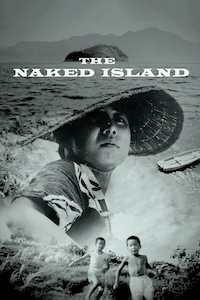
The Naked Island, from director Kaneto Shindo and released in 1960, is an interesting film in that there is very nearly no dialogue, purposefully done to increase the feeling of struggle of its characters. It follows a family of four: a husband and wife, and their two young sons, all unnamed. They live on a small island where they farm, but the island has no natural water source. Thus, the adults are constantly (several trips a day) rowing their small boat across the water to a town on the mainland, in order to refill buckets to transport home. Every drop is cherished, and all goes to their food and sustenance, and also to feeding their crops. For the most part, the family toils all day, every day, working hard in silence with everyone doing their part without having to be told what to do. But there are some moments of levity to break up the monotony, such as when the boys catch a large fish, and the family takes it to town to sell to a fishmonger. They use the proceeds to eat at a restaurant, and get to see a TV, perhaps for the first time ever for the children, as they are in awe. The peace does not last, as one of the boys becomes ill, and when help is so far away, the illness becomes a disaster. I think I expected more from this film, some feeling of emotional or metaphysical heft, but it didn’t land for me. The movie is very well regarded so maybe just caught me on a bad day, and a rewatch in the future could leave me spellbound. ★★
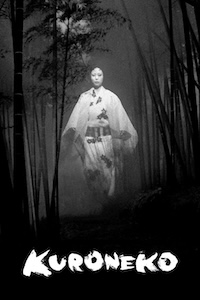
As much as I didn’t love the above film, I returned to the director for Kuroneko, as it seemed more in line with another film he did that I absolutely enjoyed (Onibaba). Kuroneko is a period horror film, and opens on a brutal scene. A group of roaming samurai are returning to the area after a battle, and come across a small solitary house near a forest. Inside, they help themselves to the food and water, and then help themselves to the mother and adult daughter, raping and killing the women, burning down the house on their way out. A year later, the women are brought back to life though, having “made a deal with the devil” to hunt down and kill any samurai they find. As ghosts, they begin luring samurai to their deaths. We then get to meet Gintoki, a young man who, through a bit of luck, has killed an infamous warlord and returned to the local leader with the bad guy’s head in tow. The leader makes Gintoki a samurai, and tasks him with the job of hunting down these ghosts that are killing his samurai. Unfortunately, turns out Gintoki was the husband and son to the 2 murdered women. When Gintoki comes into contact with the women, and they recognize him, will they be able to follow their pledges, or risk returning to hell for breaking their vows? The movie is OK, but you can break down everything that happens in just a couple minutes, and feels really drawn out at times. Not nearly as thrilling as Onibaba. ★★½

I was wanting something a little less historical after all the above pictures, so I went with Pale Flower, a Japanese New Wave film from director Masahiro Shinoda. This is about as dark a noir as you will find, and it is glorious. Muraki is newly released from prison after serving 3 years for killing a man. He’s a yakuza and was tasked with killing a member of a rival gang, but he now finds out that the two gangs have made amends in his absence, uniting to confront a third gang currently encroaching on their territories. As such, Muraki is left wondering why he did time at all. At an illegal gambling den, Muraki is bewitched by the young and attractive Saeko, a mysterious woman whom no one seems to know anything about. Muraki approaches Saeko and she confesses she is a thrill-seeker, and wants in on bigger bets than what she can find on her own. Muraki’s connections get her in on a high stakes room, but that thrill only lasts so long, until she starts looking for other vices. The ultimate femme fatale if there ever was one. Meanwhile, Muraki’s boss has a new task for him, one that will most likely send him right back to jail. Outstanding film and Muraki is as cool and collected as any film noir lead in the history of movies. The epic black and white presentation comes off stark and envelops you in the seediness of the yakuza underworld. And the ending will leave you thinking. ★★★★½
- TV series recently watched: Neagley (season 1), East of Eden (series)
- Book currently reading: Empire of Blood by Richard A Knaak


