
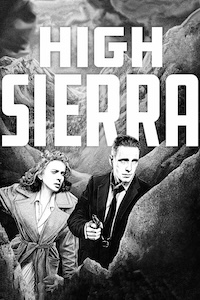
High Sierra, released in 1941 and directed by Raoul Walsh, stars Humphrey Bogart as aging gangster Mac M’Gann (based loosely on John Dillinger). Mac is supposed to be in jail for life for a bank robbery, but is paroled by a corrupt governor as a favor to the criminal underworld, so that Mac can pull another big job. After visiting his childhood home, a farm, to see how the area is going, he hits the road to California. He meets a farming family along the way (their story returns later) and then meets up with his cohorts for the upcoming heist. The two men are a couple of hot-headed buffoons, but one’s girlfriend, Marie, has ice in her veins to match Mac. She takes a liking to him immediately, but Mac is looking for “a nice girl” with whom he might settle down if he ever gets out of this life, so he is instead attracted to the farmer girl he met on the way in. Velma is a sweet, innocent girl, but she’s got a love back home. Mac and his two “friends” complete their robbery of a hotel safe, but the two younger men are killed during the escape. Mac tries to convince Velma to marry and run away with him, but she spurns his offer, and he takes Marie as his next-best option. However, the police are tightening their search, and it’s not looking like Mac will have that happy ending he envisions. I really enjoyed the dual nature of Bogart’s character, dancing the line between the man he is and the man he wanted to be. Despite being the lead, Bogart got second billing in this film behind Ida Lupino as Marie; the film company was worried that Bogart was mostly known for the B movies he’d been doing until now. However, screenwriter John Huston pushed for him, and when Huston directed his first movie later in the same year, The Maltese Falcon, Bogart finally got his top billing, and a star was born. ★★★½
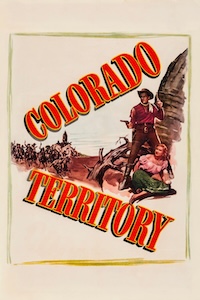
Colorado Territory is a 1949 remake of the above film, again directed by Walsh (I’ll probably skip the third version, 1955’s I Died a Thousand Times starring Jack Palance and Shelley Winters). This one stars Joel McCrea, and the setting is shifted to the old west. Train robber Wes McQueen breaks out of jail but gets right back to what he knows best, and sets up a new train heist with a couple of newbies. The film plays out much the same as High Sierra, with some notable changes. The biggest, I think, is in the lead’s internal conflict. Bogart played a character that seems like he’s tired of his criminal life, which is why he is drawn to Velma, but there’s no beating around the bush this time. Wes openly states that this is his last heist, and afterwards, he’s out of the game. The innocent girl isn’t so innocent this time either, as the rancher’s girl tries to turn Wes in for the reward so she can go back to her beau; this whole scene just makes her counterpart, the worldly girl Colorado in place of Marie, all the more attractive for the viewer, as she sticks by his side till the bitter end. It’s an OK movie, doesn’t break any new ground and plays out like most westerns from this era, but it’s entertaining enough. ★★★

The Heiress knocked my socks off, such a great movie. Based on a play, which is in turn based on a Henry James novel, it stars Olivia de Havilland (my mom will know her as Melanie from Gone With the Wind) as Catherine Sloper. Catherine is homely and shy, much to the chagrin of her father the Dr Austin Sloper. Austin fondly remembers Catherine’s deceased mother, who was boisterous and always the life of the party, whereas Catherine is the polar opposite. Still, Catherine catches the eye of the young and handsome Morris Townsend. Morris and Catherine hit it off at a party, and Catherine’s aunt Lavinia (a recent widow now living with her brother Austin) is thrilled for the match. Austin, however, guesses Morris has ulterior motives. Morris has no money and Catherine is set to inherit quite a bit. Austin interviews Morris’s sister, who initially praises her brother, but when she meets Catherine, she too becomes quiet, perhaps realizing that maybe, just maybe, her brother is chasing money after all. Austin confronts Catherine with his doubts and says some truly cruel things to her, openly complaining about her faults such as lack of grace, wit, or anything that made her mother such a lovely woman. Still, the viewer doesn’t know what to believe, as Morris is so fervent in his affection. Catherine decides to run away with Morris, which will almost certainly get her disinherited, and the viewer finally realizes Morris’s true intentions when we see his reaction to this news. He never meets her on the day when they are supposed to go, and when he comes calling years later, after Austin has died and Catherine has become wealthy, we find that she has become a much different woman than the love-struck puppy she once was. Outstanding film with excellent, witty repartee between the various characters, and tremendous acting; de Havilland would win her second leading Oscar for the film. Excellent music throughout too, including the main theme, the tune to “I Can’t Help Falling in Love With You,” though naturally the original French version from the 18th century; Elvis’s version was still 10+ years off into the future. ★★★★★
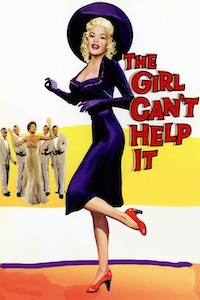
The Girl Can’t Help It stars the effervescent Jayne Mansfield as Jerri Jordan, a curvy knockout who wants to be a housewife, but whose boyfriend Marty “Fats” Murdock wants to be a star. Marty, a mobster who is recently out of jail, wants to be taken seriously in the criminal underworld again, but he needs a pretty girl on his arm as part of the package, and wants Jerri to be that arm candy. To do that, she needs to be recognizable. Thus, he hires Tom Miller to make her a star. Tom is an agent with an eye for talent, but alcoholism and bad gambling debts have derailed his career. He still knows how to work a room though, and he and Jerri start making the rounds to clubs around town to build her reputation. Whenever questioned about what or who she is, Jerri responds with, “Ask my agent,” while Tom deflects, all to build mystery about this stunning woman, which of course gets everyone wanting her. Unfortunately Jerri has no real talent outside of the kitchen, though there, she makes a mean quiche. At every club they visit, the music becomes just as much of the film as the plot, featuring early pioneers in rock and roll like Little Richard, Fats Domino, Eddie Cochran, and others. The music is great, the film, not so much. It’s not bad or anything, just awfully predictable and staid, which is a weird thing to say about a film where rock and roll music plays such a big part. Probably had a more lasting effect when it was released in 1956. ★★½
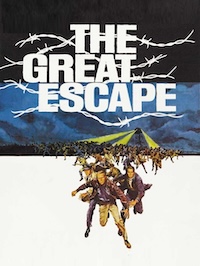
The Great Escape is a (very fictionalized) version of events about the breakout from a Nazi camp, Stalag Luft III, during WWII. It follows a handful of POWs from several countries, including the UK, USA, and Australia, all united in their efforts to escape. This particular camp is housing prisoners who have had repeated escapes (or escape attempts) at previous camps, so it is for “the best of the best.” And that’s kind of how it opens, as prisoners are already looking for ways out on the first day there, often to humorous results. It quickly becomes apparent that no one is getting out of this camp, not without some heavy planning. So the prisoners set up a committee, and start digging. Much of the movie involves the very involved plans that they have to do make, and steps along the way, in order to dig tunnels for 250 soldiers through hundreds of yards of dirt to the other side of the fence, and the dangerous consequences for when some plans go awry. The climax is the actual escape, and it is a thrilling ride full of heart-pounding action. It is certainly refreshing to see actors performing their own stunts, like Steve McQueen flying over the hills of a countryside in a high speed motorcycle. Tom Cruise notwithstanding, you just don’t see that anymore. It’s a thinking man’s action film, with lots of dialogue, but thrilling nonetheless, and an outstanding cast including McQueen, James Garner, Richard Attenborough, and a young Charles Bronson as a digger with claustrophobia. ★★★★
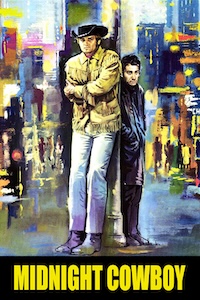
The groundbreaking film Midnight Cowboy was released in 1969 and stars Dustin Hoffman (recently off his breakout role in The Graduate) and Jon Voight (in his first major role). Voight is Joe Buck, a naive young man from Texas who thinks he’s going to go to New York and make a ton of money as a male prostitute. New York is not as welcoming as he envisioned. His first “job” breaks down in tears and Joe ends up giving HER money, and his second, when he receives felatio by a man in a theater, the guy can’t pay. Soon broke, he ends up crashing on the couch of con man, “Ratso” Rizzo (Hoffman). Rizzo knows the streets as he’s been living on them for years now, but his deteriorating health is holding him back. Thus, he starts teaching Joe “his ways.” In flashbacks, we see the trauma that led Joe to leave Texas, and over time, Rizzo confesses his own troubled childhood. The two develop an unlikely but strong friendship, leading to an emotional ending. Brilliant film with tremendous acting by its co-leads (both would get Oscar noms for Lead Actor) and awesome dream sequences that give it an almost surrealist feel at times. Also really captures the grit of seedy New York of the 60s as well as the counterculture element prevalent at that time. The film received an X rating upon release (later amended to an R upon re-release in the 70s) due to overt homosexual themes, and is still to this day the only X-rated (now NC 17) film to win Best Picture at the Oscars. ★★★★½
- TV series recently watched: Stargate SG1 (season 6), Reacher (season 4), Slow Horses (season 6), The Diplomat (season 4)
- Book currently reading: Princess of Dune by Herbert & Anderson


