
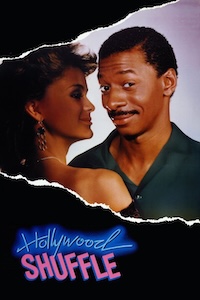
Hollywood Shuffle is fantastic satire from actor and first-time director Robert Townsend, released in 1987. He plays another “RT” in the film, lead character Bobby Taylor, an aspiring actor in LA struggling to land a meaningful role. As he laments, black actors only get to play jive-talking gang members, butlers, or slaves. The movie is mostly told in sketch comedy-like scenes, where Bobby envisions things he overhears or ideas that come to mind, like a school (full of white teachers) teaching young black actors how to talk jive, or a black version of Siskel and Ebert pointing out how ridiculous white movies can be but how they see the nuance in a movie about pimps that rove the streets as zombies preying on working girls. When Bobby does get a callback for an audition, he learns that the (again, all white) movie team wants an “Eddie Murphy type” actor (since that is currently bankable). Hollywood Shuffle is a comedy but its satire hits hard, showing time and again how right Bobby is, and it hits home when he reads a note from his younger brother stating that the kid wants to be an actor just like Bobby when he grows up. Bobby then envisions the little guy as a stereotypical pimp, one of the only roles available to a black man. The movie drags a bit in the end (which says a lot, as it’s a short film at under 80 minutes), but the writing is spot on. You can see the influence of cowriter Keenan Ivory Wayans, who had met Townsend doing standup a few years earlier; he would start In Living Color’s sketch show just a couple years later in 1990. ★★★½
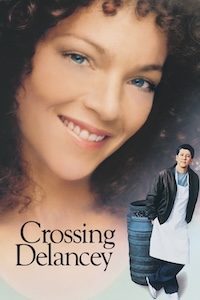
Crossing Delancey is a very typical 80s romcom. Knowing that going in, I knew what to expect and the film delivered what I was looking for: nothing complicated, but a cute love story, and in 80s fashion (and still popular today), from an unexpected source. Isabelle runs in intellectual circles and is a bit of a snob because of it. She tries to tell people that she doesn’t need a man in her life and is happy single, but she secretly wants companionship (often settling for sex with a married man for occasional flings), and her very Jewish grandmother is constantly trying to set her up. The matchmaker comes around one day with a new potential man, Sam, but Isabelle is put off by the fact that Sam owns a pickle store. While a respectable shop in the Jewish community, Isabelle wants a learned man, and has been pining away for local author Anton. We all know where this is going and the film doesn’t disappoint. It’s a delightful film with truly equal parts romance and comedy, about a woman who is lonely but “too intelligent” to admit it to herself, and turns a blind eye to where the love could be found. The city itself is a main character too, full of the buzz an bustle of 1980s New York. Not a complicated film but a charming one. ★★★★

Smithereens also showcases the city, albeit a grittier side, as it follows a young woman named Wren. She’s fled her home in New Jersey to live the punk rock scene in New York, only to find that most of it has since moved to LA. She latches on to rocker Billy, who was in a band called Smithereens with a one-hit-wonder years ago. Billy keeps dropping hints that he’ll take Wren to LA, but is just as likely to ignore her when she comes around, in favor of any other interesting woman who may be near. While Wren keeps following Billy like a lost kitten, she ignores the potential match right in front of her: Paul. Paul is homeless and living in a van, but he truly cares for Wren, no matter how badly she treats him. After getting evicted from her apartment, Wren takes to sleeping in Paul’s van, but will take off anytime she thinks she has a chance to connect with Billy. There’s no happy ending in this film. It isn’t all that deep, and the acting from a bunch of never-was’s is pretty rough, but just like Crossing Delancey, the feel of the city is great. It’s the best redeeming quality of this film. Honestly not sure what the film was trying to convey. It is trying to get me to feel sorry for Wren? Because I don’t; she takes advantage of people and is given a pass because “she’s punk.” ★★½

Choose Me is a straight up romance, though does have a few funny moments here and there. The three main characters are Mickey (Keith Carradine), Nancy (Geneviève Bujold), and Eve (Lesley Ann Warren). Mickey is recently released from a mental hospital and has come to LA to find an old flame, Eve. He goes to a bar, Eve’s Lounge, but the Eve tending bar isn’t the Eve he remembers; turns out this Eve bought the place after the original owner killed herself. Eve is a former prostitute who knows how to please a man, but not how to keep a man. She can never get herself in a good, healthy relationship. As such, she follows a popular local radio talk show hosted by Nancy Love, who serves relationship advice nightly. Despite being an expert on the radio, Nancy is shy and reserved around men in real life, and in an odd turn of events, ends up as Eve’s roommate (though Eve doesn’t know this is the Nancy she listens to every night). Into this twisted affair comes Mickey, a very confident man who is either a crazy liar or has done it all, admitting to having flown helicopters and photographed all around the world and knows martial arts. He doesn’t come off as a braggart, is just very matter-of-fact, and he is looking for a woman to marry. At turns, he falls for Nancy and Eve, but is somehow pulled into an affair between Eve’s current boytoy (a married man and pretend-gangster named Zack) where he has to defend himself with brutal force. There’s a lot going on there, but the heart of the story is about finding the right person in this crazy thing called life. Who doesn’t love a good love story, especially when there are occasional fisticuffs? ★★★½
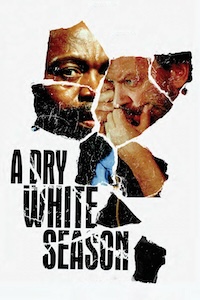
A Dry White Season stars Donald Sutherland as Ben Du Toit, a born-and-raised South African in Johannesburg in the mid-1970s. Ben lives a carefree life and is unaware of the political strife shaking his country. When his gardener, a black man named Gordon, comes to him asking for help because his young son was arrested on trumped-up charges and caned as punishment, Ben brushes Gordon off, thinking the boy must have done something to deserve it. Soon after, the boy is caught up in a protest against apartheid and killed. Ben “makes a few calls” but doesn’t do too much, until Gordon is also arrested and evidence comes out that he is being tortured, eventually dying in custody. Ben can’t turn a blind eye anymore, and starts to get involved. For Gordon’s widow, he hires a lawyer (a later career role for Marlon Brando) and sues the police, but they ultimately lose the case with a heavily stacked court system against them. Ben then makes it his mission to get the news out on his own. The papers that describe the police brutality are often run by black Africans, and are dismissed by the white populace, so Ben wants to tell a story that his fellows will actually listen to. But doing so will turn the police against him and his family. A very powerful film, all the more so because it takes place not all that long ago. In fact, though it takes place in the 70s, it was released in 1989, and at that time, apartheid was STILL going on. It’s almost impossible to believe that a country like South Africa could carry on such blatantly racist practices for so long, but it’s a reminder that these things can still happen today. There are certain people in our government who like to say that race is no longer an issue, but we should remember that it is, and always will be if we are not vigilant to injustices. ★★★★
- TV series recently watched: Visions: The Ninth Jedi (series), Lost (season 5), Race Across the World (series 4)
- Book currently reading: Bloodline by Claudia Gray


