
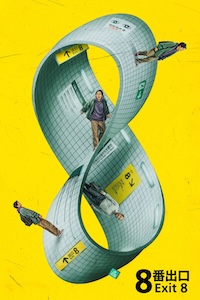
Exit 8 is a Japanese psychological thriller based on a video game. For a background, the game was developed in 9 months (an absurdly short time by game standards these days) as a way for the developer to “kill some time” between other, bigger projects. It went on to be extremely successful, and thus this movie. In the film, an unnamed young man gets off a subway while chatting on his phone with his recent ex-girlfriend, who has just told him that she is pregnant. The man is at a loss for words and isn’t paying attention to where is going, until he realizes that he is somehow going in circles, seeing the same signs again and again. He quickly realizes that he isn’t going in circles, but is in some kind of repeating maze. A note on the wall tells him to proceed if everything is normal, but if he see’s an “anomaly,” he is to turn around. The exit pointing the way out says “0” and every time he chooses right, it counts up until his desired exit 8, but if he misses an anomaly and continues forward, it resets to 0. Some anomalies are benign, like a different sign on the wall or an upside down letter, but others are either psychologically disturbing (often) or downright dangerous. And it gets harder and harder for the man (and others trapped down there too, as we soon learn) to know what is real and what is not. It’s a fantastically unsettling movie that will get your heart rate beating, and proof that you don’t need a big budget to make a very interesting and fun film. ★★★★
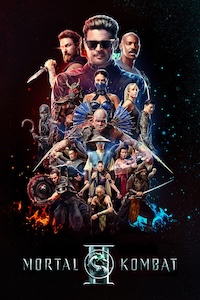
It’s already been 5 years since the Mortal Kombat film franchise rebooted, and a sequel has finally arrived. Just like the first movie, this is pretty much a direct video game adaptation, meaning lots of (bloody) fights and silly dialogue, but if you understand that going in, it’s a fun action flick. Emperor Shao Kahn and his gang of evildoers are ready to take over Earthrealm. His counterpart, Lord Raiden, has to put together 5 of Earth’s greatest champions to fight Shao Kahn’s forces in death matches (“It’s called Mortal Kombat for a reason you know?”) for the future of mankind. Their centerpiece is Johnny Cage, missing from the first film, and portrayed by the always-entertaining Karl Urban. There’s even a return for star actor Hiroyuki Sanada as Scorpion. Gore is over-the-top, just as you’d expect. More of the same from the first film, which is not a bad thing. ★★★½

Branching out from my usual fare and watched Obsession. I don’t do a lot of horror movies, but this one got such good reviews and a friend highly recommended it. Glad I gave it a go (even if I’d never watch it again!). Baron (“Bear”) has a big crush on Nikki, but the two are part of a circle of four long-time friends, and Bear doesn’t know if his feelings are reciprocated. His buddy Ian knows Bear likes Nikki, but warns him off. After a party one night, Bear drives Nikki home, and when given the opportunity to admit his feelings, he balks, and Nikki gets out of the car and walks up to her house. In an emotional fit, Bear pulls out a $5 toy he recently bought at a shop, a toy that is meant to grant a wish, and wishes that Nikki loved him more than anything in the world. As he is about to drive away, he looks up to find Nikki standing at the car door, the moonlight in her eyes. She tells him a story that her father is dying and she feels alone, so can she come over to his house for the night. Coincidence? Of course not! Before Bear knows it, Nikki is making a memorial out of his recently deceased cat to cheer Bear up, standing at the edge of the bedroom watching him sleep, and taping the door shut to try to keep him from leaving. It isn’t long before her adoration turns violent towards herself and anyone else who might stand in the way of her man. The reason I don’t often do the horror genre is they can get silly at times, and this one certainly does go overboard on the implausibly (even for such an outlandish premise), but it’s still a wild and entertaining ride. ★★★★
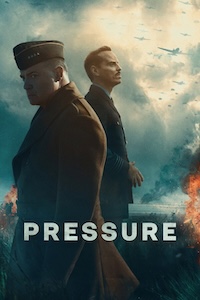
Based on a true story, Pressure tells the story of the preparation for D-Day from an angle not told before. It’s June 2, 1944, with the intent to launch for the beaches of northern France in 3 days on June 5. General Eisenhower (played fantastically by Brendan Fraser, continuing his film resurgence) brings in two highly respected meteorologists to give him the weather report that all will be good for the highly coordinated mission. One, the American Irving Krick (Chris Messina) has a sterling reputation in Hollywood for having predicted the red skies for the shooting of Atlanta burning in Gone With the Wind (and other films), and he says to launch of June 5, it will be perfect weather. The other man, British James Stagg (Andrew Scott), who’s there under the recommendation of Winston Churchill, says to wait. He sees a big storm in the Atlantic coming this way, and forecasts crashing waves, no visibility, and gusty winds, all of which would spell doom for the Allies’ invading force. Unfortunately, the next window for launch would be June 18, something that Eisenhower and the brass refuse to accept, as they know they can’t keep the cat in the bag from Germany that long. Buoyed by tremendous acting and an incredible script, director Anthony Maras keeps this film tense and fraught with an impending sense of danger throughout. Who knew a movie about the weather could be this fun?! ★★★★★

Blue Heron, a semi-autobiographical film from writer/director Sophy Romvari, follows a family of Hungarian immigrants moving to a new home in Vancouver, Canada. The kids have been in Canada long enough to have (mostly) lost their accents, but the parents still revert to their native tongue more times than not. There are 4 children, 3 younger (with the film mostly following daughter Sasha, playing the role of the director Romvari), and an older brother Jeremy, the mom’s son from a previous relationship. We immediately see that Jeremy is struggling with social issues. Sasha witnesses him stealing from a store one day, and he becomes withdrawn from the family. It isn’t long before he gets nabbed by the police for a petty crime, and the family turns to psychologists to see what is going on. The final third of the film moves forward 20 years to an adult Sasha, who is talking about her brother (in the past tense now, signaling something happened to him, with others, trying to figure out what made her brother the person he was. It shifts from a narrative film to an almost documentary-like approach. Didn’t care for this latter section, though the initial story of little Sasha living in a turbulent house was pretty good. Still, just because you set up a camera behind a child doesn’t mean the film is from her perspective, and the point-of-view moves too much to truly be a coming-of-age. Just a bit too all-over-the-place for me. ★★
- TV series recently watched: Race Across the World (series 3), Stargate SG1 (season 5)
- Book currently reading: Fallbacks Bound for Ruin by Jaleigh Johnson


