
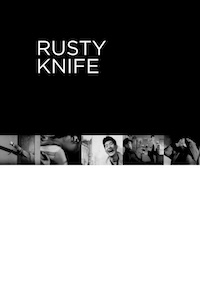
The late 50s and 60s saw some Japanese films which were obviously heavily influenced by some of what was going on in American film at the time. Starting today with a trio of action noir films that could easily have come out of the USA. First up is Rusty Knife, released in 1958 and directed by Toshio Masuda (later did Tora! Tora! Tora!). It’s about an ex-convict who’s been trying to go straight for the last 5 years. He did time for killing the man who raped and murdered his girlfriend, but is now discovering that maybe he killed the wrong guy. Meanwhile, his former employers the yakuza are trying to bring him back into the fold, all while the police are also trying to recruit him to narc. Besides the main dude having done time for killing the wrong guy, there’s also a possible new love interest, who’s father seemingly killed himself but which also may be a case of mistaken murder. For a bunch of “professionals” they sure seem to get things wrong a lot. That being side, it’s pretty engaging, once you get all the characters (and whose side they’re on) figured out. 3 stars for a good ending that you do not see coming. ★★★
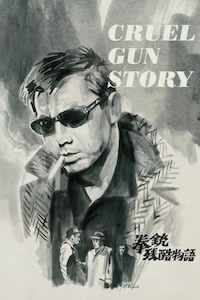
Cruel Gun Story is a movie starring Joe Shishido in the lead. He played a lot of villains in the 300+ movies he did in Japan (I’ve reviewed quite a few in this blog) and while he had a small role in the above picture, by the time this film came out in 1964 he was getting pretty well established. This one’s a heist film, and Shishido plays Joji, the ringleader. He is tasked with putting together a team to rob an armored car enroute from a horse racing track to the bank in town. Joji has his second, a longtime friend, but needs at least 2 more to pull it off, and the options aren’t good; he ends up with a needle pushing disgraced ex-cop and a has-been boxer who has taken a few too many blows to the head. Initially, the job goes as planned, until the security guards driving the armored car don’t fall for getting out when ordered, and remain safe inside their bulletproof vehicle. Joji and his team steal the whole truck with the guards and money still inside, but while deciding their next plan of action, are double crossed by the those that hired them. And then the team breaks down and starts double-crossing each other. I quickly got the sense that no one was going to survive this bloodshed, and I was right, after a Butch Cassidy-like finale. Not too satisfying of a conclusion, but it’s a fun ride getting there. ★★★½
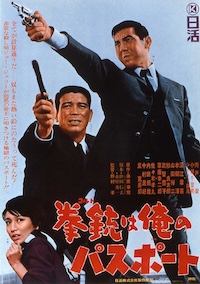
A Colt is My Passport is a spaghetti western in a yakuza Japan setting, complete with a western style soundtrack. Joe Shishido is back, as contract killer Kamimura. Kamimura is great at his job, one of the best, and his latest job involves killing a man named Shimazu. Kamimura has been hired by yakuza boss Senzaki to kill Shimazu, a former partner who has been found to be embezzling. Shimazu is always guarded and is too smart to leave himself vulnerable, rarely being seen outside his stronghold. But Kamimura is smart, and when next Shimazu and Senzaki meet, Kamimura has set up a block away on a tall building and fires with deadly precision. Senzaki isn’t pleased that the target was killed while he was near, landing him at the police station to answer questions, but there’s nothing to tie him to the killing, so he is let go. Not one to let loose ends lie, Senzaki goes after Kamimura. Kamimura expected this though, so he and his friend Shun are already trying to skip town. Unfortunately for the duo, Senzaki has powerful friends, and Shimazu’s son wants revenge too. It becomes a cat-and-mouse game, with powerful killers on both sides, and ending in a duel straight out of a Clint Eastwood flick. Outstanding action and a gripping plot all the way to its explosive (literally) conclusion. If the film sounds cool but you aren’t a fan of subtitles, be patient: it is currently being remade by Gareth Evans with a pretty strong cast. ★★★★
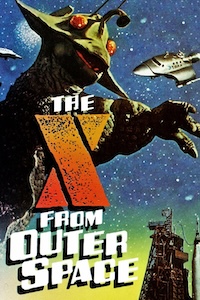
Shochiku was traditionally one of the biggest film studios in Japan, but by the late 60s, their movies (mostly dramas) were considered “old fashioned.” Facing the behemoth that was Toho studios (Godzilla), Shochiku responded with a series of horror movies. The X From Outer Space (1967) is a direct response to Toho, featuring its own gigantic monster. It takes awhile to get there though, too long in my opinion. A group of astronauts are charged with finding why spacefarers keep disappearing near Mars, and when they get there, they find huge spores that almost take out their ship. They bring one back for study, but when exposed to Earth’s atmosphere, it starts to grow, and becomes this giant chicken-looking thing that starts wrecking the place. This is a super boring movie, taking far too long to get to any action, with lots of frivolous scenes that do nothing to advance the plot. The characters are quite literally running in circles at times, bouncing from Earth to the moon base to Mars and back again (and again). And did I mention the monster looked like a giant chicken? ★
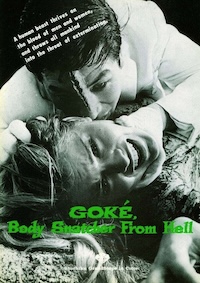
Goké, Body Snatcher from Hell followed in 1968, and is a better offering. An airplane is flying through a red hazy sky with bizarre happenings (birds flying into the windows with grisly abandon) when the pilot receives a bomb threat. While searching the fliers’ bags, one man pulls a rifle. As the shit is hitting the fan, a UFO flies past in the red sky, knocking out one of the plane’s engines and causing it to crash on a deserted island. The survivors gather, but the hijacker with the rifle runs into the jungle and encounters the alien from the UFO. It carves and entrance into his skull and takes over his body, turning him into a vampire-like being who starts to hunt the rest of the survivors, sucking their blood. As the movie progresses, we learn that this alien is just the lead in a force coming to Earth to kill everyone. Is it campy? Sure, but it also has some nice old-fashioned visual scares and is at least more engaging than the space flick above. ★★½
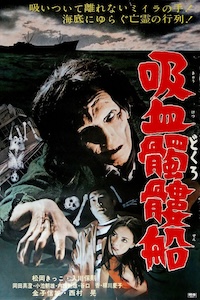
The Living Skeleton starts silly with some extreme over-acting, but it settles in to be a very good horror film. A group of deadly pirates have taken over a ship, and end up killing everyone on board, including the damsel-in-distress Yoriko. 3 years later, Yoriko’s twin sister Saeko is still in mourning when she starts to see visions of Yoriko. Looks like Yoriko’s ghost is out for revenge, as she starts hunting down members of the pirate gang. The movie is just vague enough that you don’t know if Yoriko’s ghost is doing the killing, or if she is inhabiting her twin’s body to do the deeds, or if something else sinister is going on. Sort of an update on the traditional Japanese ghost horror genre, or kaidan as they are called natively. The movie has it all, from identical twins to a mad scientist to a bad guy impersonating a good guy to get closer to the heroine. Not to mention a wild ending. Crazy film, and I was into it all. ★★★★
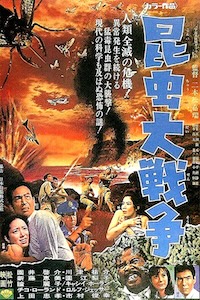
Genocide, as a film of the late 60s, plays up to the present fears of global annihilation. The gist of it is that insects, which fear their own deaths along with every other living thing on the planet because of mankind’s impending atomic wars, decide to rise up and take out humans. Some new strain of insect (which look a lot like bees) start biting people, and once bitten, the human goes insane, killing others before succumbing to the venom’s toxins. Sounds silly, and it is, but there’s some good subplots going on too that kept me interested. There’s a playboy getting it on with his girlfriend and an American woman (who turns out to be in league with the insects) and an American GI who was transporting a bomb when all this started, later gets bitten, and then goes off the deep end. The Japanese doctor trying to come up with a cure seems to be the only rational one of the lot. Zany movie, but entertaining! ★★★
- TV series recently watched: Widow’s Bay (season 1), ST Voyager (season 7)
- Book currently reading: Enemy of My Enemy by Alex Segura


