A couple years ago I watched Robert Bresson’s A Man Escaped, and absolutely loved it. Today’s a look at some of other stuff.
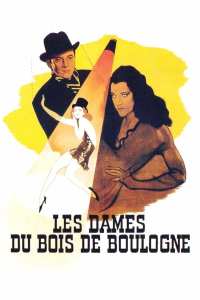 Hell hath no fury like a woman scorned. That’s the gist of Les Dames du Bois de Boulogne (The Ladies of the Park). Helene is a rich single woman who’s been in an open relationship with Jean for two years, but she loves him enough to finally get married. Unfortunately he doesn’t feel the same way, so when he calls it off to be “just friends,” Helene sets out to get her cold-hearted revenge. She knows of a single mother who has fallen on hard times. The adult daughter, Agnes, once dreamed of being a ballerina, but has resorted to being a cabaret dancer and prostitute to support herself and her mom. Helene rescues the family from their debts and puts them in a new apartment, and slyly introduces them to Jean, knowing that Agnes’ good looks will entice him. Helene is right, and Jean falls head over heals. Agnes rightly guesses that Helene has an ulterior motive, but her mom refuses to listen, feeling indebted to Helene. Agnes resists for awhile, shameful of her past, and even tries to tell Jean, but he dismisses her protestations, going on Helene’s word that Agnes’s is a fine upstanding family which has just been going through a difficult situation. Agnes and Jean get married without him knowing of her past, and only then is it revealed to him, with Helene having invited many of her former lovers to the wedding. It’s a delightful perverse film, but also has a message of redemption, and not just for Agnes. ★★★★
 Diary of a Country Priest is a low-key film about a man who takes on his first parish in a rural community, and he’s probably unprepared for what he finds there. Our unnamed priest is a young man, just out of seminary, who is quiet and contemplative, pious yet unsure of himself. He is prone to arguing with his parishioners when they don’t see things the way he thinks they should, which doesn’t exactly make him any friends in the small community. To make matters worse, he is sickly for an unknown reason, able to only eat and drink break and diluted wine. The constant wine drinking spreads rumors that he is a drunk, and a lying young girl makes up more lies about him which makes matters worse. In the end, as his illness progresses, he finds solace not in any of his community, but in a fallen priest who attended school with him, who left the church and is now living unmarried with a woman. Though he struggles with his faith through most of the film, with his friend at his side, our priest seems to find himself at the end. I liked this film, and I think I would have really liked it more if I hadn’t been interrupted while watching it. I hate to start a movie if I don’t have time to get through it in one sitting, and unfortunately I was pulled away a few times, once for an extended time, and this is the kind of character film that you just can’t do that on. It pulls you in with all of the emotion of the priest, his fear of not living up to his calling. If I watch this one again, I’d make sure to do in one sitting, and would probably rate it higher. ★★★
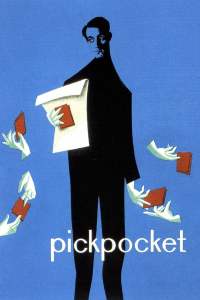 Pickpocket is widely heralded, but I just didn’t get the hype. It is about a man, Michel, who is forced to turn to thievery to survive. Already living in a rundown building (he leaves his apartment door wide open when he isn’t home, the lock is broken), and trying also to support his ailing mother, Michel has been out of work for a long time. His first stealing attempt, at the racetrack, ends up with him getting caught, but the police are unable to prove he is the thief, and he is let go. He is caught again a short time later, but the victim simply demands his money back without calling the cops. After these early run-ins, Michel is able to latch on to a group of professional thieves who take him under their wing, teaching him techniques and honing his “craft.” In the meantime, Michel begins to fall for the young neighbor of his mom’s. Bresson was famous for wanting his actors to display as little emotion as possible, preferring to let the story speak for itself, but that becomes the detriment in a film like Pickpocket. Even as Michel narrates to the viewer that he is under extreme stress from fear of getting caught, we certainly can’t tell by watching his face. Call me old fashioned, but I like to immerse myself in the film and get to a place where I am swept up in events the characters are going through, and it’s hard to do that when they are all stone-faced all the time. ★★
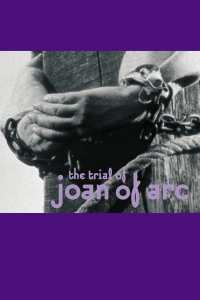 Unfortunately I didn’t really enjoy The Trial of Joan of Arc either. Bresson did a lot of research to make this film, a portrayal of Joan’s trial and eventual death by being burned at the stake, but to get that true story across, the whole picture is just spoken dialogue. In fact, it could take place in one long scene had Bresson not attempted to break up the monotony of it by showing the priests walking around. And by walking around, I mean out of the “room,” since it is was obviously filmed on a shoestring budget on tiny lots. It happens so often, it almost became comical to see the judges ask Joan a few questions, then get up and walk out the back. And unfortunately Bresson’s reliance on nonprofessional actors really shows in all the dialogue. It literally looks like they are reciting lines, unemotionally and with little rehearsing. The final scene of Joan’s death is powerful, but you’d expect that for such a climactic and historical scene. The rest of the movie bored me to sleep. ★½
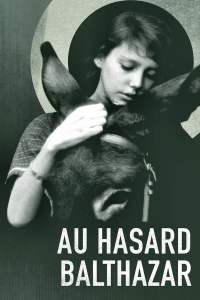 We go from 2 movies with little emotion, to one that is full of it. Au Hasard Balthazar is a monumentous film; at its root, it is the life and death of Balthazar the donkey, but it is so much more. Balthazar is born into what appears to be a good life. He is loved as a young donkey by Marie, a little girl, and Marie’s playmate/early “boyfriend,” Jacques. However, when Jacques’s sister dies, the family moves away, and Marie isn’t so happy anymore, and Balthazar’s own life of joy ends, never to return. He spends the next 15 years floating from owner to owner, all within the same tiny town, and each seemingly more cruel than the previous one. None really care for Balthazar, other than his use as a pack animal, and he is beaten and mistreated continuously. Even an older Marie, who has fallen in with a bad crowd, shows mostly apathy towards Balthazar when she sees him. In the end, Balthazar dies alone, surrounded by sheep on a hillside. The obvious metaphor to Balthazar’s life is that of Jesus (Bresson was a Catholic and did not shy away from religious material in many of his films, as noted above). Balthazar is treated roughly during his time on this earth, used as a tool by the cruel and loved by few, yet he carries on as a noble animal without ever quitting. I think the selection of a donkey, besides its obvious biblical link, works perfectly: we associate it as a burden animal, and one that doesn’t fight back and which can’t escape its life. ★★★★

 Jons Movie Takes
Good job! The last one is my favorite of the bunch. My history of Nickelodeon post is finally up, hope you can check it out. Later : )
LikeLiked by 1 person