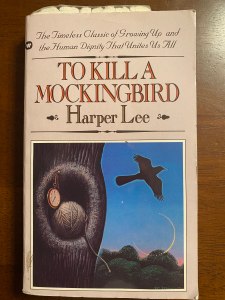
Harper Lee’s To Kill a Mockingbird is another one of those books that somehow I escaped reading in high school. Seems like everyone else did (and still does), but just never in any of the classes I was in. I finally remedied this, and what a fantastic, engaging book.
I’m sure most of you have read it, but to recap, since it may have been awhile. The book follows Scout (Jean-Louis) and her older brother Jem (Jeremy), the only children of Atticus Finch. Atticus is a lawyer in the small town of Maycomb, Alabama, and he takes his job very seriously, almost as seriously as he does with raising his kids right, with their mother long gone. His unconventional parenting style doesn’t always sit well with his neighbors or his well-to-do family, who have a respectable name (a neighboring town even bears the Finch name), but Atticus is a respected man in the community. He lets his tomboy daughter run around, not very lady like, and treats his kids almost as adults. While he does try to shield their innocence from the dangerous and uncaring world out there, he’s teaching them to be critical and independent thinkers, even from an early age.
Taken from the viewpoint of the kids and especially Scout, who is just 6 at the beginning of the book, the novel does have a certain innocence. She’s only interested in what she can get away with, her friends, and neighborhood gossip, like the recluse neighbors, the Radley family, whose son Boo no one has seen in years. Scout, Jem, and their friend Dill spend a few summers trying to peak inside the Radley house for a glimpse of him, but to no avail. Finally they are warned away by Atticus, telling them to leave that poor family alone. Scout’s world is only what she can see and hear, and she isn’t aware of adult matters going on, even when they are right in front of her. Thus, when the book takes a turn halfway through, it hits the reader just as hard as it hits Scout.
Her father Atticus has been assigned to defend Tom Robinson, a black man accused of raping a white woman. It doesn’t matter than Tom is a respected hard worker in the area (as respected as a black man can be in 1930’s Alabama), or that his accuser, a white trash woman named Mayella Ewell, whose family is as different from the Finches as the sky from the ground, all that matters is that he is black and she is white, which usually means death to the black man. Atticus however is bent on not only making a showing at the trial, but actually giving it his all. He believes Tom is innocent of his charges, and proves it well in court later on.
Scout finally sees what is going on when Atticus doesn’t come home one night. She and her duo of cohorts walk to the jail, and find Atticus facing off against an angry crowd, intent to pull Tom out and kill him. It is actually Scout who steps forward to call out one of the crowd, reminding him that she knows his son. This wakes them up, and they guiltily return to their homes. Atticus tries to inform Scout that people aren’t stupid or dangerous individually, but can become so when part of a mob. Tidbits like this pervade the whole book, and what stand out as the fantastic parenting Atticus is trying to achieve, even in a rough situation.
In the end, Tom is indeed found guilty, though Atticus is able to at least get the jury to give him several hours of deliberation, when it usually takes them just 5 minutes in such a case to return a guilty verdict. Tom is later killed when trying to escape prison. Walking home from school one day, Scout and Jem are attacked by Mayella Ewell’s dad, but Boo Radley finally comes from his house and saves them. In the confusion, Ewell is killed. From Scout’s description, Atticus is convinced Jem stabbed Ewell, and dreads turning in his own son, even if it was self defense. The Sheriff seems sure that Boo did it, but Boo is simple minded and unable to explain the events. In the end, the Sheriff states that the drunk Ewell fell on his own knife, to protect all of the innocent families from further torment.
This isn’t a very deep or introspective book, it practically lays out its meaning (don’t kill mockingbirds, i.e. things that are only in this world to create beauty and don’t hurt anyone). It’s a coming-of-age, loss-of-innocence kind of book for Scout, but Jem does his own growing up. Lee definitely wants us to know what she thinks about prejudice and social class, placing more emphasis on character than birth. But sometimes even fairly simple, straight-ahead books can leave the biggest impact. It is a heartfelt novel, will equally choke you up and make you laugh. Easy to see why it has become such a classic.

 Jons Movie Takes
One thought on “Innocence lost in Lee’s Mockingbird”