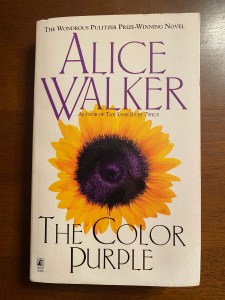
After James Joyce, it was nice to just read a normal book, and a good one at that. Alice Walker’s The Color Purple is an iconic novel that meant a whole lot to a whole lot of different people. Released in 1982, it won Walker a Pulitzer Prize (the first African-American woman to do so) and inspired a generation of young writers.
The principle protagonist is Celie, a poor teenager living in the south in the early 1900’s. Her background, established in the first pages, is about as terrible as you can imagine. Only 14 years old, she’s had two children all ready, both fathered by Celie’s own father Alphonso, who beats and rapes her without mercy. He took the children away from her shortly after birth, and she’s never seen them again. All Celie has in this world is her little sister Nettie, but Alphonso all ready has his eyes on her at the age of 12. When a neighbor, “Mister,” (his name, Albert, isn’t given until much later in the novel. For the majority of it, he’s simply known as “Mister.”), asks to marry Nettie, Alphonso refuses, giving the Celie to him instead. Celie goes from one evil house to another, and her beatings continue. Though still young herself, she has to look after Mister’s children and do all the housework. To get away from Alphonso, Nettie runs away, promising to write letters every day until she dies. However, years go by, and Celie never receives a single letter.
Over the years, new people come into the picture, including Mister’s true love of his life, Shug. Shug is a singer, once a good one, but she’s fallen on hard times due to drugs and a hard life. She moves into their house and becomes Mister’s mistress, under the same roof as Celie. Celie doesn’t care, as she has no love for Mister anyway, and her beatings are less frequent when Shug is around. Other people have tales to be told too, including Mister’s son Harpo, his wife Sofia, and his mistress Squeak, but more than I want to get into in a short synopsis.
Over time, Celie and Shug develop a friendship, and ultimately, a romantic relationship. With Shug’s encouragement, Celie begins to grow her self esteem. This is further developed when Shug finds a cache of letters from Nettie and brings them to Celie. Nettie had indeed been writing all these years, but Mister never gave the letters to Celie. Celie learns that Nettie latched on to a black married couple who have gone to Africa as missionaries. Not only that, but the couple adopted and have been raising Celie’s two children, given to them by Mister when they were just kids. Celie is thrilled at the news, but doesn’t let on to Mister. However, she does start to grow a backbone, and the book subtly shifts as Celie begins to exert more power in the house. In one letter, Celie learns from Nettie that their father wasn’t their father at all, he was a stepfather who stepped in to the void filled with their real father, a local shopowner, was lynched. Knowing that her kids aren’t the product of incest after all, Celie goes to confront Alphonso, who is still mean, but no longer this mythical all-power entity to be feared. The same goes for Mister. When Alphonso dies and the family learns that the land is rightfully Celie’s, she goes to live there, leaving Mister.
Most things finally settle out for Celie by the end. She starts her own sewing business, making clothes that become popular among the local population, and though she never gets the relationship with Shug that she wants, she does find peace. Mister (now called by his name, Albert) even finds the error of his ways, and he and Celie come to terms with each other. At one point, he asks to marry her again, now in spirit as well as in body, but she refuses, knowing that is not her path. The big reunion you are hoping for throughout the book does finally come in the end.
This book is deceptively simple, but there’s a lot going on under the surface. It is told as a series of letters, most written by Celie, and obviously some by Nettie later on (I didn’t even get into her family’s work in Africa, a whole bunch of stuff about the trials people there faced against encroaching white business owners, not to mention the village’s part is selling slaves to America in the first place). In the beginning, Celie is writing to God, as He is the only person she has in the world, when she thinks Nettie and her kids are dead. Later, when even God seems to have turned His back on her, she writes to Nettie, even before Celie knows she’s still alive. Since it is written in first person narrative by an uneducated person, the language is simple, full of grammatical errors, and often phonetic. But through Celie, Walker gets her point across. This is a woman who never had anything, born into a world that hated her from the moment she came out of the womb, but she still found love and acceptance through sheer will and perseverance. Whether you want to interpret that as God’s love in the world, as Shug does in the book, or take a more agnostic look at it, is entirely up to the reader. However, I think it is definitely about an enduring faith that there has to be something better out there. It’s a great book, and an easy page turner that you won’t want to put down.

 Jons Movie Takes
Watch the movie too, if you haven’t already . Wonderful movie
LikeLike