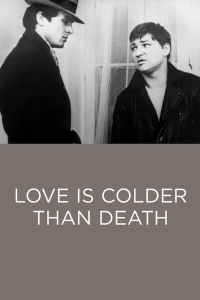
 Awhile back I watched some of Rainer Werner Fassbinder’s films, for the first time, and really liked them. Those were some of his bigger hits, so today I’m looking at his earlier, lesser-known pieces. Love is Colder Than Death was his first film, in 1969. It’s about a small-time thief, Franz (Fassbinder himself), who pimps out his girlfriend and hangs with a thug named Bruno. Franz seems to act tough but always leaves the real dirty work to Bruno, which doesn’t bode well for Bruno in the long run. I’m not sure what Fassbinder was trying to say here, unless it is maybe that you can trust no one in life. Not a great picture, and the shoestring budget is telling, but there are glimpses of the greatness that would come. Fassbinder doesn’t rush his scenes (as a director); he lets moments develop. In fact the whole film has a leisurely pace to it, which can be good or bad depending on your mood. I wasn’t feeling it, but might try it again at a later date. ★½
 Katzelmacher was his second film, based on a play he also wrote. It follows a group of young adults (some of whom would go on to be Fassbinder regulars in his films), who are frankly really boring people. All they do is have sex and talk about it with each other. Even the sex is boring, and why the women don’t leave these sad specimens of men is beyond me. But all that changes when Jorgos, a Greek immigrant, takes a room at one of their places. Rumors immediately swirl about the size of his manhood and his prowess in the sack, getting the women excited and the men jealous. However, no one seems to really get to know Jorgos, or even tries. This one I liked a lot more. You have to be patient, it is a full 40 minutes of crawling on screen before Jorgos arrives to shake things up, but there’s humor there to keep you entertained. Once our Greek gets involved, the payoff is worth it. It’s a really nice movie that doesn’t get much attention. ★★★
 And….Fassbinder crashes back to earth. I gave up on Gods of the Plague 45 minutes in. 45 minutes of literally nothing happening. It revolves around a man just out of jail. Outside of that, I can’t really tell you anything, as I’m not really sure what the plot was. There were a couple girls vying for his attention, and he seemed to still be engaged in some criminal activity here and there, but nothing much was going on. We got to watch him visit his mom, play with a record player, and take long, slow walks down the street. If there’s a story here, I completely missed it. Fassbinder’s earlier 2 films took a solid 40-45 minutes to build to something, so maybe this one would eventually too, but at least those two were interesting enough for me to hang around to get to the denouement. This one was not. ½
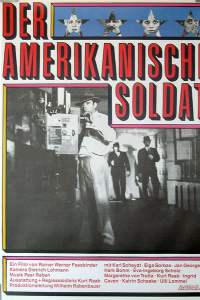 The American Soldier is Fassbinder’s take on a noir, which means it is really nothing like a noir. It has the look of a noir, but the feel of something quite different. Ricky is a German-born American citizen returned to Germany after fighting in Vietnam. He is locally known as a contract killer, and he starts getting calls to continue his killing ways immediately. However, it seems the contracts are being called in by the police, who are looking to entrap him. There’s also a side plot involving Ricky’s bisexuality, which never really plays out. Some film noirs have a nice slow burn, but this one, in true Fassbinder fashion, is more of a snail burn. It moves at a crawl, and plot points are sparse, to the point that 40 minutes in, I wasn’t sure what was going on. It filled out nicely by the end, but still a lot of stuff was left unexplained. ★½
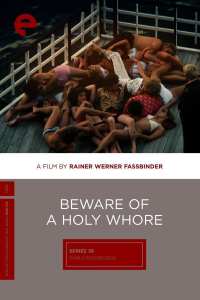 Beware of a Holy Whore is much better. It is a quasi-satirical, quasi-autobiographical film about a film production team brought together to shoot some scenes at a villa in Italy. Fassbinder used as inspiration his latest film shoot (a film called Whity, that I have not seen), and pokes plenty of fun at himself and his team of actors and film workers. Many of the people involved in the movie-within-a-movie are all ready at the villa (actors, makeup, producer, cameramen, etc) before the director and the star actor ever show up. When the director does arrive, we see him as a childish, pig-headed narcissist; all he does is yell and fire people who don’t jump when he commands. The film plays out as a train wreck of epic proportions, with revolving relationships on set, jealousies, and the producer and director constantly looking for funds to keep it going. The viewer thinks, surely this will end in failure, but when one actor is asked how the director gets away with his antics, the actor prophetically responds that the director is a genius. Sure enough, everyone is amazed by the quality of the filming when it gets underway. It’s a stark look behind the curtain of filmmaking, I can only hope that most sets show a little more professionalism. ★★½

 Jons Movie Takes
2 thoughts on “Quick takes on 5 Fassbinder films”