Some of Kurosawa’s most famous pictures are of the samurai genre, but obviously he’s got a lot more out there. Up today are movies he made in the aftermath of World War II, when his home country of Japan was going through a period of turmoil, but also of healing, and these films reflect that.
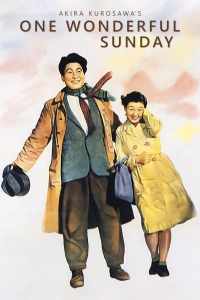 What a snoozefest, so boring I almost don’t believe it is Kurosawa. One Wonderful Sunday follows a young couple in 1947, right after World War II, when the nation is going through hyper inflation and the two cannot afford anything. They dream of a place together, but are forced to live apart (he with a roommate, her with her large family of 16 in a tiny house). Their situation makes the man completely depressed. As the two run around town this day, the girl tries to cheer him by day dreaming about their future house and business, playing with street kids, going to the zoo, but nothing lifts her boyfriend’s spirits for long. The only interesting moment comes near the end, when the girl breaks the fourth wall, passionately begging the audience to help her cheer up her man, but this excitement quickly fades, almost as fast as my memory of this bore.
 Scandal is much better, and not just because it features a bona fide star in Toshiro Mifune. He plays a painter named Aoe, who one day has a chance encounter with singer and star Saijo while out in the country. He gives her a lift back to the hotel and shares a tea with her, where the two are photo’ed by the paparazzi. This photo goes viral (in 1950 style, via newspapers). The brash Aoe decides to sue the tabloid, and hires an every-man lawyer, Hiruta, mostly because Hiruta is a family man and Aoe puts a lot of faith in his character. Unfortunately this faith is misplaced; to help his ailing daughter and poor family’s situation, Hiruta begins taking money from the tabloid and working both sides. The film starts to focus on Hiruta more and more as the film goes along, and the guilt he is wracked with, balancing the needs of his family and his personal morals. The trial is great courtroom drama, leading to a fun, satisfying film.
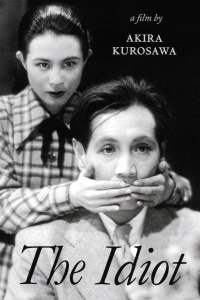 The Idiot is based on the book of the same name by Dostoevsky. Kurosawa originally made a film that was nearly 4 ½ hours long, but the studio balked at the running time and chopped it up to just under 3 hours. You can tell too, the editing is rough in spots, especially in the beginning, when we get voiceovers explaining background and character traits. But once we get into it, the viewer is rewarded with a rich and beautiful film; makes me want to read the book , and wish that the original film had survived (but sadly it seems lost to time). The eponymous idiot is a man suffering PTSD from the war, whose eyes have been opened and now only sees good in people around him. This trait makes women around him fall for his purity of heart and soul, and men act either jealous or callous, to use him to their own ends. The heart of the story is a love triangle (or more appropriately, quadrangle), but only through our hero’s insight can the characters discover who and what they really want. Hopefully, they figure it out before it leads to the downfall of everyone. A heart wrenching film, and I can see inspiration for some of the great art films that would come in the 60s and later.
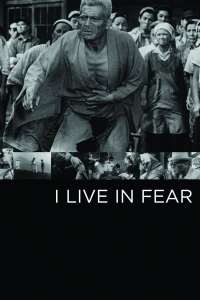 I Live in Fear is the the most direct as far as dealing with the effects of the war. It follows an old man, Kiichi Nakajima, who lives in profound fear of a new atomic attack on Japan. During thunderstorms, he even suffers from flashbacks of the day the bomb fell, seeing the sky light up and hearing the explosions. After first trying to build an underground bunker, he’s decided the only way to keep himself and his family safe is to move them all to Brazil. He wants to up and move everyone: his adult children and their spouses, his former mistresses and illegitimate kids, etc. His children have put pressure on their mom to petition for conservatorship, for fear that his actions would deplete the family savings and put them all in dire straits. While Kiichi just wants to protect his family, everyone else is purely selfish, worrying about him blowing all “their” money, or for the illegitimate children, even getting into the will at all. On the surface, the fear of the bomb is the focus, but underneath, it also becomes about the dynamic of a family with an aging patriarch, balancing his desires with what is best for him. With his hair grayed and cropped short, sporting thick glasses and a complete change of his mannerisms and movements to take on the part of the old man, Toshiro Mifune is almost completely unrecognizable as Kiichi. This is a gut wrenching film, about a man (and a society) trying to cope with the debilitating fear of losing not only life, but family and future descendants, after a horrendous tragedy nearly did just that.
 I’ve seen some of Kurosawa’s hits and loved them (Seven Samurai, High and Low, Yojimbo), and others I’ve yet to watch (Rashomon and Ran come to mind), but from what I’ve seen so far, Ikiru is the best, and a true masterpiece. It is about a man, Kanji, who’s worked in city hall for 30 years stamping approvals on public jobs, but in true bureaucratic fashion, nothing substantial ever gets done. His life is changed when he finds that he has progressive stomach cancer, with maybe 6 months to a year to live. Faced with this stunning news, he wants to live life to the fullest, but he doesn’t know how. After a first night out drinking, whoring, and contemplation, followed by a couple weeks of following after a young spunky girl who seems full of life, he finally finds a cause to which he can devote himself. The residents in a local municipality have been complaining about leaking sewage near their homes, so Kanji makes it his goal to have a park built there. At this turning point, with roughly 45 minutes left in the film, it jumps ahead 5 months, and we see Kanji has just died. The park has been built, and we see in flashbacks, from Kanji’s friends and coworkers at his memorial, how it came to happen. At first, the deputy mayor and chiefs of each department all stumble over themselves congratulating each other on the project, but they leave early, and the underlings compare notes to realize it was all Kanji that made it happen. It is only then, while sharing stories, that they realize Kanji knew his time was short; to this point, he had told no one (outside of a few strangers in the beginning) of his impending doom, not even his son. The film is about the tenacity to complete something really good and lasting before your time is up, but more than that, to simply live life to the fullest. The title Ikiru literally means “To Live.” This is a sad but beautiful film, but even with a heavy subject, Kurosawa manages to inject humor, preventing it from feeling like a dirge. I defy anyone to not be moved to tears as we see Kanji deteriorate physically, while his drive never diminishes.

 Jons Movie Takes
3 thoughts on “Quick takes on 5 Kurosawa films”