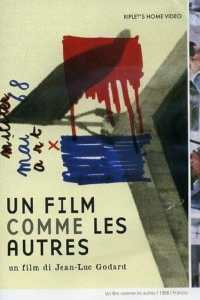
 After his film The Weekend (which I really liked) in 1967, the man who became famous for ushering in the French New Wave in 1960, Jean-Luc Godard, decided he was done with traditional movies and started making political films. He teamed up with radical leftist Jean-Pierre Gorin to make a series of heavily Maoist pieces. The first was Un film comme les autres (A Film Like Any Other) in 1968. The whole film is just 5 mostly faceless people discussing the repression of workers and what to do about it. The small group is made up of workers and students, who have lofty ideals of things that should be done, but I couldn’t help but get a sense of nothing but a whole lot of talk going on. It comes off as very pretentious, just a bunch of intellectuals bitching about the wrongs of capitalism. There’s some arguing among the group, because the workers, who have to work for a living, push back against some of the more extreme ideas of the students who are way too idealistic. The film is passably interesting, but really just boils down to watching a one sided debate for 90 minutes.
 British Sounds is even more extreme. Godard isn’t pulling any punches anymore. It opens with a long side cut of workers in an auto plant putting together cars, and a voiceover talking about how repressed they all are, how they are just slaves working for the bourgeois, how much better their lives would be if they could work under communism instead of capitalism, etc. Then it REALLY started to lose me. The next scene has the camera focused on hall in a house, and narrates how if you think the worker is downtrodden, then the female worker is even more so. How they are exploited for their sex, can’t face equal treatment, and on and on. Hilariously, during the narration, a naked woman walks in and out of the screen. But I guess that’s not exploitation? Or are we being sarcastic? Whatever it is, like the first movie, the film is very condescending. By this point, I just wanted Godard to go back to making fun movies.
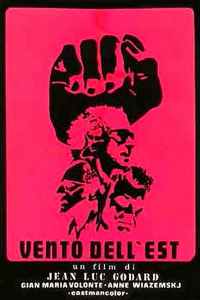 Le Vent d’est (Wind From the East) is finally a bit better, at least it has a (loose) plot and feels more like a movie, albeit one with an agenda. Again, it is about the plight of the worker. There’s a strike going on at the local factory, where workers are demanding better conditions and higher pay. At various times, members of the both the workers (dressed as normal, everyday people) and the owners (dressed like English high society from the early 20th Century) are kidnapped by the other side. Over it all is a narration, sometimes about what we are seeing, but most often going off on separate tangents, such as railing against the state of traditional cinema, which is “run by the bourgeois.” In poking fun at traditional films, Godard breaks the fourth wall by showing his actors having their makeup applied during the scenes, or in one instance, having the actor lay down comfortably where he “died” and then splashing blood on him from off camera. We even see a scene when “production” is halted because pro-capitalist people hold the “anarchist” actors hostage. The whole thing is mildly amusing, but it never loses sight of its defense of Maoism, communism (even glossing over Stalin’s evils), and the predicament of the working class. The second half of the movie becomes a quasi-lecture/rant against moviemaking, and no one is safe. The main target is “Nixon Hollywood,” but the narrator goes on to target progressive filmmakers too, saying they don’t go far enough. Then we get a quaint little tutorial on how to make weapons and bombs at home. Good family flick.
 The next film is actually a good one. Lotte in Italia (Struggle in Italy) is about a girl coming to grips with her goals as a Marxist, and how to find a way to achieve those goals. The film is told with her telling her story to the camera in her native Italian, with an unseen narrator translating to French (and us English twerps reading the subtitles from the translation). She talks about her life as a student, and how she wishes life should be, and it isn’t before long that she realizes she’s a bit of a phony. She tells workers who want better wages to just strike, but doing so wouldn’t put food on the table for their families. She talks about independence from her parents, but returns to them when she needs money or a place to stay. She admits to the camera and to herself that she doesn’t have enough life experiences to achieve the sort of social freedoms she envisions, and her attempts to learn more have failed (for instance, she took a sewing job in a factory to talk to real workers about their struggles, but found that the grueling work and big deadlines kept her and them quiet and focused on their jobs). In the end, she seems to have a clearer picture of what she wants to attain for society, but seems no closer to reaching the goals. Her final thoughts are that even the film she is in, the medium to which she is speaking to the viewer, is owned by the bourgeois as a system of control. I genuinely liked this movie, more than the 3 previous, and though I obviously don’t agree with everything our girl was putting out there, at least it was more “real” than the previous showings.
 Finally comes Vladimir et Rosa. This movie starts with a narrator telling us we are going to watch a film, introducing the characters, what we are going to see, etc. They admit that this film was only made to raise money for a different project, but say that it is still worthwhile because it advances their cause. That argument is debatable. The film is loosely made as a response to the 1968 protests in Chicago after the Democratic National Convention (look it up if you want more info). Godard and Gorin themselves are in this film, Godard playing the accused, Vladimir, but also a policeman later, and Gorin is the judge, but also Vladimir’s friend Karl Rosa. Sometimes it seems the two are playing as themselves too. It boils down to their revolutionary ideas themselves put on trial, but Godard and team use it to show how stacked the system is against them. The whole thing is a jumbled mess: a bombardment on our senses with people talking over each other, half-assed ideas that aren’t explored, and pure propaganda. In the end, I enjoyed 2 of the 5 films from this period of Godard’s work, but not sure I’d rewatch any of them.

 Jons Movie Takes
2 thoughts on “Quick takes on 5 Godard films”