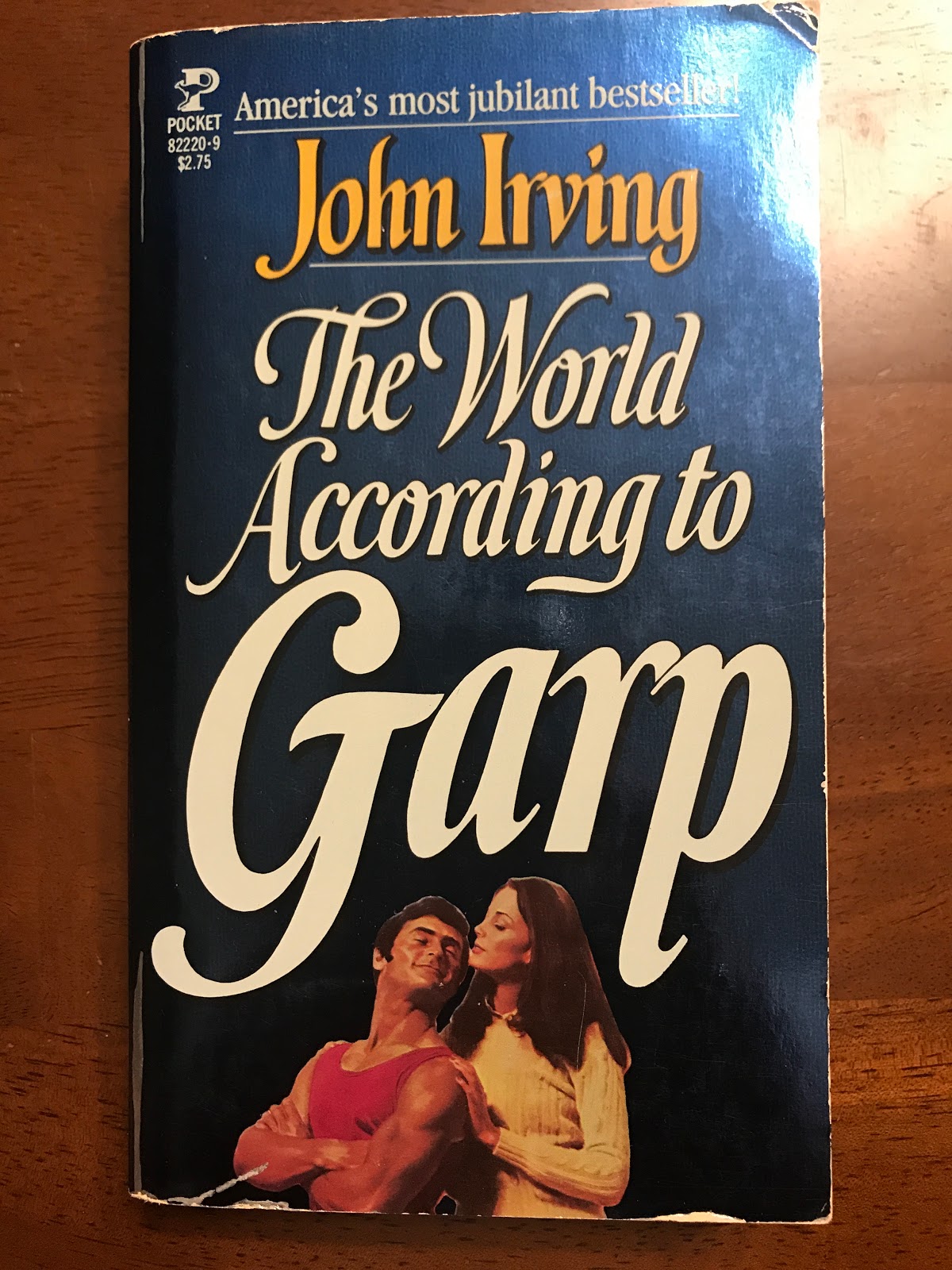
John Irving is probably most famous for writing The Cider House Rules, whose movie adaptation won a few Oscars in the late ’90s. A better book though was his The World According to Garp, released in 1978 (and also later made into a movie starring Robin Williams). I’m not ashamed to say this book had me bawling in the end, even though I wasn’t sure I’d like it in the beginning.
The book starts with Jenny Fields, an independent woman who comes from money, but refused to be married off to pump out kids. In fact, she is asexual, not attracted to men or women, but she decides that she would like to have a child. So she has one in the most unusual way, basically impregnating herself from a brain damaged soldier during World War II. The soldier, Garp, is unaware of his surroundings and in fact dies shortly after Jenny used him. Not knowing his first name, she names her son T.S. Garp (T.S. being his name, standing for Technical Sergeant, though Jenny never tells anyone who the father is, much to the chagrin of her well-off family). Jenny takes a position as a nurse at an esteemed all-boys school, and raises Garp as a single mother.
*Major spoilers below, that would really ruin it for you if you think you might read this book (which I highly suggest). If you love an emotional roller coaster, stop reading this and go get it! Otherwise, continue.*
Garp is raised just as his mother wants: he is a free thinker, free doer, and completely independently minded, caring little for others. Without giving you the whole life story, he does grow to have a family, including a wife (who he cheats on sporadically early in the marriage, but eventually stays with) and kids. Along with the relationships in his life, we are privy to Garp’s longing to be a good writer. He begins writing in college in order to impress his future wife Helen, who, as a life-long reader, has said she will only marry a man who can write well enough to appease her. While living in Vienna with his mom after graduation, Garp writes a short story which is indeed very good, and soon after is able to complete his first novel. This book is published, and while not a huge seller, it does get critical acclaim. However, Garp is by now playing second fiddle to his mom, who has written an autobiography titled A Sexual Suspect, which has become a world-wide bestseller and vaulted her to the class of feminist icon. Jenny is now wealthy enough to take care of Garp and his new family, so while Helen does get a job, Garp stays at home and continues to try to write. Jenny goes on to open a women’s sanctuary which helps women of all types, including transexuals, and a fanatical sect of women who cut out their tongues in support of a young girl named Ellen James who was raped and mutilated in this way by her attacker.
Garp’s second novel is not as good as his first, but still well received (but again, not a big seller). After this, Garp finds he is unable to find new ideas. His life has gotten stale, and he seems to have lost his imagination, and can only write about things in his life. Tragedy strikes though, giving Garp something to write about, from a terrible situation. Coming home with the kids in the car one night, Garp rear-ends a parked car in his driveway. The car belonged to Helen’s lover, and the two were engaged in sex in the front seat. Everyone is severely hurt, physically and emotionally, and their youngest son dies. While spending months recovering at his mom’s sanctuary, Garp writes an explosive new novel, full of sex and violence. His friend and editor tells Garp that the book is not up to the standard of his previous books, but it will most definitely sell. And that it does, making Garp famous and rich. Trying to restore their family, Hellen and Garp decide to have another child, and soon after, Garp is approached by the real Ellen James, and they unofficially adopt her as well (as her parents recently died). The family of five finally find happiness, though it will be short lived.
In the final chapters, everyone dies, many within a couple years of each other. In quick succession, Helen’s father, a close family friend, and Garp’s mother Jenny all die (Jenny is killed by a redneck because of what she stands for). There is to be a memorial for Jenny by a pro-feminist party in New York, and no men are to attend, but Garp sneaks in, dressed in drag. He is found out and barely escapes the anger directed his way, by many of the women who think his big novel shames and objectifies women. This foreshadows Garp’s eventual death, when one of these fanatics approaches him and shoots him point blank. Afterwards, life goes on for the rest of the family (Garp was only 33, so there was much life still to live), and the rest of each of their lives are told in summaries, so by the end of the book, we know the entirety of the life and family and T.S. Garp.
This is not a short book, and Irving does not write in an overly descriptive manner, so a whole lot happens. The above synopsis is extremely abbreviated. But because so much happens, because we grow with Garp and know all of his little flaws and brilliance, it really hurts when we see him go. He is just one person, but his larger-than-life persona (and ego) fill the pages of this book, making him feel real, tangible, as does his family and friends. If you enjoy deeply emotional books, ones that build slowly but surely (giving you time to get to know everyone involved), this is one you’ll like.

 Jons Movie Takes
One thought on “Irving brings love and loss to Garp’s World”