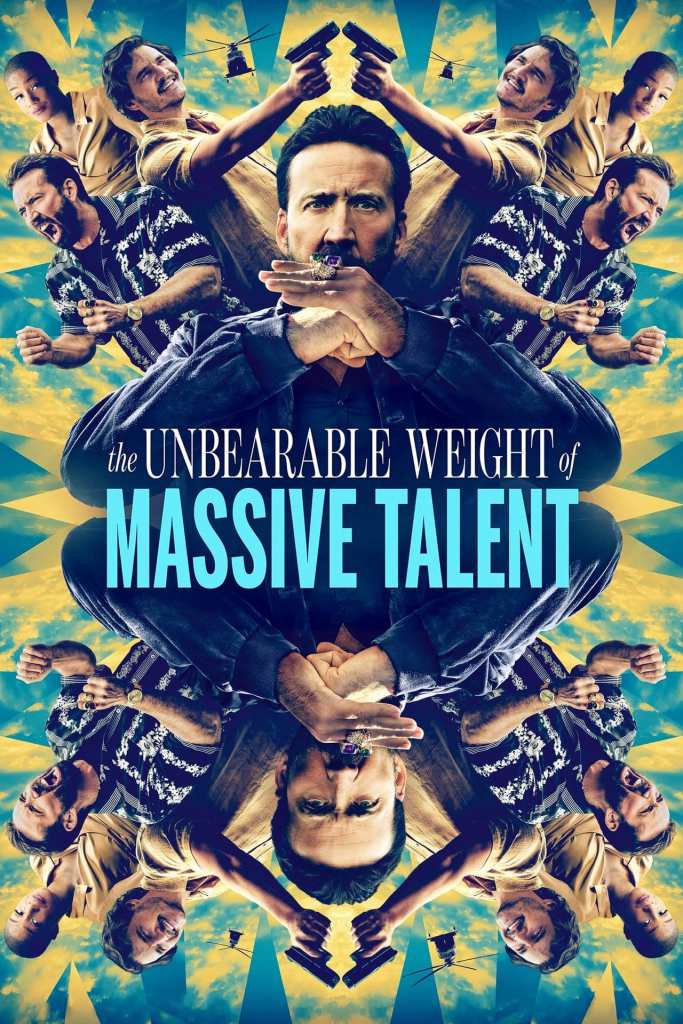
When I saw Cage’s previous film, Pig, I made some snarky comments about his history, especially lately, of picking questionable roles. Well, after catching his newest, The Unbearable Weight of Massive Talent, you can see the egg on my face. Two solid films in a row definitely makes me rethink those words.
Cage plays a fictionalized version of himself. Everyone he runs into talks about his big hits of the 90s and early 00’s, but that was a long time ago, and he can’t land a good role these days. To make matters worse, his longtime devotion to his career has been to the detriment of his family, and he’s facing divorce and an alienated teen daughter. After his latest attempt to land a promising role in an upcoming exciting film doesn’t pan out, Cage decides it is finally time to retire from acting. To make a little cash, he accepts an offer from a millionaire, superfan Javi Gutierrez, to attend his (Javi’s) birthday party on a private island for a million bucks.
Cage goes to the island and meets Javi (Pedro Pascal), and the two instantly hit it off. Javi has written a screenplay in which he wants Cage to act. That screenplay is shit, but Cage agrees to write a new one with Javi. The one they work on mimics the bromance they are forming on the island. But Cage has a secret: he has been recruited by the CIA to spy on Javi, who is apparently a big time arms dealer, who has recently abducted a politician’s daughter for leverage. The CIA wants Cage to locate the girl. If this convoluted plot sounds like something out of a Nicolas Cage movie….well, it is. But don’t let the superficial-sounding plot turn you away. This film is funny, but also smart, with plenty of references to film history, and not just Cage’s own filmography, as well as a peak into plot elements and devices that get tossed around by someone who knows what he’s talking about. I had a good time, and it looks like the actors had a good time making it too. Cage is fantastic, but it is Pascal who steals most of the scenes he is in, and the movie does a good job of keeping the viewer guessing. How could this goofy millionaire playboy with money to burn, with a private museum devoted to Nicolas Cage’s movies, be an international crime lord? Very entertaining. ★★★½
Everyone associates Orson Welles with Citizen Kane. It was his first film as director and it cemented his reputation as a master of the craft at the young age of 26. But unless you are a cinephile, you probably aren’t as familiar with his followup picture, which also has a cult-like following. The Magnificent Ambersons was released just the year after Kane, in 1942. It tells the story of Amberson family and their decline from the wealthiest family in town to a footnote in history. Isabel Amberson is looking to get married, and while she is fond of a young inventor named Eugene Morgan, she rejects him when he muffs a serenade one night, and marries the staid Wilbur Minafer instead. The couple have one child, George, who is a rapscallion around town from an early age, leading the townsfolk to anticipate the day when he gets his comeuppance. He never does, at least until he is a young man. At that time, George falls for a beautiful young woman named Lucy Morgan. Yes, that Morgan. Eugene, now a widower, has returned to the city with his daughter after having made money as an early supporter and inventor of the automobile (a device that George scoffs at, thinking it beneath his station). The bristly George still hasn’t made any friends outside of his circle, but the times of “station” and “old money” are coming to an end, if only he could see the writing on the wall. Wonderful film, even in the 88 minute version that is shown today. As a person who regularly suffers from FOMO, I wish the original 131 minute version still existed, to see Welles’ original vision. That version was cut up immensely by the production company after initial previews didn’t go well, and the original footage destroyed. No one living knows what that original version was, thus leading to the mystery of the film. Even so, the version we have is right up there with the best. ★★★★★
Othello has another famous story behind its production. The film is obviously based on the Shakespeare play, and by now, you either know it or you don’t (I am not a Shakespeare buff, and did not know it, but I did like the movie). Not having read the play or seen an adaption before, I don’t know how accurate it is, but it is well done. I love the story behind the film too. Perhaps due to experiences he suffered in films like Ambersons, Welles wanted more complete control over his production. Othello was one of those that he made completely self-financed. Welles would film sections of the movie until he was tapped out, and then go act in a film or play to get paid, and come back to film some more. In this way, it took 3 years to complete Othello, and while the production levels are low on such a tight budget, Welles’ complete mastery of the camera hides this fact. There are scenes that look like they came from any big-budget Hollywood picture. This movie hasn’t changed my opinion: with few exceptions, I’m not a big Shakespeare fan, but this adaptation is very well done. ★★★
Mr Arkadin is a mystery, quasi-thriller about a mysterious millionaire, the eponymous Gregory Arkadin, who hires small-time smuggler and general ne’er-do-well Guy Van Stratten for a strange mission. Arkadin claims amnesia before 1927, with no recollection of how he showed up in Switzerland that year with $200k, money that he then used to build his fortune. Guy uses his connections and a nose for digging up dirt to get to the bottom of Arkadin’s mystery, but the trail leads to connections that Guy is completely unprepared for, and the biggest surprise is saved for the viewer. Once the movie gets going, it is really good, but Arkadin isn’t even introduced until 30+ minutes in, and it takes forever to build a plot. I understand they were laying the foundation for the first third of the film, getting the viewer to know who exactly Guy is and what makes him tick, but I was honestly bored until Guy’s investigation started ratcheting up. However, even in the beginning, there’s some incredible imagery, as you’d expect from the perfectionist Welles. The final 30 minutes is a solid 4+ star film, but I have to even it out from the slowish beginning. ★★★½
Chimes at Midnight is another take on Shakespeare, with Welles taking the role of John Falstaff, a character who Welles always said was his favorite. Culling material from a few Shakespearean works (mostly Henry IV Parts 1 and 2, and a bit from Henry V and Richard II), the movie follows Falstaff’s influence over and his shenanigans with King Henry IV’s son, Prince Hal. The comedic Falstaff loves to drink and womanize, which the young Hal of course is drawn to as well. While the king is dealing with an uprising from Henry Percy over the line of succession, Hal and Falstaff are off carousing. This leads to the king’s lamentation that he wished Percy and Hal could switch places, even though Percy at the moment is his enemy. It isn’t until the rebellion is put down and Hal pledges to his dying father that he will take the thrown and treat it with the respect it is due that Henry IV is able to find comfort. Unfortunately for Falstaff, the newly crowned Henry V keeps that vow and no longer has time to dilly dally with his old bud, brusquely telling him he is not welcome at court. This movie gets tons of attention and, as you can expect from Welles at this point, it is detailed and gorgeous to watch. But again, Shakespeare’s not my thing. I was unfortunately bored though stretches of the movie, but did stick around to see the heartfelt ending. ★★½
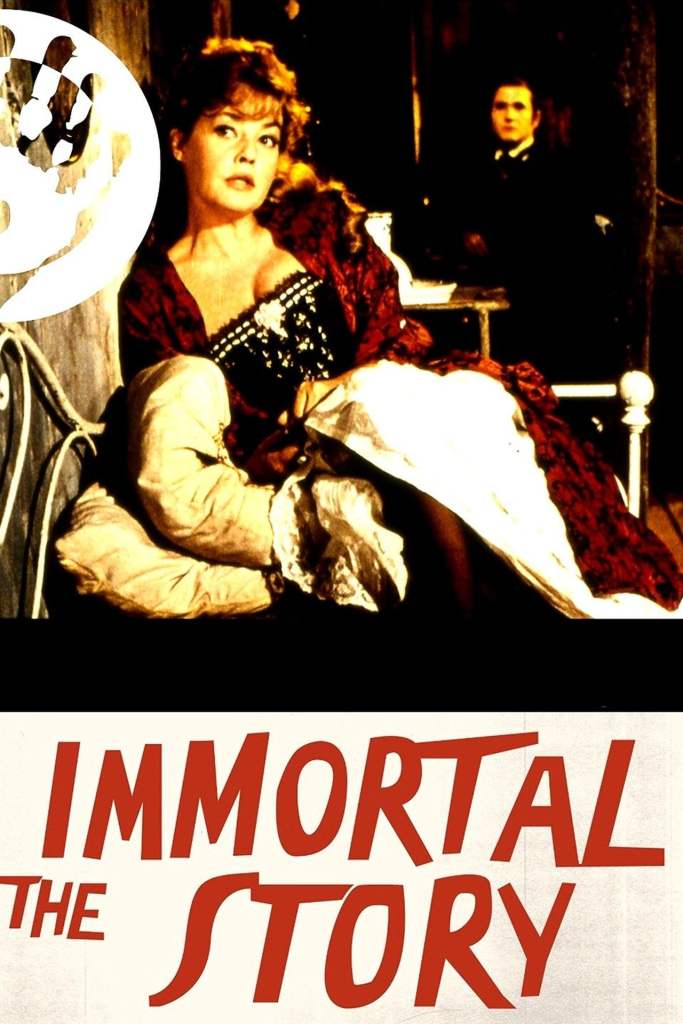
The Immortal Story is a tidy (just shy of 1 hour) film, and this one was more my jam. Based on a story by Karen Blixen and released in 1968, it was Welles’ first color film, as well as his final fictional film released in his lifetime. He plays Mr Clay, an old rich man living in a mansion in Macao. His only companion is his bookkeeper, Levinsky, who reads to Mr Clay at night. For something new, one night Mr Clay begins a story he once heard about an aging rich man who paid a young stud to impregnate his wife. Levinsky interrupts Mr Clay and finishes the story for him, giving him the news that the story is old and oft-told amongst sailors; it probably never happened. Mr Clay, who only believes in facts and figures, wants to make this story happen, and tasks Levinsky with finding a woman to “play” his wife, as well as a sailor to do the deed with the girl. Levinsky knows poor sailors are a dime a dozen, but finding a willing woman will be harder (and expensive). He has one in mind: Virginie, who is a poor clerk’s mistress on the island. As luck (good or ill?) would have it, Virginie is poor because her father was once Mr Clay’s partner, and was swindled by Clay out of his fortune. In fact, Mr Clay now lives in the mansion that Virginie grew up in. When they find their sailor, does the event play out as Mr Clay hoped? Fantastic, tidy little story, with the incomparable Jeanne Moreau portraying Virginie. The final act is a bit more ethereal than you might expect, but I loved it all. ★★★★
TV series currently watching: Cobra Kai (season 4)
Book currently reading: The Eye of the World by Robert Jordan
Today I’ll be reviewing five films from French director René Clair, whose career spanned the silent to sound era. Up first is Sous les toits de Paris (Under the Roofs of Paris), from 1930. An early sound film, it features a lot of music over most of the film, interspersed with scenes of dialogue here and there; an experienced director getting his feet wet in a new medium. The film follows Albert, a street singer whose only income is selling sheet music to accompany him for ten cents a sheet. Albert has a good heart, and stops a thief from plying his trade on Albert’s unsuspecting customers. One of the would-be targets is the attractive young Pola, who, unfortunately for Albert, already has a boyfriend, Fred. Fred though is a womanizer and a brute, and Pola soon leaves him. She won’t let Albert get fresh though, making him sleep on the floor as she takes his bed while hiding from her ex. The aforementioned thief isn’t done with Albert either though, and sets him up to get arrested, all a ploy by Fred to get Pola back. It’s a cute enough film, though a bit dated obviously in its views about women (Pola is expected to swoon over any man who gives her an eye). ★★½
À nous la liberté (Freedom For Us) followed in 1931, and is more of a straight-forward comedy. While it still has a lot of music, it is also more of a “normal” talkie, more dialogue-driven than just accompanying sound. And it’s very funny, from the opening scene, when we see a toy production assembly and are led to believe it is a toy worker’s shop, until the camera zooms out on the workers and we see they are prisoners. Émile and Louis are friends in jail but have a plot to get out. On the night of their escape, Émile sacrifices his chance to get out to make sure Louis gets free. Louis makes the most of it, scamming his way into a company and working his way up to president, becoming wealthy in the process. A few years later, Émile is free and begins working at the phonograph factory Louis owns (in a much-the-same assembly line that hearkens back to his prison time; I couldn’t help but see comparisons between these industrialized shots to Chaplin’s Modern Times, which was still a couple years into the future). The two old buddies run into each other and instantly connect again, but it all may come to an end when other former criminals recognize Louis and threaten to unmask him to the police. Lots of sight gags, so if that’s your type of humor, you’ll have plenty to enjoy. ★★★
The above films had plenty of music, but Le Million (1931) is what I would consider a “true” musical, with tunes sung by the actors (not just background) which advance or enhance the story. In the film Michel is an artist buried in debt; he owes everyone from merchants to neighbors. He wants to marry his neighbor Beatrice, but has no money to do so. Just as things are at their bleakest, Michel sees in the paper that a local resident has won the Dutch lottery for millions of francs. Michel is obviously elated to see his life changed, but first he has to get that lottery ticket back. You see, he put it in an old jacket pocket, which Beatrice had. But she gave the jacket to an old man dodging the police, who sold it to an opera singer looking for just such a prop for his latest role as a Bohemian, and so it goes. Aiding Michel in his hunt for the jacket is his best friend Prosper, but the two “friends” will do anything to get that ticket and keep from having to share it with the other. Everyone is involved, from homeless to criminals to cops. Lots of laughs, some decent tunes (though nothing really catchy enough to sing later), and overall a fun little film. Definitely feels more modern than the prior two pieces, which had more of an old-timey feel to their production/presentation. ★★★½
After awhile Clair found himself in America, where he made a handful of pictures, including 1942’s I Married a Witch. The film starts off in 17th century Salem, where Jennifer and her father Daniel have just been burned at the stake as witches, with their spirits confined to an oak tree planted on the spot. As a spirit, Jennifer curses the man who put her there, Jonathan Wooley. The curse states that he and all of his descendants will be unhappy in love, and we see through a quick montage that the curse has held up, all the way to present day. Wallace Wooley is on the cusp of becoming governor, but like his fathers, cannot find love. He is to be married to a beautiful but shrewish woman whose father has been one of Wallace’s political backers. On the eve of the wedding, a lightning strike hits the oak, freeing Jennifer and Daniel. Jennifer hatches a diabolical plan to further wreak havoc on the Wooley family: if unloving marriages aren’t bad enough, what if Wallace was enticed to marry herself, a witch, for the ultimate revenge? Unfortunately for Jennifer, she is the one who mistakenly partakes of the love potion, putting a kink into her plans. There’s some good chuckles here and there, but ultimately this isn’t the kind of movie you are going to remember for long once the credits roll. It’s very typical of the films of this era, which means decent, but nothing really stands out about it. ★★
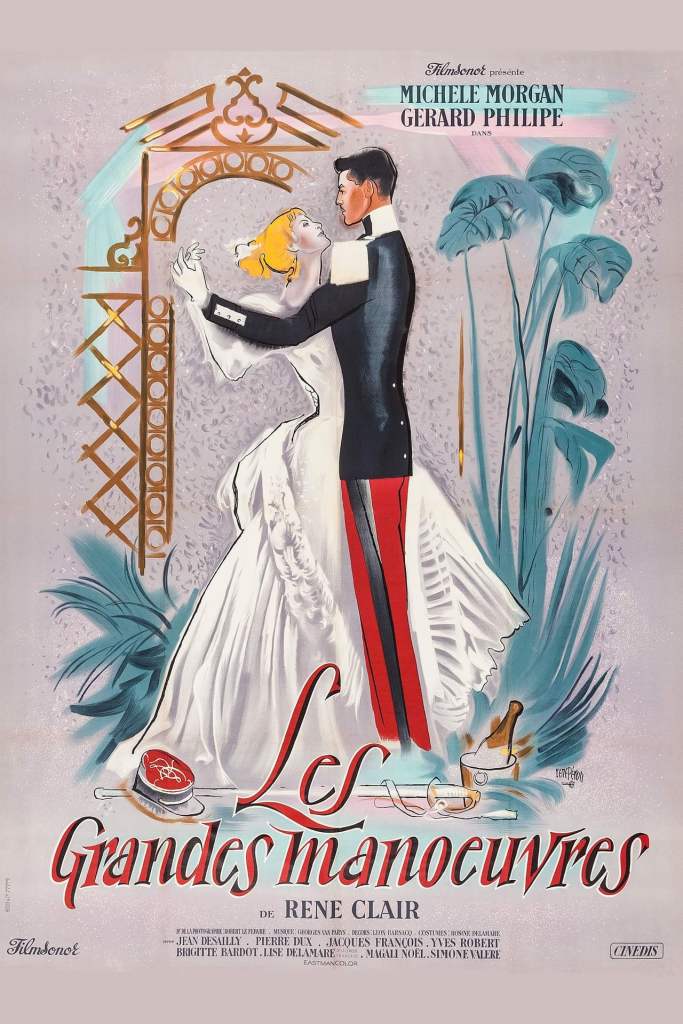
Les Grandes Manœuvres (The Grand Maneuver) came a few years later, in 1955, and was Clair’s first color picture. This is a delightful film about a French officer who makes a bet he can’t win. Armand is your typical Don Juan character, wooing ladies and strutting around town with quite the scandalous reputation. Thinking he can’t lose, he takes a bet with a group of men that he can “obtain the favors” of any woman chosen at random, and within the next 30 days before military training maneuvers take him out of town. The random woman ends up being Marie-Louise, a Parisian new to the area who is already whispered behind her back, A) for being divorced, and B) for possibly being a “kept woman” to the respectable Victor Duverger. The rumors are false; Victor does want to marry her, but there is no hanky panky going on. What Armand doesn’t account for is his actually falling in love with Marie-Louise. Unfortunately for him, anytime she starts to reciprocate those feelings, she hears a new rumor of the sordid past of her admirer, and all the while, Victor is waiting in the wings to take her away. It’s not a very original story, but it is a very fun (and funny) movie, with some cute subplots (like Armand’s friend trying to use Armand’s tried-and-true techniques on a woman of his own), and absolutely gorgeous sets and costumes. Highly recommended. ★★★★½
TV series currently watching: Star Wars Rebels (season 4)
Book currently reading: The Eye of the World by Robert Jordan
How about some classic 80’s films, featuring some heavy star power? Today I’ve got three from director Alex Cox and a couple from Brian de Palma, with an Albert Brooks comedy thrown in too. Starting off with Cox’s debut, Repo Man, starring the late great Harry Dean Stanton and Emilio Estevez. Parts of this film looked familiar, so I’ve either seen it long ago or caught bits and pieces over the years. Still “new enough” to me to be fresh. Or, to borrow from a popular website, maybe I should say “rotten.” I don’t get the praise this film gets, or maybe it’s just made for a different generation. It’s a haphazard mess about various groups including some repo men, government agencies, UFO thrill-seekers, and a local gang, all looking for a stolen Chevy Malibu, because apparently, there are the bodies of alien terrestrials in the trunk. Estevez plays Otto, a young punk going aimlessly through life when he is recruited by Bud (Stanton) to join his repo team. Their adventures include lots of crazy repos and interactions with the other seedy night-time inhabitants of Los Angeles. People talk about how funny this film is, but I only laughed exactly once: a great exchange between Bud and Otto where Otto comments there aren’t any bills in Russia because everything is free. Bud shoots back that nothing’s free in communism and that Otto better not be a communist. “Or a fuckin Christian neither.” That was funny. Other than that, this film’s a hot mess, and reminds me of all the things I generally used to not like about 80s low budget movies. ★
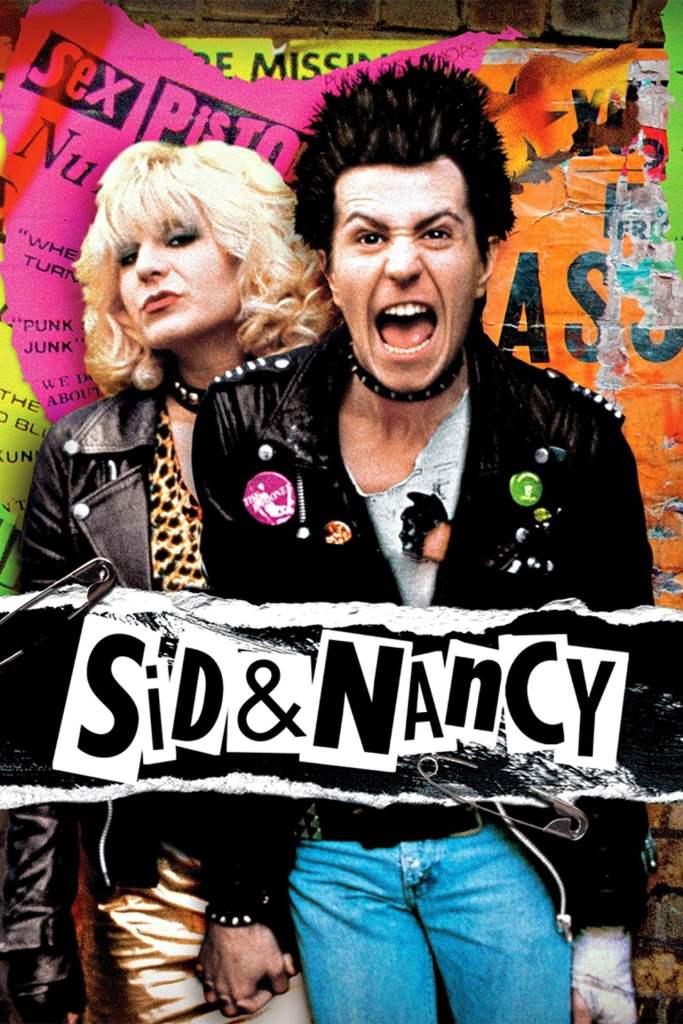
Thankfully I gave Alex Cox another try with Sid and Nancy, and, it’s funny, because for all the reasons I didn’t like Repo Man, I really enjoyed this one. The chaotic, fly-by-the-seat-of-your-pants film style didn’t hold well for a narrative film like the above, but it works perfectly in the rock and roll scene. Sid and Nancy tells of the last year or so in the life of the Sex Pistols bassist Sid Vicious and his turbulent relationship with Nancy Spungen. The movie follows Sid’s rapid descent: leaving the band, further dependency on drugs, and eventually Nancy’s murder in a hotel room in New York. Their relationship is always front and center, how they fed off each other through manipulation, codependency, and the destruction it wreaked on their lives and those around them. Chloe Webb and a young Gary Oldman are absolutely fantastic as the star crossed lovers. I have no idea how accurate the film is (there’s lots to research online if you so care), but as a work of entertainment, it is tops. ★★★★
And, opposite to my reaction to Repo Man’s positive reviews, I mostly enjoyed Walker, despite its negative reception at the time of its release in 1987. It’s a fairly loose depiction of a man named William Walker, who, with a wealthy backer in the 1850s, led a group of Americans to Nicaragua to aid in a civil war against the president. Walker’s support comes from millionaire Cornelius Vanderbilt, who wants friendly control of the area to use as a land bridge for moving goods (in the days before the Panama Canal). Like a lot of Americans in those days, Walker is a huge believer in the might and right of the United States, and he sees no problem in going to another country to exert its influence. His group hits the shores of Nicaragua and immediately finds success, assimilating the rebels that are there fighting into his group, and they continue on towards Granada. The film plays out with a lot of purposefully placed ridiculousness (but no more ridiculous than the material it is based on, where the real Walker did indeed find himself as president of Nicaragua for a couple years before being deposed), poking satire at the ego of the American viewpoint of , but is also stark in its brutality on both sides. As it goes along, it takes on undertones (and some not so under-) of the current situation (in the 80s) of America’s backing of the Contras in Nicaragua. Seems that we just have to keep sticking our noses in places. Anyway, the movie is out there, but I laughed more and enjoyed it more than Repo Man, and again, a strong cast doesn’t hurt (led by Ed Harris in the lead, who is donning that black hat decades before Westworld). ★★★
Lost in America is a delightful old-school comedy from Albert Brooks, starring himself and Julie Hagerty as a married couple with a midlife crisis. David and Linda have what most people would consider a successful life, making good money in Los Angeles. David has been eyeing a promotion at his ad agency, but when he is passed over and instead offered a (good, but not wanted) job in New York, he decides to leave it all behind. He convinces Linda to sell their house, liquidate all their assets, and hit the road in a Winnebago; completely drop out of society, “You know, like in Easy Rider.” Unfortunately they don’t get very far out of LA before things go south. In Las Vegas, Linda’s unknown gambling addiction loses all of the couples’ money. With just a couple hundred bucks to their name, their idea of an easy life on the road is dashed before it even begins. Brooks’ humor isn’t for everyone, but I ate it up. When he goes in to ask the casino manager for their money back, I laughed till I cried. When driving on their last tank of gas and pull into a mobile home park at night and he quips, “My legs are tired, guess this looks like a good place to live.” I laughed harder. It’s not visual gags, it is your old school humor with some intelligence. I imagine kids these days would scoff, but I wish they still made comedies like this. ★★★★
I’ve seen quite a few Brian De Palma films (Carrie, The Bonfire of the Vanities, Mission Impossible, Casualties of War, to name a few), but in his long career, there’s always more to unearth. Dressed to Kill dates to 1980, and begins with a sexually frustrated wife, Kate (Angie Dickinson). She complains to her therapist, Robert (Michael Caine) about her inept husband, and even makes advances to Robert, which he declines. One day, Kate hooks up with a stranger she runs into at the city museum, and when leaving his apartment that evening, she is attacked and murdered in the elevator. The only witness is a high-class call girl, Liz (Nancy Allen), and she becomes the police’s number one suspect. But Liz knows she is innocent, and she is aided in her personal investigation by Kate’s son Peter, a whizkid who wants to find his mom’s killer. The suspense in this film borders on 80s schlock, but there are highlights, and the killer’s identity isn’t (completely) heralded. Though the thrills are a bit old-timey, there’s still enough to enjoy for the modern viewer. ★★½
Blow Out is a fantastic mystery thriller starring John Travolta and Nancy Allen. Jack is a low-budget film sound effects editor, good at his job but with skills far above his current line of work. He’s out one night in the park with tape recorder in hand, getting new sounds to use in film, when he witnesses a car go off the road and into a creek. Jack jumps in and saves Sally, but the man in the car does not survive. At the hospital, Jack learns the dead driver was Governor McRyan, who was on track to become the next president of the USA. Sally was not McRyan’s wife; she was a call girl, so the powers at be are quick to do a coverup. When Jack reviews his audio recording, he becomes convinced that it was no accident, as he is sure he hears a gunshot before the tire blows out. The police don’t believe him, but Jack is relentless in getting to the bottom of who may have wanted the governor dead. That rabbit hole goes a lot deeper than anyone would have guessed, and it seems everyone is involved. Travolta is on his game here, and this is easily one of the best I’ve seen him in. Lots of twists, but nothing gimmicky, and some real suspense, with John Lithgow glowing as the sinister bad guy. ★★★★★
TV series currently watching: Snowpiercer (season 1)
Book currently reading: The Eye of the World by Robert Jordan
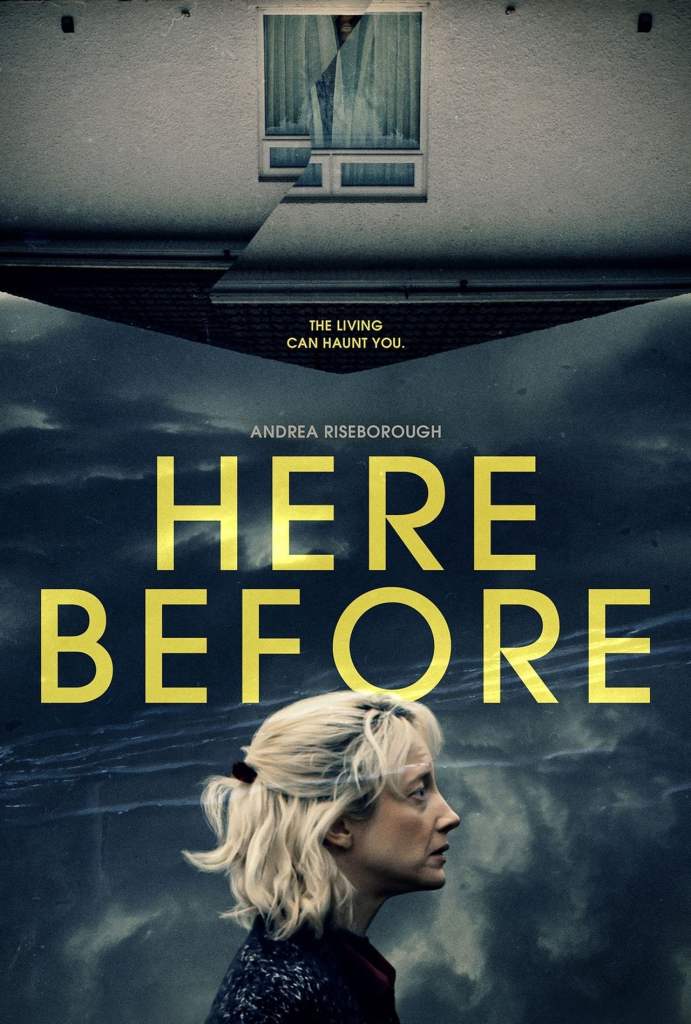
Here Before is, mostly, a very good low-key psychological thriller, that keeps the viewer guessing on what exactly is going on for a good portion of its running time (which is short at 83 minutes). The central character is Laura (Andrea Riseborough, who’s been in a few things, but whom I most remember as Tom Cruise’s companion in Oblivion). She and her husband and son are living in a semi-detached house when they get new neighbors. Laura is immediately drawn to the new family’s daughter, Megan. Megan seems to reciprocate those feelings, and a strange attachment develops between the two. Laura’s husband makes allusions to a daughter the couple lost a few years ago, and the viewer thinks maybe Laura sees something in Megan that reminds her of her dead daughter. But then Megan starts claiming memories of the daughter’s life, and Laura starts to think Megan is her lost daughter reincarnated. The end has a weird twist that knocks this film down a notch for me, and the burn is awfully slow anyway, so that may turn others off. But for most of the journey, I was digging it. ★★★
Red Rocket got a lot of attention in the indie film circuit, and while I’ve yet to see a film of director Sean Baker’s that I really loved, I wanted to give it a chance. The central figure is Mikey Davies, who returns to the rural town of Texas City after a decade-plus career in LA as a porn actor (going by the name of Mikey Saber, in reference to his huge… um… you get it). Broke and with no prospects, he finds himself on the couch of his wife (still married, though long separated). Lexi made the trip to LA with Mikey long ago, but her career flopped where his took off, and she’s been back in town for a long time now. Mikey is bumming around town when he falls for the girl working at the local donut shop. Unfortunately the girl, Raylee, is only 17 years old, but as Mikey and the filmmakers agree, that’s legal age. The two start a relationship, even as Mikey has been sleeping with his wife again, so she won’t kick him out. Mikey sees a potential porn star in Raylee, and starts grooming her to accompany him back to LA, to jumpstart his career again. Simon Rex is deserved of all the accolades he got as Mikey, he really is fantastic, but the movie is awfully off-putting for my tastes, and not the least of which is the predatory behavior of Mikey on Raylee. The ending is also very strange and silly, just sort of comes out of left field. Movie lovers will enjoy Rex’s performance, but in my book that’s really the only reason to watch. Not sure what all the hype was about as far as the film itself goes. ★★½
Second time in a couple weeks where I watched a movie with glowing reviews that was a big old dud in my book. Did we watch the same movie? C’mon C’mon stars Joaquin Phoenix as Johnny, a journalist working on a report about how kids feel about the future. It’s a busy job that takes him across the country, but into his chaotic life comes his nephew Jesse. Johnny’s sister is trying to help her estranged husband, who is having a mental breakdown, and she’s asked Johnny to watch Jesse for a bit. Johnny takes Jesse off to New York to “help” him in his job. I guess from there, the two are supposed to form a bond, Johnny (I’m sure) will learn how to stop and smell the flowers, but I’ll never know, because I gave up on this slog after about 40 minutes. I’m always a leery of films shown in black and white; sometimes it works, but it can equally as often just come off as pretentious, and this film very much felt like the latter. And the way the film is told, with tons of voiceover, where characters will continue conversations even as the scene changes, grated on me to no end. It was like watching one long commercial that never went anywhere. ½
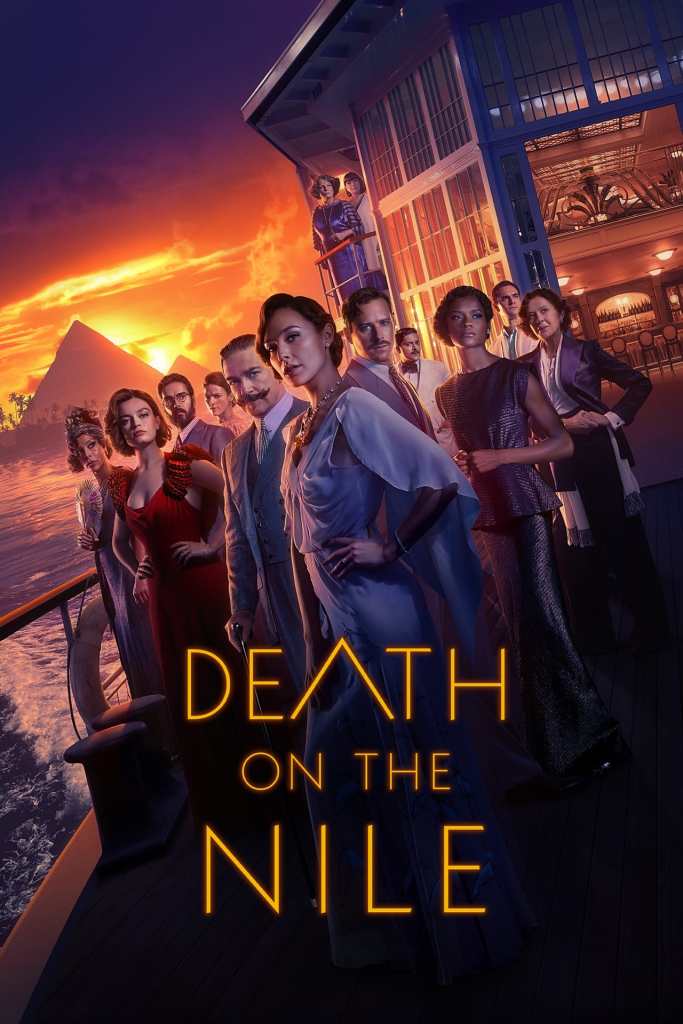
Death on the Nile is a quasi-sequel to 2017’s Murder on the Orient Express, in that they are both based on Agatha Christie novels focused on super sleuth Hercule Poirot. This film carries over the same actor as Poirot (Kenneth Branagh), as well as the same writer, directer, and production team. As in the first film, the rest of the cast is filled out with all-stars, including Gal Gadot, Annette Bening, and Armie Hammer. In this escapade, a wealthy heiress named Linnet has just married Simon, after a short whirlwind affair. Simon’s ex-girlfriend, Jackie, Linnet’s former friend, is not over him, and Linnet’s former boy-toy, Windlesham, hasn’t moved on from her either. Both exes find themselves on a river cruise with the new happy couple, along with a host of others who all carry varying degrees of grudges against Linnet. So of course, she ends up dead. But Poirot is also on board, and he can sniff out the murderer. I have much the same feelings towards this film as I did Orient Express: there are highlights for sure, but for the most part, strong acting covers up a lot of holes in the writing. Some of the old-timey shtick is cute, but there’s also some eye-roll moments. All in all, a hair above average. ★★★
I just finished up watching the first season of Netflix’s The Witcher, so thought I’d jump into the animated prequel film The Witcher: Nightmare of the Wolf. This one follows the life of Witcher Vesemir, who apparently (since I haven’t seen it yet) plays a bit part in the second season of the show, as main character Geralt’s mentor. This film shows Vesemir as a kid who, with dreams of riches and glory, leaves his past life behind to initiate into training to become a Witcher. If you’ve not seen the show (or played the video games), Witchers are human mutants given special powers, and are tasked with destroying the very real monsters in the magical land. Told in two time periods, when Vesemir is a child trying to survive his training, and later as an adult when he is tasked to save a kingdom from a beast killing children in the area. I never used to watch any adult animated films or series, but have recently dipped my toes into a few, and movies like this make me glad for it. I really enjoyed the backstory of a Witcher’s life, what they go through, and more details about their powers, as well as more history of the wars between humans and elves. The world of the Witchers has lots of depth which, if played right, can yield stories for years to come in various shows and film. Me, being a fantasy world reader/watcher, really enjoyed it all. ★★★½
TV series currently watching: The Witcher (season 1)
Book currently reading: The Eye of the World by Robert Jordan
Who’s in for some German films today?! I’m diving in for director Volker Schlöndorff. Influenced by the late 50’s/early 60’s French New Wave movement, Schlöndorff’s early films were tied to the New German Cinema movement. He started in Germany but would later make films in several countries, including the USA (where he would make the first film version of Atwood’s The Handmaid’s Tale). I’ll be focusing on five of his German pieces today, starting with his debut, Young Törless, in 1966.
Young Törless is about a boy, Thomas Törless, who is new to boarding school. He is quiet but very intelligent, observing everything going on around in a detached way. Two of the more powerful boys at school, Beineberg and Reiting, begin tormenting another boy, Basini, after it is discovered that Basini had stolen money from one of them. The two bullies threaten Basini with disclosing the theft to the teachers, which would most likely get him expelled, so Basini agrees to be their servant, doing anything they ask. Unfortunately this turns into cruel and demeaning torture. Though it is strongly hinted but never explicitly stated (maybe due to censors?), it seems the boys are making Basini engage in homosexual acts. Thomas is disgusted with the cruelty, but refuses to help Basini if Basini won’t help himself. It’s a very good story, lots of undertones of societal norms and acceptances, but I found the acting to be terrible. Maybe Schlöndorff went with non-professional actors (I didn’t research), but sometimes they are downright bad. Took away from what should have been a very moving film. ★★½
A television film released in 1970, Baal stars Rainer Werner Fassbinder (who had directed just a couple feature films to this point, and was yet to explode on the international scene), as well as several of Fassbinder’s usual troupe of actors. Baal (Fassbinder) is a gifted poet, and in the beginning of the movie, he is attending a snooty bourgeois dinner. Baal obviously holds a lot of disdain for the other guests, and he makes his feelings known. He gets booted out, but not before wooing the host’s wife, and later bedding her. Back amongst the common people, we see that Baal’s contempt isn’t relegated to just the rich: he treats everyone with derision. Honestly, he’s a huge asshole, even sleeping with his best (and only) friend’s girlfriends. The women know that Baal is a huge jerk, but they can’t seem to help themselves around his bad boy sexy attitude. Don’t worry, because by the end of the film, Baal gets what’s coming to him. Normally, this is not a movie I’d like very much. There’s little plot, and it can be a bit heavy handed at times, but damn, if I wasn’t enthralled throughout. I hung on every one of Baal’s moves, just like the ladies. I was all in from the opening song to Baal’s comeuppance. ★★★½
In The Lost Honor of Katharina Blum, Schlöndorff attacks the runaway tabloid journalism that was rampant in West Germany at the time. In the film, a man escapes police surveillance, steals a car, and ends up at a night club. There, the man, Ludwig, meets Katharina, and she is instantly smitten. Normally quiet and reserved (her friends call her “the nun,”), Katharina takes Ludwig home at the end of the night. The next morning, police storm her apartment, but Ludwig is nowhere to be found. So starts the smear campaign. The cops are all over Katharina, looking for information as to Ludwig’s whereabouts, and if she was in league with him all along. Within a couple days, they build a solid case against her, but it’s all circumstantial evidence. To turn the screws, the police leak some details to the tabloids. One journalist in particular isn’t satisfied stopping there, and he goes after Katharina’s employers, mother, etc. Anything for a splashy front page story. By the end, the viewer has no illusions to the writer’s morality, but at the same time, the movie forgives Katharina an awful lot for her aiding and abetting, and I couldn’t look past that so easily. Engaging film though. ★★★
Coup de Grâce is the one film out of today’s series to hit it out of the park. Set in Latvia in 1919 at the tail end of the Bolshevik Revolution, German soldiers Konrad and Erich have returned home, trying to push back Bolshevik soldiers looking to expand Russian territory. Konrad and his unit are stationed out of his childhood mansion, and he is reunited with his sister Sophie. Erich was a childhood friend of the family, but now as adults, Sophie starts falling in love with him. He does not seem interested, insisting that she would not be satisfied with him. Whatever it is that is keeping him from getting with Sophie, Erich’s rebuff greatly upsets her, and Sophie begins sleeping with random soldiers in their company as a way to make Erich jealous. She also has a secret of her own: whenever she goes into town on errands, she meets up with friends that are supportive of the socialist/communist movement. Despite her political ideologies, she can’t help herself but continue to love Erich. The reason for Erich’s hesitation is a big surprise to the viewer, so I don’t want to give it away, but let’s just say that the film was way ahead of it’s time. When Sophie learns the “why,” she gives up her charade and joins the militant guerrillas against the German soldiers. It will not end will for her. Explosive movie full of intrigue and emotion. ★★★★
Ending today with The Tin Drum, which won all kinds of awards upon its release in 1979 (Palme d’Or, Oscar for Best Foreign Language film, among others). The main character is Oskar, a boy who is born fully intelligent and cognizant (watching his birth from his point of view is a sight to see!). Oskar’s mother, Agnes, is in a rough marriage with pro-Nazi Alfred, but she’s had a longtime affair with anti-Nazi Polish citizen Jan, and Jan may even be Oskar’s father. Two things happen when Oskar is 3 years old: he is gifted a toy drum, which becomes his favorite toy, never putting it down; and he witnesses his parents engaged in drunken tomfoolery. Disgusted with their behavior, Oskar decides he will never grown up. He doesn’t, staying the same size and not aging a day afterwards. A medical oddity, his parents accept it and life goes on. Throughout the next few years, Oskar witnesses a lot of things that a normal 3 year should not see (sex between Agnes and Jan is one example), and he also witnesses the death of all of those close to him. First Agnes, who, after getting in a huge argument with her husband about eating eels, goes on to eat fish at a breakneck speed until she dies. Jan is killed by the Nazi’s when they raid the Polish post office where he works. Now raising a 16-year-old Oskar in a 3-year-old body, Alfred starts paying the teenager from the apartment upstairs to help watch him. Oskar has his first love with this girl, but walks into a room one day to see her having sex with Alfred too. This finally motivates Oskar to move on, and he goes out into the world to have adventures of his own. The film has moments of dark comedy, later-Fellini-esque magical realism, and while some moments can get a little silly, the emotional punch of Oskar’s often turbulent ride has more highs than lows. ★★★½
TV series currently watching: Lost in Space (season 3)
Book currently reading: Relentless by RA Salvatore
Had a good time (date night!) checking out the latest romcom, The Lost City. Starring Channing Tatum and Sandra Bullock (doing what she’s done best for nearly 30 years now), it gives serious Romancing the Stone vibes, and while it might not one day be considered a classic like that film, it is still a fun diversion.
Loretta Sage is an author of a longtime series of romance novels, but five years after the death of her husband, she’s about ready to give it all up. She can’t find a satisfying ending for her latest book, and doesn’t like how some of her biggest fans care more for the male model gracing the cover of her novels than the novels themselves. That model is Alan Caprison, whose persona, Dash McMahon, is the main hero in Loretta’s books. Chiseled and good looking, the ladies (and many men) love “Dash,” but Loretta thinks he’s just a shallow musclehead. Finally with an unsatisfactory ending pushed through, Loretta, her publisher, and Alan embark on a book signing tour to promote. However, plans go awry.
The evening of their first meet-and-greet, Loretta is kidnapped by Fairfax (Daniel Radcliffe). He’s a wealthy treasure hunter with a bit of forgotten-brother syndrome. He wants to find a legendary item known as the Crown of Fire, supposedly on a remote island in the Atlantic. Loretta once wrote about the Crown, with the help of her deceased husband at the time, who was an expert archeologist. Fairfax is hoping some of her husband’s knowledge has rubbed off on Loretta; he takes her to the island and wants her to decipher some ancient writing to find the artifact’s location. However, using her smartwatch’s location, Alan is able to higher an ex-special forces guru (Brad Pitt) to rescue her. When the rescuer falls, “Dash” must step up to be the hero from Loretta’s books.
I do like the modern take on the classic tale. Though the strong man is there to rescue the damsel in distress, Loretta certainly holds her own and does a lot of the “rescuing” too. The movie is also very funny, and there isn’t too much cheese going around. If you are measuring the film purely on entertainment factor, it scores high. ★★★½
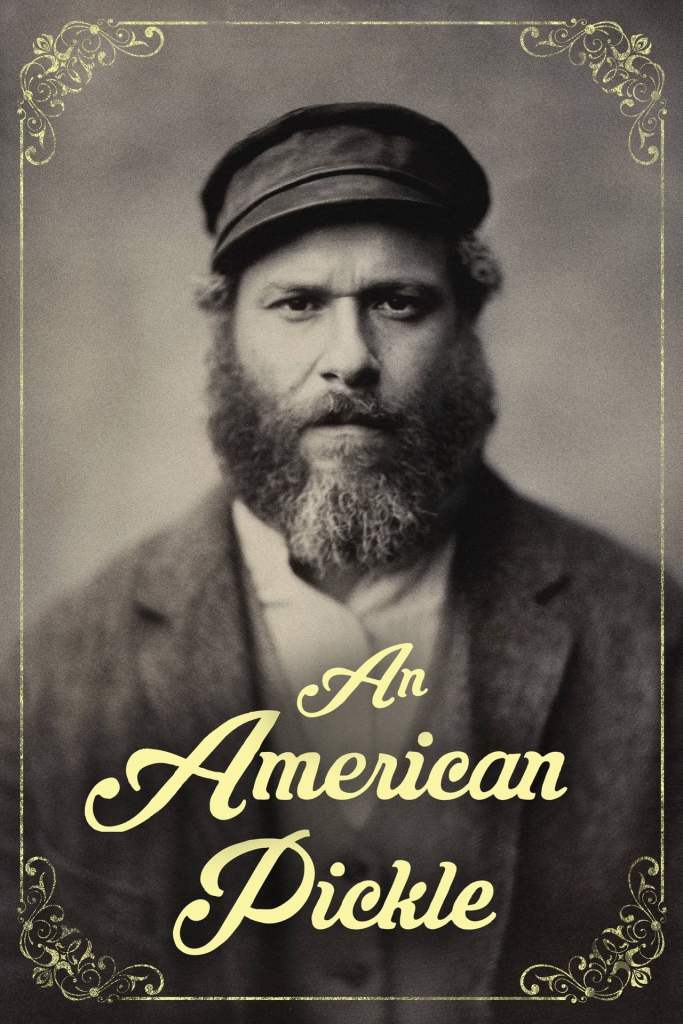
Thanks a lot Zac. You know, once in awhile my buddy recommends something decent, but more often than not I am reminded that we do not share tastes in movies. An American Pickle was his latest recommendation. I usually steer clear of Seth Rogen films (the only one that I can recall truly liking wasn’t even a comedy: Boyle’s/Sorkin’s Steve Jobs), and this movie hasn’t changed my mind. In this one, he plays Jewish Russian immigrant Herschel Greenbaum, who’s come to America with his pregnant wife to escape persecution. He falls into a pickle vat at work one day and the brine keeps him preserved for 100 years, awakening finally in present day Brooklyn. Herschel is united with his only living family member, great-grandson Ben (also played by Rogen). Ben’s parents are dead, but he seems to have left them on bad terms, as he doesn’t want to discuss family events with his ancestor. Ben’s been struggling to find success with an app he’s been building for 5 years, but Herschel immediately finds success and popularity in the pickle business. Jealous and angry, Ben tries to sabotage Herschel at every turn. There are chuckles, mostly from Herschel’s learning curve adjusting (or failing to adjust) to this new world, as he butts up against social media and changes to societal norms, but chuckles is all it elicited from me. Far too predictable, not funny enough to stand up to the great comedies, and not enough heart to cross into solid drama territory. ★★
Violet, starring Olivia Munn, is a very interesting movie. The title character is a woman struggling with inner demons in her everyday life. Successful professionally, she is hounded by an inner voice that tears her down at every step, and continual thoughts belittling her, which show up as written script across the screen. When Violet gets really frazzled, the screen fades to red as the conversations around her fade out, indicative of Violet pulling away from those around her. The film follows along as she tries to reconnect to old friends, stand up for herself at work, and find love, all while everything in her mind and body keeps telling her that she isn’t good enough. There’s a lot going on on screen, and the near-incessant dialogue can make it tough to really focus on what is happening. Thus, I can’t say much for the acting performances, because I found it hard to really center on the characters for any length of time, but the film is very different from your usual dramas. I think it is definitely worth watching, for a new viewing experience if nothing else, but not sure it is all that memorable. ★★★
The Bombardment (original title The Shadow in My Eye) is a Danish film detailing a horrific event near the end of World War II. The German gestapo have a base in Copenhagen where they interrogate and torture local underground resistance fighters, and Allied spies have been urging the British to take the target out. The first half of the film will test your patience, where nearly a dozen or so various characters are introduced, ranging from the resistance, some British Royal Air Force pilots, a conflicted Danish civilian who’s enlisted in the German occupying army, a nun at the local school who is searching for signs of God in these awful times, and a trio of young friends at the school. I get that the filmmaker wanted to flesh these characters out, but it did take a really long time to get to the meat and potatoes. When the bomber planes take off from England, the events will hit you hard. On their way to bomb the gestapo headquarters, one of the planes clips a tower and crashes into the school. The two ensuing bomber raids see the smoke, and mistakenly think the school is the target. With the atrocities of the war in Ukraine in full view, we are easily reminded that these mistakes happen in war, but that doesn’t make them any easier to swallow, and maybe more so when they are done by “the good guys.” Though I’m sure Operation Carthage is still taught and remembered in Denmark, I’d never heard of it, and I’m not ashamed to admit I was moved to tears. ★★★★
Dumb, dumb, dumb. Bad Luck Banging or Loony Porn is a cumbersome title for a cumbersome movie. It’s labeled as a comedy-drama, but it’s more of a dark satire. Emi is a good teacher at a well-to-do school, but she’s in hot water after she and her husband make a sex tape, which gets uploaded to the internet. The parents at the school are calling for her job, but the school is trying to do its due process, knowing that Emi has been good at her job. The movie is made up of three parts. The first is mostly just Emi walking around town, while the camera catches scenes of vulgarity or explicit advertisements all around her. The middle section steps away from Emi and is just a bunch of tiny segments, a montage of sorts, about society and its norms and taboos. The final section is the school meeting that night, where Emi sits in front of all the parents to learn her fate. There’s a lot of ridiculousness at the meeting, including a parent who insists on showing the sex tape on her tablet to all present, just so “they know what they are talking about.” The fathers obviously love it, but then go on to talk about how terrible Emi is. Stupid movie, which I ended up fast-forwarding through large chunks after the monotony set in. ½
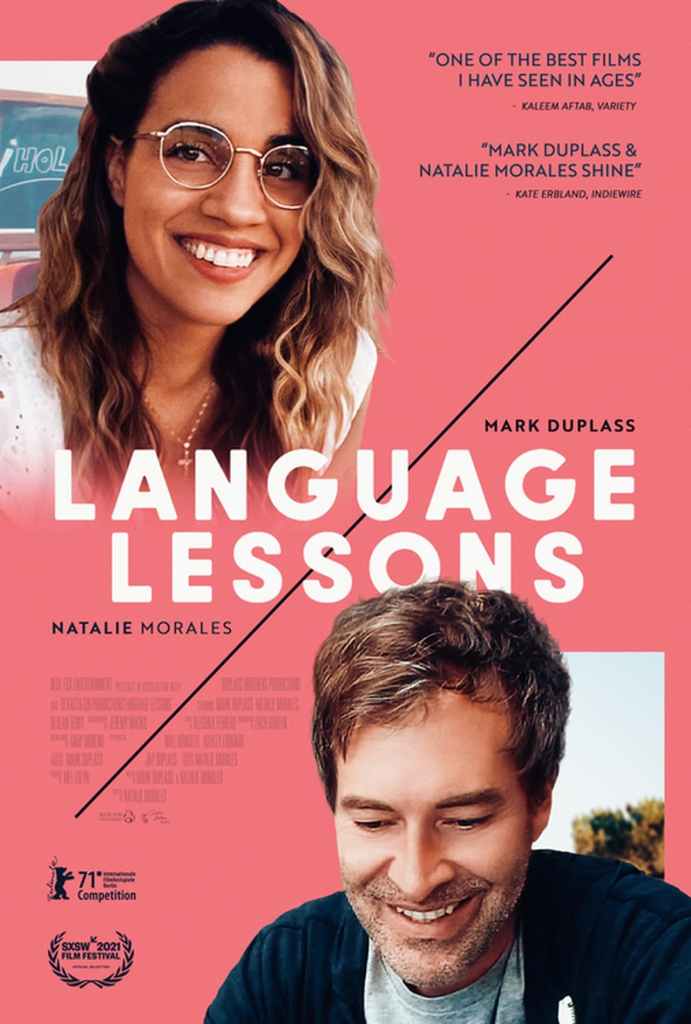
Language Lessons is a small indie film with only two characters: Mark Duplass as Adam, and Natalie Morales as Cariño (the two co-wrote the screenplay as well, with Morales taking director duties). Adam has just been gifted 1000 Spanish lessons from his husband Will, sort of as a prank, but also because the couple is very wealthy and look for creative presents to give each other. Cariño is the Spanish teacher, who will give Adam once-a-week online lessons for the next couple years from her home in Costa Rica. On the morning of their second lesson though, Adam’s screen comes on to show him laying in bed, despondent. Adam tells Carińo that Will died in an accident last night, and since he took care of everything from finances to housework, Adam has no idea where to begin. Over the course of the film, Adam and Carińo form a strong friendship. At first, she helps him through his grief, but later, he is able to return the favor when Carińo starts going through her own struggles. It’s kind of a genius way to make a film in the early COVID era, as the two characters are never in the same room (it was shot during the pandemic lockdown), and we only see them when they are talking to each other via Zoom/Facetime. Production aside, it’s a very nice movie too. Nothing groundbreaking, but it’s a tender, well-acted film about finding your way back to life. ★★★½
TV series currently watching: Silicon Valley (seasons 3+4)
Book currently reading: Relentless by RA Salvatore
After recently watching some Francesco Rosi films, an Italian director known for gritty realistic and political films, I thought about going for the opposite side of the spectrum. Another Italian, Luchino Visconti, is known for his lavish, often historical, dramas. I’m starting with Senso, which takes place at a time in the mid-19th Century when Italy was occupied by an Austrian army. At the opera house, we meet the movie’s centerpiece, Livia Serpieri. A countess married to an older man, Livia is immediately attracted to the young dashing Franz Mahler. Unfortunately Franz is on the wrong side; he’s a soldier in the Austrian army. As Livia’s cousin Roberto protests against the Austrian occupation (which gets him sent off in exile), Livia can’t help herself; the viewer knows Franz is playing her for her money and doesn’t really care for her, but she is all in. Even when he disappears for weeks at a time, she takes him back. We get to ride along with the train wreck as Livia continually follows after Franz like a little school girl. I enjoyed it while watching it, but I’m not sure it is going to be all that memorable. Nothing really stuck with me once it was over. ★★★
The Leopard is an old school historical drama, taking place in mid-19th Century Sicily. The Prince of Salina (Burt Lancaster) looks over a vast estate, a castle so large that there are rooms no one living has visited. Salina enjoys the comforts of his ancestral position, but times are changing. A war is about to break out between the current King and a revolutionary named Garibaldi. Salina is old enough, and wise enough, to think that whoever wins really won’t change his lifestyle; rulers come and go, but things always have settled back to norm in the past. Salina dotes on his nephew, Tancredi (Alain Delon), who is joining up with Garibaldi’s rebellion. As the film goes along though, we see that Tancredi is definitely of the “new class,” and doesn’t hold any real ideals, joining whatever group will provide him the better comfort in the future. Salina will also see before the end of the movie that this time, there is no returning to the way things have held for generations. People of “new money” coming to balls are changing societal norms, and there are more people like Tancredi, who are ambitious and will do anything to get ahead, than like Salina, who likes to go with the flow and not change the status quo. It has a very Gone With the Wind-like feel; a way of life is leaving forever. The movie is long (3 hours), but I didn’t see a lot of extra fat. Every scene and every conversation lends to character development and/or overall feel. And to say it is gorgeous is an understatement. Beautiful costumes, shot on location in Palermo, the whole movie is a joy to watch. ★★★★
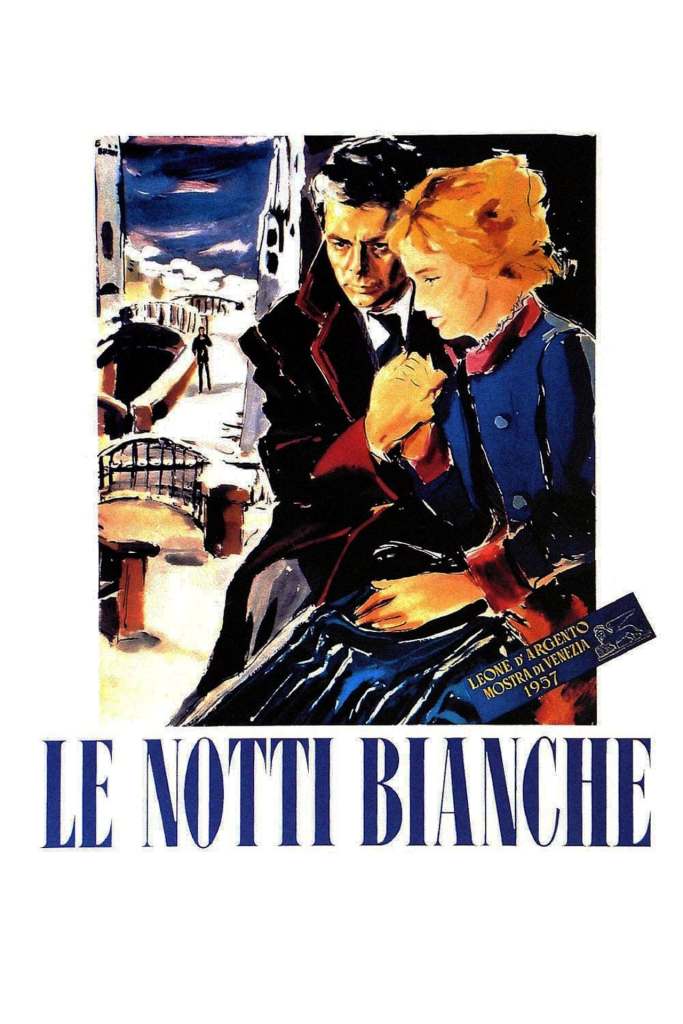
I usually review these films in chronological order, but since this director made so many historical pieces, and wanting to split them up a bit, I watched The Leopard (1963) before Le notti bianche (White Nights, 1957). Based on a story by Fyodor Dostoevsky (I’ve read a couple of his major works, but not this one), it tells the tale of a man, Mario (the great Marcello Mastroianni), who is wandering the streets late one night. He happens upon a woman crying, who is receiving unwanted attention from some drunk men. Mario chases them off and meets the girl, Natalia (an adorable Maria Schell). Mario is instantly smitten, and while Natalia seems to like him too, she is reserved. Mario soon learns her story: raised in an extremely conservative household by an overbearing grandmother, Natalia fell in love with the first man who came along, a lodger in their household. However, he owed the wrong people some money, and told Natalia he needed to disappear. He promised to reunite with her in one year at the bridge where Mario found her waiting. With the anniversary here, Natalia has been returning to the bridge every night, waiting for her “true love.” Mario can’t believe what he is hearing: here’s a smart and attractive young woman who has put her life on hold for a year for someone who Mario is sure is never returning. Despite a cute little story, solid acting, and outstanding cinematography in the smoky nights, I didn’t get into this one. Natalia was so cute she was nauseating after awhile; Mario wasn’t the only one who was ready to bang his head against the wall over her antics. ★★
You ever get that feeling that you watched a completely different movie than everyone else? Visconti received a lot of attention for The Damned, but I thought it was downright awful. Taking place in 1930s Germany, it follows an aristocratic family, the Essenbecks, who run a steel business. The patriarch, Baron Joachim von Essenbeck, does not like Hitler, but some of his kids and grandkids see opportunity in backing Hitler’s new regime. One night, the Baron is murdered in his own bed, but the man charged in the crime has been set up by other family members, because of his outspoken criticism of the Nazi party. As the power struggle for governing control of the company ramps up, each family member will stop at nothing to make sure he (or she) comes out on top. Sounds great, but this movie was far too over the top. The actors are continually hamming it up in every scene. You don’t even have to listen to the dialogue to know if someone is up to no good, just look for a caricature-like evil grin on their lips and you’ll know. Wild camera work, with extreme close-ups, doesn’t help. And I didn’t even mention that its runtime approaches 3 hours. I’ll give it a single star because I actually made it through and didn’t quit, but I’ll never watch this one again. ★
Sometimes filmmakers will make a movie that is purposefully abhorrent, just to elicit a reaction. Death in Venice is such a film. Based on a book by the renowned author Thomas Mann, and following in the wake of The Damned and continuing down a similar vein (the repugnant behavior of the elite class), this film follows a successful composer, Gustav von Aschenbach, as he vacations in Venice. Gustav is dying of some unknown illness, and goes around in a foul mood. He is arrogant and quite frankly, an asshole, as he makes demands upon baggage handlers, hotel staff, etc. However, he starts to enjoy himself when he becomes smitten by an effeminate boy, who can be no more than 12 or 13 years old. The boy, Tadzio, is at the resort with his family, and Gustav takes any opportunity to lear at him on the beach or in the community dining room. Almost wanting to keep himself miserable, Gustav decides to leave and return home, but his luggage is inadvertently shipped to the wrong place, and Gustav returns to the hotel in Venice. The scene of him on the boat back to the resort, where is so giddy that he can’t sit still, with sweeping happy music playing over, all because Gustav can return to Tadzio, is as creepster as it gets, and will leave you feeling dirty. Back in Venice, Gustav continues his leering, but also begins to notice other dire events around the city. There are rumors going around of a sickness, and Gustav sees city workers spreading disinfectant around the streets. The hotel staff says nothing is wrong, but obviously something is going on. There’s an obvious correlation between the rampant disease in the city, Gustav’s own decaying body, as well as his sinister thoughts and urges, so while the material is repulsive, I found it to be a much better film than The Damned. ★★★
Finishing up today with Visconti’s full, original version of 1973’s Ludwig. Often edited down to smaller lengths over the years, I went for the 4 hour version, in Italian rather than English. After the overall unevenness I experienced with Visconti’s films leading up to this, maybe I’m a glutton for punishment, but thankfully I enjoyed this one. It tells the life and death of King Ludwig II of Bavaria, starting with his coronation at age 18 in 1864. Ludwig immediately finds himself in the crosshairs of the aristocracy; he spends lavishly with no regard to what the nobles want, and seems to take little interest in governmental affairs. Whether it is financing Richard Wagner’s latest opera and paying off Wagner’s substantial debts, or barely supporting his country’s involvement in the Austro-Prussian War, Ludwig is certainly not making any friends at court. He mother and confidents urge him to marry and produce an heir, but Ludwig only has eyes for his cousin Elizabeth, who is already married. In a moment of inspiration, she tells Ludwig to look inward and find that he doesn’t really want her at all, and that he should marry her sister Sophie instead, as she will at least be a good, faithful wife. In a moment of self-reflection, Ludwig finds what Elizabeth was alluding to, that he is gay. Devoutly Catholic, he prays to be released from his homosexual urges, and announces that he will indeed marry Sophie.
The second half of the film slows down a bit. Ludwig keeps delaying his wedding to Sophie, until he ends up cancelling it altogether. He begins spending even more lavishly than before, and removes himself from state affairs until he is lonely, unkept, and surrounded solely by young men and sycophants. He is abandoned by Wagner, who really was just into it for the money, and when Ludwig tries to pull in actors or other artists to be close confidants/friends, they betray him as well, leaving him very much alone. When the government has had enough with his ways, they decide to take him out, and get a doctor to declare him medically unfit to rule. As his family has a history of mental illness, it is very believable (even the viewer is unsure). His short 22 year reign ends unceremoniously, when he dies in a shallow lake. Whether it was suicide or murder, remains a mystery to this day. I thoroughly enjoyed the first half to 2/3’rds of the movie, and while it did slow towards the conclusion, it’s still an overall very engaging film. Helmut Berger is tremendous as Ludwig II, and he did win Italy’s version of an Oscar for the role. ★★★½
TV series currently watching: Peacemaker (season 1)
Book currently reading: Relentless by RA Salvatore
Some very good pictures in today’s lineup, so let’s get started! After Yang is the second film from director Kogonada (I really liked his debut, Columbus, a few years ago). Taking place at some undetermined point in the future, Jake (Colin Farrell) and his wife Kyra (Jodie Turner-Smith) are raising their adopted daughter Mika with the help of android Yang. Yang was purchased to help Mika, who is of Chinese descent, have a connection with her birth nation, as Yang looks Asian and is filled with facts about China. Early in the film though, Yang malfunctions and shuts off. Yang is everything to the household: servant, babysitter, and Mika’s best friend. She is devastated, and Jake, who’s a bit of an absent father due to work and who relies on Yang to watch his daughter, starts looking into getting him repaired. When Jake takes Yang to get him fixed, they access his memories and give a copy to Jake, who starts reviewing them. What he finds will wake Jake up to the world around him. The film examines questions of what is humanity, and do you need to be human to exhibit it. Yang’s memories remind Jake to slow down and look around once in awhile, to enjoy life. Very touching film, told in a beautiful, leisurely pace that allows the viewer to enjoy the path Jake is taking along with him. ★★★½
I Was a Simple Man is a quiet, understated film about a man who is anything but simple. Masao is an older man of Japanese descent, living in Hawaii with only a dog as his companion. His wife died many years ago, and he is estranged from two of his adult children: the eldest son lives on the mainland and is only a voice on the phone, and his daughter barely wants to speak to him. Masao’s younger son is around, but suffers from a mental illness that has kept him from holding down a job. Within this scenario, Masao is given the graven news from his doctor that he is dying, and he doesn’t have much time left. As the film progresses, we see what splintered Masao’s family, and the guilt he lives with because of it. As he grows closer to death, Masao begins to see the spirit of his long-dead wife, and converses with her about his regrets. This is a film which forces your attention, or you’ll miss a delicate word or sentence which can really add to the experience. A beautifully subtle picture that reminds you to make the most of the life you are given. ★★★★
American Underdog is a pretty straight forward biopic about the life of NFL quarterback Kurt Warner. Growing up in St Louis and in college when Warner burst onto the scene in 1999, I’ve been wanting to see this movie since it came out, though I didn’t expect to learn anything new. I was right, but the movie is told well. It stars Zachary Levi as Warner and Anna Paquin as his wife Brenda (as well as Adam Baldwin, Bruce McGill, and Dennis Quaid (who would never miss an opportunity to be in an uplifting sports flick) as coaches along the way). After a short introduction to a young Warner who grows up loving football, we see Kurt play his way onto the field in college at Northern Iowa, an invitation to training camp with the Packers, but then his subsequent cut and slow climb back. Unless you just aren’t a football fan, you know the story of how he went from stocking shelves at the local grocery store to leading the St Louis Rams to a Super Bowl win in just 5 years. His meteoric rise is told very well and it is extremely touching. I’m an admitted crier at an emotional film, and even though I knew what was coming, I was a blubbering mess at the end of this movie. That’s not to say it’s a super great film or anything, but it does know how to pull at the heart strings. Nothing groundbreaking, but sports film fans will find plenty to life. ★★★½
Not sure how I missed Outlaw King when it hit Netflix a couple years ago, but a buddy recently told me to check it out. I’m a big fan of the Mel Gibson Braveheart movie, and this one is told from the perspective of Robert the Bruce, the villain-turned-hero in that movie. In this one, the role is taken on by Chris Pine. Robert’s father has just sworn allegiance to the King of England, but Robert is torn by his love of Scotland and his wish to see the land ruled by its own. William Wallace has just suffered a big defeat and is in hiding, and when he is found and killed by the King’s men, Robert has finally had enough. With his father dead, Robert assumes leadership of the family and its people, and sets out to get enough followers to stand a chance against England’s armies. The film is decent enough; good action, and the bloody battles are exciting. You can’t help but compare it to Braveheart though, since many of the characters are shared across the two films, and while it doesn’t quite reach that film in emotional heft, it’s still a fine film on its own legs. ★★★½
Drive My Car is a multi-language Japanese film about a director searching for his way back to life. When we meet Kafuku, he is an accomplished theater actor, and is married to Oto, an equally well-thought-of screenwriter. The two seem to have a strong, passionate relationship, and in fact, it is their sex that spurs Oto to creativity, as she often relates stories to Kafuku afterwards. When a flight of his gets delayed one day, Kafuku returns home to find Oto sleeping with a young actor, Takatsuki. Kafuku sneaks out of the house without alerting them to his presence, and days later, Oto dies suddenly of a brain hemorrhage. Two years later, Kafuku still has not recovered from the whole experience. He has given up acting, and is now directing. He has been hired to put together a performance of Uncle Vanya in Hiroshima, and goes there to audition actors and begin production. Of course, Takatsuki is there, and is given the lead roll of Vanya. This brings back a lot of emotions to Kafuku, which he slowly, over the course of the three hour film, relates to the driver brought to ferry him back and forth from hotel to rehearsal space. The driver, a young woman named Misaki, has her own inner turmoil raging, and the two help each other along the way. This is a deeply touching movie. To say it moves leisurely is an understatement; director Ryusuke Hamaguchi is in no hurry to get to the end, and allows scenes to breathe until the viewer feels like he or she is sitting at the table with the characters, going over lines, glimpsing into inner turmoils, and feeling the anguish of the individuals. Strong film, and, recent years notwithstanding, is one of the rare foreign language films to have been nominated for an Oscar Best Picture (the 14th of all time). ★★★★
TV series currently watching: The Expanse (season 6)
Book currently reading: Dragons of the Dwarven Depths by Weis & Hickman