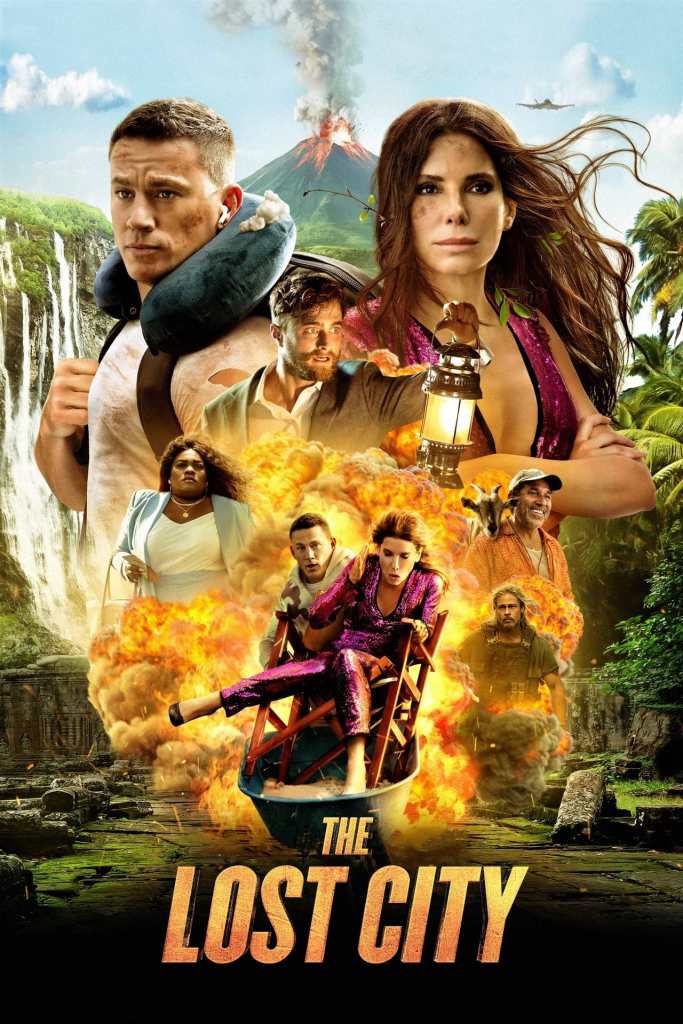
Had a good time (date night!) checking out the latest romcom, The Lost City. Starring Channing Tatum and Sandra Bullock (doing what she’s done best for nearly 30 years now), it gives serious Romancing the Stone vibes, and while it might not one day be considered a classic like that film, it is still a fun diversion.
Loretta Sage is an author of a longtime series of romance novels, but five years after the death of her husband, she’s about ready to give it all up. She can’t find a satisfying ending for her latest book, and doesn’t like how some of her biggest fans care more for the male model gracing the cover of her novels than the novels themselves. That model is Alan Caprison, whose persona, Dash McMahon, is the main hero in Loretta’s books. Chiseled and good looking, the ladies (and many men) love “Dash,” but Loretta thinks he’s just a shallow musclehead. Finally with an unsatisfactory ending pushed through, Loretta, her publisher, and Alan embark on a book signing tour to promote. However, plans go awry.
The evening of their first meet-and-greet, Loretta is kidnapped by Fairfax (Daniel Radcliffe). He’s a wealthy treasure hunter with a bit of forgotten-brother syndrome. He wants to find a legendary item known as the Crown of Fire, supposedly on a remote island in the Atlantic. Loretta once wrote about the Crown, with the help of her deceased husband at the time, who was an expert archeologist. Fairfax is hoping some of her husband’s knowledge has rubbed off on Loretta; he takes her to the island and wants her to decipher some ancient writing to find the artifact’s location. However, using her smartwatch’s location, Alan is able to higher an ex-special forces guru (Brad Pitt) to rescue her. When the rescuer falls, “Dash” must step up to be the hero from Loretta’s books.
I do like the modern take on the classic tale. Though the strong man is there to rescue the damsel in distress, Loretta certainly holds her own and does a lot of the “rescuing” too. The movie is also very funny, and there isn’t too much cheese going around. If you are measuring the film purely on entertainment factor, it scores high. ★★★½
Thanks a lot Zac. You know, once in awhile my buddy recommends something decent, but more often than not I am reminded that we do not share tastes in movies. An American Pickle was his latest recommendation. I usually steer clear of Seth Rogen films (the only one that I can recall truly liking wasn’t even a comedy: Boyle’s/Sorkin’s Steve Jobs), and this movie hasn’t changed my mind. In this one, he plays Jewish Russian immigrant Herschel Greenbaum, who’s come to America with his pregnant wife to escape persecution. He falls into a pickle vat at work one day and the brine keeps him preserved for 100 years, awakening finally in present day Brooklyn. Herschel is united with his only living family member, great-grandson Ben (also played by Rogen). Ben’s parents are dead, but he seems to have left them on bad terms, as he doesn’t want to discuss family events with his ancestor. Ben’s been struggling to find success with an app he’s been building for 5 years, but Herschel immediately finds success and popularity in the pickle business. Jealous and angry, Ben tries to sabotage Herschel at every turn. There are chuckles, mostly from Herschel’s learning curve adjusting (or failing to adjust) to this new world, as he butts up against social media and changes to societal norms, but chuckles is all it elicited from me. Far too predictable, not funny enough to stand up to the great comedies, and not enough heart to cross into solid drama territory. ★★
Violet, starring Olivia Munn, is a very interesting movie. The title character is a woman struggling with inner demons in her everyday life. Successful professionally, she is hounded by an inner voice that tears her down at every step, and continual thoughts belittling her, which show up as written script across the screen. When Violet gets really frazzled, the screen fades to red as the conversations around her fade out, indicative of Violet pulling away from those around her. The film follows along as she tries to reconnect to old friends, stand up for herself at work, and find love, all while everything in her mind and body keeps telling her that she isn’t good enough. There’s a lot going on on screen, and the near-incessant dialogue can make it tough to really focus on what is happening. Thus, I can’t say much for the acting performances, because I found it hard to really center on the characters for any length of time, but the film is very different from your usual dramas. I think it is definitely worth watching, for a new viewing experience if nothing else, but not sure it is all that memorable. ★★★
The Bombardment (original title The Shadow in My Eye) is a Danish film detailing a horrific event near the end of World War II. The German gestapo have a base in Copenhagen where they interrogate and torture local underground resistance fighters, and Allied spies have been urging the British to take the target out. The first half of the film will test your patience, where nearly a dozen or so various characters are introduced, ranging from the resistance, some British Royal Air Force pilots, a conflicted Danish civilian who’s enlisted in the German occupying army, a nun at the local school who is searching for signs of God in these awful times, and a trio of young friends at the school. I get that the filmmaker wanted to flesh these characters out, but it did take a really long time to get to the meat and potatoes. When the bomber planes take off from England, the events will hit you hard. On their way to bomb the gestapo headquarters, one of the planes clips a tower and crashes into the school. The two ensuing bomber raids see the smoke, and mistakenly think the school is the target. With the atrocities of the war in Ukraine in full view, we are easily reminded that these mistakes happen in war, but that doesn’t make them any easier to swallow, and maybe more so when they are done by “the good guys.” Though I’m sure Operation Carthage is still taught and remembered in Denmark, I’d never heard of it, and I’m not ashamed to admit I was moved to tears. ★★★★
Dumb, dumb, dumb. Bad Luck Banging or Loony Porn is a cumbersome title for a cumbersome movie. It’s labeled as a comedy-drama, but it’s more of a dark satire. Emi is a good teacher at a well-to-do school, but she’s in hot water after she and her husband make a sex tape, which gets uploaded to the internet. The parents at the school are calling for her job, but the school is trying to do its due process, knowing that Emi has been good at her job. The movie is made up of three parts. The first is mostly just Emi walking around town, while the camera catches scenes of vulgarity or explicit advertisements all around her. The middle section steps away from Emi and is just a bunch of tiny segments, a montage of sorts, about society and its norms and taboos. The final section is the school meeting that night, where Emi sits in front of all the parents to learn her fate. There’s a lot of ridiculousness at the meeting, including a parent who insists on showing the sex tape on her tablet to all present, just so “they know what they are talking about.” The fathers obviously love it, but then go on to talk about how terrible Emi is. Stupid movie, which I ended up fast-forwarding through large chunks after the monotony set in. ½
Language Lessons is a small indie film with only two characters: Mark Duplass as Adam, and Natalie Morales as Cariño (the two co-wrote the screenplay as well, with Morales taking director duties). Adam has just been gifted 1000 Spanish lessons from his husband Will, sort of as a prank, but also because the couple is very wealthy and look for creative presents to give each other. Cariño is the Spanish teacher, who will give Adam once-a-week online lessons for the next couple years from her home in Costa Rica. On the morning of their second lesson though, Adam’s screen comes on to show him laying in bed, despondent. Adam tells Carińo that Will died in an accident last night, and since he took care of everything from finances to housework, Adam has no idea where to begin. Over the course of the film, Adam and Carińo form a strong friendship. At first, she helps him through his grief, but later, he is able to return the favor when Carińo starts going through her own struggles. It’s kind of a genius way to make a film in the early COVID era, as the two characters are never in the same room (it was shot during the pandemic lockdown), and we only see them when they are talking to each other via Zoom/Facetime. Production aside, it’s a very nice movie too. Nothing groundbreaking, but it’s a tender, well-acted film about finding your way back to life. ★★★½
TV series currently watching: Silicon Valley (seasons 3+4)
Book currently reading: Relentless by RA Salvatore
After recently watching some Francesco Rosi films, an Italian director known for gritty realistic and political films, I thought about going for the opposite side of the spectrum. Another Italian, Luchino Visconti, is known for his lavish, often historical, dramas. I’m starting with Senso, which takes place at a time in the mid-19th Century when Italy was occupied by an Austrian army. At the opera house, we meet the movie’s centerpiece, Livia Serpieri. A countess married to an older man, Livia is immediately attracted to the young dashing Franz Mahler. Unfortunately Franz is on the wrong side; he’s a soldier in the Austrian army. As Livia’s cousin Roberto protests against the Austrian occupation (which gets him sent off in exile), Livia can’t help herself; the viewer knows Franz is playing her for her money and doesn’t really care for her, but she is all in. Even when he disappears for weeks at a time, she takes him back. We get to ride along with the train wreck as Livia continually follows after Franz like a little school girl. I enjoyed it while watching it, but I’m not sure it is going to be all that memorable. Nothing really stuck with me once it was over. ★★★
The Leopard is an old school historical drama, taking place in mid-19th Century Sicily. The Prince of Salina (Burt Lancaster) looks over a vast estate, a castle so large that there are rooms no one living has visited. Salina enjoys the comforts of his ancestral position, but times are changing. A war is about to break out between the current King and a revolutionary named Garibaldi. Salina is old enough, and wise enough, to think that whoever wins really won’t change his lifestyle; rulers come and go, but things always have settled back to norm in the past. Salina dotes on his nephew, Tancredi (Alain Delon), who is joining up with Garibaldi’s rebellion. As the film goes along though, we see that Tancredi is definitely of the “new class,” and doesn’t hold any real ideals, joining whatever group will provide him the better comfort in the future. Salina will also see before the end of the movie that this time, there is no returning to the way things have held for generations. People of “new money” coming to balls are changing societal norms, and there are more people like Tancredi, who are ambitious and will do anything to get ahead, than like Salina, who likes to go with the flow and not change the status quo. It has a very Gone With the Wind-like feel; a way of life is leaving forever. The movie is long (3 hours), but I didn’t see a lot of extra fat. Every scene and every conversation lends to character development and/or overall feel. And to say it is gorgeous is an understatement. Beautiful costumes, shot on location in Palermo, the whole movie is a joy to watch. ★★★★
I usually review these films in chronological order, but since this director made so many historical pieces, and wanting to split them up a bit, I watched The Leopard (1963) before Le notti bianche (White Nights, 1957). Based on a story by Fyodor Dostoevsky (I’ve read a couple of his major works, but not this one), it tells the tale of a man, Mario (the great Marcello Mastroianni), who is wandering the streets late one night. He happens upon a woman crying, who is receiving unwanted attention from some drunk men. Mario chases them off and meets the girl, Natalia (an adorable Maria Schell). Mario is instantly smitten, and while Natalia seems to like him too, she is reserved. Mario soon learns her story: raised in an extremely conservative household by an overbearing grandmother, Natalia fell in love with the first man who came along, a lodger in their household. However, he owed the wrong people some money, and told Natalia he needed to disappear. He promised to reunite with her in one year at the bridge where Mario found her waiting. With the anniversary here, Natalia has been returning to the bridge every night, waiting for her “true love.” Mario can’t believe what he is hearing: here’s a smart and attractive young woman who has put her life on hold for a year for someone who Mario is sure is never returning. Despite a cute little story, solid acting, and outstanding cinematography in the smoky nights, I didn’t get into this one. Natalia was so cute she was nauseating after awhile; Mario wasn’t the only one who was ready to bang his head against the wall over her antics. ★★
You ever get that feeling that you watched a completely different movie than everyone else? Visconti received a lot of attention for The Damned, but I thought it was downright awful. Taking place in 1930s Germany, it follows an aristocratic family, the Essenbecks, who run a steel business. The patriarch, Baron Joachim von Essenbeck, does not like Hitler, but some of his kids and grandkids see opportunity in backing Hitler’s new regime. One night, the Baron is murdered in his own bed, but the man charged in the crime has been set up by other family members, because of his outspoken criticism of the Nazi party. As the power struggle for governing control of the company ramps up, each family member will stop at nothing to make sure he (or she) comes out on top. Sounds great, but this movie was far too over the top. The actors are continually hamming it up in every scene. You don’t even have to listen to the dialogue to know if someone is up to no good, just look for a caricature-like evil grin on their lips and you’ll know. Wild camera work, with extreme close-ups, doesn’t help. And I didn’t even mention that its runtime approaches 3 hours. I’ll give it a single star because I actually made it through and didn’t quit, but I’ll never watch this one again. ★
Sometimes filmmakers will make a movie that is purposefully abhorrent, just to elicit a reaction. Death in Venice is such a film. Based on a book by the renowned author Thomas Mann, and following in the wake of The Damned and continuing down a similar vein (the repugnant behavior of the elite class), this film follows a successful composer, Gustav von Aschenbach, as he vacations in Venice. Gustav is dying of some unknown illness, and goes around in a foul mood. He is arrogant and quite frankly, an asshole, as he makes demands upon baggage handlers, hotel staff, etc. However, he starts to enjoy himself when he becomes smitten by an effeminate boy, who can be no more than 12 or 13 years old. The boy, Tadzio, is at the resort with his family, and Gustav takes any opportunity to lear at him on the beach or in the community dining room. Almost wanting to keep himself miserable, Gustav decides to leave and return home, but his luggage is inadvertently shipped to the wrong place, and Gustav returns to the hotel in Venice. The scene of him on the boat back to the resort, where is so giddy that he can’t sit still, with sweeping happy music playing over, all because Gustav can return to Tadzio, is as creepster as it gets, and will leave you feeling dirty. Back in Venice, Gustav continues his leering, but also begins to notice other dire events around the city. There are rumors going around of a sickness, and Gustav sees city workers spreading disinfectant around the streets. The hotel staff says nothing is wrong, but obviously something is going on. There’s an obvious correlation between the rampant disease in the city, Gustav’s own decaying body, as well as his sinister thoughts and urges, so while the material is repulsive, I found it to be a much better film than The Damned. ★★★
Finishing up today with Visconti’s full, original version of 1973’s Ludwig. Often edited down to smaller lengths over the years, I went for the 4 hour version, in Italian rather than English. After the overall unevenness I experienced with Visconti’s films leading up to this, maybe I’m a glutton for punishment, but thankfully I enjoyed this one. It tells the life and death of King Ludwig II of Bavaria, starting with his coronation at age 18 in 1864. Ludwig immediately finds himself in the crosshairs of the aristocracy; he spends lavishly with no regard to what the nobles want, and seems to take little interest in governmental affairs. Whether it is financing Richard Wagner’s latest opera and paying off Wagner’s substantial debts, or barely supporting his country’s involvement in the Austro-Prussian War, Ludwig is certainly not making any friends at court. He mother and confidents urge him to marry and produce an heir, but Ludwig only has eyes for his cousin Elizabeth, who is already married. In a moment of inspiration, she tells Ludwig to look inward and find that he doesn’t really want her at all, and that he should marry her sister Sophie instead, as she will at least be a good, faithful wife. In a moment of self-reflection, Ludwig finds what Elizabeth was alluding to, that he is gay. Devoutly Catholic, he prays to be released from his homosexual urges, and announces that he will indeed marry Sophie.
The second half of the film slows down a bit. Ludwig keeps delaying his wedding to Sophie, until he ends up cancelling it altogether. He begins spending even more lavishly than before, and removes himself from state affairs until he is lonely, unkept, and surrounded solely by young men and sycophants. He is abandoned by Wagner, who really was just into it for the money, and when Ludwig tries to pull in actors or other artists to be close confidants/friends, they betray him as well, leaving him very much alone. When the government has had enough with his ways, they decide to take him out, and get a doctor to declare him medically unfit to rule. As his family has a history of mental illness, it is very believable (even the viewer is unsure). His short 22 year reign ends unceremoniously, when he dies in a shallow lake. Whether it was suicide or murder, remains a mystery to this day. I thoroughly enjoyed the first half to 2/3’rds of the movie, and while it did slow towards the conclusion, it’s still an overall very engaging film. Helmut Berger is tremendous as Ludwig II, and he did win Italy’s version of an Oscar for the role. ★★★½
TV series currently watching: Peacemaker (season 1)
Book currently reading: Relentless by RA Salvatore
Some very good pictures in today’s lineup, so let’s get started! After Yang is the second film from director Kogonada (I really liked his debut, Columbus, a few years ago). Taking place at some undetermined point in the future, Jake (Colin Farrell) and his wife Kyra (Jodie Turner-Smith) are raising their adopted daughter Mika with the help of android Yang. Yang was purchased to help Mika, who is of Chinese descent, have a connection with her birth nation, as Yang looks Asian and is filled with facts about China. Early in the film though, Yang malfunctions and shuts off. Yang is everything to the household: servant, babysitter, and Mika’s best friend. She is devastated, and Jake, who’s a bit of an absent father due to work and who relies on Yang to watch his daughter, starts looking into getting him repaired. When Jake takes Yang to get him fixed, they access his memories and give a copy to Jake, who starts reviewing them. What he finds will wake Jake up to the world around him. The film examines questions of what is humanity, and do you need to be human to exhibit it. Yang’s memories remind Jake to slow down and look around once in awhile, to enjoy life. Very touching film, told in a beautiful, leisurely pace that allows the viewer to enjoy the path Jake is taking along with him. ★★★½
I Was a Simple Man is a quiet, understated film about a man who is anything but simple. Masao is an older man of Japanese descent, living in Hawaii with only a dog as his companion. His wife died many years ago, and he is estranged from two of his adult children: the eldest son lives on the mainland and is only a voice on the phone, and his daughter barely wants to speak to him. Masao’s younger son is around, but suffers from a mental illness that has kept him from holding down a job. Within this scenario, Masao is given the graven news from his doctor that he is dying, and he doesn’t have much time left. As the film progresses, we see what splintered Masao’s family, and the guilt he lives with because of it. As he grows closer to death, Masao begins to see the spirit of his long-dead wife, and converses with her about his regrets. This is a film which forces your attention, or you’ll miss a delicate word or sentence which can really add to the experience. A beautifully subtle picture that reminds you to make the most of the life you are given. ★★★★
American Underdog is a pretty straight forward biopic about the life of NFL quarterback Kurt Warner. Growing up in St Louis and in college when Warner burst onto the scene in 1999, I’ve been wanting to see this movie since it came out, though I didn’t expect to learn anything new. I was right, but the movie is told well. It stars Zachary Levi as Warner and Anna Paquin as his wife Brenda (as well as Adam Baldwin, Bruce McGill, and Dennis Quaid (who would never miss an opportunity to be in an uplifting sports flick) as coaches along the way). After a short introduction to a young Warner who grows up loving football, we see Kurt play his way onto the field in college at Northern Iowa, an invitation to training camp with the Packers, but then his subsequent cut and slow climb back. Unless you just aren’t a football fan, you know the story of how he went from stocking shelves at the local grocery store to leading the St Louis Rams to a Super Bowl win in just 5 years. His meteoric rise is told very well and it is extremely touching. I’m an admitted crier at an emotional film, and even though I knew what was coming, I was a blubbering mess at the end of this movie. That’s not to say it’s a super great film or anything, but it does know how to pull at the heart strings. Nothing groundbreaking, but sports film fans will find plenty to life. ★★★½
Not sure how I missed Outlaw King when it hit Netflix a couple years ago, but a buddy recently told me to check it out. I’m a big fan of the Mel Gibson Braveheart movie, and this one is told from the perspective of Robert the Bruce, the villain-turned-hero in that movie. In this one, the role is taken on by Chris Pine. Robert’s father has just sworn allegiance to the King of England, but Robert is torn by his love of Scotland and his wish to see the land ruled by its own. William Wallace has just suffered a big defeat and is in hiding, and when he is found and killed by the King’s men, Robert has finally had enough. With his father dead, Robert assumes leadership of the family and its people, and sets out to get enough followers to stand a chance against England’s armies. The film is decent enough; good action, and the bloody battles are exciting. You can’t help but compare it to Braveheart though, since many of the characters are shared across the two films, and while it doesn’t quite reach that film in emotional heft, it’s still a fine film on its own legs. ★★★½
Drive My Car is a multi-language Japanese film about a director searching for his way back to life. When we meet Kafuku, he is an accomplished theater actor, and is married to Oto, an equally well-thought-of screenwriter. The two seem to have a strong, passionate relationship, and in fact, it is their sex that spurs Oto to creativity, as she often relates stories to Kafuku afterwards. When a flight of his gets delayed one day, Kafuku returns home to find Oto sleeping with a young actor, Takatsuki. Kafuku sneaks out of the house without alerting them to his presence, and days later, Oto dies suddenly of a brain hemorrhage. Two years later, Kafuku still has not recovered from the whole experience. He has given up acting, and is now directing. He has been hired to put together a performance of Uncle Vanya in Hiroshima, and goes there to audition actors and begin production. Of course, Takatsuki is there, and is given the lead roll of Vanya. This brings back a lot of emotions to Kafuku, which he slowly, over the course of the three hour film, relates to the driver brought to ferry him back and forth from hotel to rehearsal space. The driver, a young woman named Misaki, has her own inner turmoil raging, and the two help each other along the way. This is a deeply touching movie. To say it moves leisurely is an understatement; director Ryusuke Hamaguchi is in no hurry to get to the end, and allows scenes to breathe until the viewer feels like he or she is sitting at the table with the characters, going over lines, glimpsing into inner turmoils, and feeling the anguish of the individuals. Strong film, and, recent years notwithstanding, is one of the rare foreign language films to have been nominated for an Oscar Best Picture (the 14th of all time). ★★★★
TV series currently watching: The Expanse (season 6)
Book currently reading: Dragons of the Dwarven Depths by Weis & Hickman
I and my wife (especially) have been very excited to seen Disney/Pixar’s Turning Red. We would have seen it in theaters, but Disney’s change of mind to show it on Disney+ allowed us to kick back and watch it at home.
Taking place in 2002 in Toronto, 13-year-old Mei Lee is a (stereo-) typical child of Asian descent, balancing her social life with friends at school with a demanding home life where her mother expects straight A’s as well as a helping hand with the family business. “Balancing” is sort of a strong word here, because Mei doesn’t even tell her parents about her friends, even though she isn’t really getting into trouble or anything, but she is into boy bands and boys in general, as any teen girl is, but her mother would not understand.
If you’ve seen any preview, you know the twist: one morning, Mei is hit with the family curse and turns into a giant red panda. Until now, unbeknownst to Mei, the women in the family have this ability going back generations, but a ceremony during a red moon will “trap” the panda spirit, allowing her to live a normal life. Until that ceremony in a couple weeks though, Mei has to try to not get too excited, or the panda comes out. Rather than try to lock it away, Mei and her friends hatch a plan to market the panda to kids at school, selling meet-and-greets and memorabilia, in an effort to raise enough money to see their favorite boy band at an upcoming concert. But can they get away with it before Mei’s mom finds out?
In typical Pixar fashion, Turning Red is gorgeously colored, though instead of going for Pixar’s usual realism approach, they instead chose to mix in some anime-style character reactions, in keeping with the whole Asian theme. The film tackles themes such as puberty and youth independence, and while on the whole I did really like the movie, some parts struck me as odd. The movie really promotes choosing fun over responsibility, and there’s no argument here that Mei’s mother is overbearing, but still, the message seems clear to just ignore your parents and do what you want. Also, when Mei and her friends are cashing in panda’s appearances, it is apparent that consumerism trumps all. Those two being the biggest messages of the film didn’t leave a good taste in my mouth, but I still think that it is a fun movie for teens and pre-teens, with nothing too objectionable for that age group. Should be another big hit for the studio. ★★★½
The Batman, the latest box office smash and a small reboot of the franchise, stars Robert Pattinson as the titular hero. Casual filmgoers may wonder if the Twilight star was up to the task, but any film lover, who’ve seen him shine in a serious of indie films over the last 10 years, was probably, like me, looking forward to this new take. I was not disappointed.
From director Matt Reeves (known mostly for Cloverfield and the Planet of the Apes reboot series), The Batman steps away from the shared DC Extended Universe to start its own shared universe (2 sequels and 2 separate HBO Max TV series are already in the works). Leaving Ben Affleck’s Batman behind, Pattinson steps into the role with a whole new version. In this one, Bruce Wayne has been fighting the fight for 2 years (thankfully, we don’t get the origin story yet again). Despite his best efforts, crime has only gotten worse, and Bruce is starting to think that he isn’t making any difference in Gotham. This depression seeps into his vigilante life; Batman goes out at night and, in frustration, beats lowlifes to within an inch of their lives, but more always come out. And his biggest villain is waiting in the wings.
When the city’s mayor is brutally murdered, and an enigmatic note is left for Batman at the crime scene, police detective James Gordon reaches out to the Bat for help. None of the rest of the police force trust Batman, not liking that this vigilante is out doing their job better than they are, but Gordon knows he is perhaps Gotham’s only hope. Just as Bruce is unraveling the riddle left for him, another victim pops up. This time, it is the current Gotham police commissioner, Pete Savage. Obviously this new criminal is targeting men of power and influence in the city, but not because they are “good guys.” In fact, his notes elude to the fact that these victims weren’t victims at all, but were liars engaged in criminal activity, unbeknownst to the city at large. It is up to Batman to follow the clues to see if he can take down this new “riddler” before he continues his killing rampage on Gotham’s elite. Batman is aided by Gordon, his trusty Alfred, as well as the sexy Selina Kyle (Catwoman, portrayed by Zoë Kravitz), who has her own agenda to follow.
This is a long film, sitting right at 3 hours long, but I didn’t feel it for most of its length. In fact, I was all in for the first 2 hours or so, and loving every minute of it. Reeves does a fantastic job of getting the viewer into the dark and depressing atmosphere that is modern day Gotham City, and we feel Batman’s hopelessness along with him. I’ll have to say though, Riddler’s last big plan, the finale of his long-planned revenge on the city, felt wrong, like it was just thrown together, and didn’t fit as well as the steps leading up to it. Still, it’s a strong film and great leaping off point for the future of the franchise. Unlike others, I did like Affleck’s older and beaten-down Batman and wish he would have had a chance to make the movie he wanted (before it was abandoned and turned in this new direction), but Pattinson does an admirable job of this new, younger Batman just getting into his crusade. ★★★½
Checking out a few films from Italian director Francesco Rosi today, a director known for his realism. I’m starting with the one that put him on the map: Salvatore Giuliano. Based on the life of Giuliano, it tells the tale of his recruitment and subsequent life of the Sicilian bandit as he doggedly struck at police and was generally a thorn in the side for right-wingers who wanted Sicily to be part of the unified Itsaly in the mid 1940s. Despite circling his life, he is shown on screen very little. The film begins at the end, with his body found shot up in a plaza and the public spectacle that it becomes, but then rewinds to his activities in the years leading up to his death. The story is told through those he ran with, and the authorities who chased him. I guess this was done to add to the legend, but whatever. He was a modern day Robin Hood character, and was very popular amongst the general pop, who wanted freedom from Italy. About halfway through, the film turns to the courtroom, and the final half was like watching paint dry. I’m sure it’s a great film, but I was bored out of my mind by the end. I did appreciate that film was shot in and around Guiliano’s spots: the plaza of his death is the same in real life as the film, as are the mountains that were his hideout. ★½
Hands Over the City is even more political than the last, shining a light on political corruption in the Italian government. Land developers see the value of land, but not with old buildings on it. So they start tearing down empty buildings, but unfortunately the disturbances cause damage and even a couple deaths in neighboring old buildings that were still inhabited. While some in the government are intent in pointing blame to those in charge (mostly to further their own political ambitions), the developers don’t see anything wrong with the outcome; you can’t make an omelet without breaking some eggs. This is a thinking man’s thriller, with a lot of charged dialogue. When it too turned to a courtroom (or, more precisely, a city meeting that looked like a court), I thought, “Here we go again…” But it was better this time. Still, not a really entertaining film in my opinion. I don’t mind dialogue driven movies, but Rosi obviously cared more for getting his point across than entertaining. ★★
The Moment of Truth is less political, and for my tastes, much more entertaining. It tells the tale of a young man named Miguel, who leaves his father’s farm and moves to the big city, with dreams of success. Unfortunately he finds jobs scarce and really struggles to find his footing. A family friend who was supposed to get him a start doesn’t help. Miguel finally finds a level of success in bull fighting. It seems he has natural instincts and a flare that pleases the crowd, and quickly rises in the ranks to become a well-known matador. After he is injured in a match though, Miguel has a hard time finding his mojo again, and definitely loses a step. Miguel is portrayed by a real-life matador (also named Miguel) and while the actual bullfighting is tough to watch (it shows their deaths and all), I enjoyed this movie more than the first two, though animal lovers will obviously find plenty to fault. The ending is at least much more exciting than my previous trips through Rosi’s oeuvre. My biggest gripe is the same I have with many realism films (both post- and neo-): the use of non-professional actors leaves much of the picture feeling dry. ★★★
Christ Stopped at Eboli, a true story based on a memoir, follows a man named Carlo, who is sent to the remote city of Aliano as a political prisoner for having been a vocal opponent to Mussolini’s fascist regime. The title of the film comes from Carlo’s first view of the town, saying that Christ’s love and influence spread all over the world but stopped at this desolate land, where “only conquerors and the lost happen through.” The land is unforgiving, the inhabitants poor, and their struggle made worse under a cruel and tyrannical mayor. Carlo was schooled as a doctor but never practiced; that doesn’t stop the locals from seeking him out when they get sick. Before he knows it, he is treating everyone and has become very popular. Unlike the other people of authority in the city, he actually cares for the poor, and they love him in return. The leaders in Rome want to squash his popularity, by issuing an edict that he not be allowed to medically treat people, but the Mayor is forced to allow it when his daughter becomes ill. The film ends with his Carlo’s freedom and return north to Turin, but his views are forever changed by his time in the south of Italy, and how the people there are forgotten by the rest of the country. I watched the full 4 hour version of this film (it was also edited down to a 2 hour feature), and I highly recommend the full movie. I’m sure the shorter version loses a lot of the character building that makes this such a lovely piece. Ol’ Rosi started off rocky for me, but I’m warming up to him. ★★★½
In Three Brothers, the matriarch of the family has died, and her widower has asked their three boys to come home to bury her. The three have gone in very different directions with their lives, and the film looks at each of them. The oldest, Rafaele, is a judge who is looking at taking on a case about local terrorism, a case that has already gotten police and other judges killed. Middle son Nicola, is a laborer who flirts with communism ideas. Nicola’s marriage is on the rocks, and he’s brought his daughter for the weekend. The youngest son is Rocco, who has devoted his life to helping at-risk children, trying to help them turn their lives around before they end up incarcerated for life or dead. Each person is wrapped in their own world, too much to notice the suffering of their father, but Nicola’s daughter latches on to his side; she and her grandpa become inseparable. Rosi drops some of his trademark realism for this film, delving a bit into the dreams of each character, and it is better for it. He can’t help himself but throw some political talk in the end, but that didn’t distract too much. ★★★
TV series currently watching: Star Wars Rebels (season 3)
Book currently reading: Dragons of the Dwarven Depths by Weis & Hickman
Steven Soderbergh’s latest, Kimi, just hit HBO, and as luck would have it, I just watched some of his stuff, so let’s keep it going! This one stars Zoë Kravitz as Angela Childs, a young woman living with a serious case of OCD and mysophobia, which COVID has not helped. Thankfully she has a job that allows her to work from her apartment, so she never has to leave. She works for a company called Amygdala, which has launched its newest smart speaker named Kimi (think Alexa or Siri). Angela goes through moments when Kimi wasn’t “smart enough” to answer a question or problem for its user, and writes a quick bit of code to make the system smarter. One day, Angela hears what sounds like an assault on the recording. It all being anonymous, Angela has to get her hacker friend to track down more info on the file and put it in context to see if her hunch is correct. When she finds she’s right, she tries to go to her bosses at Amygdala. They give her lip service about going to authorities, but with the company about to go public, no one wants the bad press, and they are more than willing to silence Angela, permanently. The film starts a bit slow but really heats up in the second half. There’s just a hint of Soderbergh’s trademark goofy humor in the end, but it doesn’t distract from the thrilling climax. Little goofy, but I loved the ride. ★★★★
In the long history of film, I’d be willing to bet there are more romantic comedies that start strong and fizzle out before the end than the other way around. I Want You Back is the rare example that starts slow but builds to a satisfying journey, if you can stick it out that is. Starring Charlie Day and Jenny Slate, the movie starts off with 2 separate couples whose relationship have just fallen apart. Peter and Emma have each just been dumped by their significant others, and they meet each other while crying in the stairway of their large office building. After telling each other their stories, they make a pact to help either other. Peter will get close to Emma’s ex, and vice versa, with the intent to break them up from their new relationships and draw them back to each other, respectively. The movie starts out slow, and for a comedy, I honestly didn’t laugh once in the first 30 minutes. But it did grow on me after awhile. I had put the movie on in the background of my computer while I did other stuff, and around the hour mark, I realized I’d stopped doing anything else and was watching and enjoying the movie a lot more. It does get better, funnier, and becomes a solid romcom by the end. I’m not a big fan of the genre, so maybe others will like the entirety of it more. ★★★
Riz Ahmed gave a powerhouse performance in Sound of Metal, about a musician who suddenly loses his hearing. His followup, Mogul Mowgli, is in a similar vein. Zahir, stage name Zed, has always wanted to be a rapper, but after decades of struggling, he’s about to age out of this young man’s game. His last chance is an upcoming tour that he’s signed to, the first big tour of his career. On the eve of his big break, he collapses and, at the hospital, is diagnosed with an autoimmune disease, which quickly takes away his ability to walk. Desperate for a quick solution in hopes of still making the tour, he tries everything from religion (at the urging of his conservative British-Pakistani parents) to an experimental procedure which may leave him impotent. Ahmed is just as good as the last film, but this one doesn’t hit as heard emotionally. It goes for more of an artsy feel, which may earn points with the critics, but I often prefer more realism for my tastes. ★★½
Titane is French director Julia Ducournau’s followup to her acclaimed 2016 film Raw (though it freaked me out). Specifically, I said at the time that that film was “sort of fucked up.” Titane is even worse. As a child, Alexia is badly hurt in the backseat of a car when her dad gets in an accident, and she has a titanium plate inserted along her skull. After leaving the hospital, Alexia coldly walks past her parents, but greats the car with hugs and love. Fast forward a few years and Alexia is all grown up, working as a showgirl at a car show. She’s popular among the circuit goers, and when she is followed to her car by a fan one night, she gruesomely kills him by stabbing her metal hairpin through his ear. She goes back inside to shower, but leaves the bathroom to see an empty car revving its engine in the showroom. She goes into the car and proceeds to have sex with it. Later, she realizes the car has impregnated her, after she sees she’s leaking motor oil from her vagina. A pregnancy test confirms it, and Alexia tries to give herself an abortion with that metal hairpin. All this happened in the first 20-30 minutes, and that is where I checked out. I’m not in to such grisly and disturbing films. Like Raw, this one is getting plenty of praise, but it is just too gross for me. ½
They Say Nothing Stays the Same is a lovely, contemplative film out of Japan, about a man who is seeing his way of life come to and end. Toichi leads a simple life, inhabiting a ramshackle hut right next to the dock where he ferries people back and forth across the river. He’s been “the boatman” all of his life, transporting local villagers to the other side to hunt or visit the larger town down the road. However, a large bridge is being built just upriver, close enough that Toichi can hear the constant banging and work every day. On his daily trips across the river, his clients range from the friendly and kind (mostly the villagers who know Toichi well) to the downright rude (bridge workers or people from the town), who belittle Toichi and his life from a bygone era. Toichi takes it all in stride, smiling and nodding and never rising to anger. His simple life changes one day when he finds a young woman floating in the river, barely alive. He brings her to his hut and nurses her back to life, but there are rumors that a girl was involved in some murderous deeds in a village up river, and Toichi believes it may be his new guest. This is not an action packed drama; it is a quiet, simple film which hearkens back to the classic Japanese dramas of decades past. It will make you think about what true kindness is, and is great for later reflection. ★★★½
TV series currently watching: Hit Monkey (mini-series)
Book currently reading: God Emperor of Dune by Frank Herbert
It’s been over 2 weeks since my last post, which is a lifetime for me! I’m an Olympics junky, and spent that time cheering on my country. It was nice to just sit back and let my mind rest too, but I’m excited to get back into some new movies!
I’m starting off with Moonfall, which I did go see in the theaters at some point the last couple weeks. This one is about, well, just what it sounds like. The moon has gone off its orbit and is slowly headed towards a crash course with the Earth. Brian Harper (Patrick Wilson) is a disgraced astronaut who got in trouble during a mission a few years previously when his space trip came in contact with an alien presence. His former friend Jocinda Fowler (Halle Berry), who didn’t stick up for him back then, now needs his help to see if they can stop the moon before it kills everyone here at home. They are aided by a conspiracy theorist named KC Houseman (Game of Thrones’ John Bradley), who has suspected for a long time that the moon isn’t exactly what it has always seemed to be. Lots of computer-aided special effects as the approaching moon causes gravity mayhem and other disasters, but the action is about the only thing going for this movie. The dialogue is truly eye-roll worthy, and the plot “twists” make less and less sense as the movie goes along. It’s the latest disaster flick from director Roland Emmerich (Independence Day, 2012, The Day After Tomorrow), but generally I like his action dramas better (The Patriot, Stargate). Decent eye candy but that’s about it. ★★
I was not expecting to be moved so fiercely by The Fallout. The film follows Vada, a normal 16-year-old girl, whose life is shaken when a student shoots up her school one day. Vada takes shelter in a bathroom with 2 other students whom she doesn’t know well: Quinton and popular school beauty Mia. Afterwards, Vada feels lost and hollow, and doesn’t know how to return to normal life. Nick, previously her best friend, becomes involved in activism against school violence and gun control, but Vada isolates herself from him and her family. Living through that moment with Quinton and, especially, Mia brings Vada closer to them, and she starts hanging out with them more. With Mia, whose parents are often off traveling for work, Vada finds someone with whom she can share her innermost feelings on feeling lost and unmoored. I’m lucky to have graduated high school in ’98, when the worst school violence I saw at the time were bad fist fights in the hall that would bring teachers running. We had fire and tornado drills but never a shooting drill. Thus, this movie was eye-opening for its stark portrayal of what our teens have to deal with today. More than that, Jenna Ortega is fantastic as Vada, a girl struggling to find footing in a world that doesn’t make sense anymore. ★★★★½
I don’t have a ton of experience with Turkish films (outside of Nuri Bilge Ceylan, whose movies are of an entirely different feel). My Father’s Violin is a family film about a girl who finds herself in the center of family drama. Özlem is an eight-year-old girl whose father, Ali, has raised on his own. Ali is a street musician and while they are poor, Özlem is happy. That is, until Ali dies suddenly. Özlem is faced with heading to an orphanage, so her father’s musician friends reach out to Ali’s estranged brother Mehmet, the only surviving family she has. Mehmet is a celebrated violinist and he doesn’t have time to take a little girl into his life. Mehmet is persuaded by his wife to take Özlem on paper, with the intent to hand her over to Ali’s friends, but a wrench is thrown into the works when the child welfare group mentions they will have perform a surprise visit to Mehmet’s house at some point in the next month to make sure Özlem is being well cared for. In the next month, Mehmet will have to balance caring for a child, preparing for a big upcoming concert, and facing the demons that separated him and his brother long ago. It’s a decent family flick with a good message, cheesy in all the right places. Maybe it’ll be popular in Turkey, unfortunately I can’t see any American kids sitting through a film with subtitles. ★★★
Munich: The Edge of War is a historical drama based on a book from a few years ago. It tells a fictional story set inside a real-life event. After an initial introduction showing a trio of friends graduating from Oxford in 1932 (British citizen Hugh Legat and German couple Paul and Lena), the film jumps to 1938, on the precipice of World War II. Legat works in Prime Minister Neville Chamberlain’s office as an aid, when he is approached by MI6 with a mission, something that no one will know about, even Chamberlain. British intelligence has been approached by Paul in Germany, who has information about Hitler’s longterm plans. Once a Hitler supporter, Paul has had a change of heart, and he hopes to influence Chamberlain not to agree to the summit to be held in Munich, a meeting between the four European superpowers in play. It’s a high stakes attempt at altering the course of history and preventing what seems an inevitable war. There’s some great actors here (Jeremy Irons as Chamberlain, 1917’s George MacKay as Legat), and while the film has its moments, it comes off as awfully wordy and light on tension. One of those cases where I’m sure the book is a lot better, and something gets lost in the transfer to screen. ★★½
Paper Spiders follows Melanie (Stefanie LaVie Owen) as she approaches high school graduation. She’s a bright kid with a bright future, but her home life is suddenly on the rocks. Her dad died a few years ago, and her mom, Dawn, is showing signs of cracking. Dawn (longtime indie film actress and award winner Lili Taylor) has it in her head that their new neighbor is harassing her. At first, she thinks he is throwing rocks at the house and trying to break in, but later Dawn is certain he is crawling on the roof, using a machine to give her headaches, and following her to work. When Dawn loses her job and Melanie tries to reason with her boss for a second chance, he gives Melanie a revelation: Dawn’s behavior is not new, and she’s been suffering from paranoid delusions for quite some time. The house is already under financial stress, even more so when Dawn pays out $5000 to a private investigator to rig up the home with CTV cameras and spy on the neighbor. Melanie doesn’t know what to do. She’s doesn’t want to turn on her own mom, but by not confronting her sooner, she faces disastrous consequences later. Living with someone with a mental illness is obviously never easy, but this picture shows how it can be infinitely harder when all of that responsibility falls onto a 17-year-old, with no family or friends to help. ★★★½
TV series currently watching: The Book of Boba Fett (mini-series)
Book currently reading: God Emperor of Dune by Frank Herbert
Been hearing a lot of good things about Guillermo del Toro’s latest, Nightmare Alley, but finally getting a chance to see it. It stars Bradley Cooper as Stanton, a down-on-his-luck drifter in the late 30s. The film opens with him dumping a dead body in an hold farmhouse before setting the place on fire, but we don’t learn until much later what all that was about. Instead, we see him mosey into a carnival, and finding work there. A smart and charismatic man, Stanton works his way up from stage hand to assistant on several of the acts, making a lot of friends along the way. One in particular is clairvoyant Madame Zeena and her husband Pete. Pete was once an esteemed mystic, but alcoholism has relegated him to the background. After learning the secrets to their act, Stanton convinces another performer, Molly, to run away with him. Two years later, in Buffalo, Stanton and Molly are doing the psychic act on the city’s wealthy elite, and making good money doing it. Stanton’s greed gets the better of him, and he starts to ply his trade on the filthy rich, but instead of using Molly to feed him clues, he finds a psychologist to feed him private info on his marks so as to earn their trust. But the stakes are high: these are not the kind of people you want to piss off. Nightmare Alley is a fantastic neo-noir, a great throwback to the genre of the 40s. I’ve read some thought the movie was slow, but worth it for the explosive and exciting ending. The finale is that, but I didn’t think it was slow at all. It builds well and the all-star cast (Rooney Mara, Toni Collette, David Strathairn, Willem Dafoe, Ron Perlman, Cate Blanchett, and Richard Jenkins) are all equally arresting on screen. ★★★★
Only the Animals is a French film which is hard to describe without giving away the fun of the movie. It is told from the perspective of five characters, whose lives intersect, often in jaw-dropping fashion. You get the point of view from each person one at a time, which means often I thought one thing had happened, and later learn that events went down quite differently. At the end, I think the director (Dominik Moll) tried to make it a bit too “clean” and tie everything up in a pretty bow, but I still really enjoyed the movie. It is surprising, often gut-punching. I’m sorry I’m being so vague on this one, but it really is worth it if you avoid spoilers and go into this one blind. ★★★½
The Weasel’s Tale is a Spanish language film out of Argentina. The premise is that of 4 elderly people living in a huge house together, alone and apart from the world. Mara was an acclaimed actress 50+ years ago, and the house is filled with her awards, honors, and mementos from that long-ago time. Her husband Pedro was once an actor too, but you get the impression he was only cast in movies with Mara due to their connection, and jokes abound about his acting ability (or lack thereof). The other inhabitants are Mara’s longtime director Norberto and his preferred screenwriter Martin. This film is billed as a dark comedy/thriller, and the jokes come fast and free. All 4 of the people can’t stand each other, and belittle each other at every turn. However, they (mostly) unite when someone comes to disturb their easy existence. Francisco and Barbara “mistakenly” wander over to the house and are in complete awe of the once-celebrated actress Mara, bombarding her with compliments. Mara’s ego laps it up, but the trio of men smell something rotten. And of course, Francisco turns out to be a land developer, and the viewer is quickly let in to the secret of his intent to get Mara’s house and land away from her. But the men of the house have a secret of their own, and they can fight fire with fire. This is a supremely delightful comedy with a surprising semi-dark twist in the end. The type of humor was right up my alley, though some may find it a bit hokey. I myself laughed and chuckled through much of the film. I’m mostly a “single viewing” comedy watcher, as the laughs often lose their luster on subsequent watchings, but this is one I can watch again. ★★★½
I had high hopes for Last Night in Soho. A great director (Edgar Wright) and a strong cast (including Anya Taylor Joy and up-and-comer Thomasin McKenzie (go see Leave No Trace if you haven’t yet)) couldn’t bring this one all together. It starts well enough. Eloise “Ellie” loves everything about the 60s, including its fashion and music, and draws inspiration from that time period to pursue her dream of being a fashion designer. She gets accepted to a fashion school in London and heads there, but a partying roommate leads to her finding a new place to live while in school. Her new digs are in the top room of an old boarding house, and in her first night there, she dreams about Sandie, who once lived in the same room. Sandie is a hot blond, newly arrived to the Soho area sometime in the 60s, with the goal to be a singer. It starts off well enough, and as Ellie dreams of her every night, Sandie is taken under the wing of a manager named Jack. Ellie dyes her hair blond and starts designing clothes based off of those worn by Sandie in her dreams. But something weird is connecting Sandie and Ellie, and as Sandie’s life spirals, with Jack pimping her out and putting her on stage, scantily clad and in rough joints, so too does Ellie start to become unhinged. Advertised as a psychological horror film, the horror aspect doesn’t really emerge until the final third or so of the movie, when Ellie’s dreams become nightmares, and her visions extend into her waking world as well. The movie is visually stunning: bright and colorful, with the vibe and feel of the hopping nightlife of 60’s Soho. But the plot devolves into a bad B movie hack-and-slash, relying too heavily on jump scares to startle the viewer. 3+ starts for the visuals and acting, but the totally letdown conclusion crashes that down to ★★
French sports drama Final Set opens with a look at young tennis stud Damien Thosso, who, at 17 years old, is ready to take the tennis world by storm. But the movie isn’t about about him, it’s about Thomas Edison, who was once in Damien’s position. Thomas was supposed to be the next big thing 18 years ago when he made the semifinal of the French Open in 2001, but he never got close to that feat again. Now 37 years old, fresh off a reconstructive knee surgery and well past his prime, Thomas is under pressure from his wife to finally retire and move on to something else, but Thomas doesn’t know what “something else” is. His only passion is tennis, and he wants one more attempt at the French Open. Unfortunately with his current ranking, he has to go through qualifiers to even make the tournament. He plays well in qualifiers, earning him sponsors as well as talk of future tournaments, much to the chagrin of his wife, who has put her career on hold waiting for Thomas to finish up. As a sports film, I don’t think I’m giving too much away by saying he does indeed qualify and, wouldn’t you know it, his first round opponent is Damien Thosso. Regular readers of mine know that I’m a sports movie buff, and I enjoyed this one too, though it does tend to stretch the sentimentality hard in the final act. It touches on several stresses in Thomas’s life but doesn’t quite resolve enough. ★★★
TV series currently watching: Silicon Valley (season 2)
Book currently reading: Redwood by Mark Danielewski