Quick takes on 5 French films

It’s been quite awhile since I did a set of reviews solely on French films, and with so many good ones out there, I’m back! Starting with a couple from Robert Bresson, whom I’ve mostly enjoyed. First, his film Mouchette, from 1967. For the first 20-30 minutes of this film (and it is only 81 minutes long), I was making fun of it in my head. First, every time Mouchette cries, which is often, there is a river of water running down her face; just an absurd amount of “tears.” Also, Bresson’s penchant for using non-professional actors and calling on them to show little emotion makes the performances feel very wooden. But as the movie goes along, you get the emotional heft that Bresson has built into the story, and I couldn’t help but get swept away. Mouchette is a young teenage girl who is the only one seemingly caring for her family. Her mom is bedridden, she has a younger brother who is only a baby, and her father is an alcoholic. Mouchette does all the housework, and while you’d think school would be a nice break, when she is there she is teased for her poor clothes and real wooden clogs. I think she has one true happy experience in the entirety of the film, a flirty moment with a boy at a fair, but it is cut short when her dad roughly escorts her away. Coming home from school one day, it begins to storm, and Mouchette becomes lost in the woods. She is found by a man who is the local poacher, and he warns her into silence about what she may have heard that night (the man killing another in the woods). The poacher will do more vile things to her than just warn though, before the night is through. Evil continues to descent on poor Mouchette, until she just can’t take it anymore. A very stark and haunting film, and the emotions that Bresson pulls from the viewer feel even stronger because he didn’t rely on “acting” to help you along. ★★★★

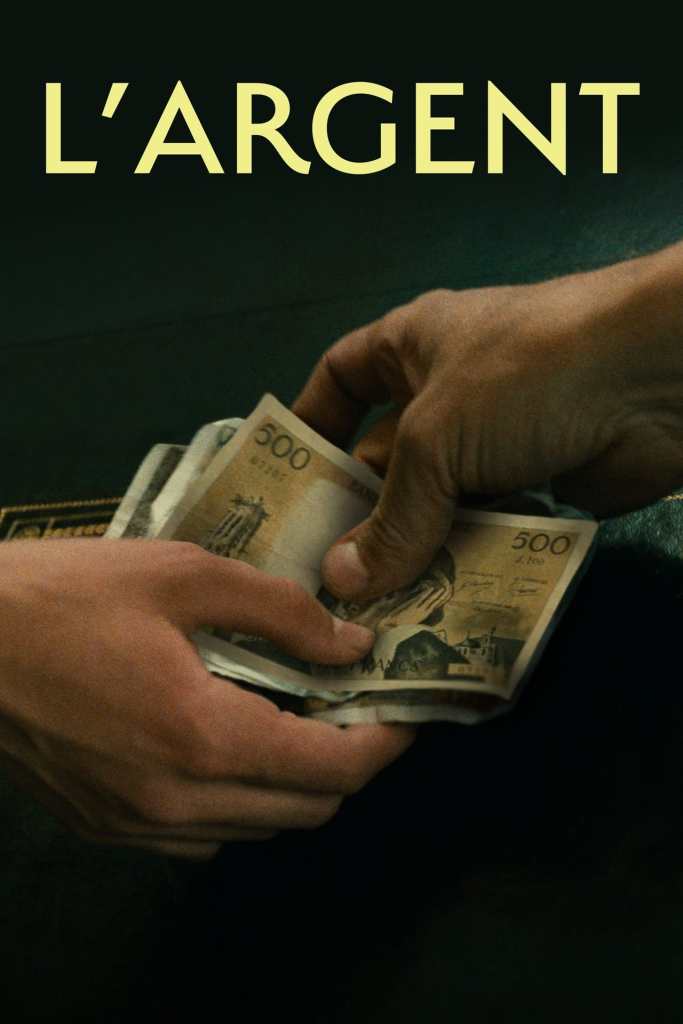
Bresson’s last film was L’Argent (Money), released in 1983. Based on a Tolstoy short story, the movie follows a man named Yvon, though at first, you don’t realize who is the main character, as the movie begins on a teen named Norbert. Norbert and his friends are a bunch of entitled idiots, who pass around counterfeit bills, rob ATM machines, and steal from their employers. One of those fake big bills brings about Yvon’s downfall. A shop he was servicing in his job pays him with the fake money (knowingly, because the manager didn’t want to get stuck with it). When Yvon tries to use that money later, he is arrested, and though he gets off with just a warning, that is the beginning of Yvon’s decent into crime. He loses his job over the ordeal, and when he gives a go at being the driver of a getaway car during a bank robbery, Yvon’s luck runs out. He is arrested again, and sentenced to 3 years. After his wife leaves him in jail, he tries (unsuccessfully) to kill himself. When he is released, he has pent up a bunch of anger that he will unfortunately unleash on the innocents he comes across out of jail. There are some emotional punches, like in the above film, but it does feel a bit all over the place, Again, a very brisk film at just 83 minutes, but I think more length could have made the picture feel fuller and less choppy. But of course, that was Bresson’s style, to only show “the important moments” in his character’s lives. Good, not great. ★★★

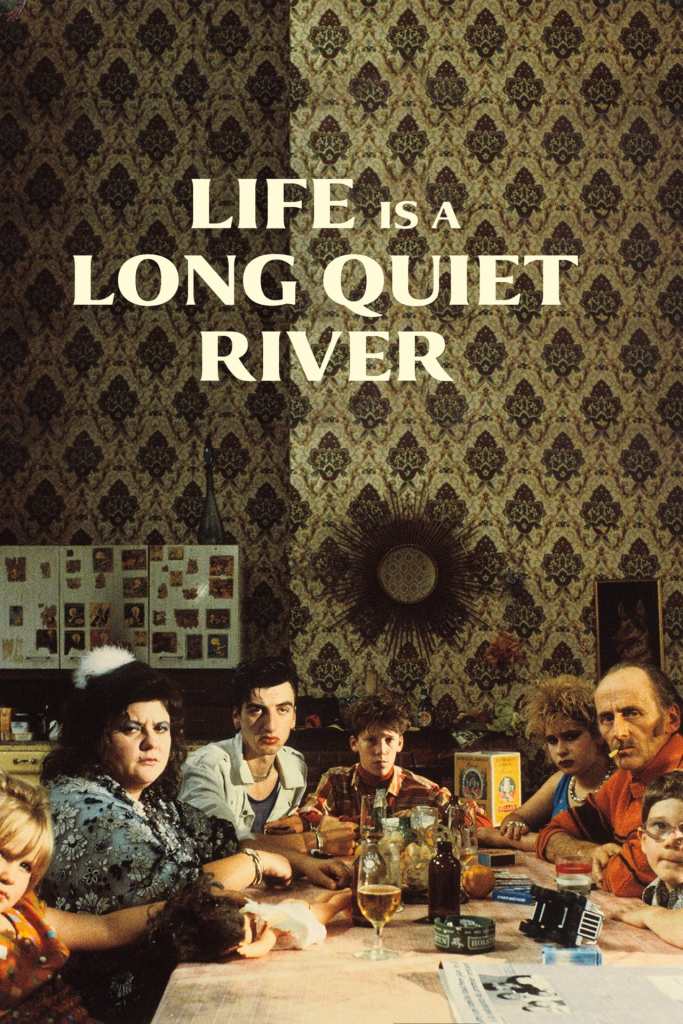
I hadn’t heard of this director, Étienne Chatiliez, but after the soul-sapping Bresson films I’d just watched, I was ready for a comedy. Life is a Long Quiet River is short on any kind of sustained laughter for quite awhile, but it redeems itself by the end. It follows two 12-year-olds, and their very different families. Maurice comes from the poor Groseille family, a motley group that scrapes by via hustles, cons, and outright thievery. Bernadette is of the Le Quesnoy family, whose head of household, Jean, owns the area’s electric company. Maurice and Bernadette have obviously lived very different lives, but they are all in for a rude awakening. A nurse and doctor at the local hospital have been having a long-term affair, and when the doctor’s wife dies, the nurse expects to finally be made legitimate. She is rebuffed though, so to get even, she comes clean to the doctor, the Groseilles, and the Le Quesnoys: the nurse switch their babies 12 years ago, in a moment of rage after a fight with the doctor. The Le Quesnoys are afraid that Bernadette will not take the news well and hide it from her, but they do go and “buy” Maurice from the Groseilles, introducing him to the family as a newly adopted son. Maurice has plans though to support his former family and friends, and starts putting them in action. Before the end, he has all of his friends and both families all hanging out together, much to the chagrin of his “new” parents. As I said, the movie begins slow, and I wasn’t into it at all for a good way through it, but once the child swap is made clear and Maurice digs in, it really picks up fast. ★★★

I don’t know why I keep going back to Claire Denis. Despite her esteem in film circles, I’ve yet to see one of her movies that I really liked. Beau Travail is supposed to be one of her best, and it’s just further proof that she’s not my cup of tea. The film is told from the perspective of a man named Galoup, relating the story of his days stationed in the African nation of Djibouti in the French Foreign Legion. Galoup is a hard-nosed sergeant who adores his commander, Forestier. This adoration leads to jealousy when Forestier praises a young man in the troop named Sentain. Galoup starts going out of his way to try to discredit or embarrass Sentain any time he can. When discussing this film, a lot of people talk about an explosive event when Galoup tries to take Sentain out, but that event isn’t until the very end of the movie. The entirety rest of the film has virtually no dialogue, and just lots of shots of the hot, sweaty, shirtless men working or playing out in the sun. The entirety of the plot of this film can be told in 2 sentences, so while the film is gorgeously shot, there’s no substance there. I don’t get the pride at all. ★½

Let’s end on a high note. La Haine (literally Hatred, but released in the USA as Hate) is a social commentary about hatred leading to further hatred. Taking place in and around Paris in the mid-90s, a local Arab immigrant named Abdel has been injured while in police custody, an event that has led to riots in the streets. Friends of Abdel’s include Vinz (a Jewish man), Saïd (a Muslim), and Hubert (an African), all immigrants or sons of immigrants. The three friends are obviously very upset with police, and the movie follows a period of about 24 hours as the trio wander the streets of the poorer area where they live and, later, around Paris too. It shows their run-ins with drug dealers, gangs, skinheads, and, of course, various police officers. Tensions are high, especially because Vinz found a gun that had been lost by one of the policemen during the previous night’s riot, and he is vowing to kill a cop if Abdel dies in the hospital. There’s a lot of bravado by the three men, especially Vinz, but they are not much more than boys, which is apparent when faced with real violence. Hubert is the only one with a good head on his shoulders, thinking that the only real way out is to move and get to a better area. Of course, he too is a bit naive, because there are troubles everywhere. There’s lots to unpack from this film, the kind of picture that I think I could glean more and more from multiple viewings. And even though the ending is expected from early on, it is still shocking and absolutely incredible. ★★★★★

  • TV series currently watching: Silo (season 1)
  • Book currently reading: The Fires of Heaven by Robert Jordan

Quick takes on After Love and other films

Land of Gold is an intriguing movie that can’t overcomes a couple of its faults. The movie follows a man named Kiran Singh, the son of an Pakistani immigrant, who is carrying around some baggage from his dad, yet followed in his footsteps as a cross country truck driver. His wife is about to have their first child but Kiran can’t shake the worries of not being a good father, and has been dragging his feet to do things like paint the bedroom, etc. Kiran takes one last trucking job before the kid’s birth, but runs into a problem on the trip: a stowaway. A young girl, no more than 10 or 11, snuck into the haul of his truck in order to get to Boston. Elena is the daughter of immigrants too, from Mexico, but her undocumented parents were nabbed by the authorities while Elena was away, and now she’s trying to get to an uncle, the only other person she knows in this country. At first Kiran doesn’t want anything to do with her situation, but unable to leave her alone, he agrees to get her to her uncle. Along the way, Kiran will face those memories of his father and do a lot of learning. There’s some good moments, but honestly the acting is not so good, and not just from Elena (readers of my blog know that, generally, I am not a fan of child actors). A lot of the emotions are forced and there are some wild leaps of faith to get from where Kiran begins to where he ends up. ★½

You Hurt My Feelings is a very nice comedic drama which is light on the drama but has plenty of good laughs. There is an overarching plot about a wife who hears her husband criticizing her new, as-yet unpublished book to a friend, but mostly the film is a lot of light humor, which isn’t a bad thing. The main star is Julia Louis-Dreyfus as the wife, Beth, who wrote one mildly successful memoir and who has been working on a followup. Her day job is as a college literary professor whose students haven’t read her book. Her husband is Don (Tobias Menzies), a therapist. Lots of funny little moments throughout the film, such as Don’s therapy sessions with some zany clients, or Beth’s class, or just their daily activities in a (hate to say it) Seinfeld sort of way. Making fun of the little things in life. Obviously the big takeaway is how honest you should be in your relationships (Don is always telling Beth her book is good, but behind her back admits he doesn’t like it; there’s also a big subplot about each parent supporting their son with sometimes unwarranted praise). It’s that fine line between honesty and not hurting those you care for, and the ramifications of not treading that line carefully. The plot is thin, but the laughs are real. Seinfeld lovers will find plenty to enjoy. ★★★½

No nice way to say it, Brother’s Keeper is just a dumb movie. It opens with shots over the protagonist’s (a young boy) shoulder, so my first thought was, “Someone’s been watching a lot of Dardenne brothers lately.” But this is a poor copy. The film follows Yusuf as he takes care for his very sick friend, Memo, for a day, inside an extremely harsh boarding school in Turkey. Memo is practically comatose, unable to walk or even open his eyes, and everywhere Yusuf goes for help, he is either given the run-around or flat out turned away. The school’s staff is made up of completely unbelievably idiotic, bumbling, and sadistic adults who care only for themselves. The movie repeats itself constantly and the “big surprise” at the end is nowhere near worth sticking around for. Complete waste of time, but it gets one full star because I did go through to the end rather than stopping early (which is what I should have done). ★

BlackBerry is better, but unfortunately it pales in comparison to its obvious similarly veined films, The Social Network and Steve Jobs, both of which I really loved. The film follows a decade-or-so in the launch and collapse of the eponymous company, beginning with its co-founders as they pitch an idea to a cell company for funding. They don’t land that deal but do grab the attention of a power- and fame-hungry executive who knows the duo are on to something. With his business expertise, BlackBerry is launched, and becomes, at one time in history, the dominant product for businessman-on-the-go. That is, until the iPhone launched in 2007, and then it very quickly comes crashing down. It’s Always Sunny’s Glenn Howerton is over-the-top as the bombastic executive (who apparently is nothing like his real-life counterpart), and his vitriol is absolutely absurd for this movie. No one acts like that all the time. His character aside, the movie is fun, but like I said, this kind of movie, about a product in the tech industry, has been done better. ★★★

After Love is a quiet and endearing film about finding your place in the world when you seem to have lost your anchor. The film begins in England and the camera starts on Mary, an English woman who converted to Islam to marry, and her husband Ahmed, returning home from a family get-together. As Mary is in the kitchen making tea, she’s talking to Ahmed in the background, in their living room. We see him sit down and then it gets quiet, and when Mary brings Ahmed his tea, she learns that he has suddenly died. It’s a heart-wrenching moment in the first five minutes, but the ride is just starting for Mary. Going through his things a couple days later, she finds his cell phone, and discovers an unknown number with whom he’s had a lot of contact. She traces the number to a woman in France, just across the English Channel from their home. Turns out Ahmed has led a second life there, with a French woman, and they have a teenage son together, Solomon. When Mary goes to the woman, Genevieve, to confront her, she can’t get her words out, and Genevieve mistakes Mary for a woman hired to clean their apartment in preparation to move. Over the next few days, Mary gets to know this other family of her late husband, who does not yet know that Ahmed is dead. When she does admit who she is, and she does indeed finally come clean near the end, everyone involved will learn more about the man they loved and the people who now have to live without him. Just the kind of quiet, indie film I love. ★★★★

  • TV series recently watched: Somewhere Boy (series), Justified (season 4), Curb Your Enthusiasm (seasons 1-2)
  • Book currently reading: The Fires of Heaven by Robert Jordan

Quick takes on The Eight Mountains and other films

I’m very hot or cold on Wes Anderson, and his last film was a total bust, but I had expectations for his newest, Asteroid City, mostly because the cast is jam packed, so much so that just listing all the A-listers would fill this paragraph. Unfortunately though, talent doesn’t always deliver a great film, and I could not get into this one at all, so much so that I didn’t finish it. After 45 minutes, I had yet to see anything resembling a plot develop, and gave up. The film throws a ton of characters at the screen, as they deliver a play-within-a-play, with everyone going in a different direction. It is Wes Anderson doing his Wes Anderson-y thing, and it is all too much. He’s too busy trying to remind everyone how clever and quirky he is to try to give us some kind of overarching story to follow. I think I ready somewhere that his next picture would take a different course, and be a darker film. If true, I think that’s a great idea, because his shtick, once cute and fun, has gotten stale. ½

The Eight Mountains is an Italian movie with a deceptively intricate story and complex characters, and is quite simply one of the most gorgeous movies I’ve seen. It follows Pietro over a generation, starting when he’s a boy whose family rents a summer house in the Italian Alps. In the village, Pietro meets Bruno, the only other child in town, and the two become fast friends, a friendship which will come to last a lifetime. For those first couple years, Pietro’s family returns every summer and he and Bruno always pick up right where they left off, but a couple events change their course. First, Pietro’s family overreaches and offers to take Bruno with them to Turin at the end of one summer, to give him an opportunity at proper schooling. Bruno is a bright boy, but there’s already talk of him giving up on education to become a laborer as his family is, and Pietro’s family wants to give him an opportunity for something different. Bruno’s father shuts that down. Secondly, Pietro, always a bit at odds with his workaholic father, says some awful things, and heads out on his own, setting up a rift in his family that keeps him away for many years. He only returns after his father dies, to reconnect with his mom, and return to the mountain village to see to the rented house and close up his parents’ affairs there. Turns out Bruno is still around, and not only that, but Bruno kept in touch with Pietro’s parents all these years, continuing to hike the mountains with Pietro’s dad in the summers. The two young men bond again, in a project to rebuild a house up on the mountain, a house that Pietro’s dad always wanted to restore but never did. If the movie ended there, it would still be a great film, but it continues, as Pietro still needs to find himself and his course in life, and Bruno has his own rocky road to traverse. A deep and introspective film, with beautiful scenes that take your breath away. Makes me want to pack up and move to the mountains; I could watch this movie with no sound and still be awed and inspired. Helps that the story is just as moving! ★★★★★

Monica stars Trace Lysette as the eponymous Monica, a transgender woman returning to her hometown after years away. She’s a good looking woman, hammered home by all the catcalls she gets from men around her, so while she is accepted everywhere, she hasn’t been accepted in her own family. Monica is going home to watch after her ailing mother, from whom she is estranged. Her mother Eugenia (Patricia Clarkson) doesn’t even recognize Monica when she arrives, and at first Monica seems hurt by this, but her brother confirms that he knew she had transitioned, and even he wouldn’t recognize her if he didn’t know who it was. Monica and her brother slowly feel each other out, telling stories about their childhood as brothers, and eventually make confessions about deep hurts revolving around their mom. Unfortunately the film moves at a snails pace in a deliberately “art house” manner that gets old after awhile. The camera is always behind or to the side of the “action” on screen; at first I thought it was very indie, but after awhile, it seems like the director is either inept or purposefully hiding some shoddy acting. Knowing those involved, I tend to think it’s the former. There are some nice moments in the final 30 minutes, and while in some movies, the journey is worthwhile, I don’t think I can say the same this time. ★★½

How to Blow Up a Pipeline is certainly a sensational title, and the movie is no less so, so it is unsurprising that reviews are on opposite sides of the spectrum with little middle ground. However, if you ignore the politics of it, the movie by itself is very engaging. Based on a nonfiction book by a climate activist who calls for sabotage against the companies that continue to perpetuate climate change, the film follows a group of like-minded 20-somethings who are tired of trying to bring about change peacefully and are ready to blow shit up to send a message. Each of the characters has been personally affected by climate change (one who lost a mother who died during a heat wave, one who has terminal cancer due to documented pollution from a local oil refinery, a man who has seen his generational land taken away by the government to build a pipeline, etc). The group is done talking, and while they don’t want to hurt anyone, they do want to do something that will be noticed. They target the new pipeline, and read up online how to build homemade explosives to pull it off. It is certainly an exciting film, and while it has a cast of little- or un-knowns, they (for the most part) do an admirable job of keeping the viewer engaged during the flashbacks that tell each person’s story. Obviously I am not a proponent of destroying property in any way, but I get why these characters are so angry. I’m not a denier; there’s far too much evidence of man-made climate change affecting our world, but I don’t think destroying stuff is the answer. Unfortunately I don’t know what the answer is. All that aside, this movie as a piece of fiction: ★★★½

I recently wrote on my blog that I wasn’t much into modern comedies (I do like the classics, however) because even the ones that are supposed to be well thought of, I just don’t get into. Maybe I’m watching the wrong ones though, because I thoroughly enjoyed The Blackening. The set up itself is a joke: in a slasher film, it’s always the black person that is killed first, so what happens when the entire cast is black? Poking fun at the genre while remaining fun and funny, it follows a group of friends who rent a remote cabin to celebrate Juneteenth. Once inside, they discover a “game room” with a sadistic game, complete with a figurehead of a racist caricature front and center. The game asks questions about black culture and people of color in film and entertainment, and if a player answers wrong, someone dies, and eventually the friends are hunted by a giant Jason-like figure in a blackface mask. But this group of friends is willing to fight for each other, setting up a spectacular finale. The movie is smart but also biting, while keeping humor throughout. When it points out an element of racism from decades ago, the viewer laughs and thinks, “Well, at least we’ve come a long way since then.” When it points out something that is still a problem today, the viewer still laughs, but hopefully thinks about it. I certainly did. The jokes rarely go low brow for easy laughs, and yet I still laughed, out loud, non-stop. A rare modern comedy that I could watch again and again. ★★★★½

  • TV series recently watched: The Big Door Prize (season 1), Slow Horses (season 1)
  • Book currently reading: The Fires of Heaven by Robert Jordan

Quick takes on 5 ’50s American films

Up today is a set of classic 1950’s American films, starting with 1953’s The War of the Worlds. I think most people know the story, so I won’t rehash it, but will say that it differs from the book quite a bit, especially in the end. The author of the book, HG Wells, didn’t think much of religion for much of his life, and it tells in the book, but this film, releasing when it did, obviously has a much different view. In fact, though the aliens still die from Earth’s bacteria and their lack of immunity to it, they conspicuously do so right after attacking a church. For 1953, I think the film looks great (it won the Oscar for Best Visual Effects) and is still engaging today for fans of classic films. For me personally, this is my first time watching this movie since I was a kid. There was a TV series in the late 80s that came at a time when I, as a child, loved all things space, and the series was developed as a sequel to this film, so I had watched it then. Obviously I didn’t remember all the nuance of the movie, but so many of its visuals were still tucked away in my brain. ★★★★

The Incredible Shrinking Man, released in 1957, comes from director Jack Arnold, known for many sci-fi films of the 50s like Creature from the Black Lagoon and It Came from Outer Space, though I’ve never seen any of them myself. If they are as good as this one, I’ll need to look them up. The movie follows Scott, a tall good looking man who runs afoul of some radiation one day, which causes him to start shrinking in size. He first notices when his wife no longer has to step on her toes to kiss him. The doctors run a gamut of tests until they discover the reason for his shrinking, and then spend awhile trying to find a cure. When the cure finally comes, he’s down to 3 feet tall. The cure does halt his shrinking, and after Scott meets a little person traveling with a circus, he realizes he can still lead a good life, until, that is, he starts shrinking again. And this time, he gets down to doll size, with no end in sight. At that size, he becomes prey for animals, and as he gets smaller still, for insects, and dangers lurk everywhere. Through it all, Scott narrates to us his thoughts and emotions during his ordeal. He struggles with his sense of self and place in the universe. A very fun film for people who like sci-fi films that offer more than just visual pleasures, but also make you think. ★★★★½

Can’t have a set of 50s films and not throw in a film noir, so my pick was Night and the City by the great director Jules Dassin*. The film follows a conman named Harry Fabian over the course of one long night in London. Harry is always working on a get-rich-quick scheme, none of which ever turn out, and everyone knows it except for him. He’s got quite the reputation in the underbelly of the city but his good nature keeps him plenty of friends. Harry’s latest plan involves getting in on the wrestling circuit, by backing a veteran Greek wrestler named Gregorious and Gregorious’s protege. But as is always the case in Harry’s life, his best laid plans go awry, and he spends most of the movie chasing the ever-elusive final piece of the puzzle that will make everything right for him. Harry’s not the only character in the movie though: we’ve got a corrupt night club owner named Phil, Phil’s scheming wife Helen, Gregorious’s son and crime lord Kristo, and a half dozen other minor characters in the bowels of the city, including forgers, thugs, thieves, hit men, and smugglers. If you are looking for a good guy in this film, you’ll be looking for a long time, and part of that is what makes this film so great. It’s hard to make a good picture where there isn’t anyone to really root for, but Dassin pulls it off with an intriguing and completely engrossing film about the city’s seediest. Fantastic cinematography too, with so much texture that you forget the film is in black and white! ★★★★½

A Face in the Crowd, from 1957 and directed by one of the best directors of all time in Elia Kazan*, stars a young Andy Griffith in his first film (3 years before the start of his eponymous TV show), in an almost unrecognizable role as compared to the aw-shucks good guys that he’d become famous for later. In fact, his brilliant over-the-top performance is so arresting that I’m reminded of another Kazan film which made a star of its breakout actor: Marlon Brando in A Streetcar Named Desire. Here, Griffith plays Larry “Lonesome” Rhodes, a musician who, in the beginning of the film, is sobering up in a jail cell in Arkansas. There, he is found by radio journalist Marcia Jeffries (Patricia Neal) and interviewed for her local show. Rhodes, a fast talker with a likable personality and a devil-may-care attitude, is an instant hit, and his star shoots for the heavens on a meteoric rise. Building a rabid fan base by presenting as an everyman, his fame grows as he moves to Memphis and, finally, New York, with his own TV show. Marcia sticks by his side throughout, falling in love with him as all the women do, but he only finds time for her when he needs something or has a misstep in his career. Over time, Rhodes morphs into a megalomaniac, womanizer, and swindler, and he has the power to get whatever he wants, yet his fans are none the wiser. Marcia, though, sees him for what he has become, and makes moves to unmask him. In the end, Rhodes is brought down when Marcia keeps his mic on at the end of his TV program, and the audience at home hears his off-color remarks about what he really thinks of people. They turn on him instantly, and he is dropped by his advertisers, his network, his political friends, and everyone else, with a final, almost prescient monologue given by a young Walter Matthau (just his fourth film). These days, our leaders somehow survive these hot mic moments; maybe Americans have just gotten dumber with time, so that we don’t even care anymore if someone is deserving of our allegiance. ★★★★★
Sometimes I stumble upon a title which I can’t believe I hadn’t seen before, and such is the case with John Huston’s* (like Kazan, also one of the best) The African Queen, starring Humphrey Bogart and Katharine Hepburn. I’ve seen plenty of films from the director and both of the film’s stars, but I have to say, this one didn’t grab me as much as I expected. Don’t get me wrong, very good movie, but it did not blow me away like some of the above pictures. Taking place in east Africa in 1914, Bogart plays Charlie, the driver/captain of a small steamboat with the name of the movie. He brings mail and supplies to the little villages along the river, including the one where British missionaries are teaching English to the locals. The missionaries are preacher Samuel Sayer and his sister Rose (Hepburn). Unbeknownst to them, war has hit Europe, and on his latest visit, Charlie tells them to expect trouble, as Germany controls this area of Africa. Soon after, German troops do indeed sweep through, torching the village. Samuel initially survives but goes made and dies soon after, leaving Rose alone. Charlie finds her like that, and is moved to help her escape the area, taking the dangerous river path down towards a lake and, hopefully, freedom. They must dodge Germans, crocodiles, stinging insects, and crazy storms if they are to survive. It’s a fine adventure film, released in 1951 when many were saying its two leads were past their prime, but they are still on their game here, and the acting is supreme. The movie as a whole though, just not the perfection I was expecting. ★★★½

*Elia Kazan and Jules Dassin fell on opposite ends of the 50s McCarthy era. Dassin was blacklisted and had to make movies in Europe for awhile. Kazan “named names” to the House Committee on Un-American Activities and, while it lost him a lot of friends, he continued to make movies in Hollywood. John Huston survived the era but moved to Ireland, disgusted with the “witch hunt” in his home country.

  • TV series recently watched: The Chosen (season 3), Justified (season 3), Foundation (season 1), Hijack (series)
  • Book currently reading: The Day of the Tempest by Jean Rabe

Quick takes on The Artifice Girl and other films

Up until now, I’ve enjoyed the Fast and Furious films for what they are: mindless action, yes, but always fun and exciting. Unfortunately that trend ends with Fast X, the latest in the series. And what’s worse, there’s another (supposed finale) coming. But let’s stick with this one first. There’s a new bad guy, Dante Reyes (Jason Momoa), who is the son of the fifth film’s (Fast Five’s) bad guy, Hernan Reyes. When Hernan was killed in that film, Dante swore revenge, but he doesn’t just want to kill Dominic Toretto and his team of do-gooders: he wants to make Dominic suffer first. And since Dominic values family and friends above all else, those people become Dante’s targets. As in the past, this film delivers on the action, both in the car and with hand-to-hand fighting, but the action is idiotic at times, and that’s saying something for a franchise that asks you suspend belief in order to enjoy it. On past films, I was able to do that, but this movie ups the silliness factor to a place beyond the scale, to a point where incredulity takes over. Add to this a gluttonous-sized cast that has grown to an unsustainable number; it’s to the point that a character shows up and I have to struggle to remember what film they were in, and what their backstory is. All of that I could forgive, if the movie was fun, but it wasn’t. And it’s never a good thing when an action movie becomes boring. ★

The Artifice Girl is probably the best movie that no one has seen, and I can’t speak highly enough about it. It is a super low budget film with a handful of actors you’ve never seen/heard of, but don’t let that deter you; it is one of the most thought-provoking movies I’ve seen in a very long time. It begins in an interrogation room, where a man, Gareth, is being grilled by a couple of investigators named Amos and Deena. The two aren’t cops, but we don’t know exactly who they are in the beginning, only that they’ve been hunting Gareth for awhile now. When they present evidence that they know who he is, a man involved with enticing online sexual predators, Gareth finally comes clean: yes, he is a man who has been entrapping predators and secretly turning them in to the authorities. Amos and Deena are most interested in the girl Gareth has been using to lure the predators, but Gareth has a surprise for them: the girl, Cherry, isn’t a girl at all. She/it is an A.I., a program built that can render itself in real time to appear to be a young pre-teen in front of a webcam, tempting would-be creepsters into outing themselves. Over the course of the rest of the movie, which takes place over decades, all kinds of ethical ideas and issues are raised, as “Cherry” grows far outside of the confines of her original programing. I remember how I felt after watching Alex Garland’s groundbreaking Ex Machina, and while that film had a decent budget and featured some strong visuals that this movie does not, it had the same kind of exploratory ideas that left you thinking long after the movie ended. The Artifice Girl is 95% dialogue, with no real action to speak of, but it is dialogue that is timely for today, and will stimulate the mind and leave a lasting impression. ★★★★★

The Night of the 12th is a French mystery/police drama about the case of a woman who was attacked coming home from a party in 2016 (a fictional film about a real event). Clara was walking home around 3am when a man came up to her, sprayed her with a flammable liquid, and threw a lighter at her, engulfing her in flames. She died quickly, but afterwards, the case went unsolved. The film follows the investigating team as they track down and interview a series of suspects over a period of 3 years, mostly old boyfriends. Clara had a taste for bad boys, so while none of the men are upstanding citizens, they each have rock solid alibis for the night of the 12th. The film flat out tells the viewer in the beginning that France has a high percentage of unsolved murders every year, so I’m not giving anything away when I say that if you are hoping for a resolution to Clara’s case, prepare to be disappointed. The case’s solving is not the story here, it is the frustrations that come with being unable to find closure, for both Clara’s parents and friends, as well as for the cops striving to find justice. A very good film, as long as you are a fan of the path and not necessarily the goal. ★★★

Gerard Butler usually delivers when it comes to action films, his bread and butter. Even when critics disagree, I often enjoy them. But not this time. In Kandahar, he plays Tom Harris, a freelance mercenary who usually works with “the good guys.” His latest mission has him in Iran working for the CIA, where he is able to infiltrate their nuclear program, giving the CIA access so that they are able to cause a meltdown of the facility. Afterwards, he takes up another mission to Afghanistan, but before he can complete the mission there, his cover is blown. A Pentagon whistleblower has outed CIA missions in the area, including his last one, and the world has his picture plastered on every TV screen. Now Tom has to find a way out of the region, with both Iran’s intelligence forces and the Taliban hot on his heels. The action sequences are still good, don’t get me wrong, but there’s not enough of them for a Butler film, especially in the first half, and despite the setup of all this political intrigue between various nations in the middle east, the movie devolves into Tom just killing one bad guy at a time. They can’t all be winners, Gerard. ★½

The Starling Girl is a coming-of-age movie in a rarely explored setting. Jem Starling is a typical 17 year old girl with raging hormones, but she is taught to suppress everything by her devout parents in their Christian fundamentalist church group. Jem is very devout too, making sure that her dance performances in church give glory to God rather than to herself, and crying with shame one day when someone points out that her bra can be seen through her shirt. Things start unraveling for her though, first at home, when her Dad’s old friend dies from suicide and her Dad starts drinking again, a habit he had kicked before Jem was born. Then, Jem starts finding herself attracted to Owen, the pastor’s oldest son, who is recently returned with his wife from a mission trip to Puerto Rico. Owen has come back with new ideas, and is less beholden to his father the pastor’s doctrines. As a viewer, we see immediately that Owen is showing predatory moves towards Jem, but as an impressionable and innocent young woman, she falls head over heals “in love.” It’s a tightrope that no one can balance forever, and it isn’t long before Jem and Owen are found out, and everything comes crashing down. Very well acted film, especially from Eliza Scanlen as Jem. Scanlen was the fourth March sister in Greta Gerwig’s 2019 version of Little Women, and while she had a big role in that film, the other sisters were heaver hitters Saoirse Ronan, Emma Watson, and Florence Pugh; easy to get lost in that all-star group. Here, she has the film to herself, and shines. ★★★½

  • TV series recently watched: Star Trek Strange New Worlds (season 2, The Last of Us (season 1), Black Bird (series), The Patient (series), Secret Invasion (series)
  • Book currently reading: Moby Dick by Herman Melville

Quick takes on the von Sternberg/Dietrich films

Up today is a series of films directed by Josef von Sternberg and starring Marlene Dietrich. I’ve seen a handful of Sternberg’s silent films and really liked them, but only even seen one Dietrich picture before. These are the ones that put her on the map, starting with her breakout, 1930’s The Blue Angel, filmed and released in her native Germany. It stars Emil Jannings as Dr Rath, a college professor. He learns that some of his boys have been frequenting a local cabaret called The Blue Angel, and in particular, ogling over its star, Lola Lola. Rath goes to ferret out his boys, but in doing so, becomes completely smitten by Lola (Dietrich), so much so that he spends the night with her, ruining his reputation and getting him fired from the college. Not one to admit defeat, Rath hits the road with Lola when her troupe is ready to move on. As the years go by though, he continually sinks to new lows, until 4 years later, when he has become the group’s stage clown, and Lola is entertaining new men. The film starts out slow with some dated, hokey comedy, but picks up speed and morphs into a serious drama before the end. Jannings, who won the first ever Best Actor Oscar for 1928’s The Last Command (also directed by von Sternberg) received top billing at its release, and he was hoping it would catapult his sound film pedigree, but Dietrich definitely steals the camera in every scene. Jannings would later star in several Nazi propaganda films, which ended his career after the war, but this would be Dietrich’s last film in Germany; she would find fortune and stardom in Hollywood. ★★★½

The Blue Angel had barely been released when Dietrich flew off to Hollywood to again team with von Sternberg for Morocco, a pre-Code film starring her and Gary Cooper. And pre-code it is: in the first 20 minutes we see Cooper’s character negotiating with a prostitute and Dietrich’s kissing a woman during a performance. It is the latter example that this film is most famous for. In the film, Tom Brown is a member of the French Foreign Legion and is new to the area, though he’s the type of soldier “with a lady in every port.” He becomes smitten by a new singer at the local club, Amy Jolly. Unfortunately for poor Tom, Amy has also caught the eye of wealthy French bachelor La Bessiere. Before Tom can pursue Amy though, he needs to get out of his current relationship, with his commander’s wife no less. This love quadrangle carries on for awhile, and honestly starts to drag the movie down, but the ending is just (barely) good enough. More than anything it was Dietrich’s coming out in Hollywood, and that one scene has left an iconic, lasting impression. I often see it in montages of old films. ★★½

Dishonored is the best of the bunch (so far). Released in 1931, it gives Dietrich a much different role than her previous pictures. Taking place in Austria in 1915, as the first world war is chugging, she plays Marie Kolverer, a down-on-her-luck woman of the night. She quips early in the film that she is afraid of neither life nor death, a remark that gains the ear of an Austrian Secret Serviceman called simply “Chief.” He decides Marie has the looks and temperament to serve her country as a spy. Designated as Agent X-27, Marie is sent out into the field to root out traitors to Austria who’ve been flipped by Russia. Her first target goes down easily, giving Marie a bit of self confidence, but she finds her second quarry much more challenging, and not only because she falls in love with him. When Austria does nab him, Marie can’t bring herself to see him at the end of a firing squad, and so she acts to set him free, a decision she’ll come to regret. Strong film with lots of mystery, suspense, and even some 30s thrills, and an explosive ending that stuck with me. ★★★★½

Dietrich returned to her cabaret roots in 1932’s Blonde Venus, but unfortunately not with a great result. By 1932, she was a bonafide star and received top billing on this film, but it is also known for introducing the world to a very young Cary Grant, in one of his first films (and also an uncredited Hattie McDaniel in one of her first movies too; shoutout to my mom and her love of Gone With the Wind). Dietrich portrays a Helen, a German singer/dancer who falls for American scientist Ned Faraday, marrying him and relocating to America. A decade later, Ned has come down with Radium poisoning from his work and, unless they can come up with enough money to pay for a radical new treatment in Europe, he’s given about a year to live. Helen decides to return to the stage, and her looks immediately land her a well-paying job. On her first night out, she catches the eye of rich bachelor Nick Townsend (Grant), who, after hearing her story, decides to pay for her husband’s treatments. His actions aren’t completely on the up-and-up though; with Ned off to Europe for his therapy, Nick convinces Helen to move into his place. Over the next year, the couple genuinely fall for each other, leaving Helen in a very tight predicament when Ned is coming back. Upon his return, he learns of the affair and demands Helen leave, but she can’t take their son with her. Refusing to lose her son, and with Nick gone (he had previously left, unable to bear to see Helen around town with her husband), Helen takes her boy and runs away. But as money dwindles and investigators on her tail, she won’t find a happy ending out in the wild. The movie is pretty run-of-the-mill, and while Dietrich is eye-arresting as always, the movie is kind of all over the place and a bit of a mess. ★★

Shanghai Express is another hit. It is so different from the above movies, and really stands out. The film begins at a busy train station in Peking (Beijing), China, as characters from all over the world are trying to get on board for a train headed to Shanghai. Security is tight, as China is in the middle of a civil war. We spend the first half hour getting to know all these varied people, and it is awhile until we even see Dietrich on camera. But when she comes, she arrives with a splash. There are hints among the passengers that Shanghai Lily, a famous courtesan, will be on board, and that’s who Dietrich turns out to be. Unfortunately for her, she knows someone also on the train: former lover Doc Harvey, a British captain. The two still harbor feelings for each other, but the breakup was a bad one and they don’t know how to act towards each now, many years later. As they are feeling each other out, the war comes to the train, but not in physical fighting. After soldiers stop the train to pull off a suspected rebel fighter, another guest on the train unmasks himself as a leader in the insurgency, and he will use all of his chess pieces at his disposal, namely, the other guests as possible hostages/trade bait to get his fighter back from the government. A tidy film at just 80 minutes, but a whole lot happens in that time. Maybe not the best acting (I’m starting to see Dietrich as sort of a one-trick pony at this point), but the story is engaging and the ending, while predictable, is a good one. ★★★★

The Scarlet Empress has Marlene Dietrich portraying one of the most famous women of all time, Catherine the Great, empress of Russia. Lots of films and shows have touched on Catherine in the last few years, so I’m kind of Catherine’ed out, but I have to say, this film is one of the most spectacular of the bunch, regardless of being 80 years old (though it may not be the most accurate…). The movie follows Catherine as a young girl in Prussia, her innocence dashed when she is promised to the Grand Duke (and future emperor) Peter of Russia and she finds him to be anything but a young, dashing, heroic leader of men. Instead, she falls in love with Count Alexei, a womanizer at court and one-time lover of Peter’s aunt Elizabeth. When Catherine realizes that Peter will only keep her around until Elizabeth is gone, and plans to replace her, she moves to make sure she is the one doing the replacing. High on melodrama, but also high on production value, with gorgeous sets and costumes, the film isn’t bad, but it has some glaring problems. Its almost complete disregard for historical facts being one, but even as a film on its own, the flow of the story is cut (often) by constant intertitles narrating goings-on at court and around Russia. It seemed like anytime the movie started to gain some traction, it would come to an abrupt halt with an intertitle explaining something to the viewer. ★★★

The Devil is a Woman was the last film made by this director/actress team, and the least well regarded at the time, though I liked it better than a couple of the above films. It begins with a young man newly arrived to Seville for a short stop before heading on to Paris. The man, Antonio, is smitten by a masked woman at the carnival. The woman, Concha, leaves him a note to meet that evening before disappearing, but before the rendezvous, Antonio runs into an old friend, Don Pasqual. When Antonio asks Don Pasqual if he knows this Concha, Don Pasquale relates an unbelievable-but-true story about the woman, who has given him (Pasquale) nothing but heartache. They first met many years ago, when Concha was just a poor factory worker, and over the years, he has lavished her with money and gifts to help her situation. In return, she would always disappear, for weeks, months, or years at a time, only to show up again when she was broke and in need of her sugar daddy. The last time Don Pasqual saw her, he gave her a small fortune to buy her out of a contract, and she promptly got into a carriage with another man and took off again. Antonio swears he’ll have nothing with the woman, now knowing all this, but he is just like every other man she has sank her teeth into, and it may lead to his ruin as well. It’s a fun little movie, with Dietrich openly playing the succubus that she so often hinted at in previous films. ★★★½

  • TV series recently watched: Evil (season 3), Shantaram (series)
  • Book currently reading: Moby Dick by Herman Melville

Quick takes on Beau is Afraid and other films

Tori and Lokita is the latest from the Dardenne brothers, a team I very much enjoy. This film didn’t quite hit the emotional highs of some of their other pictures, but it is still a good one. Tori and Lokita are a pair of African immigrants in Belgium. Though they met during their immigration, they pretend to be siblings, so as to stay together in the system. The two do shady business for a local restaurant owner, who pays them cash for deliveries, both food from the restaurant and drugs on the side, and the occasional sexual favor from Tori. Tori, just 16 years old, is trying to scrounge up enough money to apply for for a residence permit, so that she can get a more permanent job, while also needing to send money back to her family in Cameroon as well as pay back the group that smuggled her and Lokita into Belgium. 11-year-old Lokita isn’t just along for the ride, he will do anything to protect Tori, as he proves when she is forced into watching the restaurant owner’s drug farm for a couple weeks. It’s an emotional roller coaster of a film, about a duo who will do anything for each other, but loses plausibility a couple times. That’s the only reason I’m docking it a bit from the Dardenne’s usual excellence. ★★★½

I went into Gringa because it stars Steve Zahn who, while not necessarily known for his great performances, does have a penchant for showing up in decent low budget films that I enjoy. Unfortunately this is not one of those. The film’s main character is Marge, a teenager with self esteem issues, living with her single mom. When her mom is killed in a car accident, Marge is faced with the probability of going to live with her uncaring grandparents. Instead, Marge decides to head to Mexico to find her estranged father Jackson (Zahn). A failed soccer player, he’s been an alcoholic for all these years, but has recently started coaching a youth team down there and is trying to turn things around. He is amazed to find this daughter on his doorstep, a girl he had all-but forgotten. Marge can help him beat his demons, even as he does the same for her. Nice idea, but the execution is rough. The acting is not bad, even from relatively newcomer Jess Gabor as Marge, but the dialogue is pure cheese and the plot way too predictable, even for a film like this when you can see the ending a mile away. ★½

Gotta be honest, Are You There God? It’s Me Margaret wasn’t on my list to rush out and see. Obviously I’m not the targeted demographic, as a man with one adult child (a son), I have no experience relating to the subject matter. But I’m glad I ultimately watched it. Taking place in 1970 (when the original bestselling book by Judy Blume was written), it follows Margaret Simon, newly moved from the city to the suburbs, as many families were doing at that time. Margaret is 11 years old and comes from a sheltered school, and her eyes are opened to new friends who are in a rush to grow up. They are all at that age where they can’t wait to grow up, but are scared of the changes their bodies will be going through (though they each put on a brave face in front of their friends). Margaret and three others form a club, where they talk about boys, ways to increase their bust size, and promise to tell each other when they each finally get their period. As Margaret turns 12 and all her other friends are getting theirs, she’s feeling left behind. At the same time, Margaret is facing turmoil at home. Her parents, one Jewish and one Christian, raised her to let her choose her own religion when she gets old/mature enough to do so on her own, but Margaret’s grandparents aren’t so thoughtful, and fight over getting Margaret to join their faith. Narrated throughout by a girl talking to a God she’s not even sure she believes in, it is a poignant look at the fears, hopes, and perseverance of a girl “becoming a woman,” at that time in your life when every setback is perceived as a tragedy. A little hokey at times, but really nice film. ★★★½

Beau is Afraid is the latest from young horror filmmaker Ari Aster, whose explosive Midsommar earned acclaim in 2019. I was not a fan the first time I saw it, but it has grown on me in subsequent viewings, and if nothing else, it was the breakout vehicle for Florence Pugh, IMO one of the best in the business right now. Speaking of best, does it get any better than Joaquin Phoenix? He plays Beau, a man with a book full of neuroses, mostly as a result of his overbearing mother. But that was not unraveled early in this 3 hour film; first, we are getting to know Beau. He lives in an comically bad section of the city (to the point of silly, where corpses lay in the street, naked serial killers wander out in the open, and cops ignore it all to chat with local hookers) and fears even leaving his apartment. When a sequence of events gets him out, he is locked out of the building, and a stream of strangers lets themselves in, ransacking his place overnight. After sleeping on the street, Beau returns and calls his mother to let her know he’ll be late for his visit that day. A man answers the phone, claiming to be a UPS driver who just entered this house and picked up the ringing phone, but there’s a woman there who’s just been killed by a falling chandelier. Beau now has to rush there as fast as he can, to see if it was his mom who died, but events keep coming up to delay him. And not just any “events,” we’re talking getting hit by a car, finding himself in a crazy house with a weird family, taking in a “forest theater” production, and a host of other zany adventures. For the paranoid Beau who has anxiety even when stepping out his door, it’s all too much. Along the way, we also see flashbacks to what made Beau the man he is, and learn about his mom and the “one who got away.” As always, strong acting from Phoenix, but the movie has problems, its biggest being that nothing in the entirety of the film ever resolves (even at the end of the 3 hours). For awhile, this continual punishing of Beau drags you in, but after awhile it becomes very tiresome. The ending is so weird too. I can’t tell if writer/director Aster is intentionally leaving it open for interpretation, or just spitting in the face of the viewer. I can’t recall a film I liked so much that I had such little desire to see again. ★★★★

Acidman is a two-hander starring Dianna Agron and Thomas Haden Church as an estranger daughter and father. Maggie hasn’t heard from her father Lloyd in awhile, and hunts him down, only to find that he has become obsessed with UFO’s and making contact with extraterrestrials. That’s the whole movie in a nutshell. A lot of the film explores their clumsy attempts to communicate with each other, after years of burying their feelings, but unfortunately the whole thing is a bore. Agron has done a lot of these low budget indie films lately, but often to better results. In this one, you can watch the first 20 minutes, then skip ahead to the last 20, and really not miss anything. ★

  • TV series recently watched: Fleishman is in Trouble (series), Walking Dead: Dead City (series), The Lazarus Project (season 1), See (season 3), Justified (season 2)
  • Book currently reading: Cloud Atlas by David Mitchell

Barbie delivers a modern empowerment message for women

I finally got out to see Barbie, and see if it lived up to the hype. For the most part, it does. It’s exceedingly funny and does give a good story about women empowerment, and the challenges women still face in today’s society.

Stereotypical Barbie (Margot Robbie) is the original Barbie, living in Barbieland with all the other barbies (Doctor Barbie, Space Barbie, etc). Life is pretty perfect for the life-like dolls, but Barbie suddenly starts having problems. She starts worrying about death, her normally-arched feet go flat, and she finds cellulite on her legs (oh the shame!). For answers, Barbie visits Weird Barbie (the doll that gets played with a little too harshly by girls, and has the scars to show for it). Weird Barbie says that in the Real World, Barbie’s owner must be having some bad thoughts, which have worked their way into Barbieland. Barbie must go to the Real World and see if she can resolve those issues.

Barbie expects that she and her fellow barbies have empowered girls to become strong women who pursue their goals and always achieve success, but obviously Barbie finds a much different world than what she expected. Men rule the world, even at Barbie HQ Mattel, where not a single woman sits on the board. While she is discovering frustration for the first time, Ken, who tagged along, is finding power. In Barbieland, the kens are just an afterthought, but in the Real World, men seem to have the power. He takes those ideas back to Barbieland before Barbie herself gets back, so that when she returns, her world has been turned upside down, and men now rule the roost. Thankfully, Barbie has brought back a couple real people, who can help save the dolls from the kens.

There are plenty of laughs, poking fun at Barbie herself with all the stereotypes, as well as the “failed” barbies over the years that were discontinued. It is definitely deserving of its PG-13 rating, with some adult jokes that, while they may be over the heads of some kids, parents should know what they are taking their kids to. Really the only problem I had with the movie is, rather than try to create balance between Barbie and Ken, it suggests that the world can only survive if Barbie is at the head; her happiness is much more important than Ken’s. The movie did drag at times, but overall it is a lot of fun, and, for my tastes, one of those rare comedies that can be viewed multiple times and repeatedly enjoyed. ★★★½

Oppenheimer dazzlingly revisits a important man and his project

Barbenheimer is here! An estimated 200,000 people saw both this weekend, and while I won’t get out to see Barbie until Tuesday, I did see Oppenheimer this weekend with some buddies from work (in IMAX, of course). Christopher Nolan has slowed down since his Batman days, releasing just 4 films in the last decade. While not always successful (2020’s Tenet lost a bunch, with its big budget), they are always talked about. This film will definitely continue that trend, and hopefully bounce back in the box office too. Initial estimates are certainly looking good, despite its R rating for some nudity and a sex scene.

The film is the story of J Robert Oppenheimer, “the father of the atomic bomb.” The movie bounces around a lot, following a timeline before the war (Oppenheimer in school at Cambridge and then Germany, and his first teaching gig at U of Cal-Berkeley), while also looking at his “trial” to lose his security clearance due to ties with Communists in the mid-1950s, and another timeline in the late 50s following politician Lewis Strauss, who played an integral part in Oppenheimer’s post-war career. Thankfully, Nolan easily differentiates these 3 storylines, so it is easy to follow.

Born in the USA of Jewish immigrants from Germany, Oppenheimer had a condescending attitude to others, due in no small part because of high sense of self, and while the film does show all of the important moments in his life that historians should know, especially his time leading the Los Alamos project and organizing the Manhattan Project, we also see his personal life with girlfriends, his wife and kids, and the many friends (and enemies) he makes before and during the war. The most exciting moments obviously come during the war effort. When news breaks that German physicists have successfully discovered nuclear fission, scientists in the USA immediately realize the potential for that breakthrough in a bomb. Though Germany has many brilliant minds in quantum physics, and they have at least a 12 month head start in their nuclear bomb program, Oppenheimer theorizes that the USA can catch up, due to the fact that many of Germany’s scientists are Jewish, and thus Hitler is less likely to give them his full backing. Oppenheimer immediately fights to get a team of the most brilliant people he can think of, and gets the government to pour money into his project (ultimately $2 billion worth, in 1940s money!).

In typical Nolan fashion, the movie is beautiful to watch and craves to be seen on the big screen. For those who worry about sitting through a 3 hour film: it is a “quick” 3 hours, always moving. I didn’t notice the length at all. I urge you to get out and see it, for an important moment in history, the ramifications of which we are still dealing with today. ★★★★½

Quick takes on The Covenant and other films

Cadejo Blanco is a Spanish language film out of Guatemala. It is marketed as a thriller/drama, but is light on the thrills which I think turned some people off, as reviews are sort of middling. I really enjoyed this one though, with one caveat (more on that later). Sarita is a young woman who doesn’t enjoy the party scene—the exact opposite of her sister Bea. Bea begs Sarita to go to a club one night because she (Bea) is going to break up with her boyfriend and wants support. Apparently Bea’s boyfriend is involved in the local gang, though this is all news to Sarita, who’s never met the guy. Before the night is out, Bea and Sarita get in a fight and Sarita goes home alone. The only problem is Bea never returns. Sarita promises her grandmother that she’ll find Bea and return safely, but it seems the only way to accomplish this is to infiltrate the gang. Sarita has to prove herself, and she is willing to do anything to find her sister. She better be willing, because the gang will make her do it all before the end of the movie. So, the only problem I have with the movie is the very uneven acting. Karen Martinez (in her first leading role after a couple small parts) is fantastic as the lead, but everyone else… not so much. If you can get past the wooden acting, where it seems actors are literally reading their lines, the movie offers a strong story about the lengths Sarita will go to for her family. Also has an excellent feel of the seedy underbelly of criminal Guatemala, and offers gorgeous camera work. Three stars, but should have been four if they could have gotten any kind of supporting cast. I absolutely loved the ending, but here too, may not be everyone’s cup of tea. ★★★

All it takes for me to like a Guy Ritchie movie is for him to make a very un-Guy Ritchie like kind of movie. The Covenant is that; it’s a straight up war movie with none of the theatrics that seem to plague Ritchie’s oeuvre. The movie takes place in 2018 Afghanistan. Our soldiers have been fighting there since the towers went down in 2001, and the men are definitely giving off vibes that they are tired of the whole business; no one wants to be there anymore. Master Sergeant of this particular company is John Kinley (Jake Gyllenhaal). He and his team have been tasked to find who is making bombs for the Taliban, and they face danger everywhere they go. Aiding them (and other soldiers all around the country) are locals who have been hired as interpreters. For their cooperation, they’ve been promised VISA’s to take themselves and their families to the USA, as they’ll definitely be hunted by the Taliban. Helping Kinley’s team is Ahmed, a smart man who knows the lay of the land and has a good intuition for when people are lying. One mission goes sideways and Kinley’s team isn’t able to get out fast enough, being set upon by the Taliban. Kinley is wounded, and Ahmed saves his life. In and out of consciousness, Kinley is carried on a litter by Ahmed over 100 miles across open country, avoiding the roads and the Taliban, until they can get to an American base. When Kinley comes to, he is in a hospital in Los Angeles, and he realizes Ahmed has been left behind. The Taliban are furious that they let an American soldier out of their grasp, and have put a huge bounty on Ahmed’s head. Kinley is not about to leave a man behind, a man who saved his life. Unable to get the brass to help, Kinley returns to Afghanistan as a civilian, and will not leave until he gets Ahmed and his family to safety. High power action and thrills, with fantastic acting by our two leads, and thank God, Ritchie is able to let them do their thing without putting in (too many) laughs or zany camerawork. ★★★½

Unidentified Objects is a road film (nearly) like every other road film that has ever been done. I say nearly because we do have a new twist: not only are the two people strangers, and completely opposite people at that (in personality), but they are each individuals who are often ostracized by society. Winona is a sex worker, and Peter is a homosexual little person. Winona must get to a secluded area in Canada because she is convinced that aliens will meet her there to abduct her; she knows this because she claims to have been visited by them before. She has no car, so she pays her apartment neighbor, Peter, to drive her up there. Peter, with chronic health problems and the bills to match, agrees. Despite his small stature, he has a giant chip on his shoulder, so much of the humor is supplied by him in this little trip up north. The banter is good, and Matthew Jeffers is fantastic as Peter, a man who has built a wall around himself for protection from all those who would hurt him, but unfortunately the film can’t help but visit every road film trope that has been done before, and often better. It has its moments, especially when Peter and Winona finally begin to let each other in, but there’s not enough to make this movie stand out from the crowd. ★★½

When it comes to long movie titles, I can’t help myself; when I hear of one, I have to see it. Doesn’t get much longer than The Cow Who Sang a Song into the Future. Unfortunately the title is about the best part of this movie. It starts out well though: on a riverbank littered with dead fish, a woman emerges from the water. Turns out it is Magdalena, who supposedly killed herself in the river 30+ years ago, though her body was never found. She hasn’t aged a day, but her 2 kids are now grown and her husband is an old man. Magdalena walks into town and is spotted by her husband, and he nearly has a heart attack. Fearing for his health, daughter Cecilia returns to town with her own kids (Magdalena’s grandchildren). They and Magdalena’s other child, a son, don’t think Dad actually saw his long-dead wife, but simply had a vision or a dream in his poor health. That is, until weird things start happening around the farm. Anywhere Magdalena goes, which is usually out of sight from the others, electrical gadgets go strange, or animals behave oddly, or if she starts to giggle, others nearby break out in uncontrollable laughter as well. Her presence does other things as well: Cecilia and her brother start talking about buried hurts between them and their father, and Cecilia’s son Tomás, who is transitioning to a woman despite Cecilia’s wishes, also finds peace. And then, in the midst of all this, the movie just ends. It happened so fast that I had to rewind and see if I missed something. Maybe the whole thing is just over my head, but I just didn’t get it at all. ★½

I just can’t catch a break here with these last couple movies, because it doesn’t get any better with Rise. A French film, the movie follows a classically trained ballet dancer named Élise, who is rattled at a performance when she sees her boyfriend making out with another girl backstage. During her dance routine, Élise falls and seriously injures her ankle. The doc tells her they’ll reevaluate in 3-4 months, but that she most likely will need surgery, and a 1-2 year rehab before she’s ready to dance again, and if it doesn’t heal right, she may never dance at a top level again. Élise obviously takes it hard, but before long, starts envisioning life without dance. She joins her friend and friend’s husband (an entrepreneurial chef) in their new business, as a food preparer at a hall out in the country. The place rents itself out for various functions, and one such new group is a contemporary dance troupe. Of course, being around them, Élise starts to feel the bug, and though she may no longer have the dexterity for ballet, she may be able to dance a new way. Will she succeed? You’ll have to tell me, if you ever watch it, because at this point, with 45 minutes to go, I gave up. The filmmakers chose to go with a real dancer in the lead role as Élise: Marion Barbeau, who is a première danseuse with the Paris Opéra Ballet. Great dancer, but she can’t act on camera, and it is rough to watch. Add to that lame humor, wooden dialogue, and a plot that goes nowhere fast, and I was bored to tears. ★

  • TV series recently watched: Mayans MC (season 5), Bupkis (season 1), Its Always Sunny (season 16)
  • Book currently reading: Cloud Atlas by David Mitchell