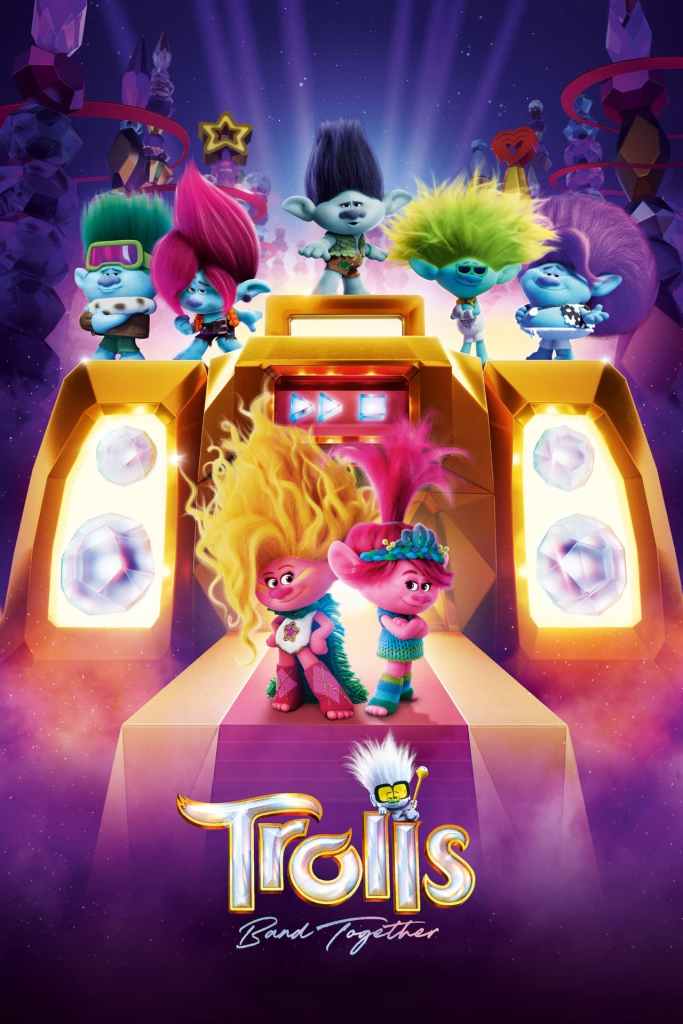
I’ve been a big fan of the Trolls films ever since I saw the first back in 2017. It seems like that movie took a lot of people by surprise, and it exploded into a huge franchise with short films, holiday specials, and a couple TV series. Trolls Band Together is the third feature film after 2020’s Trolls World Tour, and it may be the best one yet, if you are of my generation or older (though kids will still find plenty to like too).
We learn at the beginning of this film that Branch was once the youngest member of a boy band named Brozone, but the band, made up of 5 brothers, broke up after a disastrous performance, and Branch never saw his brothers again. He is approached by the eldest brother, John Dory, with news that brother Floyd has been kidnapped by a pop music duo named Velvet and Veneer, who have been using Floyd’s troll powers to boost their singing ability to become stars. Branch has to set aside his years of resentment to go out with John Dory and find the other 2 brothers, so they can come together to rescue Floyd. Of course Branch’s girlfriend Poppy is going to go help too, and there’s a surprise for her along the way.
I feel like this film has even more inside jokes for adults than the previous two, and some that are a bit risqué for young kids (the movie comes from Dreamworks, the folks who delivered the Shrek franchise, if that gives you an idea of what to expect). Most of that will be over the heads of little kids though, and nothing is too objectionable in my opinion, though some straight-laced parents may bristle. I thoroughly enjoyed this film, with all of its references to 90s/00s pop culture and the whole boy band phenomenon. And to top it off, with Justin Timberlake continuing to voice Branch (with Anna Kendrick as Poppy), the film brings N Sync back together for the worst-kept-secret reunion that fans have been wanting for decades. ★★★★½
I liked Fair Play a whole lot more than I expected to. On the surface, it seems like a trashy romance novel, but there’s some heavy emotional intensity here, and it takes a hard look at how differently men and women are treated, and expected to act, in the professional work environment. Emily and Luke are in a relationship, serious enough that Luke proposes at the beginning of the film, but they have to keep it secret at work; they are both financial analysts at the same hedge fund company, and they have not disclosed their relationship, a big no-no. At the high pressure company, their immediate supervisor loses a lot of money and his job becomes available. Luke expects the promotion, but it is Emily who gets it. Immediately, there are whisperings around work about what she may have done to get it, even though Emily is a brilliant analyst and earned the job on her own. As boss now, Emily gives Luke every opportunity to make a standout move, but a poor decision on his part loses the company 25 million. Good moves by Emily and Luke earn the money back, but the harm has been done. As Luke gets more and more angry about Emily’s advancement and his own stagnation, their relationship deteriorates quickly. There’s an almost psychological thriller element to the film by the end, as Luke approaches and goes off the deep end, while Emily, a strong woman, won’t meekly let it go. Hot sex scenes to satisfy the pulp crowd, but good social commentary to give you something to think about too. ★★★½
Return to Dust is the polar opposite of the above film. No edge-of-your-seat thrills, no fast-paced action, but it is no less emotional. A film out of China (which always seems to deliver slow-paced, thoughtful movies), the film begins on Ma Youtie, an older man who has remained single. The “fourth brother” in a society where wealth and influence flows downhill, he has very little in his life, but seems content with it. He is set up in an arranged marriage with Cal Guiying, a woman who suffers from a disability in her left arm, as well as incontinence (constantly wetting herself) and infertility, which has all added up to a lifetime of abuse by her family and no husband until now. Over the course of the rest of the film, this unlikely duo with shared past hurts build a loving life together. With the Chinese government offering cash for landowners to tear down empty buildings for future development, Youtie and Guiying initially bounce from place to place, always eventually being evicted, until he starts building a home of their own on empty land. While the city dwellers scoff at Youtie’s insistence to keep his mule instead of a car, he doesn’t seem to care at all what others think; when a chance at public housing in an apartment comes up, Youtie dismisses it, because he doesn’t know where he’d put his chickens and pigs. It all slowly builds to a resonant and emotionally draining finale. Not a film for everyone, but those with patience will be rewarded. The film opened to huge success in China in 2022, but aired for only 2 weeks before theaters banned it, for feelings that it cast a negative light on the government’s policies. ★★★★★
Somewhere in Queens is not a deep movie like the above, but it is a funny little picture with some tender moments. Leo works construction in the family business, but as a person who has stayed in the shadows, he’s been passed up by his younger brother, who is foreman on job sites and stands to take over when their dad retires. Leo has always had a hard time standing up for himself, and his shy and quiet son, “Sticks,” seems to be following in his footsteps. Sticks is a star player on their high school basketball team, but it is a team with no aspirations, and everyone expects Sticks to go into the family business upon graduation. However, a chance meeting with a talent scout at Sticks’ last game, who was there to see a player on the opposing team, gives Leo and his family hope that maybe the unheard-of step of going to college may be an option. However, all of Leo’s hopes regarding the matter may come crashing down when Sticks’ girlfriend breaks up with him, hurting the emotional young man’s concentration as tryouts approach, and Leo makes it worse when he bribes the girl to get back with Sticks in order to keep his confidence up. The movie does an excellent job of establishing the characters in the first 10 minutes: Leo is a “lovable loser” and his son has a hidden talent that you can root for. Lots of funny moments regarding Leo’s very Italian family (even if a lot of the jokes are all cliche at this point). But it’s not all fluff. There are some deep seated hurts in this family, which come to light in the final 20 minutes, and the film takes an (almost-too) dark turn as old and new grudges are brought to light. Still, it ends well. Some good talent involved, with Ray Romano as Leo and Laurie Metcalf as his wife Angela. ★★★½
Cassandro is a biopic about the lucha libre wrestler Saúl Amendáriz. The son of a Mexican immigrant after an affair with a married man, Saúl grew up in El Paso but regularly crossed the border to wrestle in Juárez. A gay man, Saúl has resisted wrestling as an exótico, which in the lucha libre world, is a wrestler who fights in drag. In Saúl’s time in the 1980s, they never won fights and were often the villains. However, when Saúl meets a new trainer, he finally goes all in and develops the persona of Cassandro, a flamboyant exótico who plays the crowd. While all of this is going on inside the ring, Saúl is struggling in his personal relationships as well. He is carrying around a lot of hurt from hearing his dad use homophobic language towards exótico wrestlers when Saúl was a child, as well as Saúl dealing with his closeted gay boyfriend. Strong acting from Gael Garcia Bernal in the lead, who always delivers, but the film is rather ho-hum, even if it does deal with an important subject. ★★½
The Burial is also based on a true story. Tommy Lee Jones plays Jeremiah O’Keefe, who runs a funeral home and insurance family business in Mississippi. In financial straights, he is approached by a larger funeral business, Loewen Group’s owner Raymond Loewen, to sell a couple locations for some capital to shore up O’Keefe’s business. However, Loewen strings O’Keefe along, and he realizes that the company is waiting him out, hoping to gobble up everything in bankruptcy. So O’Keefe sues him. O’Keefe’s longtime friend and lawyer is a good ol’ white man from the south, which won’t play right in the predominately black county where the suit will be heard, so O’Keefe recruits power lawyer Willie Gary (Jamie Foxx). The rest of the film is the surprises that come out in the trial. There’s some laughs in the beginning, some very exciting moments later, but in my opinion the film had a few too many “gotcha” moments, bombshells that are dropped in trial that are just there to elicit a gasp from the viewer. The film could have been exciting on its own with a few of those dropped out. Still, it’s good, with some funny moments supplied by Foxx’s over-the-top ambulance chaser-turned-lawyer for justice. ★★★½
TV series recently watched: Rome (season 1), Curb Your Enthusiasm (seasons 6-8)
Book currently reading: Dune House Corrino by Herbert & Anderson
It’s rare these days that an animated film geared towards kids really scores high for me. I consider myself a “child at heart” but usually, even the ones that review well by others, I just shrug off. Not so for Nimona, a wonderful film about loving yourself for who you are, and standing up for what is right. In a futuristic city which has held on to its medieval traditions (knights, carriages, etc), Queen Valerie has bucked one particular tradition and allowed Ballister Boldheart to enter knight school as a boy. Commoners aren’t supposed to be able to become knights, but years later, Ballister has done the work and he is ready to graduate to full knighthood. He is graduating at the same time as his boyfriend Ambrosias Goldenloin, heir to the legacy of Gloreth, the kingdom’s worshiped figure who, 1000 years ago, vanquished a great monster to bring about peace. At the ceremony though, someone has planted a weapon inside Ballister’s ceremonial sword, and when the queen knights him, the weapon lashes out and kills the queen. Ballister is the prime suspect, and he flees. Ambrosias can’t believe that Ballister would do such a heinous crime, but there are no other suspects. Alone, Ballister finds an unlikely friend in Nimona. Nimona looks like a teen girl, but she’s a shape-changing being who can become anything from a mythical dragon to the boy next door. Because of her abilities, she’s been hunted as a monster through the years (and as we learn later, she’s lived a very long time) and she’s always been alone. Seeing a universally reviled Ballister, she finds someone who can relate to her, and they team up to find who is behind the queen’s murder. Very religious people may find a few faults in the film (the gay relationship being the least. The filmmakers really hammer home Nimona’s offense when Ballister tries to ask her how or why she is what she is; they obviously have an agenda to push) but that did not bother me and it didn’t derail the story. And the story is wonderfully engaging, fun, funny (very funny!), and beautifully told in a 2D animation style that is different than anything else being made today. The visuals pop and it is a sight to see. Great film for all ages. ★★★★★
You Are So Not Invited to My Bat Mitzvah is a teen coming-of-age comedy about a couple best friends, Stacy and Lydia, as they approach that most celebrated day for teen Jewish people. They are imaging the party to end all parties, even as they navigate the social mine field that is school. Stacy has had a crush on a boy named Andy for a long time, but has been to shy to act on it. Unfortunately it is Lydia who catches his eye first, and when Stacy gets mad at Lydia, Lydia swoops in and snatches him. As more barriers come in between Stacy and Lydia (some real, some perceived, but when you are that age, they all feel real), their envisioned bat mitzvahs may be the least of their worries. There’s some funny moments, both from the teens and their friends, as well as their out-of-touch parents (Stacy’s are played by Adam Sandler and Irina Menzel), but nothing memorable from this film. I feel like it’s been done before and done better. ★★
I’m usually a Wes Anderson fan, but his last two movies were total busts. However, I gave The Wonderful Story of Henry Sugar a chance because it is based on a Roald Dahl story. This is a short film (40 minutes) based on a short story, the first in a planned series from Anderson for Netflix. I called his last film too “Wes Anderson-y,” but in this format, his style works. The film is told as a story, nearly work-for-word from Dahl’s story, which is funny because it is in the same deadpan, narrative style that Anderson enjoys in his original films. The narrator is one of the on-screen characters, who will tell the viewer the story while interacting with the other (oblivious) actors in each scene. The gist is this: Henry Sugar is a gambler in need of funds when he stumbles upon a doctor’s journal. The journal talks about the doctor coming across a man who meditated and studied until he could “see without his eyes.” Sugar knows he could put this skill to use, so as to “look through” playing cards to see what card was up next when at the casino. What he does once he’s mastered the skill though is what sets the film apart from just being another simple story. It’s gorgeously told, and while the film has Anderson’s usual gaggle of high profile buddies (Ralph Fiennes, Ben Kingsley, Benedict Cumberbatch, and Dev Patel), they don’t really get to “act” all that much, since one or the other is constantly breaking the fourth wall to narrate the story to us viewers. Still, you are reminded about the genius of Dahl and how he can use simple ideas to relate a stellar fable for kids and kids-of-all-ages. I hope Anderson’s future Dahl stories are as good as this! ★★★★
Nowhere is a Spanish thriller/drama about a woman’s tenacity and will to live. Mia and her husband Nico are fleeing Spain after a poorly run dictatorship government has started killing its own residents to alleviate food and supply shortages. People unable to work, such as children and pregnant women, are particularly targeted, and while Mia has been able to hide her pregnancy, she is coming up on her due date, so the couple is out of time. They pay all that they have to smugglers who promise to get them to Ireland, but the two are separated when getting divided up onto shipping containers. Where Mia ends up, her container is searched by authorities. Thankfully she was able to hide on top of a large shipping crate, because everyone else is killed and the bodies dragged off. Alone in the container now, Mia is loaded up onto a ship and they set out. On the first night though, a storm washes several containers off the boat, and Mia discovers herself afloat in the sea. For the remainder of the film, every day becomes a struggle, with storms, lack of food and water, a baby (who she is forced to birth by herself), and a slowly sinking container that is the only thing keeping her from drowning. So much happens so fast that, with an hour still left in the movie, I had no idea what else Mia could do to try to survive, but she continues to find a way. I really enjoyed the movie. I’ve read that people complained that it is unbelievable, and while it could obviously never happen in real life, honestly, it is no more unbelievable that Cast Away or some other survival-type picture. It’s a great glimpse at what a person will do to stay alive and save her child. ★★★½
I can’t decide if Brother is an absolutely brilliant movie all around, or just a very “pretty” picture with powerful acting and important subject matter. I tend to lean towards the latter, but that doesn’t make it a bad movie. Far from it, but I’m not going to gush as some others are. It is indeed powerful though. It follows 2 brothers, Francis and Michael, and is told in a non-linear fashion dealing with 3 different times in their lives: as kids with their working single mother; as teens/young men as they start to drift in different directions; and, 10 years later, when Michael is alone caring for their mother, who has never recovered after Francis’s unnamed death. I say unnamed, but the writing is on the wall from early in the film. Michael is the quiet one. He’s shy, not very popular, non-confrontational, and he looks to Francis for protection. Francis, a large and imposing character, is everything that Michael is not, and that willingness to pick a fight gets him targeted by police far too often. Not that the police need an excuse, as they are always rattling the doors in the poor, predominately black area where the family lives. The director, Clement Virgo (an established director who has mostly worked in TV) has about as steady a hand as you will find, and the movie feels raw throughout, aided by a great soundtrack that fills each scene with color and emotion. So while every aspect of the film is great, as a whole, it didn’t quite get into “perfection” range for me. Still, a very strong showing, and the acting by both leads (Lamar Johnson and Aaron Pierre) will move you. ★★★½
TV series recently watched: Harley Quinn (season 4), Spy/Master (series)
Book currently reading: Dune House Corrino by Herbert & Anderson
Some great movies up today, so let’s dig right in! To Leslie is one of those films that allows its lead, in this case Andrea Riseborough, to really show off their talent. The movie begins with a home video-esque clip showing an early-30s Leslie being interviewed by the local news, for having won $190k in the lottery. She’s celebrating, promising to finally buy a house, get her son a guitar to further his musical enjoyment, etc. In the next scene, 6 years later, she is being evicted from an extended stay motel for failure to pay. She’s alone, and for awhile we don’t know what happened to her son James. We quickly learn that Leslie squandered all that money, leaving her estranged from her son and her family and friends from back home. First she goes to her son James’s apartment. He lets her crash on the couch with the promise that she won’t drink, but that only lasts a day. James puts her on a bus to return to their hometown to stay with her old friend Nancy and Nancy’s boyfriend Dutch, but there is obvious animosity between Leslie and Nancy, and that too only lasts a short time. Broke and with nowhere to go, Leslie finds a savior in a man named Sweeney, who runs a local motel. He sees her and her struggles, and offers her a job cleaning rooms, with a room to sleep in at night. Slowly Leslie starts taking the needed steps to put her life back together. Great supporting cast including Allison Janney, Owen Teague, and Stephen Root, but Riseborough is the star, holding the film together with, at first, her antics and world-is-against-me attitude, and later, with her climb (sometimes kicking and screaming) back to life. Very powerful film about the spiral of alcoholism, a woman’s rock bottom, and the faith to not give up, even when you have nothing left but the breath in your body. ★★★★
I’m late to the Luther series. A buddy at work told me I needed to watch it, so I finally did over the last 6 months or so. Not a long series, just 20 episodes released in a handful of seasons over the last 10 years. It stars Idris Elba as the titular character, a British detective with a penchant for bending, or outright breaking, the law in order to get his crook and save innocent lives. I won’t get into the show, watch if you like (I do recommend it), but I do have to spoil the end of the show for where the film starts; you’ve been warned. At the end of the last episode, Luther has been arrested, as his crimes have caught up with him. In the film, which starts just before that arrest, Luther is called to a kidnapping. He promises the young man’s mother that he’ll find her son, but the villain, David Robey (a wonderfully devilish Andy Serkis) knows Luther’s skill at finding the bad guy. He is the man who gets Luther’s past spread across the news, leading to Luther’s arrest shown in the show. With Luther in jail, Robey sets out to enact his scheme. There’s a lot of kidnapping and murder on the docket, with Robey holding many people beholden to him through blackmail, some of whom are in the police department. But Luther still has friends on the outside, people who know that the police will need him if they are to stop the killings, so he is helped to escape. Luther must evade the police and Robey’s underlings if he is to take the circle down. Pretty decent action/detective flick, though I thought Robey’s big reveal in the end, why he was doing all this, was a bit of a letdown. Fans of the Luther show will have plenty to enjoy. ★★★
Call Me Chihiro is a charming film out of Japan. Chihiro is a bubbly, seemingly always happy young woman who works the counter at a bento stand. When it gets out that she’s a former sex worker, she becomes very popular, especially with the male laborers who work in the area. Her outgoing personality finds friends easily, but she seeks out those who are outcasts like herself: a homeless man, a shy teen girl, another teen whose home life sucks, and a boy in the neighborhood with a single mom who is never home. The film is made up of Chihiro’s and these other characters’ days, moving around the city and in and out of each other’s circles. Readers of my blog know that I’m big on plot, and sometimes these “nothing really happens” kinds of movies don’t connect with me, but this one is special. Chihiro’s effervescent personality is cheerful to everyone she encounters, but she is lonely and oftentimes sad on the inside, which you don’t really pick up on right away. Chihiro admits early in the movie that she isn’t a person who will find love, and at the time it seems like an offhand remark, but you learn as the movie goes along that she really believes it. Funny, heartwarming, but also very poignant. ★★★★½
I enjoyed the first Extraction film a couple years ago; it didn’t try to do too much, but delivered plenty of action and was entertaining. Sequels always feel the need to ramp it up to another level, not always with positive results, but the Extraction sequel surpasses the original in every way. At the end of the first, Tyler Rake was successful in his mission but left for dead, and the new movie picks up there. Barely alive, Rake is rescued by teammates Nik and Yaz, and after he recoups, he is approached by a stranger (another Idris Elba sighting!) for a new mission: to rescue a woman and her 2 kids from a prison in Georgia (the country). The woman, Ketevan, is Rake’s ex-wife’s sister, and she’s in prison because she’s married to a crime boss currently in the same lockup. The boss, Davit, is only in jail because the Americans want him and George is trying to pacify, but Davit’s family runs the country. So by going in and rescuing Ketevan and the kids, Rake is pissing off a family with connections across the country. Strap in and get ready to see Chris Hemsworth kick some ass. The first film had very little real plot, but there’s more to develop here, and more emotional heft too, and while that’s all well and good, the action is even better too. The fighting will go from the prison yard to a train to the streets to the top of a high rise skyscraper, and never lets up. Action film lovers rejoice. ★★★★½
Ever feel like you watched a completely different movie than what everyone else is talking about? That’s how I feel about They Cloned Tyrone, a film which seems universally liked (6.6 on IMDB, 3.6/5 on the notoriously tough Letterboxd). A satire and a throwback to classic blaxploitation films, it follows a man named Fontaine (John Boyega), a drug dealer in a rough-and-tumble urban city. When one of his underlings comes in short one day and blames a user who is late on paying, Fontaine goes to get his money. The user, Slick Charles (Jamie Foxx), is a larger-than-life character who likes to act tough, but he quickly hands over what money he has when threatened with violence. Fontaine doesn’t get far with it; in the parking lot of the motel, he is gunned down by a rival dealer. Funny thing is, the next day, Fontaine wakes up in his bed with no memory of the prior day’s events. When he goes back to Slick for his money again, Slick can’t believe his eyes. Together, and along with one of Slick’s “ho’s” (Teyonah Parris as Yo-Yo), they start doing a little digging around town. What they find is right out of a sci-fi film: experimental drugs being fed through the fried chicken to its inhabitants, a whole network of surveillance from hidden cameras, brainwashing, and, of course, cloning, all projects being run by a group of white scientists in a hidden lab that runs underneath the entire city. Some of it works, but a lot of it doesn’t, and I found that there was too much “down time,” especially in the first half of the film. By the time it really started to pick up in the second half, I had already checked out, and honestly became a little lost in all the twists and turns. Or maybe the heavy satire was just lost on me (though I think I have a pretty good idea of what the filmmakers were trying to do). ★½
TV series recently watched: Stargirl (season 3), The Walking Dead: Daryl Dixon (season 1)
Book currently reading: Lords of the Sith by Paul Kemp
Sometimes its the films that you know nothing about that really surprise you, and that’s what I got from What We Do Next. A short movie (one hour 17 minutes) with only 3 actors (though good ones in Karen Pittman, Corey Stoll, and Michelle Veintimilla), it is dialogue-driven drama/thriller that pulls you in with its words alone. It begins with a young up-and-coming politician named Sandy who is comforting a 17-year-old girl named Elsa. Sandy is building a platform on helping minority women in need, and Elsa fits the bill: she’s long been sexually abused by her father. Sandy has come up with $500 for Elsa, hoping it will give her a chance to move out on her own and start a life away from her dad. The film then jumps ahead 16 years, where Elsa is finally getting paroled. She took that $500, bought a gun, and killed her father. Now, with her parole hitting, a news reporter is looking into her old crime, and is asking questions, like where she got the money for the gun. In the intervening years, Sandy has moved up in the political world: she’s a New York City councilwoman, with a bright political future that may include mayorship, senator, or even more. Sandy, not wanting to dim her rising star, goes for help to her old friend and one-time lover, Paul. Paul is the person who came up with the $500 16 years ago. At the time he was a young idealist lawyer, but he too “grew up” and is now in corporate law. Sandy bends Paul to her will, getting him to agree to be named as the person who handed Elsa that money, but if Elsa is going to lie, she wants something in return. She demands a better job than what most convicts are offered, wanting to support her ailing mother. She gets what she wants, but 5 months later, Elsa gets in a bar fight and might see it all fall apart if her parole is revoked. She will not quietly go back to jail, so the threat of blackmail to Sandy and Paul sets off a wild set of events. The finale, an epilogue taking place 5 years further in the future, rocked me. A fantastic picture looking at greed, narcissism, racism, and the lengths people will go to save their own ass. Near perfection. ★★★★½
I’m going from a movie with 3 actors to one with just 2. Biosphere takes place entirely inside a protective dome, keeping its two inhabitants alive. Billy (Mark Duplass) and Ray (Sterling K Brown) are childhood friends, and unfortunately may be the last 2 remaining humans on the planet. We learn before too long that Billy is the former President of the United States and Ray was an advisor, and Billy takes responsibility for something that fried the Earth’s atmosphere. They are now stuck in this dome that Ray had previously built. A lot of things have to keep going right for them to continue to survive, but one of the things is their fish tank, a continual source of food. Unfortunately, the last female fish dies, leaving just 2 males, so Billy and Ray know they now have a finite amount of time left. A miracle comes when one of the male fish starts undergoing sequential hermaphroditism, transitioning from male to female. Ray comments that some animals have been known to do this in nature, when the threat of extinction is very real. And sure enough, it isn’t long before Billy’s testicles starting being absolved into his body, and his “outie starts becoming an innie.” Ray doesn’t know how to feel about that, especially when his childhood friend’s budding breasts brush up against his arm and he is aroused. There’s quite a few good laughs and both actors are entertaining, but the movie as a whole isn’t all that memorable. Good enough for a single watch though. ★★★
No idea why I bothered with Haunted Mansion. The trailers looked dumb enough that I skipped it in theaters (where it bombed) and it got bad reviews. I thought maybe I’d see something that everyone else missed? Sad to say, not the case. In the film, single mother Gabbie and her young son move into a rickety old mansion outside New Orleans. Of course it is haunted, and the ghosts follow you if you try to leave, so they are basically stuck there. They bring in a team of experts to help clear the ghosts out. This includes a local expert in haunted houses, a psychic/medium, a priest, and, the lead of the film, a man who invented a camera that can capture pictures of ghosts. Turns out the ghosts of the house are being haunted themselves. All were lured to the house and killed, and the man behind it has nefarious plans to capture 1000 souls. In order to free all his ghostly victims and shut it all down, the team needs to find out what his motives are and how to stop him. Plenty of great actors including LaKeith Stanfield, Rosario Dawson, Tiffany Haddish, Owen Wilson, Danny DeVito, Jamie Lee Curtis, and Winona Ryder (as well as Jared Leto voicing the big bad guy), but all of that ability means squat when the plot is dull. The movie might play better towards kids (definitely seems to be “light scary” for the younger crowd) but even they might be bored before the end, and the hokey jokes seem from a bygone era. ★
Flora and Son is the newest from director John Carney, who has become known for making movies about musicians down on their luck (Once, Begin Again, Sing Street). I (mostly) enjoyed the first two, but despite critical praise, did not care for Sing Street, thinking Carney’s formula was growing old. It has been awhile since then, and in his newest, he still has a musician who never made it big, but instead of making him the main character, the film focuses on a different person, Flora. A young single mother to a teenager, Max, and living in a bad apartment in Dublin, Flora has had a rough life, and bemoans that it’s never going to get any better. She and her son hate each other, and she’s not exactly mother of the year. She stumbles across a used guitar and gets it fixed up for her son’s birthday, but he rebuffs it in anger. Flora starts learning it herself, taking online lessons from a man on the other side of the world, Los Angeles guitarist Jeff, who never had much success making his own music. Through the power and emotion of music, Flora realizes she has shut herself off from the world, and finally starts to allow herself to open up. She starts mending her relationship with Max, and also begins falling in love with Jeff. There’s a couple very nice moments, like when Flora has that initial “aha moment,” but the film is still far too formulaic. You know exactly how it’s going to end in the first 20 minutes, so you really only stick around to watch it play out. I think this is the last Carney film for me, not sure I can sit through this story again in the future. ★½
You all know I usually stick to either very new or very old movies, but I stumbled upon The Road, a film I missed back in 2009, and it checked a lot of boxes for my tastes (post-apocalyptic, the always-great Viggo Mortensen, etc), so I had to give it a whirl. Based on a book by Cormac McCarthy, it takes place 10-ish after an unknown cataclysmic event has put mankind on the brink. The man (no names are ever given) has raised his son in this “new” world. The boy was born as the world was burning, and he’s never known any different, and the story of what happened to his mom is left until the later stages of the movie. All we know is Dad and Son have been wandering the desolation left of the world, heading south towards the ocean, where the son expects to see blue water. There’s no other hope to be had, with a world where cannibals roam the cities, all plant life is dead and shriveled, no animals have survived, and food is becoming more and more scarce. The man knows there is no hope, but he will do anything to protect his son, even if it means killing the boy if capture by one of the “bad men” becomes assured: the man carries a gun with two remaining bullets, one for each of them, should it come to that. It’s a bleak movie in an uncaring landscape, but there is still love, and fans of the genre will find plenty to like. ★★★★
TV series recently watched: Ahsoka (season 1), Justified (season 5), Succession (season 1)
Book currently reading: Lords of the Sith by Paul Kemp
I’ve been excited to see The Creator since the trailer first dropped. It looked very fresh, and while the idea wasn’t new (a war between humans and artificial intelligence), It seemed very promising. Unfortunately it was unable to deliver.
The film begins in the year 2065, a decade after AI detonated a nuclear warhead over Los Angeles, setting off a war that we are still fighting. There’s basically 2 sides: America and its allies in the west, who have outlawed artificial intelligence, against the east, or “New Asia” who still lives with and supports robots/AI. But the tide may be turning. The USA has developed a weapon called NOMAD, a low orbit space station with incredible weaponry, which can target objects from space and hit with pinpoint accuracy, decimating entire towns. Its goal: finding and killing Nirmata, a mysterious person who is supposedly the mastermind behind AI’s advancements in New Asia. While NOMAD is in space, on the ground is Joshua Taylor, an undercover agent who may finally be zeroing in on Nirmata. Unfortunately, he’s gotten too close to his subject, Nirmata’s daughter Maya. Taylor and Maya have fallen in love, and are expecting a child. This comes apart when NOMAD destroys the village where they’ve been living, killing Maya, and bringing Taylor back into their fold.
Five years later, Taylor is brought in by the military brass with a new mission. Intelligence has found that Nirmata has developed a new super weapon, and they want Taylor to lead a mission into an AI base to take it out. With new info that Maya may still be alive, Taylor jumps at the opportunity. He and his team make it in, only to find that the “weapon” is a young girl-looking robot nicknamed Alphie, who can control technology with a thought. Basically she can control or override any technology she is near. Rather than kill her on sight, Taylor rescues Alphie, with the hopes that she can lead him to Maya. For the rest of the movie, Alphie and Taylor develop a bond in the hunt for Maya, while being pursued by the Americans. We learn some things along the way too, such as the robots contending that the bomb over LA was caused by human error, not by AI, and that America has always been the aggressor. The film culminates in the duo getting on board NOMAD, attempting to end the war.
The film fulfills its promise of gorgeous computer effects, and it looks really cool, but as far as story goes, it is a huge letdown. It comes off as a super low budget action flick with slick graphics, and that’s about it. There are some wild plot points that make no sense, like the Americans shooting any robot they see, but when they capture Alphie at one point, having to go through this whole “decommission” process instead. Or those kinds of “you have two options” scenarios where “neither is good” that always pop up on dumb action flicks. Not to mention, if Taylor really believes in his country and their war, why he’d be willing to throw it all away and sacrifice millions of lives to try to find Maya again. There’s so much that just doesn’t make any sense. And though I was hoping for at least some kind of new ideas exploring AI, especially with where we are in our world right now, there was none. In fact, it reverted to human’s view of AI 30 years ago, when AI basically equals a robot. Dumb, dumb, dumb. Should be 1 star, but getting 2, just because even though it is bad, it looks so damn good. ★★
Over the past 20ish years, Casey Affleck has done an excellent job of balancing big Hollywood blockbusters with smaller budget indie films, and it is often the latter where he can really shine (Manchester by the Sea, A Ghost Story, etc). Dreamin’ Wild is another such film, based on the true story of Donnie Emerson. Donnie was a musical prodigy of sorts, growing up in rural Washington in the 1970s. He and his brother Joe self recorded an album in a makeshift studio in their parents’ barn when Donnie was just 15, but it never found an audience, and Donnie has been chasing the dream his whole life. In 2008, he and his wife Nancy run a small music recording studio in a town that can hardly support it, barely scraping by. While Joe stayed close to where they grew up, Donnie rarely returns to his parents’ ranch. Once a sprawling 1700 acres, his dad literally mortgaged the farm to support Donnie’s dreams way back when, and now, has just 65 acres left. Wracked with guilt, Donnie has stayed away. In this setting, unexpected success finally comes. A record collector stumbled across their album in Spokane one day, and loved it, showing it to all his vinyl-loving buddies. Word spread across the internet, and now magazines and music producers are banging on Donnie’s door, wanting to tell his story. Donnie, who has has never seen anything but failure, cannot find the hope in it, expecting it all to be too good to be true. The film does a great job of showing the mood of a musician. In my work, I see a lot of people chase that dream and it is easy to get frustrated when people don’t come out to hear you play; the movie shows what can become of a performer after a lifetime of those frustrations. Not all that complicated of a movie, as you know just about everything that’s going down in the first 20 minutes, but it is built on the performances of its leads, particular Affleck and Walton Goggins as his brother Joe. ★★★½
The Blue Caftan is tremendous, one of those great international art films that, if that’s your cup of tea, you should definitely watch. Halim is a loving husband to Mina, and the two run a caftan store in Morocco. In an age where everything is done by sewing machines, Halim is old school, doing all the sewing himself, and he’s very good at it, while Mina runs the front of the store. However, Halim has a not-so-hidden secret: he’s gay. When the two hire an apprentice, a good looking young man named Youssef, to help with their backlog of work, Mina can’t help her jealousies. But while Halim continues to visit bath houses to fulfill his desires with other men, he remains a doting husband, even more so after Mina’s cancer returns. The film’s pace is not for everyone, but if you are like me and enjoy the quiet stories of everyday life, this movie will envelop you and pull you in this trio’s tale. Outstanding picture with a high re-watchability factor. ★★★★★
Revoir Paris (released in the USA as Paris Memories) follows a woman named Mia, who is having an average day until she is at a restaurant in the evening which is the target of a mass shooting. A gunman kills many there that night, and when we see Mia again 3 months later, she’s not been able to move on. The traumatic event has left her with no memory of that evening, so she joins a support group of other survivors of the attack, and tries to piece together her memories. Part of her journey is to find the man who sheltered with her, but turns out he was an illegal immigrant, so he disappeared after they were rescued by police, and has gone into hiding so as to not get deported. The best part of this movie is Mia’s day before the shooting; the blurb for the movie tells you the shooting is coming, and there’s a lot of tension in the buildup to that event, because it seems like any other day until that happens. But otherwise, I don’t understand why this movie has receives so many good reviews. Seems very rote to me: Mia goes to one place, remembers something new, goes to a different place, same cycle. Really seemed to get nowhere fast. ★★
Past Lives, on the other hand, is highly deserving of its praise, but it’s not a film for everyone, due to an extremely languid pace. In Korea, Na Young and neighbor Hae Sung are 12-year-old best friends, who seem to have a strong connection to each other. Na Young’s mother recommends they go on their first date together, which they do under the watchful eyes of their parents, but the mom has an ulterior motive: Na Young will be moving with her family to Canada soon, and Mom wants her to have some strong, lasting memories of her homeland before they go. When we next see Na Young, 12 years later, she has changed her name to Nora and is living in New York, pursuing her dream of being a writer. Hae Sung never left Korea; he’s finished his required military service and is in college. They find each other on Facebook and immediately pick up where they left 12 years prior, and fall into an easy online relationship. However, their lives are busy with beginning careers, so they are unable to travel to meet in person. Another 12 years in the future, and Nora is now married (to an American), and Hae Sung, recently made single after a breakup, comes to New York to finally see Nora for the first time since they were kids. Neither knows what to expect, and while Nora’s husband doesn’t know how to feel about it, he suspects Nora needs closure. Again, Nora and Hae Sung hit it off right away, but Nora is never going to leave her loving husband. A wonderful film exploring fate and the concept of past lives/reincarnation and, above all else, true love. The ending is as emotional as you will ever find. ★★★★½
The Beasts is marketed as a thriller film, but isn’t really, compared to what Americans would typically consider a thriller. It revolves around Antoine and Olga, a French couple who’ve moved to rural Spain in order to start an organic farm. They’ve been there a couple years at the start of the film, and we see that they are butting heads with the locals who have lived in the region for generations, led by a man named Xan. Xan and most of the village want to sell their land to a foreign wind turbine company who wants to build on it, but Antoine, in love with the peaceful and quiet countryside, has refused. Xan of course sees Antoine as an interloper, and makes him the target of, at first, derogatory jabs and remarks and, later, physical violence. Antoine is a much bigger guy, but he’s not a violent person, and rather than respond in kind, he buys a pocket video recorder and tries to catch Xan in the act, in order to turn him over to the police. But Xan isn’t a dummy and catches on quick, leading to further acts when he knows he can get away with it. The first half of the movie, with its building suspense, is great, but after a big showdown between Antoine and Xan, with a good 45 minutes left, the pace dies and the movie goes off track. There’s a big thing with Antoine’s and Olga’s adult daughter coming into the picture, and all this other extraneous stuff that just seems to lengthen the film without adding to it. The movie got a lot of awards internationally (17 nominations at the Goya’s, Spain’s Oscar equivalent) and a French César award for best foreign film, but the end, for me, was a big let down. ★★½
TV series recently watched: Slow Horses (season 2), Only Murders in the Building (season 3)
Book currently reading: The Fires of Heaven by Robert Jordan
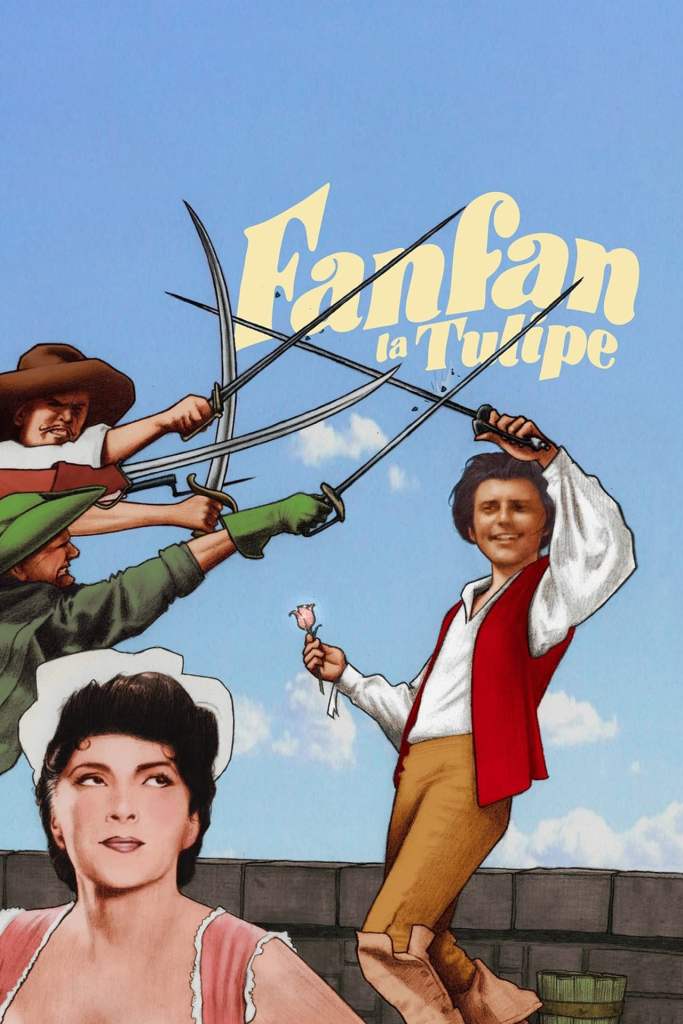
My Brilliant Career, from 1979, starts us off today on the right foot. From director Gillian Armstrong and based on a book released in 1901, the film takes place in rural Australia in the 19th century. Sybylla (Judy Davis) is a woman who dreams of a career in literature or music. The last thing she wants is a husband that will hold her back, but from a poor family, she has limited prospects to afford her an opportunity to reach her goals. Sybylla refuses to listen to her mother, so to try to teach her some manners, she is sent to live with her grandmother, her mom’s wealthy mother (Sybylla’s mom gave up the fortune to marry for love). Sybylla and her grandmother butt heads, but Grandma has hopes that Sybylla may settle down and marry the older Frank Hawdon (Robert Grubb), who is set to inherit a fortune. Sybylla obviously doesn’t want Frank, but she is attracted to the younger and more carefree Harry Beecham (a young Sam Neill), a childhood friend of hers, now all grown up. But, though she likes Harry, will she give up her goals and marry? The movie is extremely authentic feeling, and not just because of the rich scenery of rural Australia or the period costumes. In a lot of films like this one, the woman *seems* to be strong-willed, but backs down when confronted with a man’s sweet smile. Sybylla doesn’t back down, and she will not settle for less than what she wants. Great way to start today’s film set! ★★★★★
Long before The Truman Show and Dead Poets Society, before his breakout with Picnic at Hanging Rock (I’ve never reviewed this classic, but it’s really good), Australian director Peter Weir’s first film was Homesdale, released in 1971. It follows a half dozen or so eccentric people as they visit the Homesdale Hunting Lodge, a vacation spot with a staff of characters as strange as their guests. As the visitors get comfortable at the lodge, they start to play out weird fantasies, no matter if those fantasies adversely affect others or not. A black comedy with some horror elements, especially at the end, it is a weird, weird movie, and honestly not very good, but it is short (just under an hour) and there are a few truly funny moments that come out of all the zaniness. So better than nothing at all, but not much. ★½
A couple films later, as Weir was starting to make a name for himself, he came out with The Last Wave in 1977. This is a surprisingly good movie; I say that only because I don’t see a lot of people talking about it, so didn’t really expect much. It has some of the same kind of uneasy, almost surrealist moments that I felt during Picnic at Hanging Rock, which is unsurprising given the two films came out so close to each other. This movie follows a lawyer named David Burton who has been named public defense counsel for a group of aboriginal men accused of murder. The victim was found drowned with strangulation marks on his neck. The 4 accused are mum, though David thinks there is more to the story, and he’s right. He begins to believe that the men did indeed kill the victim, but that it was a tribal execution, though Australia doesn’t recognize any remaining Aborigine tribes in the city of Sydney. While all this is going on, there’s been some crazy weather patterns over the city and surrounding area, dumping massive amounts of rain. David starts having premonitions (including dreaming of one of the accused, before he meets him) and nightmares about running water, with a big sense of foreboding. All of it may be connected to an impending disaster, the likes of which the Aboriginal men have foretold. Great apprehensive feel throughout the second half of the film, and if a little of it is “out there,” it really works in the context of the movie. ★★★★
In recent years, New Zealand director Jane Campion is known for her The Power of the Dog, which got a lot of acclaim upon its Netflix release in 2021, netting her a Best Director Oscar. She’s also known for The Piano (haven’t seen it, but it’s up next!) and I highly recommend her miniseries An Angel at My Table (didn’t review it, but take my word on this one). Before I get to The Piano, let’s check out her first film, 1989’s Sweetie. All I can say is, they can’t all be hits. I’m willing to give her a pass based on her other work, and this being her first picture. It follows a woman named Kay, who either is socially awkward, or maybe every character in the movie is. I couldn’t quite tell, because all dialogue is delivered in a deadpan, black comedic way, and I wasn’t exactly getting it. Anyway, Kay is in a relationship with a man named Louis, but they are on the rocks. Into this bumpy life comes Kay’s estranged sister Dawn, whom everyone calls Sweetie. Sweetie was babied by their father and always thought she was going to be a star, but obviously that never happened. She still thinks it’s in her destiny though, and she’s dragging along some deadbeat named Bob who is her “manager.” The two break into Kay’s house and refuse to leave. Kay calls Dad to come take care of the situation, which is fortuitous timing, as he’s just been kicked out of his house by his wife/their mom. Apparently his coddling of Sweetie has always rubbed Mom the wrong way and she’s done with the whole thing. Sweetie’s antics border on the edge between repulsive and hilarious, but they are always to the extreme, as is the ending of the film, which you will not see coming. There’s good moments, some stuff works, but a lot of the comedy, and especially the way it was delivered, wasn’t doing it for me. Chalk this one up to a young director. ★★½
And finally, The Piano, the movie that put Campion on the map in 1993. It stars Holly Hunter as a mid-19th century woman named Ada, a woman who hasn’t spoken a word since she was 6 years old, the reason for which we never learn. At the beginning of the film, she lives in Scotland with her pre-teen daughter Flora (Anna Paquin) and her parents, but her father has just sold her to marry a man in New Zealand, Alisdair (Sam Neill). Mother and daughter head to the foreign land with all of her goods, including her beloved piano, Ada’s chosen way to express herself. She finds New Zealand wanting. First, Alisdair seems like a good man but he doesn’t get Ada at all, even leaving her piano on the beach where Ada and Flora arrive, because he doesn’t want to let his workers take the time to move it across the tropical land. Ada finally begs a local man, George Baines (a former whaler who has embraced the local people and their customs, played by Harvey Keitel) to take her to the beach so she can play it. George is moved by her playing; he’s a rough and tumble man who is moved to emotion for the first time in a long time. George gets the piano brought up to her house, and then contrives to get Alisdair to let Ada give him (George) piano lessons. Really he just wants to see and woo her. The two begin a passionate affair, which leads to all kinds of problems obviously. The film is gorgeously told, juxtaposing Ada’s silence with an at-times frantic piano soundtrack, all against the sweeping vistas of a rural country. The film won the Palme d’Or at Cannes, making Jane Campion the first female director to win the prize, as well as 3 Oscars (screenplay for Campion, Best Actress for Hunter, and Best Supporting Actress for Paquin at age 11, the second-youngest to win a competitive Oscar). ★★★★
TV series recently watched: Superman & Lois (season 3), Foundation (season 2), Curb Your Enthusiasm (seasons 3-5)
Book currently reading: The Fires of Heaven by Robert Jordan

I can’t remember the last time an original (non-sequel) Pixar film let me down, but I did not get into Elemental at all. A twist on the classic love story about two people from different sides of the tracks, the movie follows a fire element girl named Ember. Her parents immigrated to Element City when she was a baby, to start a new life, but the city mostly caters to elements of earth (tree-looking people), air (clouds), and water, so fire elements have always been on the outs. Even so, her dad built a good business and now, years later, Ember is looking to follow in his fire-steps and take over the family business. However, she falls in love with a water element, Wade, a relationship that is strictly forbidden by her father. It’s cutesy enough, but doesn’t really do anything new, and honestly I spent much of film indifferent, which is almost as bad as bored. I think kids would like it more, but it does make me wonder if Pixar has lost a step. I am excited for next year’s Elio and even Inside Out 2 (though their track record on sequels isn’t always the best), so hopefully this is just a one-off. ★★½
Aporia Is a very impressive movie, showing that you can make a high concept sci-fi film on a minuscule budget. Sophie has been unable to get over the death of her husband Mal a year ago, and their daughter too is barely getting by in school. Mal’s former friend and colleague, Jabir, comes to her with an idea. A physicist, Jabir has been working on a time machine for years, but realized long ago that actually going through time would be impossible. However, it can send energy (particles) through time, and if directed at someone’s brain at a certain time and place, it could kill. A perfect target would be the drunk driver who killed Mal. Sophie agrees, and just like that, Mal is back in their lives, and only Sophie and Jabir seem to know he was ever gone (something to do with them being the observers of the change). When Mal notices his wife acting differently (because of her elation at having him back), she comes clean, and he is thankful. But this leads to a new dilemma: should they continue to use the machine to take out serial killers or radical terrorists in the past? And while Mal and Jabir work on the time machine to make it able to affect times further in the past, Sophie looks up the family of the person she killed to bring back her husband, and how their lives have changed. This leads to the group deciding to kill another person, but this time, they may not like the changes. Tremendous film, and while the ideas aren’t necessarily new for people that watch a lot of sci-fi pictures, it does put a family spin on it that adds tons of emotion. The ending is very predictable, but done so well that I just didn’t care. ★★★★½
Air is the story of the signing of Michael Jordan to Nike when he was a newly drafted NBA rookie in 1984. And who would of thought anyone could make signing a contact exciting, but director Ben Affleck (barely) pulls it off. Starring Affleck, Matt Damon, Viola Davis, and Jason Bateman, at the beginning of the movie, Nike’s basketball department is in trouble. The shoe company has become a mainstay in the track and field and running area, but they’ve struggled to be “cool” in pop culture. (As someone quips early on, inner city kids aren’t watching Bruce Jenner throw a javelin.) Nike has a couple hundred thousand dollars in the budget to try to sign 3 or 4 rookies to shoe deals, but marketing expert Sonny Vaccaro (Damon) wants to spend it all on one guy: Jordan. The company knows Adidas and Converse will have a leg up on them, and Jordan is a hyped rookie who will be able to choose whichever he likes better, but Vaccaro wants to do more than have Jordan wear Nike shoes; he wants to build a brand around who he thinks will become the greatest basketball player ever, and that is idea that he sells on Michael (and more importantly, he parents). This movie has the potential to be dry and boring, but Affleck’s steady hand and ability to grow suspense from simple things like waiting for a phone call go a long way. Say what you will about his acting, but I think he’s a great director (Gone Baby Gone, The Town, Argo). ★★★
White Building is the rare film out of Cambodia. When it begins, it seems to be following Samnang and his friends, as they work on a hip hop dance routine. Just when you think it’s going to be a “reach for your goals” kind of movie, it becomes something much deeper. Samnang and his parents live in a dilapidated building in the center of the city. The city wants to tear it down and build something new (and more profitable), but the tenants have been loath to go, at least, not for the peanuts the government is offering for their apartments. Most of the inhabitants worked for the city in one form or another, and Samnang’s dad thinks they should be treated better. Add to this, the father is fighting infection in his extremities, but refuses to see a doctor. Less and less dialogue as the movie goes along, until there is almost none as the end approaches. I’m not smart enough to understand meaning in that, but it doesn’t create a bigger feeling of loss as Samnang “comes of age.” Decent enough for art film lovers, but didn’t blow me away. ★★★
Joy Ride was supposed to be a good comedy for adults, but it was just too much for me, and honestly got old quick. I can only handle so many sex jokes, and that is literally every joke in this film. Audrey (adopted from China as a baby) and Lolo (an immigrant to USA from China) have been best friends since they were kids, and have remained so as adults, even though their lives have gone in different directions. Audrey is a successful lawyer and rents her garage to Lolo, who is a “starving artist.” When Audrey is sent to China to close a big business deal, Lolo goes along to help translate, but has an ulterior motive: to look up Audrey’s birth mom while they are there. They are joined by Lolo’s cousin Vanessa (purely along for the gags, as she lives mostly an online life), and, in China, team up with Kat, Audrey’s good friend from college (again, just another person for gags, so she and Lolo can butt heads for Audrey’s attention, and more sex jokes since she’s dating a devout Christian). Of course, once settled in China, nothing goes right. The humor is what is supposed to keep the film moving along, but as I said, it got stale for me quick. I started fast forwarding to see where the plot went with Audrey’s birth mom, but finally I realized I just didn’t care, and gave up. ½
TV series recently watched: Black Snow (season 1), Titans (season 4)
Book currently reading: The Fires of Heaven by Robert Jordan
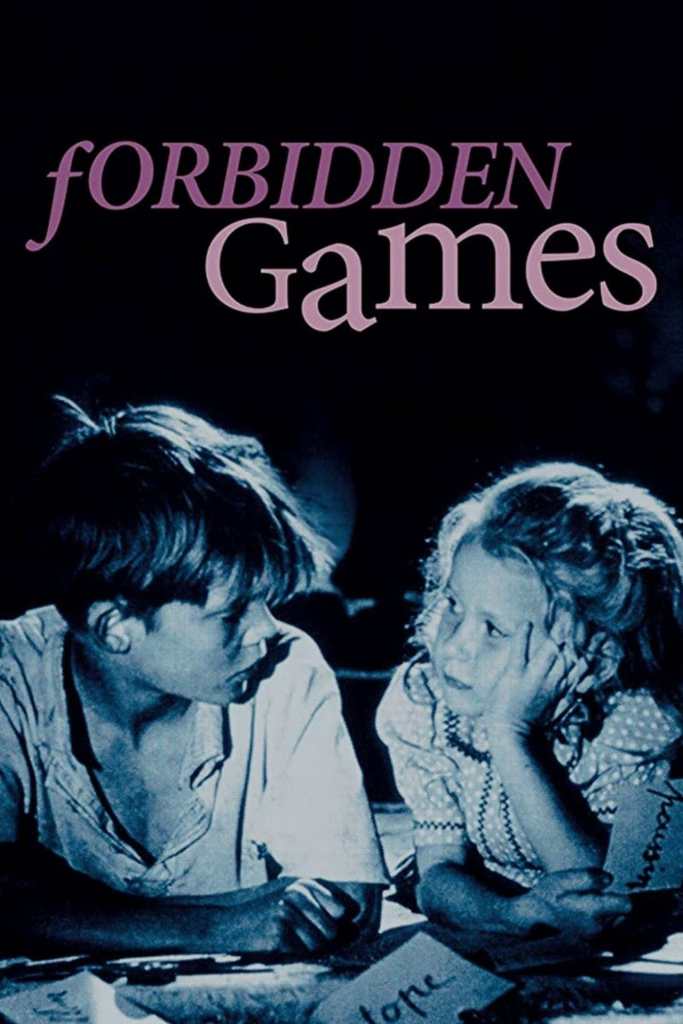
The Little Mermaid got a lot of shit when it came out, by people who probably never saw it. Without going into any of that, I had personal trepidation going in, just because the original is a masterpiece (and yes, I’m biased; I was 9 when it came out, so it was right in my wheelhouse, not to mention it has IMO the best Disney song ever, Part of Your World. Halle Bailey is a fine singer but Jodi Benson crushes it in the cartoon). But if you ignore all the talk and just sit down and watch the new version, it is quite good by itself. There’s no need to give you a synopsis, because everyone has seen the story, but I can talk about what is good and not-so-good. The good: it’s beautiful. Some people had a problem with the CGI, but honestly I thought the movie was gorgeous. Bright and colorful, just about every scene pops off the screen and takes your breath away. Also good: Eric got a song! Coming before Ariel comes to land, this tune really fleshes out his character and gives him some dimension. Let’s be honest, in the cartoon, Eric isn’t much more than arm candy. (The second added song, Ariel “singing in her head” after she’s lost her voice, really is superfluous though.) And the not-so-good: it is long, at 2 hours 20 minutes. I like the 90 minute mark for a true kid’s film; any more than that and they’ll often be on to something else. But if that’s my biggest complaint, then you know it isn’t so bad. Really enjoyable film for kids and kids-at-heart. ★★★★
Klondike is a film out of Ukraine, and yes, it is about what everyone thinks when you hear “Ukraine” these days. It takes place in Donbas, an area in Eastern Ukraine with many pro-Russian citizens, which Russia annexed in 2022. This film though takes place in 2014, shortly after Russia has invaded the country. Irka and her husband Tolik live a peaceful life in a rural community, until a stray rocket takes out the front of their house. The rocket was accidentally launched by pro-Russian separatists, and Irka is having nothing to do with their folly. She derides her husband because many of his friends are on the separatists’ side, but Irka’s brother, Yurik, who has been a student in Kiev, is definitely pro-Ukraine. As Tolik and Yurik make increasingly violent threats towards each other, Irka tells them both to shut up. With a baby on the way, she doesn’t seem to care which side wins, as long as the winning side leaves her alone. It’s a decent enough film, though honestly it seems like the film was mostly made just to draw attention to the conflict and events around that area, including the shooting down of Malaysia Airlines Flight 17, which figures prominently in the movie. Nothing wrong with shining a light on a topic that needs attention, but I do wish the film had more of a plot on its own feet too. ★★★
It seemed that once upon a time, Jennifer Lawrence was a star who could do no wrong, but that was a decade ago. After a string of flops in the late 2010’s, she stepped away for a couple years, returning slowly to release just a couple of movies over the last 2 years. I really liked her indie film Causeway last year, but her newest, No Hard Feelings, is just an average comedy. She plays a 30-something whose family has always lived in Montauk, NY, but after the death of her mother, she’s the last of them, and with tourists and transplants raising property values, she can barely afford to keep her family’s house. She answers an ad from some helicopter parents looking to “grow up” their 19-year-old son, basically paying her to have sex with him and get him to party more. They are afraid that he, being as shy and introverted as he is, he’ll get eaten alive when he goes away to Princeton in the fall. I think a lot of people would find fault in the dated and often sexist humor in the movie (and the filmmakers seem to know this, poking fun at their own movie when Lawrence’s character goes to a college party) and while I didn’t have a problem with that, I just didn’t think it was all that funny. Plenty of chuckles, very few belly laughs. Pure comedy fans might enjoy it more, but I think it was just a hair above average. Worthy of a single viewing but not much more than that. ★★★
Spider-Man: Into the Spider-Verse surprised everyone when it came out in 2018, and I loved it. It won the Oscar for best animated film and took in a hefty $384 million on a smaller-than-average budget of $90 mil. This year’s sequel, Across the Spider-Verse, came with some fanfare after the success of the first film, and delivered on all accounts, amassing $690 million on a similar budget. And it is just as good, if not better, as the first one. In one universe, Gwen Stacy’s dad finds out that she is Spider-Woman, and he cannot accept her as such. She runs away and joins the Spider-Society, a group of Spidermen across the universes who seek to keep the balance, knocking down anomalies that cross into universes where they do not belong, basically anything that would threaten Spider-Men in each universe. One such anomaly is the villain the Spot, who shares the universe with Spider-Man Miles Morales, the main character from the first film. The Spot has a new power allowing him to traverse the multi-verse, and he does so in order to get stronger in order to kill Miles, who he sees as the person responsible for ruining his life. Gwen goes to Miles’s universe to subdue the Spot, but when she leaves to follow him to the next universe, Miles follows, and in doing so, he himself becomes a problem to be dealt with by the Spider-Society. As I said for the first film, this movie is tremendous. Animated in a comic book style and giving tons of homage to Spider-Man’s roots in the form, the movie is more than just pretty dressings. There are some big surprises near the end that add emotional heft. There’s lots of talk about “superhero film fatigue,” with Marvel and DC films not doing too well of late, but Sony is showing that you can still make a incredible movie that will please just about everyone. I can’t wait for the next sequel (because this movie does end on a cliffhanger…). ★★★★★
Blue Jean has the subject matter that critics love, and while the leads are up to snuff (the supporting cast is more hit-or-miss), the whole doesn’t quite together as I think it should have. Jean is a P.E. teacher at a high school in the UK in the late 80s, and she has a secret. Since the government is cracking down on teachers “pushing homosexual agenda” to kids, she has to hide that she’s a lesbian, for fear of losing a career that she loves. Until now, she’s been able to keep her personal and private life separate, but there’s a new girl in school, Lois, who is getting teased because her fellow students think she is gay. It is confirmed when Jean runs into her at a gay bar one night. Lois is not ashamed of who she is, and unlike Jean, is not about to hide it, which earns her further persecution at school. With Jean’s girlfriend Viv also pushing her to stop hiding who she is, Jean has to make a decision on what is important to her and how to move forward. Rosy McEwen is excellent as the conflicted Jean (she won a British Indie Film Award for the role) and newcomer Lucy Halliday is very good as Lois too, but as a whole, it didn’t do enough for me. ★★½
TV series currently watching: Dark Winds (season 2)
Book currently reading: The Fires of Heaven by Robert Jordan