Sacha Guitry was a playwright and director in the early 20th Century in France. He wrote and produced several successful plays in Paris, but avoided making movies during the silent era (after watching a couple of his pictures, I see that he loves quick and counterpointed dialogue, which would be impossible to pull off in intertitles) but embraced talkies once they became standard. Today I’ll look at 8 of his films from the 1930’s, culled from the nice sets put out by Arrow Films and the Criterion Collection.
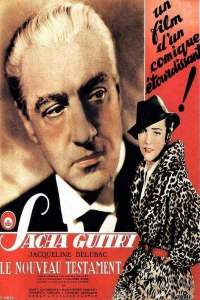
The New Testament is based on a play of his and is pretty much a filmed play, mostly on one set. It follows Jean, a successful doctor, his wife Lucie, and their circle of friends and servants. One day Jean doesn’t come home to a dinner party, but a stranger appears at the door with his jacket. Lucie worriedly goes through its pockets, and they find his last will and testament. Frantic for a clue to his whereabouts, they open it, and find a shock. Jean confesses to having an affair with a woman who (coincidentally?) shares the name with his new secretary, and more than that, admits he knows of his wife’s adultery too, with a (very young) friend present for the dinner party. When Jean swoops through the door, those present hide the will and pretend nothing is amiss. The film is a bit dated, but a lot of the quick dialogue is still funny today. But in an old-timey way, the “play” is entirely spoken, with no real action to break it up. As such, as a non-native language viewer, you are stuck reading constantly. I like foreign films, but it’s hard when you don’t get to actually watch much of what the actors or doing because you are tied to the text at the bottom of the screen. ★★
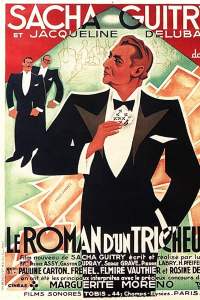
The Story of a Cheat (aka Confessions of a Cheat) is leagues better, and also, I think, way ahead of its time. It starts with Guitry, in voice-over fashion, introducing the actors and film crew who are involved in making the picture, including the composer of the music, the film editors, the producer, etc., a technique that Orson Welles would later famously do as well, and an outside-the-box idea that you can envision inspiring a young Truffaut or Resnais during the French New Wave 20 years later. When it gets going, the film is also very uniquely done. It is entirely narrated by “the cheat,” who is writing his memoir in a café, even going so far as to speak for his actors when they have a line to deliver. He begins as a young man, when he is grounded from eating the mushroom delicacy which was prepared for dinner (grounded because he was caught stealing from the till at his parent’s store), only to become the sole survivor after said mushrooms killed the other 11 members of the family. From then on, our narrator tries to go the straight and narrow path of honesty, but always seems to be pulled into schemes by less scrupulous people around him, from coworkers to beautiful femme fatales. Though we only hear one voice, his, through all of the film, it never gets stale. For one, it is truly funny, not dated at all, and is beautifully written. For two, the story has some fabulous twists and turns that keeps the viewer on his toes as we go through the peaks and valleys of our antihero’s life. I loved every minute of it. ★★★★
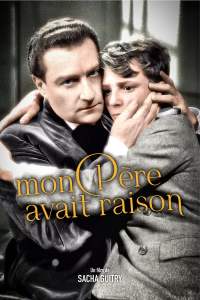
Like The New Testament, My Father Was Right is also based on a play of Guitry’s, and unfortunately the other thing they have in common is being a total bore. There’s even less going on in this film than there was in the first. The overall gist is about learning to live life to be happy and not to worry about what may or may not happen to destroy that happiness. A wealthy man raises his son on his own, after the mother flew the coup 20 years previously, and as a young man, the son has a distrust of women for fear of betrayal. It is up the father to assuage his fears. That’s really it, and it takes nearly 2 hours to get through it. There are some moments of brevity but the whole thing is pretty monotonous. The Story of a Cheat was based on a book Guitry had written, but so far, the two film adaptations of his plays have been a struggle to get through. ★
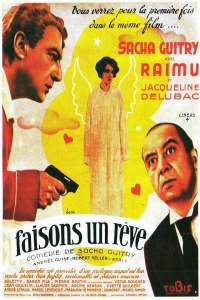
And uh-oh: another play-based film. Let’s Make a Dream comes from a play of Guitry’s from 1916. I settled in with little hope for a pleasant film. Maybe it was the low expectations, but I enjoyed this one! It’s another simple story: a husband is most clearly planning to run around on his wife one night, so she goes off to sleep with a new man of her own. What should have been a quick evening tryst goes awry when they end up sleeping through the night. The next morning, she is distraught about how to go home to her waiting husband, so her new lover plans how to get them off scott free. The big twist is yet to come though! The best part of the film is the long monologues delivered by the lover, both alone to the viewers and to his new girl later. Witty and engaging, it’s a clever and funny picture. I’m not entirely sure today’s average moviegoer would dig it, but the banter is top notch. ★★★
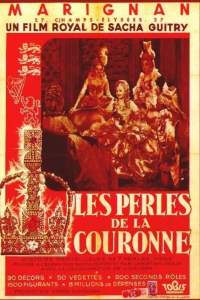
Pearls of the Crown is another original work of Guitry’s, not based on a previous play of his, and it was his most ambitious film to that point. It is the (fictitious) story of 7 pearls, four of which would go on to adorn the crown of England, and the other 3 which seem to be lost to time. Told in flashback over the course of 400 years, the tale jumps countries constantly with a revolving multitude of cast members, and involves kings, queens, mistresses, and popes. Guitry, always playing the leading man in his films, plays 3 or 4 of them here, including King François of France and Napolean III. He brings his trademark irreverent dialogue to this film, but that’s the only highlight. There was so much going on, I felt a bit lost at times. And frankly it’s all a bit boring for too-long stretches. The film has good moments, and some chuckles, but it felt really long, and wasn’t even 2 hours. ★½
Man oh man, I’m up and down with this director. I really liked Désiré, the story of a butler (with the title’s name) who takes a job with a well-to-do society woman named Odette. Odette is dating a politician and runs her household in the strict, time-honored fashion of delineated boundaries between servants and master. Though she is kind to Désiré and the maid, Madeleine, she makes sure to keep them separate from herself and her boyfriend Felix. Désiré comes from a family of valets and knows his place, and he is very good at it, but for some reason, he and Odette share some kind of subliminal attraction to each other: each night, they dream about each other and even call out their names in their sleep, much to Felix’s chagrin. Désiré is aghast at this breach of protocol, as is Odette for much the same reason. The movie is comedy, but also strays towards satire in poking fun at the differences in class. The best scene is the second-to-last act, a dinner party involving Felix, Odette, and a deaf friend, with Désiré waiting on them. It is pure laughs throughout. The ending drops the comedy though, and becomes quite poignant as Guitry screams for equal treatment for the “lesser” class. ★★★
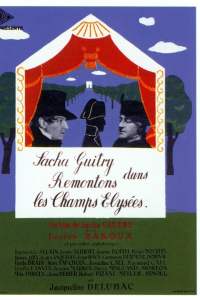
Let’s Go Up the Champs-Élysées is alright I guess. It is very similar to Pearls of the Crown, in that it is a “historical” story, in this case, about the famous venue in Paris and how it came to be, but that is just the backstory. Mostly the film focuses on a few key players, kings of France and whatnot, because the person telling the story happens to be distantly related. The storyteller in this case is a teacher, who is 64 years old today, a significant age in the history of his family. It seems his ancestors always fell in love at 54, and died at 64, so on this special day, he tells the tale of his lineage to his class. It is a long and winding story, made by head spin a bit at times. While not a complete dud, it wasn’t as engaging as the better Guitry pictures, and distinctly lacked the comedic wit of the films I’d enjoyed to this point. I have one more to go to finish this set, I’m hoping to finish with a good one. ★★
Did indeed end on a good note. Quadrille came out in 1938 (can you believe Guitry made all 8 of these films in a 3 year window, 1936-’38?!) and is about a long quadrangle. Philippe is a decent enough guy; he’s always stayed faithful to the woman in his life, though his first marriage ended after she cheated. He’s been with a successful actress, Paulette, for a number of years now, and they are discussing marriage, when her eye strays to a popular (and young) American actor named Carl. She goes and has a one-night fling with him, and the next morning, is torn between returning to Philippe or latching on to Carl for good. When Carl goes off to do his own thing, Paulette begs Philippe to take her back, but for how long? It seems she can’t control herself whenever Carl is around! Tired of her antics, Philippe starts eyeing his own young plaything, Claudine, whom he’s known since she was young but who is now a dashing young woman. As verbose as any of Guitry’s pictures, it was just clever enough to keep my attention. After seeing all these films, I’ve definitely come to know his style. While dated, some of these pictures can still be entertaining if you sit back and enjoy the wordplay, because ultimately, that’s really the focus of all of these films. ★★★




 Going to look at some of the most popular films of Ernst Lubitsch. He was extremely popular (and bankable) in his day, but you don’t hear much about these movies anymore. The Shop Around the Corner stars Jimmy Stewart (a few years before It’s a Wonderful Life) and Margaret Sullavan as coworkers in a small goods shop. They can’t stand each other, but unbeknownst to them, they’ve been writing anonymous letters to each other through a post office box and falling in love with that ideal person. The banter between them and the other workers in the store is fantastic, and there’s a whole plot involving the owner of the store (Frank Morgan, more popular known as the Wizard himself in The Wizard of Oz), and the owner’s wife having an affair with one of the other employees. But the developing love story between our two leads is the real draw. A very popular film, it was remade a couple times, into In the Good Old Summertime (starring Judy Garland) and, most recently, You’ve Got Mail with Meg Ryan and Tom Hanks. Though Mail credits the original play as its inspiration, it obviously draws heavily from this film (and if you remember, the bookstore that Meg Ryan’s character owns is named “Shop Around the Corner”). ★★★
 The above film is from 1940, but a lot changed between it and 1933’s Design for Living, specifically, 1933 is pre-Hollywood Code. As such, more than just innuendo about sex, we get straight up talk about sex and straight up (off camera) sex. And it’s funny too! This film is about a girl, Gilda (Miriam Hopkins), who ends up on a train to Paris with a couple of men, roommates named Thomas (Fredric March) and George (Gary Cooper). Gilda is a successful corporate artist in advertising but the two men are struggling in their artistic endeavors, Thomas as a playwright and George as an artist. Each of the men instantly fall head over heels for the beautiful and vivacious Gilda, and in wonderful pre-code fashion, she’s not timid or shy about her own needs: she wants them both! The two men try to put bros before hoes and shake on not pursuing the girl, but neither can keep up his end of the bargain. When Thomas goes away to London to open a play, Gilda starts sleeping with George, but romps with Thomas when he comes back to visit. The film is delightfully funny, and though I haven’t seen a lot of pre-code films, I think they are so far ahead of their time in depicting strong women who stand up for themselves and what they want, physically and otherwise. It’s a fantastically fun film, based on a play by Noël Coward (loved
 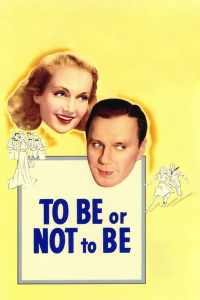 Imagine the deftness of writing and direction it takes to combine nail biting suspense with laugh-out-loud comedy. That’s what is found in To Be or Not to Be. The film follows the actors of a small theater in Warsaw, Poland, in the days leading up to and just after the Nazi invasion. Josef Tura (Jack Benny) is the leading man, supported by his wife Maria (Carole Lombard). Maria meets with a young Polish airman in her dressing room each night during the performances, and once the invasion begins, the young man goes to England where he can fight the Germans. There, he meets a Polish resistance leader, Professor Siletsky, and gives him a message to give Maria. However, Siletsky is actually a spy for Germany, and has been gathering intel on those Polish citizens who have gone over to fight against the invaders. Back in Poland, Josef and Maria have been doing what they can to support the resistance, and now take it upon themselves to kill Siletsky before he can pass on his intel to the gestapo. Sounds dire, and it is, but this black comedy is also incredibly funny. The comedic lines are delivered perfectly, at unforeseen moments, so that even when you are leaning forward during a tense exchange, when the actors are in very real fear of death, something will be said that will ease the tension and produce a laugh. Done poorly, and either the drama or the comedy suffers, but nothing is done incorrectly in this film. It all goes together so wonderfully. If the writing isn’t perfect, or if the direction isn’t spot on, or if the lines aren’t delivered just so, a movie like this could be a mess. Instead, it all comes together to brilliance. The film was not well received when it was released in 1942, it was after all satirizing the Nazi party when they were doing some very terrible things. But seen today, it is a whole other story. On a side note, Lubitsch (a German-born Jew who was a successful director in Germany before the war, and in Hollywood during it) was particularly despised by Hitler, who used Lubitsch’s face in propaganda pictures. ★★★★★
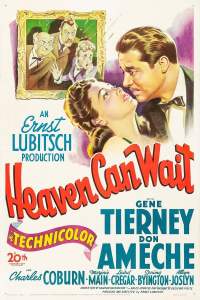 Heaven Can Wait is the first clunker from this director that I’ve seen. It still has some of the witty dialogue, but wasn’t all that intriguing for me. An old man has just died and rather than arrive at the pearly gates, he gets to the one place where everyone in his life has told him to go. At hell’s vestibule, Henry is greeted by a suave and welcoming Satan, who admits he isn’t familiar with Henry’s credentials to get him into hell. Henry begins to recount what he believes is a bad life, starting with being a naughty child, and then into adulthood, where he ran away with his cousin’s betrothed, only to continue his dalliances (off-camera of course). Henry always had a way with words, which kept him out of serious trouble throughout his life, and he uses them to save his marriage. Henry is portrayed by a young Don Ameche, who I recognized immediately from films of my childhood (Cocoon and Trading Places – one of my favorites as a kid). But nothing is memorable about this film unfortunately. ★★
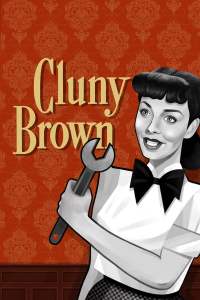 Cluny Brown is a young woman, niece to a plumber, who isn’t afraid to do things for herself (and in fact, loves crawling under a sink and fixing a leak herself). When she responds to a service call in place of her uncle and does just this, she meets a foreigner named Mr Belinski, who is in London in hiding from Hitler’s Nazis. Mr Belinski is smitten with the modern Cluny, and fate brings them together again when they meet in the country, after Cluny is there to become a maid and Belinski is again in hiding. Cluny tries to do what she thinks is proper and has a date with the local pharmacist, but Belinski tries to convince her that the man is not for her, with his staid and unadventurous lifestyle. It’s a very nice romantic comedy, with Lubitsch’s trademark risqué interchanges. And holy cow, how did some of this dialogue get past 1940’s censors?! There’s a delightful scene where Cluny is thanking Mr Belinski for meeting him in the city and rolling down her stockings and banging it out (meaning the plumbing) within earshot of the housekeepers, who are obviously flabbergasted. The dialogue is the best part of the film, as the story is a little too expected. Nuts to the squirrels! ★★★½
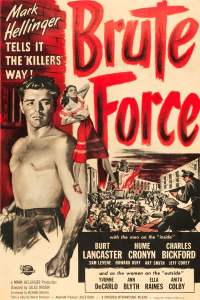 Brute Force may be one of the best prison films I’ve ever seen. Released in 1947 and directed by the great Jules Dassin before he was blacklisted during McCarthy’s communist witch hunt, it features a couple young stars in Burt Lancaster and Hume Cronyn. The “action” of the film takes place entirely in a prison, where the inmates all dream of getting out and returning to their girls waiting on the outside. No one wants out more than rabble-rouser Joe Collins. The other prisoners follow his example, and the guards are understandably weary around him because of this. Joe is particularly opposed by the sadistic captain of the guard, Munsey. Munsey plays the prisoners off of each other, fermenting paranoia and angst among them. Joe is onto the game though, and is able to gather a few close friends to plan a real escape. The attempt is fantastic; even though the viewer knows it can’t possibly succeed, we hold out hope that a miracle can happen. Interspersed throughout the film are flashbacks, some heartbreaking, for each of our main troupe, showing the reason they want to get out and the life they want to return to. This is the third Dassin film I’ve seen, and loved
 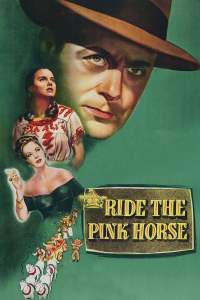 Ride the Pink Horse is a seldom-seen film noir from director Robert Montgomery, who also starred in the lead role as Lucky Gagin. Gagin comes to a tiny town in New Mexico, San Pablo, in order to blackmail a crime boss, Frank Hugo, over the murder of Gagin’s friend. In classic film noir fashion, there are some side tracks, double crosses, a ne’er-do-well girl, and some innocents who try to give a helping hand to Gagin along the way. I resisted liking Gagin through much of the film, because frankly, he’s not a very likable guy. He is rough with people, condescending, and downright cruel in his talk to the local Mexican immigrants in town, calling them derogatory names even when they are helping. I know a lot of that can be written off as part of the times in 1947, but it doesn’t make it any easier to watch. Still, Gagin gets his comeuppance in the end, and his language and character issues aside, the film itself is absolutely enthralling. Not sure how this one hasn’t gotten more attention over the years, but anyone who likes film noir should check it out. ★★★★
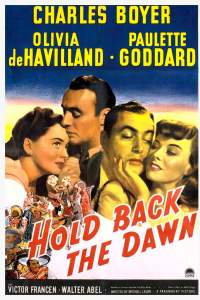 Hold Back the Dawn is a lovely romance from director Mitchell Leisen, based on a screenplay by Billy Wilder. Georges is from Romania and is trying to immigrate to America for a new start. He can afford to get to Mexico first, but it is there that he learns about quota limits on who can cross into the USA, and is told it will be 5-8 years before he can enter. A few months in, and broke from living at the local hotel, Georges is reunited with a former dance partner from Romania, Anita, who tells him how she was able to get US citizenship by “marrying in” and then quickly divorcing. Georges plans to do the same thing, and targets a visiting schoolteacher, Emmy, who is in Mexico with a bunch of field-tripping kids. Georges woos her and marries her all in a day, but is at least gallant enough to put off their wedding night. Over time, as Georges tries to avoid the USA immigrant agent who frequents the Mexican town with eyes out for people just like him trying to get into the country any way they can, Georges starts to have feelings for Emmy after all. But will he realize it himself before she catches on to his plot? It’s a very nice film; perhaps not all that memorable in the long run, but entertaining. Emmy is played by none other Olivia de Havilland, Melanie Hamilton of Gone With the Wind fame. She received an Oscar nomination for this role, and the picture received 6 nominations overall. ★★★½
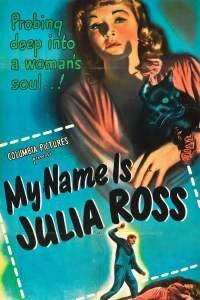 My Name is Julia Rose is sort of a tense, quasi-psychological drama, from director Joseph H Lewis. It’s a simple picture, just a hair over an hour long, and not all that deep either. American immigrant Julia is desperate for work in the UK, and visits an employment agency where she hears about a job as a secretary for a wealthy woman. All seems ok until we see the family she is to work for, and they start whispering about nefarious doings. As soon as Julia gets there that night, she is drugged, and wakes up 2 days later in a seaside mansion, and is being called a different name. She doesn’t know what their intent is, and no one knows she’s there. The rest of the film is about her boyfriend trying to hunt her down, and her repeated attempts to escape the crazy family. Strange picture, and a few too many cheesy moments, even for a 40s flick. The constant (and I mean CONSTANT) violin runs and tremolos, to build suspense I guess, grew tiresome even during the short length of this film. ★½
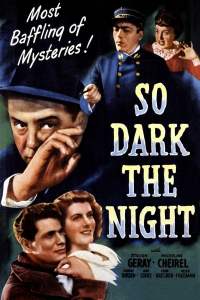 So Dark the Night is from the same director, and it is a bit better. It’s a classic who-done-it in the film noir tradition. Henri is a famous detective from Paris on vacation in a small village in the French countryside. A local girl, Nanette, sets her eyes on him as a way to get out of the tiny town. Nanette’s mother encourages her to pursue Henri, but Nanette’s father and her longtime beau Leon have obvious objections. When Nanette ends up dead of strangulation, Henri suspects Leon immediately, until Leon is found dead too. Those are just the first two, and the killer starts leaving notes of warning to Henri as well. The ending gets a little weird, with some wild leaps in typical 40s fashion, but it was still ok. And I do like a short film I can watch in about an hour! ★★½
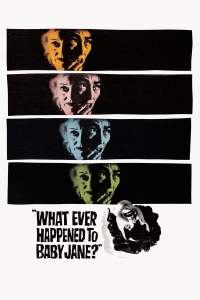 Whatever Happened to Baby Jane? hails from 1962 and stars two Hollywood heavyhitters, Bette Davis and Joan Crawford. By the 60’s they were aging stars and not getting the calls they used to, but this film revitalized their careers. Directed by Robert Aldrich, it is a psychological thriller about the Hudson sisters. Beginning in 1917, “Baby Jane” Hudson is a child star on the theater circuit while her sister Blanche looks on from the sidelines. By the mid-30s though, their fortunes have been reversed, as studios have found that Jane can’t act her way out of a box, and Blanche has become a Hollywood star. On one fateful night, it is implied Jane, in a fit of jealousy, drives down Blanche. When we see them again in the 60’s, we see that the incident has left Blanche in a wheelchair. She’s protected Jane though, so Jane didn’t do any jailtime, and Jane has been taking care of Blanche, whose residual checks keep the family living well. The film really gets going now. Jane has become a mentally unstable alcoholic, and she begins to mentally torture Blanche, who is confined to the second floor of the house, all while having delusions of revitalizing her career as “Baby Jane.” It’s a great film, tense with an almost-horror flick feel, and two leading ladies who had lost nothing to time. Fun stuff, and gripping to the end. ★★★½
 Seconds, from director John Frankenheimer (
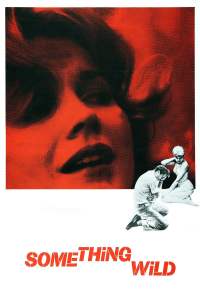 Something Wild was critically the opposite from above. Receiving middling reviews, I really enjoyed this piece, which again is a psychological film, leaning more on the drama aspects instead of the thriller like Seconds (though there are plenty of tense moments in the final 30 minutes). Walking home from school one evening, college student Mary Ann (Carroll Baker, who is amazing in this role) is brutally raped. The next day, she can’t return to a normal life, and wanders the city, unable to mentally find her footing. Mary Ann abruptly leaves her home and takes a tiny apartment in a seedy part of town, gets a lowly job in a five-and-ten, and spends her nights restless. When Mary Ann finally reaches the end of her rope, she attempts to jump off a bridge but is saved at the last second by Mike, a passerby. He takes care of her at first, bringing her to his place and feeding her, but when he comes drunk home after work, we see that he is up to no good. Mary Ann and Mike are a couple of wonderfully complex characters. Also, the director does a great job of putting us in Mary Ann’s head; you feel her hopelessness as she isolates herself from everyone in her life, and you see how alone she is even though all of New York is bustling around her. Great film that I think was just ahead of its time; if it were made today, it would be a darling of the indie circuit. ★★★½
 I was enthralled by Bill Greaves’s pseudo-documentary Symbiopsychotaxiplasm Take One, made in 1968 but not released until decades later. Greaves, an actor and documentarian (in fact, a member of The Actor’s Studio in New York in the late 40’s at the same time as Marlon Brando and Shelley Winters, among others) plays an inept version of himself trying to make a film in a park in New York with three film crews: the first is filming his movie, the second is filming the first film crew in a “making of” sort of way, and the third is filming anything that catches their eye in the area. They keep filming the same scene over and over again, from different angles, different takes, and even different actors. It seems no one is in on the joke except Bill himself; the actors and film crew increasingly wonder what the hell they are all doing there and if Bill even has a plan for it all. Of course in reality, Greaves is filming everything to edit together later for a piece about the mayhem going on and the natural, authentic reactions of those involved in it. It is mesmerizing in a reality television sort of way, but far better for those of us who love movies. It gives a real behind the scenes look. Unfortunately the film took 20+ years to get released, and only did after actor/filmmaker Steve Buscemi saw it at a film festival, and brought on acclaimed director Steven Soderbergh to help raise money for Greaves to finally get it done. They even used a lot of the unused footage (Greaves reportedly had shot 55 hours of tape initially) to make a sequel, Symbiopsychotaxiplasm Take 2 1/2. The first 40 minutes of the sequel is old footage, before they get to new stuff later on. It doesn’t have the freshness of the first film, because the counter-culture element of the 60’s shines so well in Take One, plus, we are all in on the joke now. I’d give maybe 2 stars to the sequel, but for Take One, : ★★★★
 The Honeymoon Killers is based on a true story, about a pair of serial killers who killed older woman who had placed “lonely hearts” ads. In the film, Martha Beck has just placed such an ad when she is contacted by Ray Fernandez. The two exchange letters for awhile, until they decide to finally meet at her home in Alabama. Ray makes the trip down from New York, but is only there a day or two, managing to swindle Martha out of some money. Realizing she’s been duped, Martha chases him to New York and threatens the police. Placating her, the duo hatch a plan to continue targeting old single women for money, a scheme that eventually turns to murdering their victims once the cash is safe in hand. Martha plays the crazy one, prone to fits of sudden violence, and Ray seems unable or unwilling to reign her in. Lauded in its day for its realism, it’s a good low budget film with tense moments and plenty of thrills for a late 60s historical drama. ★★★½
 I usually see newer movies, and Take Shelter isn’t a new film (2011), but I stumbled upon it accidentally, saw it had two fantastic actors (Michael Shannon and Jessica Chastain), was directed by Jeff Nichols (before he did Mud and
 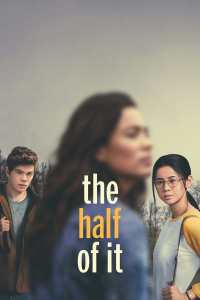 The Half of It is a very nice, new take on the classic coming-of-age tale. Ellie is a very smart and talented girl in high school, but she’s shy and ridiculed as the class nerd. She also happens to be the best writer in school, so everyone pays her to write their papers, and she uses the money to help support her single father, who hates his job in the small town where they seem to be stuck. Ellie is approached by a dumb (but nice) jock, Paul, to help him write a love letter to Aster, the prettiest girl in school. The problem is, Ellie has a huge crush on Aster herself. Aster hangs with the cool crowd because of her looks, but she’s smart and artsy and more akin to Ellie. As Ellie and Paul grow closer, this little love triangle grows very complicated. Ellie tells us in the beginning this isn’t a love story, but it is a story about finding yourself. The film is definitely more painful than warming, but it leaves you with a sense that life will be OK in the end. ★★★½
 Extraction, starring Chris Hemsworth in his classic manly role, is no sweeping, thought-provoking cinematic experience, but it doesn’t try to be. It is a straight forward action flick, and for what it is, it hits on all cylinders. Tyler Rake is a mercenary with a team that goes to the highest bidder. They’ve been hired to rescue a boy who’s been kidnapped. The boy is the son of a drug lord in India, but he’s been nabbed by a drug lord from Bangladesh. In the mission to get the boy and get them to the people with the most money, all hell breaks loose. There’s no deep plot here, no surprises, just lots of pure action, with Rake killing dozens, if not hundreds of “bad guys” on the way. If you are in the mood to see hand-to-hand fights, lots of explosions, and plenty of gratuitous gore, this film will satisfy. I went in knowing what to expect, and was happy with the outcome. ★★★½
 Little Women received a ton of accolades last year, but I just don’t get all the praise. A new telling of the classic Alcott book, director Greta Gerwig brought together an all-star cast of women, including Saoirse Ronan, Emma Watson, Laura Dern, Meryl Streep, and Florence Pugh. The actors are charming, but the characters are a bit pretentious. A family of four girls living with their mother while their father is off with the Union army in the Civil War, they are raised to be sure of themselves, kind to the needy, and strong willed in a time when women were just supposed to get married and be an ornament. Jo wants to be a writer, Amy an artist, Meg an actor/playwright, and Beth a musician, and each pursues their goals in their own way, while remaining tightly connected to each other. The film is about these pursuits, as well as the relationships that come and go. Unfortunately it all comes off as too syrupy sweet, and as the film is told in flashbacks (and even a couple flash forwards), it feels choppy, and honestly this way of telling this classic story doesn’t do justice to the girls. Starting in the present and then going back, we don’t get to see them “become” the women they are over time, it just sort of happens. And (**SPOILER**) when Beth dies, because we didn’t get to know her so well earlier, her death has a much less affect on the watcher as it does on the reader in the book, and does Beth a severe disservice. And the film feels long. It is under 2 1/2 hours, but I’ve seen 3+ hour films that went by quicker. It isn’t bad, and the actors are great all around, but not deserving of the heaps of praise. I think sometimes we go too far to applaud a woman director when she makes a good film, because the industry is lacking in good female directors, and unfortunately that was the case here for me. ★★★
 Pain and Glory is the latest from storied director Pedro Almodóvar, who I ashamedly admit I haven’t seen enough of (will rectify that before too long). It stars Antonio Banderas as Salvador Mallo, an aging, successful director who is at a bit of a crossroads. In 4 years he has lost his mother and had major back surgery which has left him in constant pain. On the 32nd anniversary of his breakout film, a local theater in Madrid is screening a restored version of the movie, bringing all kinds of emotion to Salvador. He reconnects to the star of that film, despite a falling out 30 years ago, and also begins to work through his thoughts and feelings regarding his mother. Interspersed throughout the picture are flashbacks to Salvador’s childhood, growing up in poverty. This is a film about healing, both for our main character and, I believe, for director Almodóvar. He’s on record for saying how personal the film was for him, and while it isn’t a true biography, it is also very evident that he is working things out for himself in this film. It’s a beautiful film, with a nuanced and touching performance by Banderas. ★★★★★
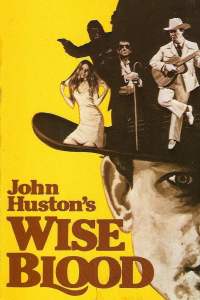 I thought it’d be nice to watch some film adaptations of some of these books I’ve been reading. Wise Blood, directed by famed actor and director John Huston and released in 1979, is based on a book by the great American writer Flannery O’Connor. I didn’t read this book, but I did read her famous book of short stories,
 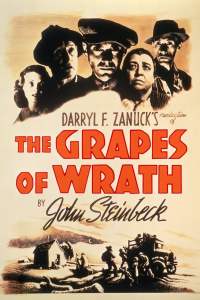 I did read
 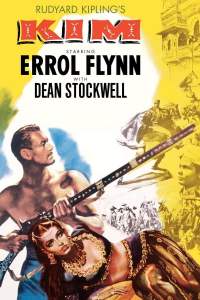 It’s been awhile, over 5 years and about 100 books ago, since I read
  1984 sticks to
 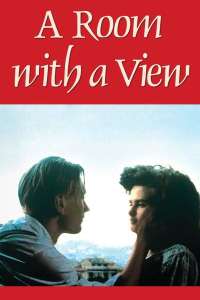 A Room With a View is based on
 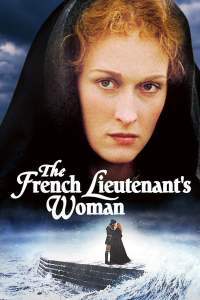 Followed up with another period drama, The French Lieutenant’s Woman, based on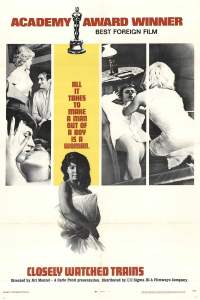
 Before Milos Forman won a couple Oscars for One Flew Over the Cuckoo’s Nest and Amadeus, he made a name for himself in the Czech New Wave in his native Czechoslovakia. On the surface, The Firemen’s Ball is a screwball comedy. A group of local firefighters is throwing a big retirement party for their outgoing chairman, and the whole troop is a bunch of bumbling idiots. The main sources of laughs come from people stealing prizes from the lottery table all night, and the lecherous old men ogling over very young women for the beauty contest to be held. But the comedy is only so light-hearted, once you realize Forman was making fun of the Communist party in control of Czechoslovakia. In fact, the film was banned in his home country for a long time. The Fireman’s Ball was his last film made there before coming to the USA. While away scanning locations for his next film in 1968, Prague was invaded by the Warsaw Pact of countries, including the USSR. He obviously did very well in America, but this was a great film and a lasting piece of that era.
 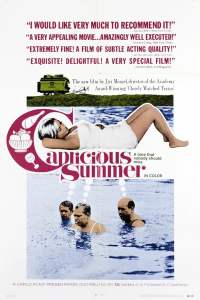 I liked Jiri Menzel’s above film so much that I hunted down another. Unfortunately Capricious Summer doesn’t come close. Released two years after Closely Watched Trains, this film is about three middle-aged men, life-long friends, as they relax on a summer retreat. They debate life and poke fun at each other as all friends do, but their relaxing days are thrown into disarray when a traveling circus performer comes to town. The one married man of the trio sees his wife fall for the performer, while the three men all vie for the attention of his lovely young assistant. I chuckled a few times, but found myself bored for way too large of a portion of this picture.
  Just as I loved and hated two films of Jiri Menzel’s, I loved and hated films by director Jaromil Jires. A few months ago I saw
  Pearls of the Deep is an anthology film, made up of 5 short skits based on a book of short stories by Czech author Bohumil Hrabal. Each part of the film has a different director. Like most anthology movies, it is a bit uneven, but overall it is a nice picture. The Death of Mr Baltazar, directed by Jiri Menzel, shows a group at a motorcycle race, each person one-upping another with wild tales they’ve witnessed, before the eponymous Baltazar crashes in the race. The Imposters (director Jan Nemec) is about a pair of dying old men in a hospital, telling each other of their exploits in life, before we find out later from the coroner that the stories were all made up. The House of Joy (director Evald Schorm) follows a couple insurance salesman who get more than they bargained for when they try to sell man who sees himself as an important artist more than a goat pelt producer. The Restaurant of the World (director Vera Chytilova) takes place in a restaurant one night when a woman is found having committed suicide, while a wedding party celebrates outside. Finally, Jaromil Jires’s Romance is a fun romp, about a beautiful young gypsy girl who offers her body to a passing young man in exchange for some new clothes from the department store, but he gets more than anticipated when they quickly fall in love with each other. Parts of the film were good (some very good, particularly Jires’s finale), and as a whole there is a sense of railing against the establishment. Unfortunately for these directors in 1965, they would lose the ability to openly do that very soon.
  Hour of the Wolf is a bit different from other Ingmar Bergman films. It’s very much a horror picture, and it shows Bergman using different themes than he’s traditionally known for. Johan Borg (Max von Sydow) is an artist of local fame, and he’s brought his younger wife Alma (Liv Ullmann) to a tiny island where he has a summer home. They aren’t there for long before Johan starts becoming distant and surly; he stops sleeping and starts talking about being haunted by demons on the island, people he names as the Birdman, the Meat Eaters, and a lady who removes her face when she takes off her hat. Shortly after Johan starts acting this way, Alma is visiting by an older woman who tells Alma where Johan keeps his diary. Trying to help him, Alma reads through it, and finds out that Johan was once involved in a scandalous affair on the island, before their marriage, to a married woman named Veronica. Johan also admits to Alma that he killed a young boy on the island once, a story that repulses Alma. A local baron invites the couple to his castle for dinner, at which Johan’s past is brought up, and allusions are made that Veronica is still around. Before the conclusion, Veronica’s ghastly visage does indeed show up, and the demons are unmasked. It’s a very different feel from what I’m used to from this director, but it is good nonetheless. Bergman’s longtime cinematographer Sven Nykvist (look up his impressive list of films!) creates a gloriously dark miasma which permeates through each successive scene, getting bleaker and bleaker until a stunning conclusion.
 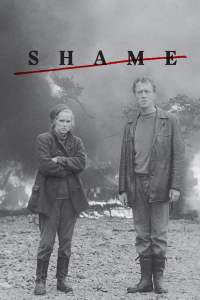 Released the same year, von Sydow and Ullman return together in Bergman’s Shame, another film very different from his usual fare. It is the most political film he ever made, and also very antiwar, as a look at the legacy of World War II and probably eyeing the ongoing Vietnam conflict as well. Jan and Eva are a married couple, violinists in a local symphony before a Civil War broke out recently, but they’ve stayed on their farm and away from the conflict. Eva is a strong willed woman and the defacto head of the house, while Jan is submissive and prefers to avoid conflict. They can’t forever though, and war finally comes to them. Nearly sent to a labor camp, they are saved at the last second by a local politician and supposed friend, Jacobi (another Bergman stalwart, Gunnar Bjornstrand), who became a conspirator for the (so far) winning side of the war. I didn’t enjoy this first hour of the film, to this point; it is almost an action film, which seems neither Bergman’s nor von Sydow’s forte, but the second act found them both in their element. Things have settled down a bit, but Jacobi has used his power over the couple to his advantage. Showering them with gifts (food and supplies, in a time when such things are hard to come by), he’s seduced Eva into granting sexual favors in exchange. The mousy Jan is unable to stop it, but when the political tides turn against Jacobi, Jan is finally able to grow a backbone. The problem is, will Eva like the man he becomes? There are some stunning moments in the second half, some heartfelt and heartbreaking dialogue and emotional peaks and valleys that only Bergman could produce. Sit through the first half, because the payoff is fantastic. The second half is 4+ stars, but I’m docking it just a bit for the first half.
 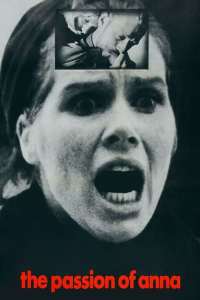 Having just finished The Passion of Anna, I’m just going to freewrite a bit on my thoughts about it. I went into this one blind, and probably should have read at least a synopsis to know what I was getting into. Without it, I didn’t know what to think for quite awhile. It starts with an almost New Wave-y feel, with a voice narration describing events to the viewer, and the film is interspersed with interviews with the four main actors, breaking the fourth wall and discussing their individual views on what makes their character tick. Ultimately, I think the film deals with one of Bergman’s favorite subjects: loneliness, and its entwinement with humanity. Andreas is a man who has cut himself off from others, figuratively and literally, but he seems to give in to others’ needs when they require companionship. This flaw (if it is one, it seems to be for Andreas) leads him to two love affairs, first with the married Eva, and later with the widowed Anna. Each of these two women have their own issues, as does Eva’s husband Elis. The film closely examines each of these four people. There are a whole lot of movies out there where characters are one dimensional, but certainly not here. These four are complex, flawed human beings, not always aware of want they want in this world, only that they don’t have it yet. Bergman’s monologues in this film are truly exceptional, and will have you thinking about the greater world around you, and your place in it. It’s an exceptional picture, probably one of Bergman’s lesser known gems, and one I’ll need to revisit one day now that I know what to look for.
 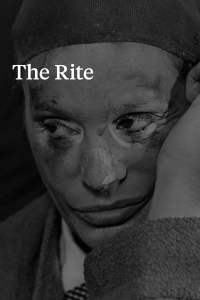 Like many high profile directors, Ingmar Bergman was a bit of a narcissist; he loved glowing praise but was condescending to unfavorable critics. For a time he led the Swedish Royal Dramatic Theatre, and when one of his productions was not warmly received, he made The Rite. It’s basically a filmed stage play, featuring a cast of just four. A traveling threater trio is brought in on charges of indecency in their latest act, and they are being investigated by a local judge, who interviews them. A short film at just 75 minutes, it is basically satire with Bergman making fun of the sensor process, pointing out perceived hypocrisy in how content can be accepted in one situation and derided in another. He also has the judge do some terrible deeds himself, which are not persecuted. I’m sure Bergman had a big laugh at it all, but it doesn’t make for a great film. Just sort of felt like showing off what he could get away with, while thumbing his nose at his detractors.
 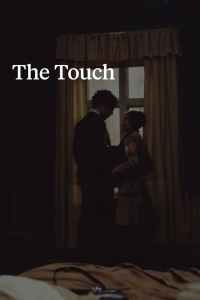 The Touch is the first truly bad film I’ve seen of this director, and at this point, I’ve seen quite a few. At least with the above The Rite, I get where it’s coming from and, while I didn’t enjoy, it at least has some artistic merit and I can see how some would get into it. I don’t see anything in The Touch. Bergman’s first film in English, and with a bonafide American star (Elliott Gould, just a year removed from MASH and two from his first Oscar nom), it is the least “Bergman” Bergman film he probably ever did. Bibi Anderson plays Karin, a woman torn between two men. Her husband Andreas (Max von Sydow) isn’t the warmest partner around, and he is absent due to work, but he obviously loves her. Karin wants something more though, and ends up in the arms of displaced American David (Gould). As the common phrase goes, I don’t know what she sees in him. David is childish, and prone to angry outbursts when he doesn’t get his way, i.e., if Karin doesn’t drop everything and come to his apartment when he calls. Their love affair is just poorly done too; it’s the worst kind of melodrama where the couple says and does things that don’t even make sense from an adult relationship point of view. Since the above films had great second acts, I stuck around until the end waiting for a big “ah-ha” moment. I’ll save you the viewing: it doesn’t come.
  Trolls World Tour is a sequel to the
 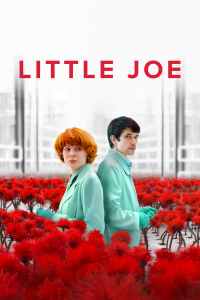 Little Joe is sort of a modern version of Little Shop of Horrors, unfortunately minus the entertainment. However, it’s not entirely bad. Alice is head scientist researching new plants. Specifically, she’s been trying to breed a plant with a pleasant, endorphin-raising scent which will make people happy. She thinks she’s found just the right blend with “Little Joe,” named after her son. Little Joe requires more care than any other plant, living only in the right environment and needing constant watering and care, but it does indeed some to make people pleasant. Unfortunately it seems to be doing more than that too. Made without the ability to pollinate (so as to not interfere with other indigenous flora), Little Joe starts using its spores to make people take care of it, and since doing so makes them happy, they are more than willing to comply. Anyone who seems to raise fears about what is going on is eventually brought into Little Joe’s posse, until only Alice is left fighting it. I feel the soundtrack really helps this film; it is disjointed and jarring in a way that would fit in a classic horror flick, and manages to ratchet up the tension here, even though we are only talking about a plant. But if you take that soundtrack away, the film is a bit of a bore. Does have solid performances from its co-leads, Emily Beecham and Ben Whishaw.
  I finally had a chance to see Parasite, the film that took all of the awards world-over last season. Like many film-goers, I was introduced to director Bong Joon-ho by
  Sword of Trust is a cute comedy-drama about an adult couple, Cynthia and Mary. They are going through the effects of Cynthia’s recently dead grandfather when they find an old Civil War era sword, with paperwork claiming the sword was surrendered by Union General Sheridan in defeat to the grandfather at the Battle of Chicabauga, and in so doing, the grandfather is claiming the North actually lost to the South. The two women don’t believe it, but they understand it might have value, so they take it to the local pawn shop, run by Mel. Mel scoffs at the story, but later finds online come conspiracy theorists who are hunting for proof that the South won the war, and are offering big money too. Mel brings Cynthia and Mary back in, and the group go on a bizarre adventure to sell the sword to some crazies. Much of the dialogue is obviously improvised, and the film has a very mumblecore-like feel to it, albeit with people closer to their 40’s instead of 20s. I’m not a big fan of the mumblecore subgenre (with a few notable standout exceptions), but this film isn’t bad. It’s quirky and funny, and has enough going on that I could look past some of its faults. It’s a short, sub-90 minute excursion too, so easy to squeeze it in if you want some light comedy.
  Tigertail is a really lovely film on Netflix, but it left me wanting more. It tells the tale of the full life of Pin-Jui. Born in Taiwan, his father died young and was then raised by his strong-willed single mother, who worked in a factory. His life-long love is a girl named Yuan, who he first met as a child living with his grandmother away from the city for a time, but who fate brought back to him as a young man years later. However, Pin-Jui has dreams of moving to America, and as a poor young person, the only way he sees to get there is by marrying the daughter of his mother’s factory boss, who will then fund their move to New York. Pin-Jui takes the chance with nary a goodbye to Yuan, but spends the rest of his life regretting that decision. His marriage to Zhenzhen is cold, and after their children grow and leave the house, she leaves him. Pin-Jui then needs to finally connect to someone again, after years of being closed off, and the person he needs to connect to is his estranged daughter. The film is told in 3 separate time lines, often moving back and forth between the younger Pin-Jui and him as an old man. It is a reflective, moving, contemplative picture, but it felt too short at 90 minutes long. I would love to see like a 2 ½ hour long director’s cut in the future, if one exists. The movie has some wonderful moments, and excellent cinematography, but it feels like a lot was left on the cutting room floor. I would have liked to see more of Pin-Jui’s growth, what made him into the man he became. It is hinted at, but for a touching film like this, I wanted more. Still, it’s a beautiful picture.
  Jons Movie Takes