Quick takes on 5 Lubitsch films

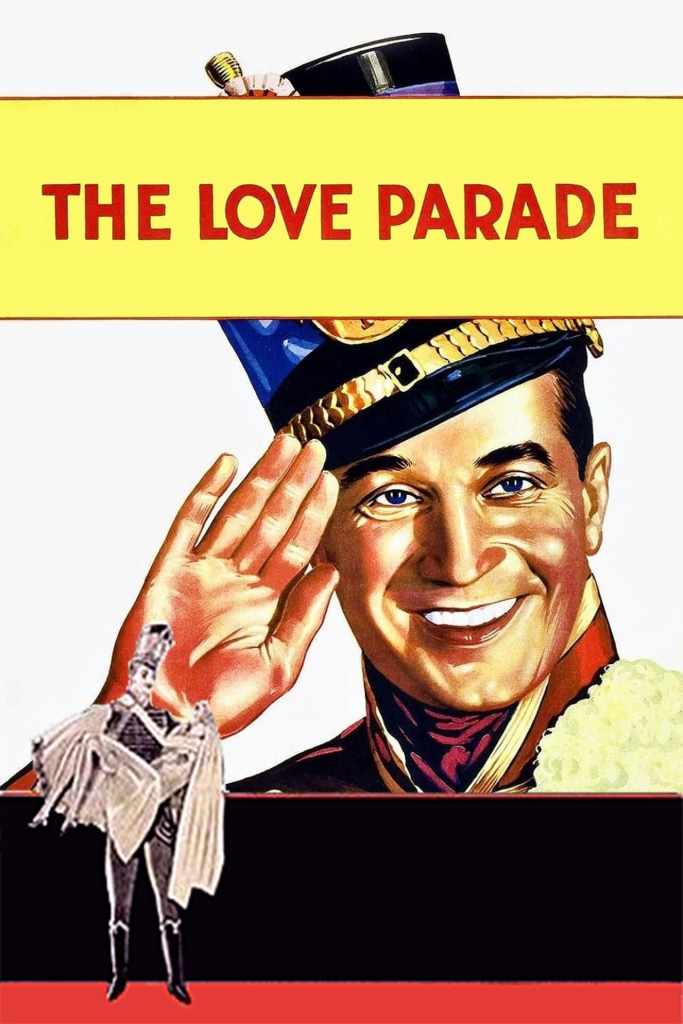
A couple years ago I reviewed some films from director Ernst Lubitsch, which were dramas and comedies which I really enjoyed, but he’s also very well known as being a pioneer in the musical category. Today I’ll be looking at 4 of his musicals from the late 20s and early 30s, starting with 1929’s The Love Parade, his first true sound film after having directed 20+ silent films and countless short films. It revolves around a simple plot: fictional country Sylvania’s queen, Louise, is under pressure to marry. At the same time, the country’s diplomat to France, Count Alfred, has been called home for his scandalous affairs with multiple married women in Paris. When he gets home, Alfred immediately intrigues Louise, and she marries him. They find that love in marriage isn’t nearly as exciting as love outside it, and the two butt heads over Alfred’s seemingly loss of masculinity to the headstrong and demanding Queen Louise. Due to being a pre-Code film, there’s lots of double entendre in the songs, and some salacious scenes involving a naked Louise bathing or lounging in bed, all things that wouldn’t fly just a couple years later. Some of the songs made me chuckle, but all in all the movie is unfortunately pretty boring. It was popular at the time though; its financial success coming just after the the 1929 stock market crash helped keep Paramount Pictures afloat. ★½

Monte Carlo is a little better, but not much. The rich Duke is getting ready to marry the Countess Helene, but she disappears on their wedding day, the third time she’s run away. Helene only agreed to marry because her funds have been depleted, but she can’t stand to think about marrying the Duke. She runs away with her maid to Monte Carlo, hoping to turn their last 10k into a fortune, and thus not have to marry. Unfortunately that money is gone the first night, and it isn’t long before the hotel is planning to kick her out for not paying. However, a wealthy man at the casino, Rudolph, takes an instant liking to her, and pretends to be a hairdresser to get into her rooms. As Helene loses staff due to lack of pay, Rudy takes on more jobs in her circle to stay close to her. Things are going Rudy’s away until the Duke tracks Helene down. The humor is a bit better in this one, but the songs are still rough and not memorable (they are more for narrative purposes and to break up the action, and often seem like an afterthought). ★★

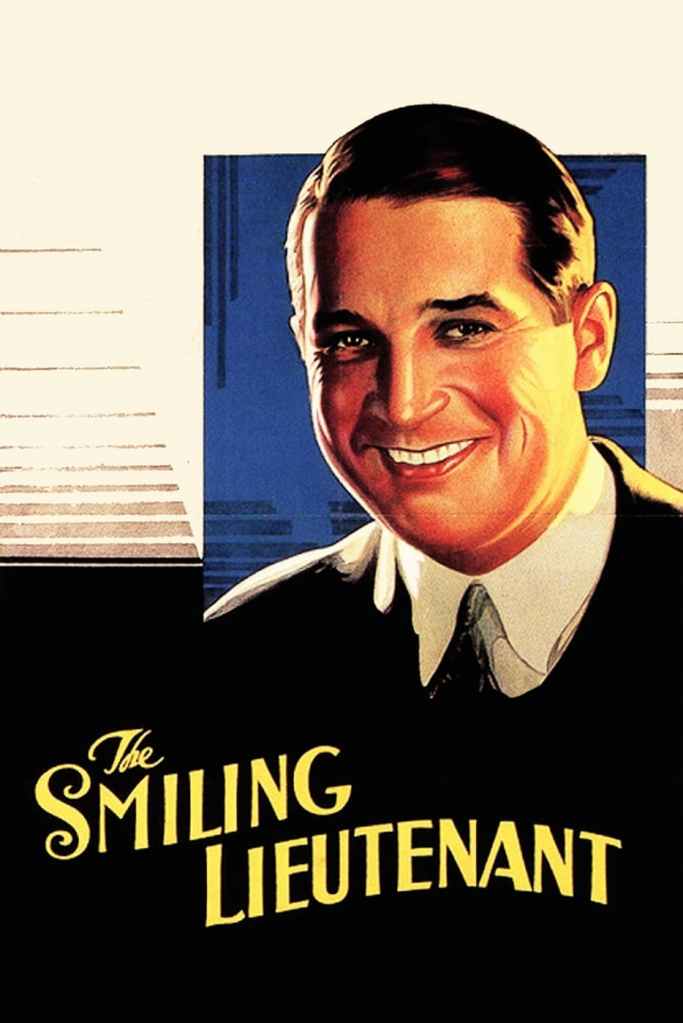
The Smiling Lieutenant is the first of these that I really liked, but it didn’t seem like it would be so at the beginning. It starts off a little kitschy and I was ready to be bored again, but it picks up quickly. The eponymous smiling guy is Niki, a notorious lady’s man, whose latest target is street musician/violinist Franzi. She gives in to his charm and the two are sleeping together soon. The royal family of neighboring (fake) country Flausenthurm is visiting, and during a military parade, Niki winks at Franzi along the street. Unfortunately for them, Flausenthurm’s most eligible bachelorette, Princess Anna, thinks the wink was meant for her. The sheltered Anna, whose best friend is her single father, is sexually repressed and ready to break out, so Niki is roped into marrying her, so fast that his head is spinning. Niki still has some power though, and refuses to consummate their marriage, slipping out in the night to continue to meet Franzi. Anna is devastated, but she’s willing to do whatever it takes to get her husband in her bed. Very funny, with better tunes than the previous films. ★★★

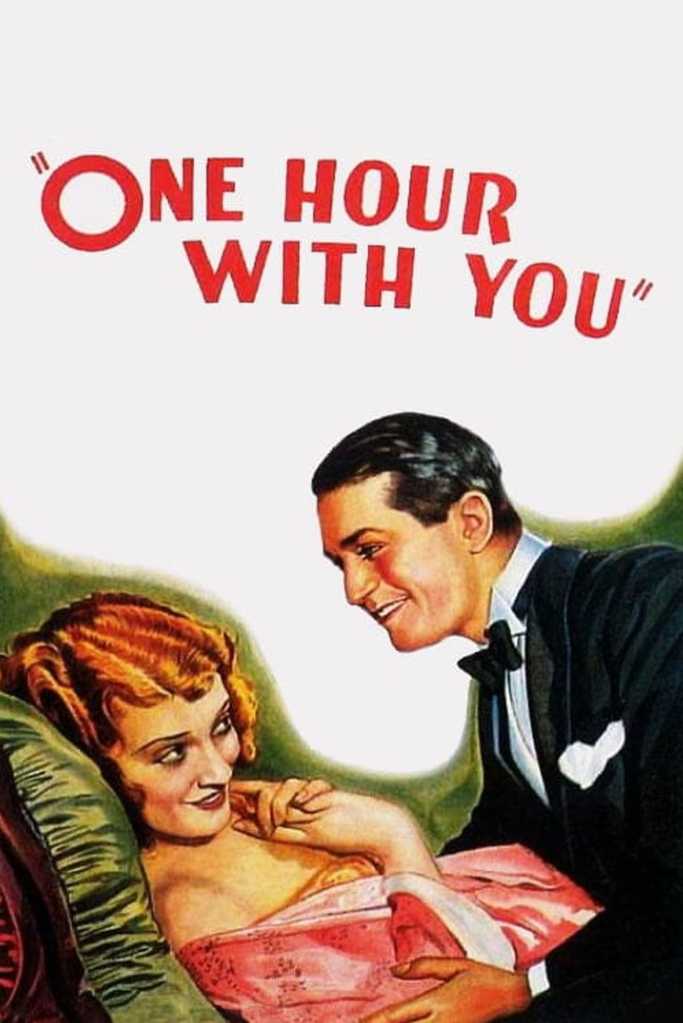
One Hour With You brings back French superstar of the era, Maurice Chevalier (who was in 2 of the above films as well) for a shorter film about a bunch of people who can’t wait to jump in bed with anyone other than their spouse. The only happily married couple is Andre and Colette. However, Collette’s childhood friend wants out of her loveless marriage and is intrigued by Andre, and Andre’s friend would love to be able to woo Colette away. Lots of innuendo (it’s still in pre-Code era), but honestly not all that entertaining. It did get an Oscar nom in 1932, but I can only guess it was because the audience was starved for something like this, because it certainly hasn’t held up. ★½

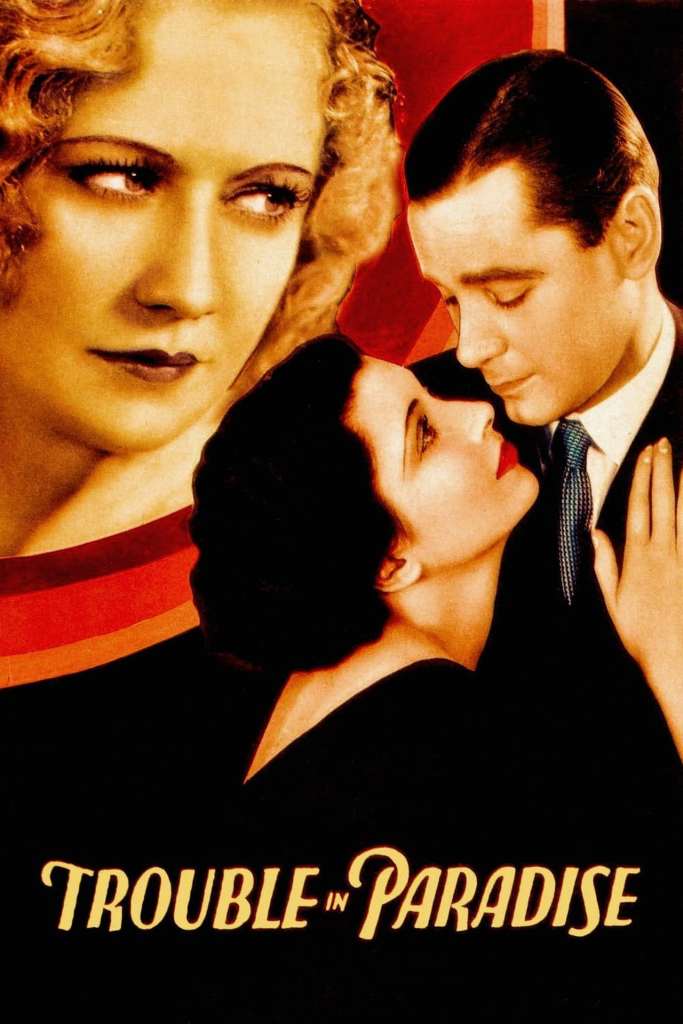
I couldn’t get my hands on a fifth musical by Lubitsch, so I’m finishing with Trouble in Paradise. By watching it, I think I’ve found I generally like his romcoms better than his musicals. Miriam Hopkins returns (Anna from The Smiling Lieutenant), and is paired with Herbert Marshall and Kay Francis (at one point, the highest paid actress in Hollywood). Gaston and Lily are each conning people in Venice, but when they meet each other, a thief spots a thief, and they form an instant bond made from mutual respect as well as passionate love. Teaming up, they steal a very rich handbag from the wealthy Madame Marietta Colet, the heiress to a perfume fortune. When Marietta puts out a substantial reward, more than the thieves can get from a fence, Gaston returns it, and endears himself to Marietta, getting hired on as her secretary. While learning Marietta’s ins and outs (and where she keeps money stashed), something inexplicable happens: Gaston starts to fall for her. Seeing competition, Lily wants to call it off, but they are too deep at this point. A fantastic finale when the masks are removed completes a wonderfully entertaining film. Funny, with witty dialogue, and even a little suspense here and there as Gaston dodges former targets and those he’s duped before. The only one out of this set that I’d watch again, but like I said earlier, his later films are much more consistent. ★★★★

  • TV series currently watching: The Old Man (season 1)
  • Book currently reading: Where the Crawdads Sing by Delia Owens

Quick takes on Thirteen Lives and other films

I didn’t rush out to see Jurassic World Dominion in theaters; I wasn’t all that thrilled with the last film in the series, and the newest one was getting pretty lackluster reviews. I’m glad I waited, as I have to say, this is just about the worst Jurassic Park film to date. That’s not to say that all the dinosaur action is bad, but the whole thing is starting to feel a little played out. In this one, dinosaurs have escaped their confines at the end of the last movie, and the whole world has started learning how to live with dinosaurs in their day-to-day lives. A new genetic company has opened a base in the mountains of Italy and has been proactively gathering the dinos there, doing research, ostensibly to find cures to human diseases in their DNA. At the same time, some monster sized locusts have started eating up crops in the midwestern USA, and there’s a thought out there that the genetic company isn’t completely on the up and up. Original Jurassic Park leads Grant, Sattler, and Malcolm are headed to Italy to see what they can see, while at the same time, the newest Jurassic World duo of Grady and Claire Dearing are attempting to rescue their adopted daughter, genetic clone Maisie, who’s also been kidnapped to Italy. There’s a million moving parts here and the film has severe sequelitis; the writers definitely threw everything against the wall to see what would stick. Not much does, and the movie is honestly a bit of a mess. It’s not all terrible, and it is nice to see the original team back in it, but I think it is safe to say that this franchise in its current form is done (or should be). ★★

As They Made Us is about a family dealing with tragedy, while at the same time tiptoeing around past hurts from within. Abigail is a 30-something with a couple kids that she is coparenting with her ex-husband. Her father Eugene has been deteriorating physically, and her mother Barbara calls her constantly to say how father has fallen, or he isn’t eating well, or whatever the case may be. Abigail doesn’t know how bad it is until she goes along to a doctor visit one day, and discovers that Eugene will not be getting better. For awhile now, doctors have been trying to tell Barbara that he will continue to get worse, and that they should start thinking about end of life treatment, but Barbara just ignores the advice and continually seeks different opinions. Armed with the knowledge of what is really going on, Abigail has to confront her mom with the facts, and attempts to make Eugene’s last weeks more comfortable at home. Throughout the course of the film, we see flashbacks of Abigail’s and her brother Nate’s growing up in this turbulent, sometimes violent, household. As children in the 70s, there were no words for what their parents were; only later diagnoses showed that Eugene is bipolar and Barbara has borderline personality disorder. Their constant arguments and the volatile household drove Nate away, and he never spoke to his parents again after he was kicked out of the house. It’s a great story, and anchored by a stellar performance by Dustin Hoffman as Eugene (Candice Bergen is Barbara), but, and I hate to say this, Dianna Agron is pretty awful as Abigail. Very wooden acting, with dialogue delivery that sounds unnatural. I’ve seen her in stuff before and never had this reaction, so maybe some of that comes from first-time write/director Mayim Bialik, though you’d think that her long career in the business would help, even if it is her first time behind the camera. Strong, emotional story let down by a poor central performance. ★★★

Thirteen Lives is the based-on-a-true-story film about 12 boys and their soccer coach getting stuck inside a cave in Thailand when it floods, an event I remember well when it happened in 2018, as it drew the world’s attention for a couple weeks as people tried to think of a way to get them out. The film gets you into it right away: the boys innocently head to a cave for just a couple hours, with an adult to watch over them, when heavy rains arrive suddenly. Monsoon season has come early, and when the boys don’t come home that night, their parents start searching. It is quickly discovered they went in the caves, but by the time a search and rescue team gets there, sections of the cave have already become completely flooded. Even Thailand’s Navy SEAL’s are unable to get through; they are trained in deep sea diving, but are unfamiliar with the tight confines of cave diving. The international community arrives in droves, with volunteers from all over coming to lend a hand. Two leading cave divers from England, Richard Stanton (Viggo Mortensen) and John Volanthen (Colin Farrell) are finally able to reach the boys 10 days after they went missing. They are starving, but alive. The trick comes in getting them out, something which the pessimistic Richard doesn’t think is possible. They boys are several kilometers into the cave, past sections that are completely underwater, including a few moments where the spaces to get through are no bigger than an adult’s shoulder width. The rescuers can’t just lead the boys out, because, being untrained, they’d get frantic, risking their lives and the lives of their rescuers. When John puts forth a daring plan involving putting the boys to sleep with anesthetic drugs and pulling them out sleeping, it may be their only hope. With more rain coming, time is running out. Directed by Ron Howard, this film is an emotional roller coaster and thrilling throughout. I was exhausted at the end, but in a good way, from 2 hours of heightened tension. ★★★★

The Black Phone, starring Ethan Hawke as a child abductor, was marketed as a scary movie but comes off as more of a thriller, and not a groundbreaking one at that. Taking place in late 70s suburbia, “the grabber” has been kidnapping high school kids in the area, setting families on edge. Finney, frequent target of bullying both at school and at home by his alcoholic father, is the latest victim. After being grabbed, he wakes up to find himself in a soundproofed basement room. The Grabber will let Finney live as long as he plays by the rules, but these rules are a bit murky. Thankfully, he has help in learning the game: a phone attached to the wall, which isn’t plugged in, still rings when Finney is along, and on the other end are the other kids that the Grabber has nabbed and killed. From beyond the grave, each kid gives Finney advice as to how to survive, and how to attempt an escape. Helping find Finney are the police, as well as his little sister, who seems to have inherited a bit of psychic feeling from their deceased mother. The film has a few jump thrills, but that’s about it, and the ending was no surprise. Hawke is a great actor, but he is over the top in this one, and not in a good way. Very average movie. ★★½

Honor Society wasn’t on my radar until I saw quite a few positive reviews pop up in my feed, and as a short film at about 90 minutes, I figured I’d give it a go. 20 minutes in, I thought I’d made a mistake, but it ended up paying off in the end. The film follows a high school senior named Honor (Angourie Rice, known from the latest Spider-Man trilogy). She’s pretty, popular, and near the top of her class, but she doesn’t care about any of that. She wants out of the little town and never wants to come back, so her sights are set on going to Harvard. She’s had a plan since freshman year, which involved charming up to high school counselor Mr Calvin (Christopher Mintz-Plasse), who is buddies with a successful Harvard alum and can thus get her a solid recommendation. Unfortunately, there are 3 other deserving students in her class: the typically smart Asian student Kennedy Park, the athletic star Travis Biggins, and the class nerd Michael Dipnicky (Stranger Things’s Gaten Matarazzo, in his first on-screen film role). Honor will stop at nothing to get that Harvard recommendation, so she sets out to bring down the other 3, finding ways to distract them right when midterms are hitting, thus hurting their grades. It’s a sleazy premise, which is why I found it so off-putting in the beginning, but despite her gruff exterior, Honor is a good person, and all of her targets end up coming out better in the end. But, for a change, the ending has a pleasant surprise that, for a film like this, truly comes out of left field and left me stunned. Not hilariously funny, but enough chuckles (and awkward feelings too, thanks to Mr Calvin’s not-so-subtle creepster vibes) that it kept me entertained to the end. ★★★½

For having never seen Heat, my friends at work gave me some, well, heat. Honestly not sure how I missed this one with such an amazing cast, but I was very busy doing school stuff in 1995. Directed by Michael Mann and with a cast including Robert De Niro, Al Pacino, Jon Voight, Val Kilmer, Tom Sizemore, Ashley Judd, and a young Natalie Portman (fresh off her breakout debut), this is a police procedural/crime thriller about the cat and mouse game between a detective and his criminal adversary. The film begins with a heist: a trio of thugs takes out an armored vehicle and grab a cool 1.6 million in bonds, the only thing they know they can grab quickly before backup arrives, and are off the scene before the cops know what hit them. Unfortunately, one of the hired thugs takes the opportunity to kill one of the security guards, leading to the team having to kill the rest to leave no witnesses. This grabs the attention of the LAPD lieutenant, a very smart man who sees exactly what is going on, and he hits the streets to shake loose some informants. That is only the start, and it builds from there. The people the thieves stole from are ready to kill to send a message, and isn’t long before the cops are circling too. Lots of moving parts here and a large cast, but it’s not hard to follow. I think the film lost a little steam in the second half (and it’s a long movie at nearly 3 hours), but the explosive ending is very satisfying. ★★★½

  • TV series currently watching: Yellowstone (season 2)
  • Book currently reading: Where the Crawdads Sing by Delia Owens

Quick takes on 6 Paul Robeson films

Up today is a set of films from trailblazing African-American actor (and singer, football player, intellectual, activist… you name it) Paul Robeson. The son of a slave who escaped north on the Underground Railroad as a teen, Robeson was well educated (academic scholarship to Rutgers where he graduated valedictorian; then a degree from Columbia Law School) and he never backed down from standing up for causes he believed him. This got him blacklisted during McCarthyism, but his career continued in Europe. I’ll be reviewing a few of his films from the 20s till early 40s.

After making a name for himself on stage, he transitioned to film with his first role in 1925’s Body and Soul. From the late silent era, Robeson plays two roles, the primary one being Reverend Jenkins. Jenkins runs a church in a small town, but in his spare time, he drinks with gamblers and ne’er-do-wells. Turns out Jenkins is an ex-con, and only pretending to be a man of God to swindle the townsfolk out of their money. He’s already made the moves on Isabelle, but Isabelle knows she can’t take that info to her mom, because her mom will not hear a bad word spoken about Jenkins. Isabelle wants to marry a working man named Sylvester (Robeson’s other role), but her mom rejects the union since Sylvester has no money. What ends up happening is Jenkins steals Isabelle’s dowry, pinched and saved by her mom, and Isabelle, knowing her mother will never believe the story, runs away to Atlanta. It’s a fascinating film and holds a whole lot of drama in its tight runtime. The version I watched had a fantastic jazz soundtrack too, making for an enjoyable experience. ★★★

Borderline, another silent film, was a lot harder for me to get into. An almost-experimental film produced by an avant-garde group, it features very little “dialogue” (intertitles), so the viewer is left to interpret what is being said and happening on screen. Characters will come together and have whole conversations (or fights, as is often the case) with never a word to the viewer to know what is being said. And I didn’t even know what was going on for a large portion of the film. It was something about a black couple (Robeson and his real-life wife Eslanda) getting mixed up in a love triangle with a white couple while visiting some sort of resort. The film was groundbreaking for its day (1930) for its depiction of interracial relationships while also showing the discrepancy of justice handed out due to race (the black Pete, who does nothing wrong while his wife is having the affair, is driven out of town, whereas the white man, Thorne, who kills his wife in a fight over her affair, avoids jail time). Great subject matter, but the execution by its out-there filmmakers was too much for me. Never a good thing when you are watching the movie and can’t understand what the hell is going on. ★½

Robeson’s first sound film, and the one that catapulted him to stardom, was The Emperor Jones, based on a play by Eugene O’Neill. We finally get to hear Robeson’s deep, booming voice, and he delivers. He plays Brutus Jones, a man who, initially, we think is a good man leaving his wife and church to go make money to send home. We quickly learn though that Jones is not an upstanding citizen. He kills a man over a gambling argument, which gets him sent to a chain gang, and when he escapes from there, he only returns home long enough to kiss his wife goodbye and fly off to the Caribbean. There, Jones hatches a plan for his biggest swindle yet: robbing a country out of its king. Through an act of trickery, he purports to be invincible, and dethrones the area’s current ruler to set himself up as “Emperor Jones.” By the end, when he pushes his people too far and taxes them to the point of revolution, Jones comes to face all the sin he’s done in his life. Unfortunately for him, it may be too late. Jones is shown as a man larger than life, and Robeson’s big frame and deep baritone voice fill out the character. It’s a typically pessimistic play from O’Neill (Long Day’s Journey Into Night, The Iceman Cometh), but expecting that, I was very much into the movie. ★★★½

I quite literally just watched a handful of films directed by Zoltan Korda, and here he pops up again. Sanders of the River was a popular film upon its release in 1935, but it has not held up well, for the same reasons that, at the time, Robeson hated the final product and denounced it. It’s not a bad story though, taken at face value. Sanders is an English colonial commissioner in Nigeria, tasked with overseeing the people and “keeping the peace.” Sanders finds help from Bosambo (Robeson), who is a tribe leader, but who is western educated. When Sanders is there, everything goes fine, but when he is called back to England for a few weeks, the tribes begin warring with each other. One of the tribe leaders, Mofolaba, takes the opportunity to kidnap Bosambo’s wife to try to force him and the other leaders under his rule. When Sanders returns, he squashes Mofolaba’s plans. Robeson thought he was making a film about the heritage of powerful black men in Africa, but it obviously turned out to extoll British colonialism, making it appear that the black population adored their English rulers. Robeson’s dislike of the film and its obvious flaws aside, at least the story was intriguing and it was better than the last couple films coming up… ★★★

In Jericho (released in the USA in 1937 as Dark Sands), Robeson plays Jericho Jackson, a navy soldier who disregards orders in order to save fellow trapped men after their ship is hit by a submarine. During the act, Jericho accidentally kills an officer, and the result is a court-martial and the threat of impending jail time. Before he goes away, Jericho escapes and flees on a boat to Africa, where his medical training helps the local people. His kindness but firmness endears him to the people, and over the next few years, he grows to be their leader. During this time, Jericho’s former commander, who was also kicked out of the navy and did his own jail time for failing to keep Jericho in custody, has been released and vows to find Jericho and make him pay. When he sees Jericho’s face on a news reel about the people of northern Africa, he goes there to fulfill his oath. Robeson was keen to take this role, about a strong black man carving his own patch, after his disgust with the previous picture, and while I appreciate the sentiment, the film isn’t all that exciting. Worth a single viewing, but not much more than that. ★★

His next film was 1940’s The Proud Valley, and unfortunately I have to say, we’re moving in the wrong direction. David is a deserting sailor who finds himself in a mining town in Wales. The men who work the mine also sing together in a choir (odd, I know, but just go with it) and David’s supremely rich voice gets him in the group, to the consternation of some of the racist townsfolk. David proves his worth though; one day a fire breaks out in the mine, and David risks his life to try to save a fellow miner. Though the man dies, the people now accept David wholeheartedly. Unfortunately after the accident, the mine is closed, but with World War II beginning, the country will need that coal again, so David and the other men trip to London to plead their case. They get approval, so the group has to go down into the dangerous mine and try to open a path through the damaged section, down to the coal veins. David again will get a chance to show his courage. Very ho-hum movie, with plenty of odd twists in the plot that will leave you scratching your head. And the acting is downright rough through much of it. Unfortunately, I found his movies to be very uneven in this set. One lauded film, Show Boat, I’m saving for another day, and I have high hopes for that one. ★½

  • TV series currently watching: Better Call Saul (final season)
  • Book currently reading: The Great Hunt by Robert Jordan

Quick takes on 7 films from the Korda brothers

Going way back in time today to two brothers who made a lasting impact on cinema. The more prolific of the two was elder brother Alexander Korda, who started making movies in his native Hungary way back in 1914; I’ll be looking at four of his films from the 1930s when he was working in England (aside — check out That Hamilton Woman, starring the greats Vivien Leigh and Laurence Olivier), and then a trio of pictures from younger brother Zoltan Korda (be sure to watch his The Four Feathers, the best version of that movie).

The Private Life of Henry VIII matched Korda with renowned stage star Charles Laughton, and it would be the breakout role for Laughton on the big screen. The film focuses on Henry VIII’s many wives, in a hilarious comedic take. The film picks up after wife # 1 (Catherine of Aragon) has already been divorced, and wife # 2 (Anne Boleyn) is about to hit the executioner’s block. Jane Seymour is waiting in the wings for the official news that Anne has lost her head, so that she can become wife # 3. King Henry VIII is depicted as a drinking, eating, womanizing debaucher who can’t keep his eyes or hands to himself, though he seems to genuinely like his newest bride. Unfortunately she dies in giving birth (finally a son!) and he swears off another marriage. But good ol’ Henry can’t back down from a challenge, and when his barber makes a quip implying that he’s too old to go at it again, he seeks out wife # 4. And then wife # 5, when that one doesn’t work out. You know where this is going. Call me old timey, but I laugh (a lot) at the kind of humor throughout this film. When Anne Boleyn is about to lose her top, a woman in the stands laments on how sad it is to see a queen treated as such, before prodding the person in front of her to move over so she can see. Laughton is fantastic as I knew he would be, and the whole movie is a lot of fun. ★★★½

After the success of Henry VIII, Korda picked another historical figure to dissect. The Rise of Catherine the Great (Korda is an uncredited co-director; Paul Czinner gets the distinction in the credits) has less laughs and more drama, but unfortunately is less arresting too. The film follows the marriage of Princess Sophie from Germany to Peter III, and all the court intrigue that goes with it. In the film, it is Peter’s aunt, Express Elizabeth, who pushes the marriage, so that Peter can hurry up and have some kids to extend the lineage. The marriage, which leads to Sophie taking the name of Catherine, isn’t consummated for awhile, as Peter sticks to his womanizing and seems to care little for Catherine. It isn’t until she claims to have lovers of her own, which makes Peter jealous, that they finally get together, but it doesn’t last. Through it all, Catherine keeps trying to nab Peter’s attention, saying all the time that she loves him. That is, until he does something egregious that causes her to change her mind, and lead to her takeover of the kingdom and the setting up of her famous rule as Russia’s leader. The film has a few intriguing moments, but it drags, and the lack of humor was noticeable; it made Henry VIII so much more entertaining. And I couldn’t help but compare it to the highly enjoyable modern show The Great on Hulu. ★★

The Private Life of Don Juan takes a new spin on the life of that famous (infamous?) lady’s man of long-ago Spain, namely, the end of his run. The film begins on the night that an older Don Juan has returned to Seville after 20 years away to find that his reputation is still intact. Unfortunately for him, a sycophant is in town trying to imitate him, though this younger version lacks Don Juan’s ability both with the sword and with the ladies. The upstart gets himself killed by a jealous husband, and news quickly spreads that Don Juan is dead. The real Don Juan uses this opportunity to go into hiding again, avoiding his wife who has been threatening him with jail for past debts, mostly to get back at him for hiding from her for the last 5 years. Don Juan goes away and takes an alias, but after 6 months (and a popular chapbook circulating about Don Juan’s supposed life), he decides to make a comeback. Don Juan returns to Seville, only to find that the legend of Don Juan has exploded in his absence. Every lady in town now claims to have been his lover, and when he steps forward as the living Don Juan, no one believes that this older man could possibly be Don Juan. There are some sluggish moments in the movie, but it is very funny, with a satirical spin behind the scenes too. The aging Don Juan is played by none other than Douglas Fairbanks, legendary swashbuckler of the silent film era in such hits as Robin Hood and The Mask of Zorro. Past his prime and finding himself unable to land big roles in “talkies”, Fairbanks would call it quits and retire from acting after Don Juan. It is a fair send-off, and he shows that, even at the end, he still had it. ★★★

Like in The Private Life of Don Juan, Korda’s Rembrandt is a film about the latter life of a famous person, this time the famous Dutch painter. At the beginning of the movie, Rembrandt is already a famous and in-demand artist, but when his beloved wife dies, he decides to stop painting what others want, and only paint for himself. When the lords of the city commission him to paint a giant mural of them at a party, he skews the painting so that it shows a group of common-man soldiers having a good time. 10 years later, Rembrandt’s finances are depleted and debts have piled up. He gives a go at begging, but refuses to fight over coppers with people who he feels need the money more than he. Events continue to go against him, but Rembrandt continues to march to the beat of his own drummer, and never bows to anyone. Charles Laughton performs as Rembrandt, teaming up with Korda once again, but they duo can’t find the magic that came in Henry VIII. No laughs, light on drama, and awfully staid, the film falls into the same trap that many biopics do: relating facts with little flair. ★½

Zoltan Korda made a few films starring Indian actor Sabu (who had a strong career in both England and Hollywood). His most famous was probably The Thief of Bagdad (co-director), but since I’ve seen that one, I’ll be looking at three other films, starting with 1937’s Elephant Boy, made when Sabu was just 13 years old. Based on a story from Kipling’s The Jungle Book, this film circles around Little Toomai (Sabu), who comes from a family of elephant drivers but wants to be a hunter. The family’s elephant, Kala Nag, has been in the family for 4 generations, and is currently being driven by Big Toomai (though Little has learned just about all there is to know, and taught the old elephant a few new tricks as well). A British soldier brings a team to the area for their yearly roundup of wild elephants (to tame them and put them to work), and Little Toomai is able to convince his father to go along for the trip. The little boy’s bubbly personality ingratiates him to the Brit, but trouble is ahead. Big Toomai is killed by a tiger, and the Brit determines Little Toomai is too small to be Kala Nag’s permanent rider, so he assigns the elephant to another man, who is known for his cruelty to animals. Little Toomai won’t stand for that, and in the middle of the night, secrets away with his old animal friend. Together, they become witness to an event which will grow to legend and cement Toomai’s name among his people. Sabu is fun to watch, but too much of the film comes off as an almost documentary (it was, after all, co-directed by Robert Flaherty, who made the first commercially successful documentary in the history of film), and I’m not a big fan of docs. A whole lot of scenes just watching elephants or monkeys at play. The story by itself is good though. ★★½

Next up is The Drum, and this one landed on me with a thud. Based on a book by AEW Mason (who also wrote The Four Feathers), it is about a turbulent time at a border town in northern India. British captain Carruthers is looking into rumors that someone is arming local rebels with machine guns, and pays a visit to the kingdom of Tokot and its king. Shortly after, the king’s brother, Prince Ghul, assassinates him to take the thrown for himself. When Ghul tries to have the former king’s son, Prince Azim (Sabu), killed, Azim escapes and finds refuge with Carruthers. The rest of the film devolves into this mess of political intrigue/plotting, but done roughshod, until a big battle at the very end of the film. There’s about 15 minutes of real excitement in the film, and otherwise I was bored to tears. Watched it and promptly forgot it. ★

Thankfully, I get to end this set on a good note. Jungle Book is a loose adaptation of that famous Kipling book, with Sabu taking the lead as Mowgli. The film is told as a story by an old man in front of a crowd by the side of a road. He relates how a boy wandered away from his family and was found and raised by a pair of wolves with their other cubs. The various inhabitants of the jungle are introduced, including the wise python Kaa and the kindly black panther Bagheera. The villain of the jungle is Shere Khan, a tiger, who, like humans, is the only being around that kills not just to eat, but for the joy of killing. In this dangerous environment, Mowgli grows from a toddler to teenager. One day, while running from Shere Khan, Mowgli finds himself in the human village. He doesn’t know human language and they recognize that he has been raised in the wild. In a twist of fate, his old mother, who perhaps recognizes him as her lost child, takes Mowgli in and teaches him how to speak. However, when Mowgli is able to purchase a knife, which he calls his “tooth,” he knows it is time to return to the jungle and fight Shere Khan. Other stories from the original book are told as well, including parts of the lost city (full of treasure) that lures people from the village. This is a wonderful film, entertaining from the very opening scenes. It is thrilling and joyous and full of heart. A lot of the animals are real, filmed well so that it all appears very natural. Only Kaa and Jacala the crocodile are fake (and obviously so, but even these are passable). It is a gorgeous film (nominated for 4 Oscars in 1942, including Art Direction and Visual Effects) and very well put together for its era. It holds up well and looks great. ★★★½

  • TV series currently watching: The Silent Sea (miniseries)
  • Book currently reading: The Great Hunt by Robert Jordan 

Quick takes on Prey and other films

I didn’t see Lightyear when it hit theaters a couple months ago. Like a lot of people seemingly, I heard some bad reviews and didn’t bother. I should know by now, never count Pixar out. I caught it on Disney+ and I have to say, I really enjoyed it as a light hearted adventure film for kids, or like me, kids-at-heart who fondly remember the original Toy Story film. As the opening title card tells us, this is the movie that caused a child name Andy to fall in love with Buzz Lightyear. In the movie, Space Ranger Buzz is leading an expedition to a new planet when they discover that the planet holds hostile life (plants and giant bugs that attack), but Buzz and his team of scientists are stranded with no way to get off the planet. Fellow Space Ranger, and Buzz’s best friend, Alisha Hawthorne agrees to watch the temporary base while Buzz experiments with testing hyperspace fuel around their solar system, with the ultimate goal of getting everyone off the planet. Unfortunately for Buzz, traveling at those speeds slows time for him, so every time he goes in space, he’ll come back just a few minutes later, while years have progressed on the planet. After a dozen or so tests, Buzz hasn’t aged at all, but all of his friends are gone, replaced with a new generation who’ve been born on the planet, and now call it home. As such, they are ready to put an end to Buzz’s tests and give up on leaving the planet, so Buzz has to steal the starship for one final test. This last one is successful and he finally reaches hyperspace speed, but when he returns to the planet, a long amount of time has passed. Buzz finds that while he was gone, the settlement has been attacked by a squad of robots, brought by a spaceship, and commanded by the evil Zurg. Teaming up with his old pal Hawthorne’s granddaughter and a couple other misfits, Buzz has to find a way to destroy the robots and rescue the settlers. Fantastic visuals, a good story, lots of laughs, the film really has it all. I can see my own granddaughter watching this one again and again, much like I did on the original. ★★★★

I loved director Joanna Hogg’s film The Souvenir a couple years ago, so I’ve been looking forward to the followup. The film follows Julie as she is trying to move on after her boyfriend Anthony’s overdose and death. She spends time with her parents, Anthony’s parents, a therapist — no one seems to have the answers she’s looking for. She decides to finish film school, and moves forward with doing her final student film project as a story about her life with Anthony. Making the film proves to be cathartic, but there are bumps in the road. Though Julie has talent, she is indecisive as a first-time director. Actors become frustrated with her lack of direction, and the lighting guy in particular blows up at her for not sticking to a script so they can plan out shots ahead of time. Julie has to push through if she’s going to realize her dreams, as well as find peace with Anthony’s passing. The pacing is slow, as it was in the first film, but whereas I really dug that one, this film felt pretentious and contrived. Julie and her snooty, artsy friends are awfully full of themselves, and the viewer is expected to belong to this pompous crowd too. Such a letdown after the emotional roller coaster of the first movie. ★½

I’m sure The Duke is a great film. Lots of critics and regular moviegoers think so. But it did not connect with me in any way. The based-on-a-true-story film about the robbery of Goya’s portrait of the Duke of Wellington in 1961, it follows a nearly-retired man named Kempton Bunton (the always affable Jim Broadbent) on his quest to get better benefits for the working class. Kempton refuses to the pay the UK television tax (something that is still around today; who knew about this?!), much to the consternation of his wife Dorothy (Helen Mirren) and family. While in London to drum up interest in his campaigns, Kempton sees the opportunity to steal the painting on display, and secrets it back to his flat, where he hides it behind a false wall in a wardrobe. He then goes on a crusade to ransom the government, with the funds to be used for charities. This is about as far as I got in the movie. The light hearted comedy wasn’t doing anything for me, and the supposed charm that was supposed to be in the movie must have gone right over my head. I was bored out of my mind and had to give up 40 minutes before the finish line. I guess I’ll never know what became of Kempton and the painting. ½

What a rebound! Fire in the Mountains is a fantastic film taking place in the Indian Himalayas. We meet the key figure, Chandra, in the opening scene. Along a road outside of town through the valley of the mountains, she is meeting tourists coming off a bus. She competes with a man to get a family to stay at her family hotel. Her competition tries to get the family to stay with him, telling them that Chandra’s hotel is far off the road, but in the end, Chandra’s price is the best, so the family goes with her. The camera follows their trek as they climb the mountain, and it is indeed a long walk, but the scenery along the way is simply amazing. At their destination, we meet Chandra’s family. She is wife to Dharam, a laborer who maybe drinks a bit too much, and they have two kids: teenage daughter Seema and 11-ish year old boy Prakash. Prakash is unable to walk, and forced to rely on his mother to carry him up and down the mountain to see doctors who don’t know why he can’t walk (we see in other scenes that Prakash is faking it; he leaves the wheelchair at night when no one is around). Dharam has high hopes for Seema, who seems to be a good student, but the family doesn’t know that she is more obsessed with TikTok than schoolwork. Chandra’s one goal is scrounging every dollar she can in order to convince the town politicians to build a road up the mountain. Not only would this help her family business, but it would let their wheelchair-bound son go to school again. Chandra is the only strong foundation in the house, and you get the impression that they’d all fall apart without her. When she finally hits her breaking point at the end of the film, the result is gripping. ★★★½

When I first heard of a new Predator film, and after the utter disaster of the last one, I didn’t have very high expectations. But when hype started to build over the last couple months, and then some pretty high reviews began hitting earlier this week, I came into Prey pretty excited. And it did not disappoint! Taking place in 1719 on the American great plains, the movie follows a Comanche woman named Naru. She has dreams of being a hunter like her brother and the other men in the tribe, but her mother wishes she’s pursue healing, for which she’s already shown no small skill. Naru and her pet dog, Sarii, roam the area around their home, looking for prey as Naru practices her skills. She and her tribe will become the prey though, as an alien predator comes to the area. It takes place a couple hundred years ago, so the predator’s technology isn’t as advanced as it will be in the movies of the 80s through 2018’s The Predator, but the alien is still a supreme hunter and physically superior to humans (and a bear, as we see in the movie), so he will not go down without a fight. The action is top notch, but there’s plenty of suspense too. It’s a bit gory, as you’d expect, so it may make some queasy stomachs lurch, but that kind of stuff doesn’t mother me, and I loved the movie. As exciting as they get. ★★★★½

  • TV series currently watching: The Witcher (season 2)
  • Book currently reading: The Great Hunt by Robert Jordan

Quick takes on the Once Upon a Time in China series

The Once Upon a Time in China series is a set of six films (and a short-lived tv series) made from 1991 – 1997, centered around Chinese folk hero Wong Fei-hung. The first couple films starred Jet Li as Wong, a martial arts master whose legend precedes him wherever he goes in late 19th century China. The tone of the first film is set early on: Wong is a simple man following traditional Chinese customs, and living in a time where British influence and western cultures are racing to modernize the country. A local Chinese gang is using the turbulent time to their benefit, wooing men with tales of riches in America, and then stealing all their money, or kidnapping woman to sell off as prostitutes. It is up to Wong to face off against the leader of the gang and put a stop to his trade. I honestly didn’t know much about this series going in (I think I was thinking more Policy Story, another Hong Kong film which I thoroughly enjoyed), and had a hard time getting into this first movie. The fighting is decent (though I could do without the 80s style sound effects, i.e., the exact same sound made every time a punch lands, which is constant), but the humor is really hokey and he film’s pace feels chaotic, and the story was, for me, hard to get a bead on. It settled down towards the end, but by then I didn’t always know what was going on. I’m hoping for a better things going forward. ★★

The sequel, following a year later, was better (or maybe I was just more prepared for what to expect). Wong, with his love interest and apprentice on hand, travel to Canton to attend a medical conference. After a few humorous moments aboard the train, the first train ride for Wong and his sidekick, they settle in to Canton, a city at a crossroads, much like in the first film. A local highly nationalistic cult, called The White Lotus, is pushing to have all westerners kicked out of the country. They are at odds with the local government, who is accepting of British immigrants and the industry/science advancements they bring. There is turmoil in the streets, and while Wong initially tries to stay out of it, he is pulled in when a local school, teaching English to the kids, is targeted by the cult, and Wong rescues the children. Wong is portrayed as a man who loves his culture, but is open to learning new ideas brought by others, even if he doesn’t always agree with them, and the film does a great job of showing that you can be proud of who you are without being close-minded to others. Again, good action scenes, but sometimes they are thrown in, out of nowhere, just to create excitement when there’s too much talking going on. The film also introduces Sun Yat-sen (Sun Wen), a historical figure who would go on to play a pivotal role in the overthrow of the Qing dynasty and become the first ruler of the Republic of China, the beginnings of which are shown in the second half of the film. The local government turns on the British when they realize they are harboring Sun in their consulate. I wish they’d dug more into the political intrigue, but it remains mostly an action film. I did like this one more than the first. ★★½

Wong and his cohorts have come to Beijing so that Wong can tell his father that he is in love. After dancing around his “13th Aunt” for the first two films, Wong is finally ready to admit he loves her. At the same time in Beijing, the empress wants to out the immigrants who seem to be invading and changing their culture, so her advisors suggest hosting a kung fu competition to show off their might. The competition brings about the opposite effect: the rival kung fu schools end up fighting in the streets. This brings about constant action in the film, but doesn’t fit within any kind of plot. The fight scenes now go beyond suspending belief to all-out ridiculousness. In the first one in the film, “Clubfoot” takes on Wong’s father. Clubfoot is the city’s best rickshaw driver, and so his kicks are super-powerful. He can take a leap into the air and, defying gravity, fly across the room scissor kicking, as well as run across the roof beams, upside down, and all kinds of silly things. Even when the movie tries to be serious (rarely), it comes off as silly. Sequel-itis is setting in. ★

Once Upon a Time in China IV brought changes: a new director (Yuen Bun, replacing Tsui Hark who had done the previous 3 movies), and a new Wong Fei-hung (Vincent Zhao replacing Jet Li). The 13th Aunt is also explained as being away, but Wong still has his usual group of sidekicks, and a “new” aunt, the “14th Aunt.” Despite all the changes in personnel, it seems they otherwise decided to use the same plot elements. There’s a new nationalist cult, The Red Lanterns, and a new competition not much different than the one in the last movie. This time, the comp is set up between the 8 nations with interest in China, and they are ready to fight dirty to beat China’s heroes into submission. Germany in particular has no qualms about racing to the lowest denominator. More high flying feats of kung fu, but the film brings nothing new to the franchise. ★

After the rough reviews of the previous film, the fifth movie brought Tsui Hark back to the director’s chair, with positive results. After the end of the previous film, foreign powers are occupying Beijing, and China is seeing its long-held dynasty falling apart. Wong Fei-hung returns home to Foshan, and there reunites with 13th Aunt and his apprentices from the first film. But a new threat is bothering Foshan: a gang of pirates. And with the government failing, no one is around to stop them, leaving it to Wong and his crew. This film ups the comedy, even more so than the previous films. Wong’s apprentices are really no more than a bunch of buffoons, and with both the 13th and 14th Aunts around vying for Wong’s affection, there are lots of chuckles at the double entendres and faux romances going on. I still think Jet Li’s high wire kung fu was better than Vincent Zhao’s, who was Wong once again in this film, and so I’m looking forward to the final film, in which Li returns to the title role. ★★½

The last film in the series was released in 1997, and was internationally known as Once Upon a Time in China and America. Honestly this was my favorite of the series, maybe because it is just so much different from the others, and not just because of the setting. Wong and his friends find themselves in the USA, as they are visiting a former apprentice who has opened a shop in San Francisco. To expand the runtime, there’s a subplot where Wong gets hurt on the way there, and wakes up in a Native American camp with a case of amnesia. His inherent fighting skills earn him a welcome stop among the tribe, and it is awhile until he comes to remember himself. He does just in time to fight off San Fran’s corrupt mayor and his hired goons, with the help of a good ol’ cowboy named Billy. The series has played with the notion of Wong’s kung fu vs guns in previous installments, but nowhere is it more apparent than in the Old West. Some new interesting villains and Jet Li’s magnetic return seal the deal. Doesn’t hurt that they toned down the slapstick either. Solid, fun movie; I wish all of them could have been as entertaining. ★★★½

  • TV series currently watching: Naomi (season 1)
  • Book currently reading: The Great Hunt by Robert Jordan

Quick takes on Montana Story and other films

There are slow films, and then there are films like Moon, 66 Questions, which takes pacing to an entirely new level. Out of Greece, it follows a single woman named Artemis who is tasked with caring for a man named Paris. Paris has had a stroke leaving him weak and with severely limited motor control. Artemis tells people that Paris is her uncle and that he has limited options for care, but the truth, which we don’t learn until much later in the movie, is that he is her father. The two have been estranged for most of their lives, due in no small part to his stern and unyielding parenting. Now helping him with all of his daily tasks, Artemis is closer to her father than she’s ever been, and learns a family secret that has been well guarded. When the secret drops, I think it is meant to land a weighty blow on the viewer, but by the time it does, I was just ready for the movie to be over. The movie tries to be smarter than it is, and uses every art film camera cliche in the book along the way. ★½

Sniper: The White Raven is another international film, out of Ukraine, and deals with relevant issues. It takes place in 2014, when Russia first invaded Ukraine and annexed Crimea. Mykola is a local teacher who is building a life off the grid. He and his pregnant wife live outside of town on a self-sufficient farm. When Russian forces come in, his peaceful life is upended when they burn his house down and kill his wife. Mykola swears vengeance, enlisting with the Ukrainian army. Coming from a pacifist background, he knows nothing about guns or military training, but he shows an aptitude for marksmanship, and graduates as a first class sniper. From that position, he reigns terror on the Russian forces. But when on a mission one day, he spots the men who murdered his wife. Mykola’s mentor and commander urges caution until they can complete their observations of the area, but Mykola rushes to take the shot. Mykkola’s haste gets his friend killed by the Russian’s top sniper, and the stage is set for ensuing battles, to see which sniper can take out the other first. Solid war film if you don’t mind the subtitles. ★★★

All My Friends Hate Me has a premise which sounded good but, in practice, was tough to watch. Pete is turning 31 and his old college friends have invited him to a big weekend bash at one of their father’s lavish estates. Pete hasn’t been in strong contact with any of them for years, and in the intervening time, has devoted himself to helping refugees with his girlfriend (soon-to-be fiancée). This goody-to-shoes life is now the butt of jokes amongst his old friends. That, and every other aspect of Pete’s life and personality. They are downright mean, to the point of discomfort for the viewer. When I read the synopsis, I was expecting a sort of The Office-like ribbing, where Michael Scott seems to always say or do something that is cringy that borders (or crosses the border) on uncomfortable, but in this movie, it takes squeamish to an entirely new level. Or maybe it just works in 20 minute intervals like a TV show, but not in a full movie. And to make it worse, it’s just not that funny here either. ★★

Hit the Road hails from Iran, and follows a family of four (along with their trusty dog Jessie) as they road trip across the country. The family members are never named, the viewer just knows them as the mother, the father, a young boy, and his older brother, who is doing the driving. There is a sense of foreboding over the car, but for most of the movie, we don’t know where they are going or why. However, there’s a lot of comic relief from the parents and the younger boy (the elder, behind the wheel, is almost completely silent, like a doomed man heading towards his executioner). The young boy in the back bounces around, and any parent who’s down a cross-country road trip with a child can relate to that feeling of being trapped in a car with a restless kid. The parents play along, doing their best to keep the atmosphere light. When the family’s destination is revealed, it is probably supposed to hit like a ton of bricks, but I didn’t feel the weight of it as much as I should have. In fact, I couldn’t latch on to this family at all. Despite generally being the kind of quiet drama that I usually dig, I couldn’t connect with their plight, and didn’t laugh at the boy’s antics. Maybe chalk this one up to just not being in the right mindset for a movie like this at the time. ★★

Montana Story is exactly the kind of underrated indie drama that I love, with the established director team of David Siegel and Scott McGhee showing a strong hand, and a couple of strong leads to keep your attention. Taking place amongst the wide open vistas of Montana, we meet Cal (Owen Teague) as he returns to his childhood home to see after his dad’s final days. His dad recently suffered a stroke and is on life support in the home, being looked after by a Nairobi immigrant nurse named “Ace” and longtime family friend/farm employee Valentina. The farm and ranch have been on the decline for awhile, so money is running thin, and Cal is there to start selling what he can in case his dad lingers on for awhile and they need the funds to care for him in his current vegetative state. Emotions in the house are high, and get higher when Cal’s estranged sister Erin (Haley Lu Richardson) arrives. You get the impression that she hasn’t been home in years, and something happened between her and her dad that created a schism. I got the distinct impression that she is now home only to see him die, and she and Cal tiptoe around each other through much of the film. This is an old school art film, the kind of family drama that you don’t see very often. It’s pace will test those with little patience, but it is a rewarding film that hits hard in the final act. ★★★★

  • TV series currently watching: DC’s Legends of Tomorrow (season 7)
  • Book currently reading: The Great Hunt by Robert Jordan

An engaging film found Where the Crawdads Sing

I feel like I have to start with this statement: I haven’t yet read the highly popular book from which this film is based. I’ve read many negative reviews comparing the film Where the Crawdads Sing to its source material, and in fact, those early reviews kept me from seeing the movie as soon as it came out. However, it’s higher audience score (96% currently on Rotten Tomatoes) changed my mind, and I’m glad I did. Taken by itself, without knowledge of the book, I absolutely loved this film.

The movie follows Catherine “Kya” Clark, a girl who grew up in the marshes of North Carolina, mostly by herself. In the beginning of the film, she is a mid-twenty-something in 1969 and has been arrested for the murder of a local former high school football star, Chase Andrews. After her arrest, the story turns back to Kya’s childhood and upbringing. At first, you think she has a happy life. Her mom adores her and she has 4 siblings, all of whom seem to get along. But then we meet her father, and he is a brute. He beats his wife until she’s had enough and leaves suddenly, and Kya’s 4 older siblings follow as soon as they can, leaving little 7-ish year old Kya in the remote cabin alone with her dad. By modeling after those who came before, Kya has learned how to deal with her dad and avoid his wrath, and he isn’t terrible to her for those first couple years. But one day, inexplicably, he leaves in the night, and a young Kya is left all alone.

As the story progresses, we watch Kya grow into a smart, independent woman, who refuses to bow down to anyone. Whispered about all of her life as “the marsh girl” by those in town, now that she’s on trial for a murder she vehemently denies, Kya refuses to ask those townsfolk for mercy now. A friendly town lawyer takes up her case, and he does a great job of showing all of the evidence as to why Kya didn’t commit the murder, but the outcome is far from clear until the jury comes back. Along the way, the movie fills in all the pieces of Kya’s teen years, including her first love (who teaches her how to read and write) and heartbreak, and where and how Chase came into her life.

The highlight of this film is Daisy Edgar-Jones in the lead role of Kya. I don’t think I’ve ever seen her in anything before, but she is incredible here. The mystery of the film is intriguing from the get-go, and the drama, the interactions between the characters, is wholly fascinating. When I see a narrative drama, I want to be moved, and lose myself in the film. I definitely did in Crawdads, and by the end, was hanging on every word and action. Now it’s time to put the book on my to-read list! ★★★★

Quick takes on 5 American Westerns

My Darling Clementine comes from one of the all-time best in this genre, director John Ford, and stars one of the era’s best too in Henry Fonda. Fonda plays lawman Wyatt Earp. He and his brothers are moving cattle across the west, but while stopping for a rest in Tombstone, the cattle are stolen away and younger brother James is killed. The likely culprit is the Clanton family, a group of ne’er-do-wells in the area, so Wyatt is sworn in as Marshall with vengeance on the mind. But first, he has to deal with the drama of Tombstone. Doc Holiday is a hot-headed gambler running from something. That something seems to be Clementine Carter, his former love from back east, who has followed him to Tombstone, much to the chagrin of his current girlfriend, Chihuahua. Clementine gives off a bit of a lovesick vibe kind of thing, but when it becomes apparent that Holliday has moved on, she may find a new reason to stay in Wyatt, who’s been smitten upon first seeing her. People who come into this film expecting to see the famous gunfight at the OK Coral may be a bit disappointed, but hopefully they, like I, find something more substantial that just a gunfight. While that battle is the big finale in the movie, the film’s focus is more on the relationships between these legendary characters. Through modern-day eyes, you do have to look past the bad of a classic 40’s western (Indians are bad, the Marshall is always right, and woman should swoon when a strong man walks through the door), but it’s still a highly entertaining film. ★★★★

From Henry Fonda to his son, Peter. Two years after his heralded work in Easy Rider, Peter Fonda directed and starred in The Hired Hand, his directorial debut. He plays Harry, a cowboy who left his wife and baby daughter years ago to go live free in the American west. After 7 years though, he’s found the life isn’t as exciting as he expected, and is ready to return home. He goes back to his wife, with friend Arch tagging along. A younger friend is killed by some thugs along the way. When Harry gets back to his wife, Hannah, he finds that she’s been living like her husband is dead, and their daughter doesn’t even remember him. To try to get into her good graces, Harry suggests he and Arch live in the barn and just be treated as hired help; no one, including their daughter, need know that Harry is Hannah’s long-lost husband. However, in town, Harry hears rumors that, over the years, Hannah has slept with the various men she’d hire to do odd jobs around the farm, so Harry decides to take his place as husband again and quash those rumors. As Harry and Hannah settle into a relationship again, Arch decides to head off to fulfill his goal of seeing the ocean, but the thugs from earlier aren’t done with the friends. When Harry learns that they’ve kidnapped his bud, Harry must leave his wife again. The film feels very amateur at times, which, though it was it was Honda’s first time directing, you’d think that his vast experience in the business would give him a surer hand. However, the movie features excellent sets and a real gritty, genuine feel, which offsets the uneven storytelling. And despite hailing from 1971, it avoids the trap of feeling dated. ★★½ 

Destry Rides Again, from director George Marshall, borders on being a spoof, but ends up be a hilarious comedy mixed with some of the best elements of the western genre. The town of Bottleneck has a law problem, in that there is none. The mayor is in the pocket of saloon owner and gambler Kent, who is the real power in the town. When Kent swindles a gambler out of his ranch, and the town’s sheriff steps in to stop it, the sheriff ends up dead, and everyone just looks the other way. Seemingly as a joke, the mayor selects a drunk, the apt-named Washington Dimsdale, as the new sheriff. Dimsdale, to everyone’s surprise, decides to give up drinking and take the job seriously, and sends off for a famous deputy: Tom Destry (a young James Stewart, whose star was just starting to shine in 1939). Destry’s dad was a famous lawman and he seems to be a chip off the old block. Destry arrives in Bottleneck and his aw-shucks attitude and easy-going nature, not to mention his refusal to carry a gun, makes him the immediate butt of jokes, and Kent and the others don’t take him too seriously. That is, until Destry starts digging into the old sheriff’s murder. Oh, and let’s not forget a love interest, in the person of Frenchie, the saloon’s singer/tramp, portrayed handily by the great Marlene Dietrich. Lots of belly laughs and an intriguing plot to keep you on your toes, I had a great time with this one. And who doesn’t love Jimmy Stewart? ★★★★½

Jubal comes from director Delmer Daves and also has some heavy hitters in the leads: Glenn Ford, Ernest Borgnine, and Rod Steiger. Ford is Jubal, a wandering cowboy who comes upon Shep’s (Borgnine) ranch. Jubal makes a good first impression and is hired on, and it isn’t long before he is made foreman. This doesn’t sit well with the ranchers who have been there awhile, most notably Pinky (Steiger). Pinky’s been dallying with Shep’s wife Mae behind his back, but Mae has now set her eyes on the easy-on-the-eyes Jubal. Jubal wants no part of that triangle, but Mae’s attention on him riles up Pinky further. The other plot line involves a religious group squatting on Shep’s land, as they tend to some sick members. Pinky wants them kicked off but Jubal urges compassion, and gets his way. He also falls for one of the member’s daughters. The best part is the cinematography; shot on location in Wyoming, the vistas are spectacular (in widescreen too!) and the colors just pop off the screen. Or maybe I’ve just been watching too many black and white films lately. The story is just OK — good but not outstanding. ★★★

Heaven’s Gate is a much-discussed film out of 1980, directed by Michael Cimino, and featuring a stellar cast of actors who, while not new to business (many coming off their breakout roles in the couple years prior), were still young in their careers: Kris Kristofferson, Christopher Walken, John Hurt, Isabelle Huppert, Jeff Bridges, and Sam Waterston. It doesn’t begin in the west; instead, we see a young couple of friends, Jim Averill and Billy Irvine, graduating from Harvard. After some foreshadowing speeches at graduation, the film jumps ahead 20 years, to where Averill is now a marshal in Johnson County, Wyoming (and Irvine will pop in later – he hasn’t changed much since college). The situation in the area is volatile. The wealthy cattle owners (Wyoming Stock Growers Association, led by Frank Canton) have targeted the stream of immigrants who’ve come looking for a new life. Canton and his fellows are contending that the immigrants are stealing cattle (some are, for food), and are ready to put an end to them. Canton puts together a “death list” of 125 names, men and women, suspected of cattle theft, and hire a load of mercenaries to come north and kill them. Canton is opposed by his right-hand man, Nate Champion, who is not a wealthy man and, while he has been Canton’s enforcer to this point, now sees that he is on the wrong side of morality. Champion and Averill, often at odds (and especially so because they share affection for the same woman, a brothel owner and also immigrant named Ella Watson), team up to see as little killing done as possible. Unfortunately, little is still a lot. This is a long film with a troubled history. Originally nearly 4 hours long, it was shrunk down to 2 1/2 after it’s opening week was lambasted by critics. They didn’t like the shorter version any better, and it wasn’t until decades later than a longer version was restored and, in retrospect and with changing views on immigrants, given more attention. I have to admit, the first solid 2 hours left me wondering if anything was going to really happen, but the fireworks in the second half more than made up for it. The cast is on their game top to bottom, and all of the characters are varied and intriguing. A couple knocks for taking so long to get going, but the end is extremely powerful. This expensive-to-make film lost a ton of money on its release. Coming off his previous hit (The Deer Hunter), director Cimino was given carte blanche in production, and its failure put an end to director-driven production in Hollywood for a long time. ★★★½

  • TV series currently watching: Yellowstone (season 1)
  • Book currently reading: Dragons of The Hourglass Mage by Weis & Hickman

Quick takes on 4 Jean Grémillon films

Jean Grémillon was a lesser-known French director whose career started in the silent era, but ranged into the 1950s. Today I’ll be looking at three of his films made during the German occupation of France during World War II, as well as a later film, starting with 1941’s Remorques (“Stormy Waters”). It stars the great Jean Gabin as André Laurent, a tugboat captain leading a crew of men on dangerous jobs bringing in floundered ships. His wife, Yvonne, is starting to put pressure on him to retire, but his job and his men mean a lot to him. One stormy night, they bring in a ship captained by an unscrupulous man with a wife ready to leave him. The wife, Catherine (Michèle Morgan), instantly has eyes for Laurent, and he doesn’t immediately turn her away. Gives some skeezy vibes to the viewer, as Laurent’s wife is ill and getting worse, something that Laurent doesn’t know. The movie has some nice moments, but ultimately it’s not all that memorable. One of those movies that I’ll come across again a few years from now and not remember having seen it. ★★
Lumière d’été (“Summer Light”) has, in the beginning at least, a lot of moving parts that seem very intriguing from the get-go. Michèle arrives to a remote, mostly empty hotel hoping to meet her boyfriend, but he’s not there. Instead she meets the varied people living in and around the hotel. Cri-Cri came to the hotel 4 years ago with her own man, but when they separated, she stuck around and now runs the place. Cri-Cri’s current beau is Patrice, a wealthy man whose wife died (in perhaps a nefarious way?) a little while back, but Patrice now has eyes for Michèle. Also ogling over the new arrival is Julien, a working man at the local mine. When Michèle’s boyfriend, Roland, does turn up, we find that he isn’t the hunky artist that we were led to believe. This little love “pentangle” has a lot going on, all swirling around Michèle and her rather innocent outlook on life. Despite all of the characters being a bit oversimplified and one-dimensional, it’s a mostly fun film. The beginning sets the tone early, and while it does start to drag after awhile, the ending was exciting enough to make up for some of that. There’s also some quite-good comic relief by a few other hotel inhabitants: the rather-dumb bartender/bellhop/jack-of-all-trades, and an older man, living in the hotel for awhile, who laments the progress of Paris (which looked much better before that eyesore Eiffel Tower went up). ★★★

Le ciel est à vous (“The Woman Who Dared”) follows a married couple, Pierre and Therese Gauthier, and their 2 kids. Pierre is a mechanic who has a love of airplanes, but Therese has made him promise to never go up in one, as she fears losing him to an accident. That is, until she rides up in a plane one day, and falls in love with the thrill of flight. The family begins to put all their funds into working up a strong plane that would allow Therese to challenge the record for most miles flown by a woman in a solo flight. Pretty straight forward film, but there’s enough there for me to not like it. When the family is doing well financially, they buy their daughter a piano, as that is her love. But when times get tough, they tell her she can’t go to a conservatory to study music, and later, even sell the piano to fund their own adventures. Pretty despicable people, and the film lets them get away with it. In fact, it glorifies her flight, and portrays the kids as happy with their deteriorating situation. I couldn’t get behind a couple of egotistical, hedonistic people who put themselves first in all things. ★½

L’Amour d’une femme (“The Love of a Woman”) centers around Marie, a late-20-something woman newly arrived to a remote island town to be its new doctor. The previous doc, retiring at the age of 70 after having spent decades caring for the island’s people, is beloved by the folks, but Marie will have to earn their trust. In a land of couples (and their kids), Marie’s one good friend is the other single woman on the island: the schoolteacher, Madame Leblanc. When Marie worries that she will always be an outsider, and if she’ll continue to be lonely, Leblanc tells her that she has raised generations on the island, and that all of them continue to be “her kids.” Marie will have that kind of relationship with them all one day. Over time, as Marie heals people, she does start to become “one of them.” Just as this starts to happen though, she falls for an engineer working on the island for a short time. André returns her love, and wants to marry her, but he wants a traditional wife, one who will stay at home and raise their kids. Marie has to decide if she can give up the career she loves for the chance at a family. The movie has great moments, some uneven moments (which are mostly a sign of the times), but overall it’s a solid film. ★★★

  • TV series currently watching: Fear the Walking Dead (season 7)
  • Book currently reading: Dragons of The Hourglass Mage by Weis & Hickman