
Trying out director Claire Denis again, for a couple films, starting with 2009’s White Material. The great Isabelle Huppert stars as Maria, co-owner, with her ex-husband Andre, of a coffee plantation in an unnamed country in Africa, a country that is seeing political upheaval as is so often the case. A radio DJ blasts the “white material” in the area, meaning the leftover colonialists who haven’t yet left, and calling for open rebellion. The “rebels” are mostly child solders, carrying machetes and rifles, without the sense to know the ramifications of the evil they bring. Maria’s plantation is facing bankruptcy, and unbeknownst to her, Andre is heavy in debt to the area’s mayor too. Maria’s just trying to bribe, cajole, or threaten any locals to come work her fields for one last harvest, downplaying the rebel threat to anyone who will listen. Unfortunately for her, the threat is very real, and when they finally descend on her home, aided in part by her mentally unstable and sloth son Manuel, it will tear apart her way of life. I was not a fan of how the film is edited, as it is very choppy and goes in fits and starts, making it hard to follow (especially when there is a flashback or dream, and you don’t immediately see it for what it is), but the story is great, and Huppert is fantastic as always. ★★★

There’s the Claire Denis I know. Let the Sunshine In reminded me that, while the critics love her, her films (usually, the above film notwithstanding) just aren’t for me. This one stars Juliette Binoche as Isabelle, a 50-something divorcee looking for love. The problem is she keeps landing with terrible men, or if she does find a decent one, she doubts him (or herself) and can’t go all in. She seems to have no problem going all in with the bad ones though, like the married man she is with when the movie starts, or the actor that she sleeps with on a first date, only to see him go back and reconcile with his wife afterwards too. As an outsider watching the film, it’s easy to see that she’s just trying too hard, throwing herself at people in an effort to race to the finish without putting in the work that actually builds a relationship, but I can (sorta) see how, at 50, Isabelle may feel like she doesn’t want to do the extra work anymore. Whatever the reason, I didn’t much feel sorry for her constant self-pity. ★½

Though controversy has dogged director Abdellatif Kechiche for a long time now, he was on top of the world in 2007 with The Secret of the Grain, which took home best film and best director at the César Awards (the French Oscars). With a cast nearly entirely of non-professionals who were never in another movie, it follows a man named Silmane who lives in southern France. He lives in a poor apartment and has had a long relationship with its owner, raising her daughter Rym as his own. His ex-wife Souad lives across town, and the two maintain a polite relationship, at least as far as it comes to their adult children and new grandkids. Souad is known for her cooking skills and in particular her couscous, so when Silmane loses his job, mostly from age discrimination, he lands on the idea of converting a derelict boat into a restaurant. Rym steps in to help him navigate the bureaucracy of permits and licenses. Of course, his girlfriend isn’t too happy about him going to the ex-wife to help launch the restaurant, but most of the drama in the film is supplied by their kids, specifically their son Majid, who has been stepping out on his wife. The movie moves along at a leisurely pace, letting you get to know the inner workings of all of its characters. We see that Silmane isn’t doing this new venture to get rich; as he gets older, he just wants to leave something for his kids when he is gone. The movie touches on a lot of subjects, including the racism the extended Arabic-French family faces from time to time. With its close-up shots of whoever is speaking, the movie often looks like a documentary, which lends well to the feeling of impending doom when things do not go well for Slimane’s enterprise in the final act. Its pace may test the patience of some viewers, but I was intrigued throughout it all. ★★★½

Kechiche followed The Secret of the Grain with Black Venus. This is a brutally hard film about exploiting a fellow human being, and it is tough to watch. It opens in Paris in 1815, where a doctor is displaying a molded cast of an African woman. He is speaking to his fellows about the measurements of her skull, size of her brain, and comparing it to an ape. They are most intrigued by her hottentot apron. Rewind five years to 1810, and the woman, Sarah Baartman, is part of a freak show in London in 1810. She came from South Africa with Hendrick Caezer, who runs the show and markets Sarah as a wild tribeswoman. Calling her the “hottentot Venus,” he displays her large frame (focusing on her large butt) and encourages paying customers to touch her. Sarah lives in shame, but her complaints to Hendrick fall on deaf ears, who manipulates her to keep going along with the show. As bad as it is, her life will only get worse. Eventually Hendrick hands her off to another man, an animal trainer named Réaux, who builds an even more vulgar show around Sarah, bringing her out naked and eventually calling for spectators to touch her sexual organs. When she breaks down in tears in front of one crowd, Réaux dumps her, and with no prospects in a foreign land, she resorts to prostitution. After awhile, she contacts venereal disease which kills her. Even in death she won’t have peace, as her body gets sold to the doctor from the beginning of the film, and he proceeds to carve her up to measure every inch of her, inside and out. Really tough film, it does not shy away from the evils of human nature when we lose our compassion and how easy it is to dehumanize others not like us. And the absolutely most frightening and disgusting aspect of this movie? It is based on fact. Baartman’s remains were on display in the Paris Natural History Museum until they were finally removed in 1974. They were eventually returned to her home country of South Africa where would finally be buried in 2002. ★★★★
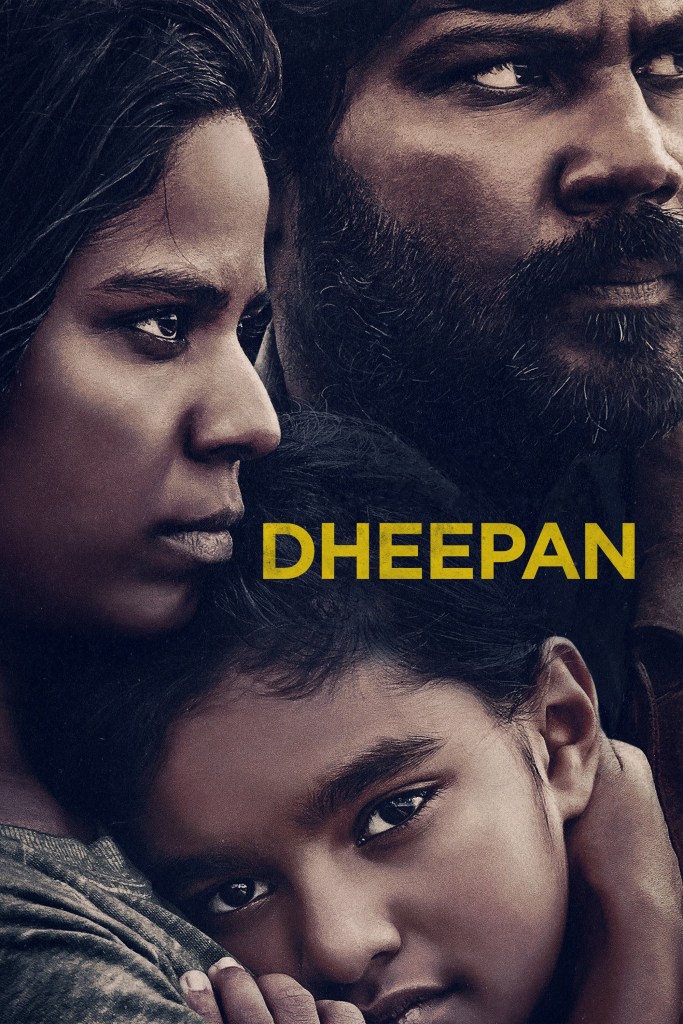
Director Jacques Audiard won acclaim just a couple years ago with his Spanish musical Emilia Pérez, but he’s been making critically loved films for decades, including 2015’s Dheepan, which won the Palme d’Or at Cannes. It opens after a battle in Sri Lanka during their civil war, where soldier Sivadhasan is seeing to the funeral pyre of his group, of which he was the sole survivor. A member of the Tamil Tigers, a militant group on the losing side of a civil war where he fought for independence from the Sinhalese controlled government, Sivadhasan now needs a way out of the country to escape persecution. Loyalists give him a new identity, as Dheepan, but to complete the disguise he needs a wife and child. They found a willing woman fleeing the country, and then finding a nine year old without parents is easy too, with the war leaving so many orphans around. Posing as a family, they make their way to France and apply for asylum. All they’ve done though is leave one war for another. They are housed in the worst kind of projects, with “Dheepan” given a job as caretaker over four buildings. The complex houses a gang of drug dealers, with lookouts patrolling the rooftops, the kinds of which any sane person would see and turn right around. Dheepan is unfazed though, and when his “wife” Yalini asks if they are thugs, he replies, “Yes, but not nearly as dangerous as back home.” Nine-year-old Illayaal is scared of her new school and surroundings at first, but as adaptable as kids are, she starts learning French the fastest. However, tension remains between Dheepan and Yalini, as she wants to escape violence all together and run away to England where she has family. When a power struggle within the gang puts his new family at risk, Dheepan relies on his roots to show them what real violence is. Tremendous movie, sort of like if Jason Statham did an art film. There’s often danger lurking just beneath the surface, even as Dheepan tries to carve out a new life, and we see this new family come together. ★★★★★
- TV series recently watched: Death by Lightning (series), Landman (season 2)
- Book currently reading: The Priory of the Orange Tree by Samantha Shannon




































 Jons Movie Takes