After recently watching her newest, The Mastermind, and enjoying 2 others I’d previously seen (First Cow and Certain Women) I decided to dive into more. A running theme in her films tends to be a slower pace, leading critics to call her masterful and viewers (on RT) to call her boring. I tend to like slower paces, so I think I’m in for a treat today.
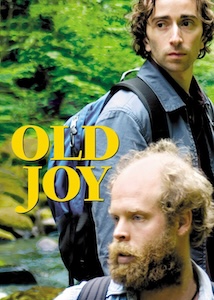
I think we’ve all had those times where we try to revisit or relive a time or place from our past, some moment that was special, and it’s never the same the second time around, because you are a different person now than you were then. That’s at the crux of Old Joy. Mark is married and getting ready to have a baby when he gets a call from old friend Kurt, asking if he wants to go camp out for a night or two and visit some hot springs in the Cascades. While Mark has settled down, Kurt is still living the hippie lifestyle of their youth, in a state of near-homelessness, crashing on couches and very carefree. Against his wife’s apprehensions, Mark heads out with Kurt. It’s a poignant film that can be summed up in a scene that takes place about halfway through, when the two friends are lost and camp down overnight. Kurt is talking about a (probably drug-induced) theory on the universe he once had, and Mark asks, “Did you tell *them* about your theory?” It’s a question out of left field and takes Kurt by surprise. Mark seems to be referencing Kurt’s time in a mental hospital, and Kurt is obviously taken aback, thinking that Mark sees him the same way that everyone sees him these days. Kurt can only shake his head at the gulf that has opened between himself and his old friend, and finally says something along the lines that he wishes they could still be friends like the old days. When Mark replies that of course they are still friends, Kurt (and we viewers) see that time has moved on. Very melancholic movie, but in a good way, if that makes sense. The kind of feeling you get when you look back fondly at a good memory, enjoying it for what it was, but a little sad that you can’t go back to it. ★★★★★
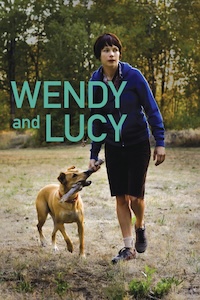
Wendy & Lucy stars Michelle Williams (in the first of many collaborations between the actor and director) as Wendy, a homeless young woman trying to get to Alaska from Indiana, pursing a job at a cannery. She’s made it to Oregon with her trusty dog Lucy, but it’s here where she hits a wall. She gets a warning from a store security guard for sleeping in her car on the private parking lot, and then her car won’t start. While waiting for the mechanic to open, she goes to a local grocery store, ties up Lucy in front, and then gets nabbed shoplifting dog food. After being booked and released at the jail, she makes her way back to the grocery store hours later, only to find Lucy is gone. The kind security guard from earlier lets Wendy use his cell phone to keep tabs with the local dog rescue, in hopes that Lucy will turn up, but in the meantime she gets bad news from the mechanic: the repairs will be far more money than she has left. Wendy is out of options, at the very end of the road. It’s a bleak movie about a woman out of options, powerfully acted by Williams, and emotionally taught. ★★★★

Meek’s Cutoff is how Reichardt does westerns, and is loosely based on a fateful voyage along the Oregon Trail in 1845. Led by Stephen Meek (Bruce Greenwood), a wagon train of a trio of families has left the traditional Trail for a cutoff, or “shortcut,” that Meek hopes will shave some time off. However, the trip takes the group through the Oregon High Desert, and the lack of water becomes a real problem very quickly. To compound matters, the travelers notice an American Indian watching over their progress from time to time. Some of the wives worry they’ll all end up dead from thirst or Indian attack, while Meek tries to waylay their fears, stating he knows the area and he’ll get them through to the other side, but as the miles and days of endless parched earth compile, death seems pretty certain. When the trailing Indian is captured one day, Meek wants to kill him immediately, but some, in particular Mrs Emily Tetherow (Michelle Williams) argue to keep him alive, as he must know where water is. This movie doesn’t have a lot of answers and ends on a very obtuse note, but is expertly crafted to create that sense of real, growing danger with no end in sight. Great cast too, including Will Patton, Paul Danoe, and Zoe Kazan. ★★★
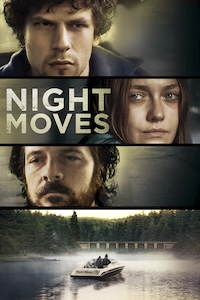
Night Moves brings another great cast (Jesse Eisenberg, Dakota Fanning, and Peter Sarsgaard; I’m always amazed that auteur directors can get big names to do these low budget films) together for a lowkey thriller. Josh and Dena are friends who share common ideals about the environment and sustainability, and view a local dam as a real threat to the area’s ecosystem. Thus, they want to blow it up. They bring in an ex-Marine, Harmon, with knowledge of such things, and together hatch a plot. The first half of the film is blowing up the dam. With fake ID in hand, Dena buys 500 lbs of fertilizer and Josh procures a boat. The actual act goes off more or less without a hitch, but the next day, they learn from the news that a camper who was in the area has gone missing and is presumed dead. Dena was determined from the beginning that no one would be hurt, and she is wracked with guilt. Josh and Harmon start to wonder if she’ll go to the police and turn them all in, so something needs to be done (in sinister voice). There’s slow burn, and then there’s Night Moves. Using the term thriller is a bit misleading as the tension is light at best, and when there is action, it mostly takes place off camera, but I was still completely engrossed at this trio, who think they are doing a good thing, but who obviously have no idea the ramifications of their actions and who are in way over their heads. ★★★½

After Night Moves came Certain Women (2016) and First Cow (2019), but after that was Showing Up in 2022, her penultimate film before The Mastermind. Michelle Williams is back, this time as an artist/sculptor named Lizzy. She works in the offices of an art school in Oregon, while also working on her own art in the evenings. Lizzy is prepping for a showing of her latest works, but the world seems bent on slowing her down. Her landlord is a fellow artist who doesn’t seem to value Lizzy’s time (and is a terrible landlord to boot), and then her cat maims a pigeon one night. Lizzy throws the bird out the window, but of course the landlord finds it and starts to nurse it back to health, only to ditch it on Lizzy in the end anyway. Lizzy is also dealing with a brother with mental health issues and divorced parents who bicker over anything when they run into each other. As Lizzy’s show nears, she starts to wonder if anyone will attend, even her own family. And that’s it, that’s the movie. There isn’t really a plot per se, it’s just the normal, everyday machinations of a mundane life. Williams is nearly unrecognizable as a slouching, disheveled woman, the kind of person who disappears in a crowd and isn’t noticed. I didn’t connect with this movie at all, I just get what it was trying to say. The rare dud from this director. ★½
- TV series recently watched: Girl Taken (series), Fallout (season 2), Hal & Harper (season 1), The Artful Dodger (season 2), Lost (season 2)
- Book currently reading: Paul of Dune by Herbert & Anderson

 Jons Movie Takes