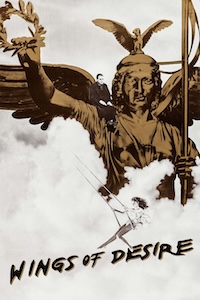
Most Americans are familiar with the 90s Nic Cage/Meg Ryan film City of Angels, but did you know it was based on Wender’s 1987 movie Wings of Desire? It follows two angels, Damiel and Cassiel, who oversee the people of Berlin. The angels can be seen by children but not by adults, and while they can comfort and influence, they can’t directly interact with the people or environment. We later learn that they’ve been in the area for thousands of years, predating humans coming to the region, and have been silent observers all of that time. Damiel begins to fall in love with a circus trapeze artist named Marion, who is depressed at the news that her troupe will be closing down. He sees her zest for live but can’t experience that himself, in fact, he and his fellow angels can’t feel anything, seeing the world in black and white and unable to feel the wind in their hair or the sunshine on their faces. Cassiel seems fine with this, knowing his place in the world, but Damiel seeks a way out. Actor Peter Falk (playing himself) is in the area to film a movie, and amazingly, he feels Damiel’s presence and speaks out to him. Peter tells Damiel that he used to be an angel too, but fell in love with humanity and became mortal. Damiel wants that too, more than anything. It’s a heartfelt movie full of emotion and magic, and defining what it is to be human. I see why it is widely regarded as Wender’s best. ★★★★★
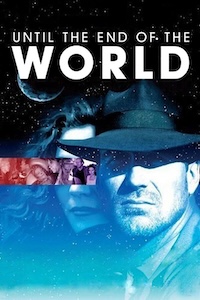
Wim Wenders may be the king of the road movie, but it is true that there can be too much of a good thing. Until the End of the World had Wender’s biggest budget (more than all of his previous films combined), and was filmed over 5 months, visiting 11 countries on 4 continents. After all that filming, he wanted to release a picture about 5 hours long, but was contractually obligated to deliver a movie of around 2 1/2 hours. He sent the studio a “reader’s digest” version of his film, which was released, and bombed. Years later, he was given a chance to release the version he wanted to, and it received acclaim. It was this 5-ish hour version I sat through, and I might as well have watched the smaller one. There’s a lot going on here. Taking place in the near future (and oddly prescient too, for the year it was made), it follows a woman named Claire. The news is reporting a rogue Indian satellite that is going to crash to Earth, most likely in southern France where Claire is, so the area is in chaos. That becomes a backdrop though, as the meandering story mostly revolves around Claire getting involved with some bank robbers, and then falling in love with chasing a man (Trevor, played by William Hurt) around the globe, who is also pursued by a private detective and the CIA, while Claire is also chased by her ex-boyfriend (Eugene, played by Sam Neill), all because Trevor has some tech that could be worth a lot of money. It’s a big mess, though at times, an entertaining mess. There’s some laughs, like when they run through a hotel in Japan, fleeing from bounty hunters, and some tears, like when it is revealed that Trevor’s tech involves “taping” film with a virtual-reality-like device in order to “implant” scenes into blind people’s eyes, all in hopes of letting Trevor’s blind mother “see” again, and even some tense moments, like when Trevor and Claire are stranded in the outback in Australia and set off on foot through the dead land, but overall, there’s a lot of dead space in those 5 hours. And the film really changes focus several times. If it were some other director without a proven track record, I’d wonder if they even had a plan going in as to how it was going to end, because there’s several hard left turns going on here. I appreciate the scope and ambition of the project, and it does have some great scenes and moments (and the soundtrack is truly awesome with Talking Heads, Lou Reed, REM, Elvis Costello, Patti Smith, Depeche Mood, and others) but as a whole, it’s not my cup of tea. ★★
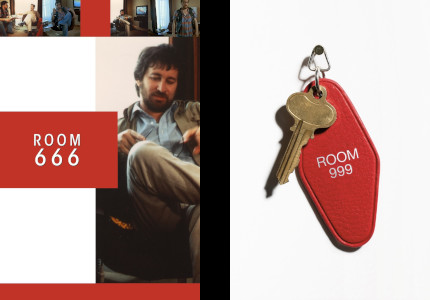
In addition to all of his feature films, Wenders was prolific in making documentaries too, and while I don’t watch many docs, I decided to get in some of them here to “fill out” his oeuvre. While at Cannes in 1982, when a lot of talk in the film industry was about the future of cinema with the growth of television and VCR’s (watching movies at home instead of in the theater), Wenders set up camera in his hotel room (Room 666) and asked a series of directors if cinema is an art that is about to die. The answers ranged from “yes for sure,” to “no, it will evolve,” to “I’m old, I don’t care.” The directors included some big names too, like Jean-Luc Godard, Rainer Werner Fassbinder (just weeks before his sudden death), Paul Morrissey, Werner Herzog, Michelangelo Antonioni, and Steven Spielberg, who gave the optimist answer that everything was fine with cinema. Easy for him to say; in 1982, his film E.T. set the record for highest grossing film for the next 11 years. 40 years later, in 2022, with streaming being what it is today, filmmaker Lubna Playoust asked the same question to today’s directors in the film Room 999. Wenders is there to answer the question this time, along with 30 others including Joachim Trier, David Cronenberg, James Gray, Asghar Farhadi, Olivier Assayas, Baz Luhrmann, Paolo Sorrentino, and Ruben Östlund. Like in the first film, the answers vary across the spectrum, but it does provide insight into how these acclaimed directors see the world and the future of their craft. Not really groundbreaking or anything, but I always enjoy a view into how filmmakers think. ★★★

Buena Vista Social Club was released in 1999 and is about the musicians involved with the same-named album released a couple years prior. Wenders strolls the neighborhoods of Cuba while interviewing the musicians about growing up there, their influences and history with music, and what they are up to now. Interspersed throughout are the songs they perform, some recorded while they were in Amsterdam in 1998, some at Carnegie Hall later that same year, and some recorded spontaneously there in Cuba during the doc’s filming. Like most musicians, there’s a lot of characters there, and they all have interesting stories to tell. The music is great, but my favorite parts were the scenes in and around Cuba, in all of its vibrancy. Fun movie. I also watched his docs Pina, about the dancer/choreographer Pina Bausch, and his newest film Anselm, about German painter and sculptor Anselm Kiefer. They were OK, not really my cup of tea, and reinforced that I’m just not much of a documentary guy. ★★★

 Jons Movie Takes