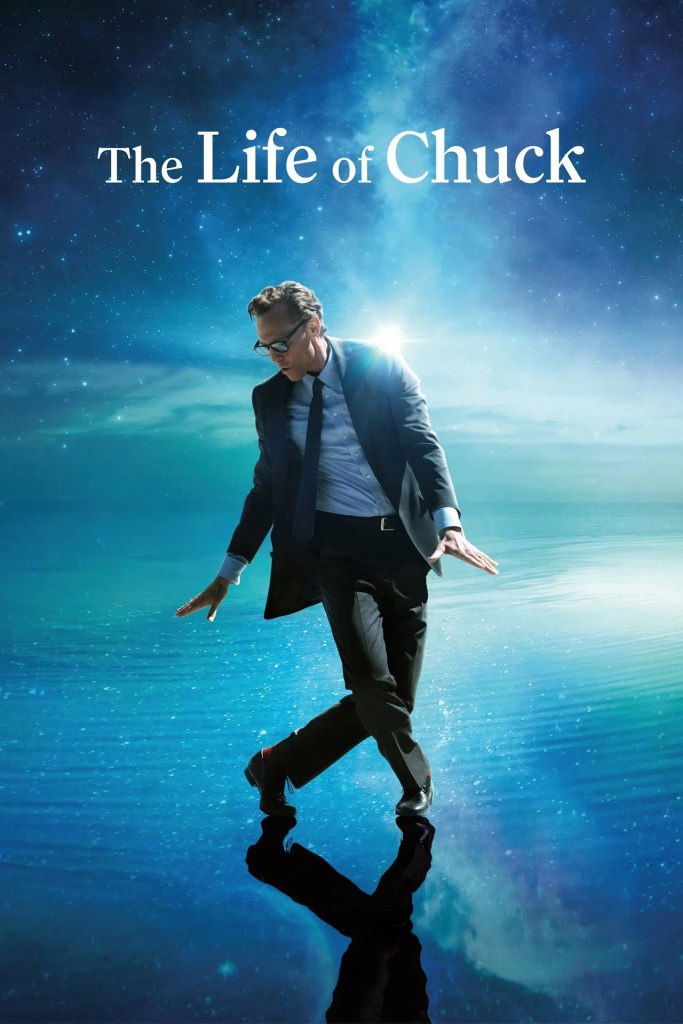
The Life of Chuck, based on a Stephen King short story, is a bit of a throwback. It is like some of the classic King books that were light on horror (though it does have a supernatural element) and heavy on heart. When the film begins, shit is starting to go wonky in the world. There have been intermittent internet outages across the globe, leading to panic, and shortly after, natural disasters begin ramping up. Rumors start flying that the world is ending. A teacher, Marty (Chiwetel Ejiofor) and his ex-wife Felicia (Karen Gillan) begin to notice billboards and TV commercials thanking an unknown man, Charles (Chuck) Krantz, for 39 years of an amazing life, and it seems whoever this Chuck is, his impending death is related to the destruction of the world. When Marty and Felicia are sitting outside one night, after the internet has gone down for good and California has fallen into the sea, they notice stars overhead are winking out. In mid-sentence, the screen cuts to black, and we know the world has ended. But why? We next flash back nine months, and finally meet Chuck (Tom Hiddleston), who seems to be a happy-go-lucky guy. Walking down the street, he comes across a busker playing the drums, and, reminded of his grandmother banging on a pot when he was a child, begins to spontaneously dance. Others pay notice and everyone has a good time. However, Chuck gets a headache, which leads to his diagnosis of brain cancer. Further flashbacks later show Chuck as a kid, being raised by his grandparents after a car accident killed his parents and little sister, and the secret in the attic that may lead to the future end of the world. There’s some great suspense, but also a lot of love, laughter, and joy. For a movie about the end of all things, its funny that I walked away feeling good. It really is kind of a feel-good film and I loved it. ★★★★½
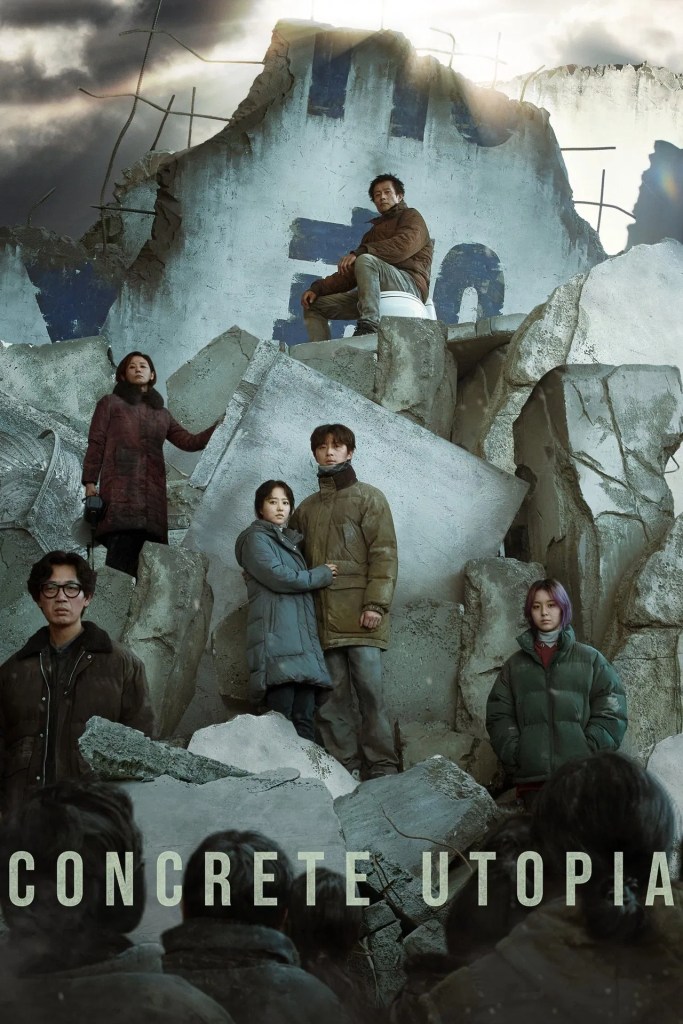
Next up are two great international films, starting with Concrete Utopia out of South Korea. A drama disguised as a disaster film, the movie opens on a shot of a row of apartment buildings, just before a major earthquake topples all of them except one. Right in the middle, one tall building remains standing, and its inhabitants are left to decide how to handle other survivors who come seeking shelter, because as they say in Game of Thrones, winter is coming. As the days and weeks go by and no word comes from “the outside world,” the people realize they very much are on their own, so in order to save resources and survive, they make the decision to only allow the apartment’s original renters stay, and everyone else must go. They elect one of their own as a leader and decision-maker, and he starts by calling those non-residents “roaches” (because they only come out looking for a hand-out, according to him), and dehumanizing them has the intended effect of making it easier to ignore their pleas, even as they begin to freeze to death outside. Finally though, as weeks turn into months, the apartment’s residents must set up teams to go out in the wasteland and hunt for food and supplies, and there are still survivors out there who have memories for how they were treated, and even for those who were not kicked out, rumors have spread about “the wealth” that exists in the lone-standing apartment building. Not to mention the fallout that comes when the residents learn that their leader may not be who he says he is. Very intense film, with a stark look at what lows people will sink to when faced with hardship. ★★★★

From South Korea we move southwest to Hong Kong, for Time Still Turns the Pages. Told in the present as well as flashbacks to the past, the film focuses on a teacher named Cheng. The school is rocked when a suicide note is found in a wastebasket, and Cheng and his fellow teachers are on a mission to find who wrote the note, in order to get them help. Cheng in particular seems driven, and we learn why through flashbacks to his past. As a young boy, Cheng was lonely and emotionally abused by his parents. His younger brother is a prodigy, both in school and at the piano, and excels at everything he tries. As such, the parents heap praise on him, while constantly asking Cheng why he can’t be more like his brother. And Cheng really does try, practicing piano until his fingers hurt and studying long hours before tests, only to continue to fail, even being held back a grade, while his little brother is admitted to a prestigious private school. Cheng begins to write in his diary about how terrible he is, how he’ll never amount to anything, and writes his own suicide note. I always stay away from spoilers in my blog, but HUGE SPOILER HERE (you’ve been warned): we soon learn that adult Cheng is not the elder brother. He is the younger brother who survived and lived on after his older brother killed himself as a child. The death rocked the family, with the mother leaving, the father blaming himself (let’s be honest, rightfully so) and the younger Cheng deciding to become a teacher instead of a doctor or lawyer, as his father dreamed. Such a very sad film, my heart ached as the elder boy, aged no more than 9 or 10 and very young still, cried at night, aching for the love of a father who refused to do so. Definitely makes you want to go give your kids a hug. ★★★★½
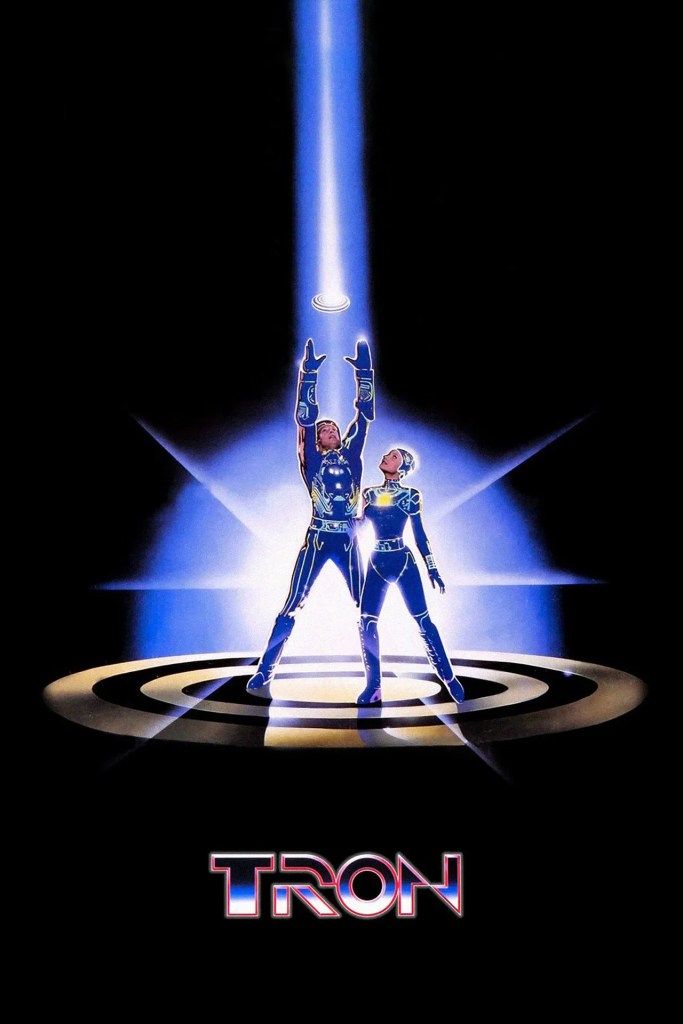
Will be seeing the newest Tron film shortly, so I decided to go back and revisit the first two movies. Tron was a favorite of mine as a child, so my thoughts on it are admittedly skewed positive. I’ve probably seen it more than 10 times as a kid, but it has been many years (decades) since I saw it last, and watching it as an adult is a much different experience. If I’d just seen it for the first time, I’d probably think it wasn’t very good, but I can’t separate my memories from it, so it’s still good to me! It stars Jeff Bridges as Kevin Flynn, a software engineer whose major program was absconded by an executive, Dillinger, at the company he worked for. Dillinger’s own program, the Master Control Program (MCP) is an early artificial intelligence that has been gobbling up programs to make itself smarter and more powerful. All of these programs exist in a virtual world, and when Flynn tries to start hacking into it, the MCP “zaps” him and digitally transports his body into the computer system. Now inside, Flynn must try to take out the MCP with the help of other programs, including Tron, the program written by Flynn’s fellow conspirator Alan Bradley. Being a “user” and not a written program, Flynn does have powers that the others do not, so they just might pull it off. The movie’s ideas are pretty groundbreaking for its day (1982!) and as such, the critics didn’t really get it and called it “incoherent.” It makes a lot more sense now, even if it often comes off as campy. Still, the film relied heavily on computer animation, the first of its kind, and while it is dated obviously by today’s standards, it isn’t half bad and is a whole lot of family fun to watch and relive. ★★★★
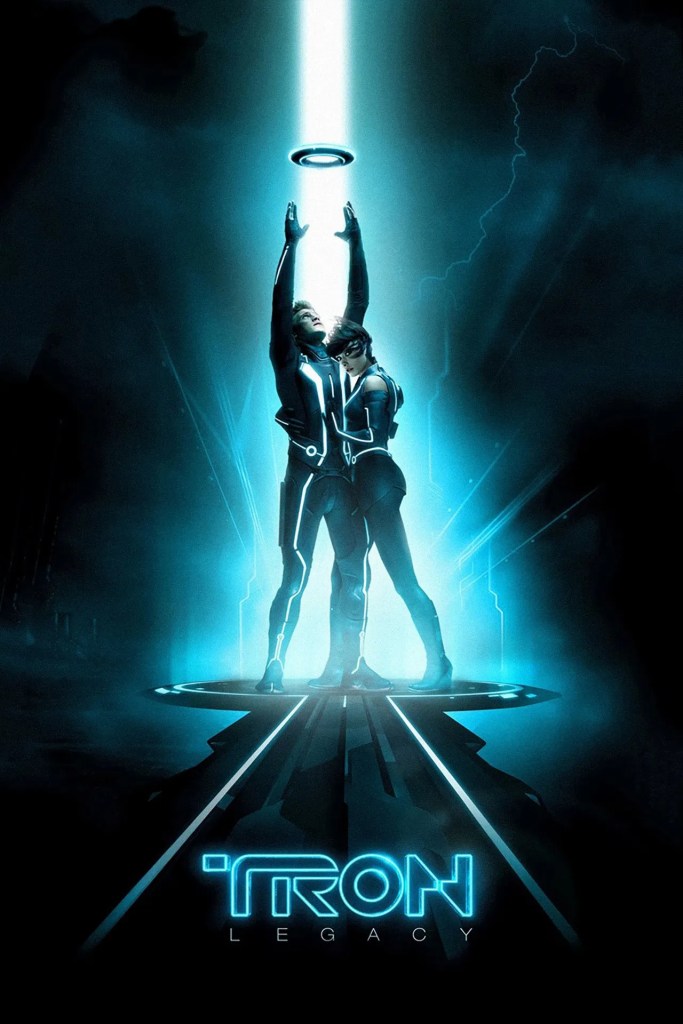
I was not a fan of Tron: Legacy when it came out (15 years ago already, time really flies) and this was just my second viewing. I liked it lot more this time around, maybe because I watched just after the first, and some of the campy nature felt as more of a continuation. (Side note: it was directed by Joseph Kosinski, his first film. He would later go on to do movies I really enjoyed like Oblivion, Top Gun: Maverick, and F1.) The film begins 7 years after the first, and Flynn has been building a new, connected virtual world. However, he mysteriously disappears one night, and after a flash forward to present day, his son, Sam, is all grown up. Sam has been struggling with his legacy of taking over the software company, and when he gets a clue as to the location of his missing father, his search leads him to be pulled into the virtual world. Turns out that Flynn had written a program, Clu, to help him in his building efforts, and Clu turned on him many years ago, trapping Flynn in the computer system. A few minutes in the real world can be years in the virtual, so since Flynn has been missing for 20 years, he’s lived in hiding in his virtual world for centuries. If he leaves his little sanctuary, Clu will know and hunt him down, with the ultimate goal of nabbing Flynn’s data disc, giving Clu the power to enter the real world. This must not happen, so when Sam reunites with Flynn, they team up to try to stop Clu and get to the portal to escape the virtual world together. There’s a whole lot going on here, and the film does suffer from trying to de-age actor Jeff Bridges to play the younger program Clu; the technology just wasn’t there yet in 2010 (and is still not quite to this day), giving the digital actor a blank, glass-like look. However, the exciting moments are still plenty good, so I’m hoping for a solid continuation in Tron: Ares when I see it later today. ★★★
- TV series recently watched: Chief of War (series), Portlandia (seasons 1-2)
- Book currently reading: Crossroads of Twilight by Robert Jordan

 Jons Movie Takes
One thought on “Quick takes on Concrete Utopia and other films”