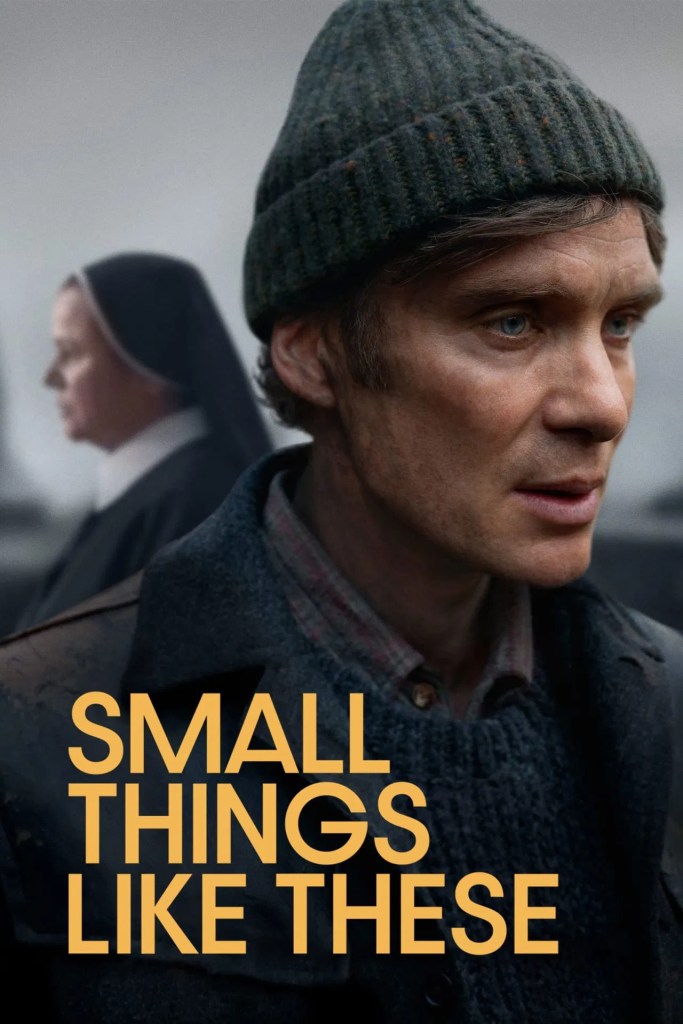
Small Things Like These is movie star Cillian Murphy’s followup to his breakout role in Oppenheimer. Returning to his roots in an indie film out of Ireland, he plays Bill, a hard-working coal merchant in 1985. He and his wife are raising 5 daughters and Bill seems to be a good guy all around, though he is haunted by thoughts of a poor upbringing, though, even there, his single mother tried to do right by him. Bill is a man of few words so it is hard to get a sense of what is going on behind those piercing eyes of his, especially when he becomes more aware of the mistreatment of some young women in the care of a local convent and school. It has long been an open secret that the nuns take in “fallen women,” which are usually pregnant single women, or sometimes just the victims of rape who are abandoned by their families, and the nuns cruelly put them to work. One day, on a delivery, Bill finds one such woman locked in a coal shed, and obviously doesn’t believe the story the mother superior (a devilish Emily Watson) concocts. Because of his upbringing, he keenly feels the desperate hope of the lonely woman in need. A film with a slow pace to match the quiet, introspective actions of its lead character, it presents a powerful story about the infamous Magdalene laundries of Ireland, but while the root of the story is strong, the telling of it is lacking. Murphy is great in the lead, but there’s just not enough there to provide the emotional heft it deserves. ★★
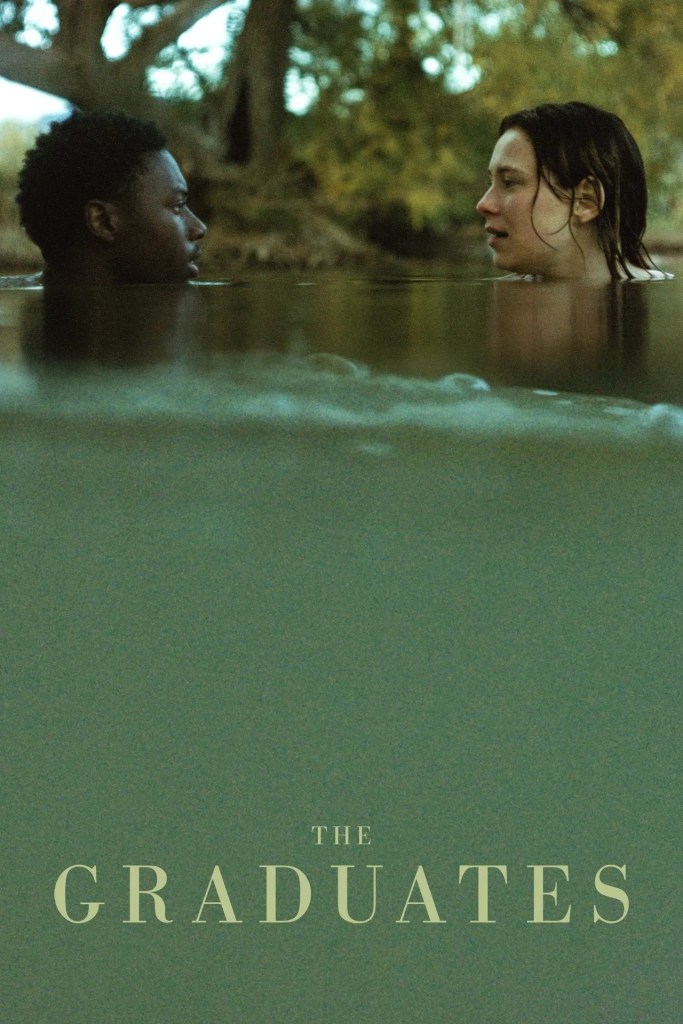
The Graduates is a timely film (unfortunately) following three people intimately involved with a recent school shooting, and how the fallout of those events have far-reaching impacts. The shooting at the school was a year ago, and Genevieve (Mina Sundwall, from the Netflix remake Lost in Space) is returning for her senior year. Her longtime boyfriend Tyler was one of the victims, and she still deeply feels his absence, while trying to find some kind of joy in what is supposed to be an exciting time in her life. Once a promising college-bound student, Genevieve is struggling just to finish. That is better than Ben (Alex Hibbert), Tyler’s best friend, who transferred to a new school after the shooting but has since dropped out. The third main character is John, Tyler’s father, who became the school’s basketball coach only to spend more time with this son, but has kept the position for one more year to lead the remaining boys and, like everyone in the film, try to find some kind of normalcy. Everyone is awkward around each, not knowing what to say, and when they do find words, not knowing how those words will be construed. All seem to be living on the edge of a knife, where any one comment or memory can be a setback. The film does a great job of conveying the feeling of unimportance; these kids are supposed to be excited about graduating and moving on, but they are stuck and can’t get excited about anything. There’s a really poignant scene about halfway through where the camera lingers over an empty hallway with sounds just outside of earshot; I couldn’t tell if it was kids talking and playing outside, or if was echoes of screams and terror from that eventful day. ★★★½
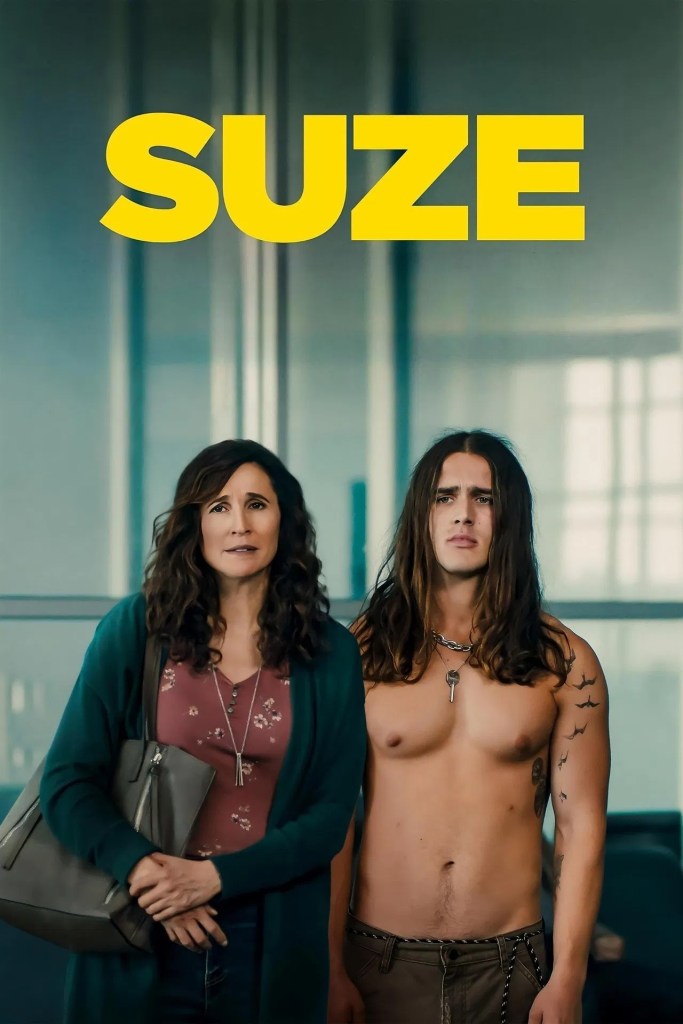
Suze is a very enjoyable comedy staring Michaela Watkins as Susan, an at-times overbearing single mother to high school senior Brooke, who is preparing to go to college. Brooke at the last minute drops the news that she has decided to go away to college rather than stay close to home, leaving Susan despondent. To make matters worse for Susan, Brooke breaks up with her boyfriend Gage shortly after leaving for school, and Gage, a young man who lives by his emotions, tries to kill himself from despair. Gage’s mother is in jail and his father obviously couldn’t give two shits for his son, so though Gage has always grated on “Suze’s” (as Gage calls her) nerves, she takes him into her home to watch over while he heals up, to keep an eye on him and make sure he doesn’t attempt it again. The two become unlikely friends, as they lean on each other to heal and grow from the absence of Brooke. As they do, Gage is able to get Suze to come out of her shell and realize she can have a life outside of her daughter, and Suze is able to show Gage that there are people out there who care about him, while they also learn some harsh lessons about the person Brooke has become. It’s a very funny movie with a strong message about being yourself, the world be damned. ★★★½
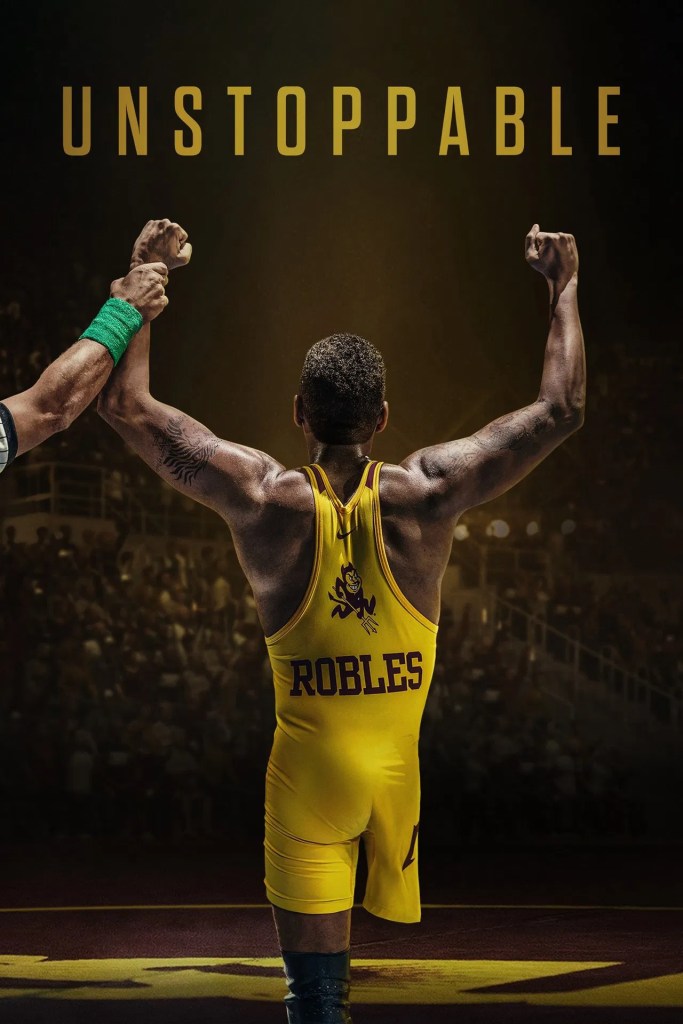
My final two films are both biographical, the first being Unstoppable, based on the life of Anthony Robles. Born with a whole leg, Anthony is driven from a young age to excel in wrestling. His high school coach is maybe his biggest fan, but his disability is obviously keeping many colleges from taking him seriously. Anthony’s dream has always been to wrestle for Iowa, who always churns out national champions in the program, but they do not offer him a scholarship, something he needs in order to go to school. Drexel offers him a full ride, but the school’s program is just too small for Anthony to be able to earn the recognition he craves, so he ends up going to Arizona State. The coach there doesn’t have high hopes for Anthony, but Anthony works harder than anyone and earns a spot on the team, going on to the greatness that you know just know is coming. Along the way, he has to face hardship on the mat as well as home, where his stepdad abuses his mom. Unstoppable is fine, and that’s part of the problem. It’s just fine. The cast is a list of those who always seem to show up in these kinds of uplifting films (Michael Pena, Don Cheadle) and there’s a surprisingly great performance from Jennifer Lopez as the mom (maybe I shouldn’t be too surprised, she’s turned in some good stuff in the past). Unfortunately Jharrel Jerome in the lead is not that great, and didn’t come off as natural. Very average film overall. ★★½
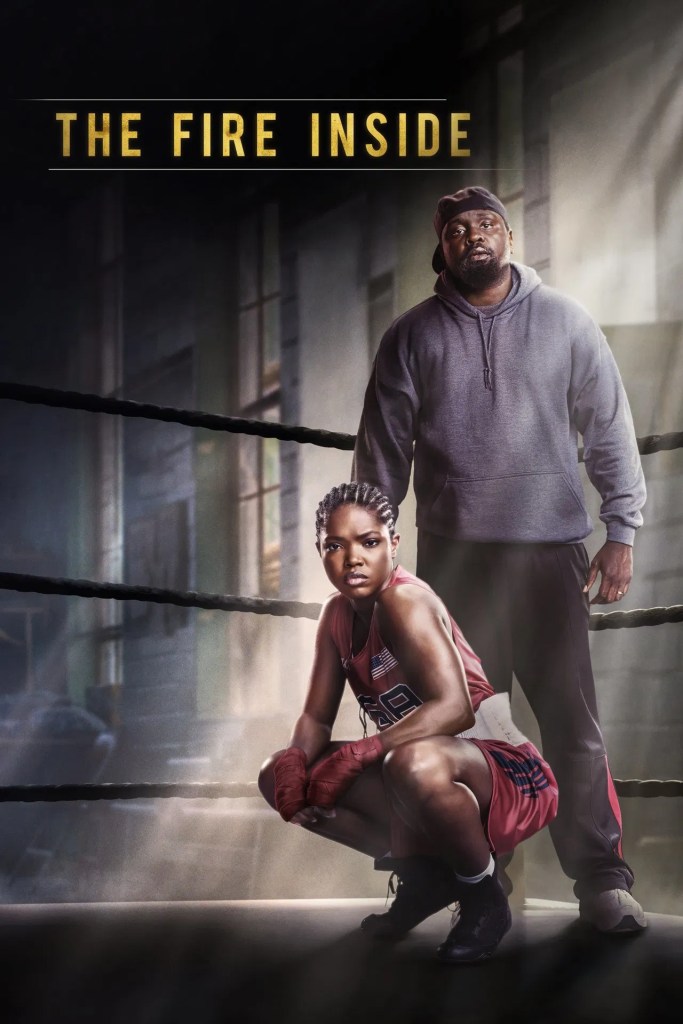
The Fire Inside is much better, this time about Claressa “T-Rex” Shields, who was a boxer who rose to fight in the Olympics for the USA. From the city of Flint, Michigan, which had gained a “certain reputation” nationally by 2010 or so, when the film picks up, Claressa is fighting the odds just to not end up pregnant or in juvie. Her dad is already in jail, and her mom cares more about whatever latest man she has and throwing parties than being any kind of parent to Claressa or her half dozen siblings. From a very small age though, Claressa has been drawn to boxing. There’s a local coach named Jason Crutchfield who teaches boys to box as a way to keep them off the streets, but he initially tells Claressa that girls aren’t allowed. When she keeps showing up at the gym, he finally relents and takes her under his wing. Through his tutelage and her own (very) hard work, Claressa gains national recognition as a young fighter who isn’t afraid to take on stronger and more seasoned fighters. A loss in the Olympic qualifiers leading up the 2012 Olympics almost derails her goals, but Claressa perseveres to win the gold medal, the first USA woman to do so. The expected endorsement deals, which Claressa was counting on to help her family’s situation, never materialize, leading Claressa to become even more motivated to go for the 2016 Olympics too. The film is well written (Barry Jenkins) and well acted (Ryan Destiny as Claressa in particular) and the story is thrilling in all the right spots. It’s from a first-time director, Rachel Morrison, but she cut her teeth as a cinematographer on some very well-received films, including Fruitvale Station, Dope, Mudbound, and Black Panther. ★★★½
- TV series recently watched: Daredevil Born Again (season 1), ST The Next Generation (season 6), Dope Thief (series)
- Book currently reading: Winter’s Heart by Robert Jordan

 Jons Movie Takes