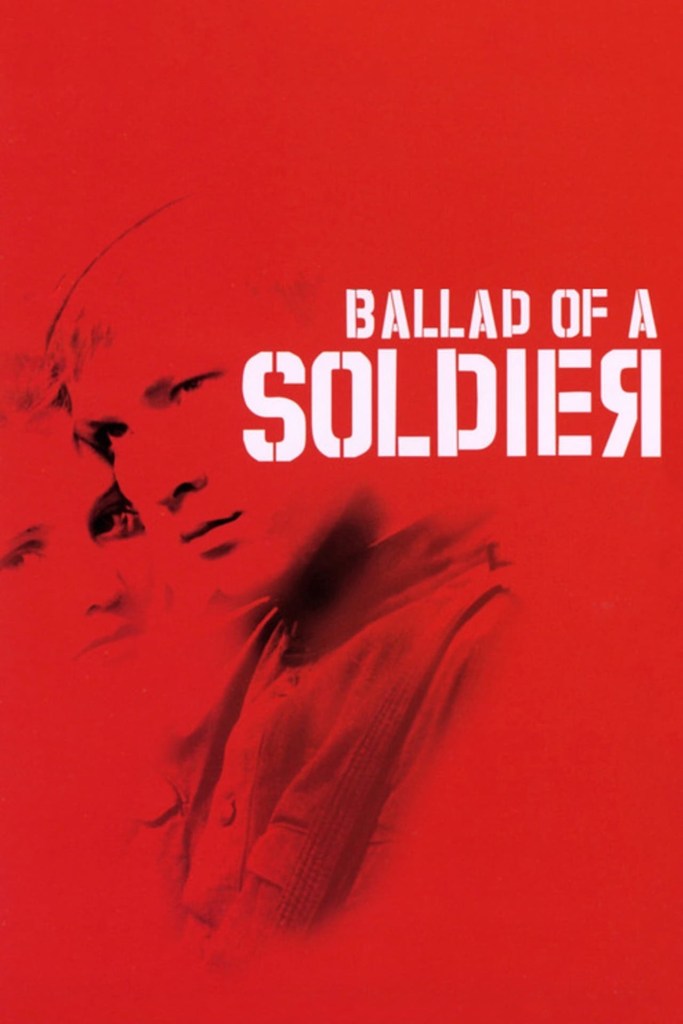
For a change of pace, how about a series of classic foreign films? Ballad of a Soldier came out of the USSR in 1959, but got some theater showings in the USA in 1960 during a thawing in the Cold War, and it was a hit. Taking place in the Eastern Front during World War II, it follows 19-year-old soldier Alyosha. There’s a short prelude in the beginning where we meet Alyosha’s mother, who talks about how her son never returned to her from the war, after which we get into the action. Alyosha heroically takes down 2 German tanks by himself, for which the general rewards him with 2 days leave to visit his mother in his hometown. But first, Alyosha needs to get there, and his trip will show the travails Russia is going through during the war. Alyosha will meet a soldier afraid to return home to his wife, now that he is missing a leg, and a mother living in fear that her son will not return. The always kind and helping Alyosha will push jeeps out of mud, promise to bring a message from one soldier to his wife in a neighboring town, and sometimes just be an ear when someone along the way needs to talk. All of these little side trips hold him up, but the most important one is Shura, a young woman hiding in a train car to get across the countryside, with whom Alyosha unexpectedly falls in love. When Alyosha finally does make it back to his hometown, his 2 days are up, and he has just minutes to hug his mom and promise he’ll be back. Of course, after the beginning of the movie, we know that will never happen, making their short reunion that much more poignant. A wonderful film about the effects of war, and told (and shown) beautifully in start black and white. It was extremely popular in its home nation even by higher-ups, yet is completely devoid of soviet propaganda (even referring to Alyosha as a Russian Soldier and not a Soviet). ★★★★½
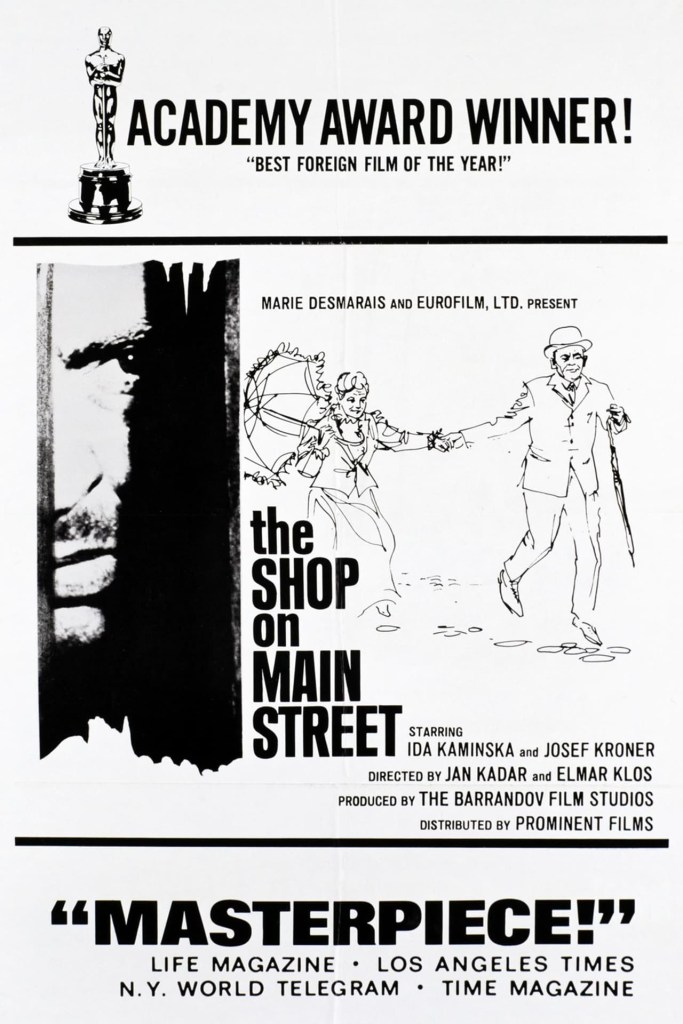
From the opening you think you might be in for a comedy, as you hear some light-hearted, playful music, but when you see it is a band playing in a square, with armed guards walking around, you realize you’ve been duped. Then a title card stating that it is 1942, and the Slovak Republic has adopted the Nuremberg Race Laws from Hitler’s Germany, and the setting for The Shop on Main Street is set. Tóno is a struggling carpenter, sidelined when much of the country’s laborers are doing well, because his brother-in-law, a higher-up in the new fascist government, doesn’t like him. He is given a chance when the government decides to take over businesses owned by Jewish citizens, under the guise of an Aryan controller, and Tóno is gifted the widow Mrs Lautmannová’s sewing shop. The problem for Tóno though is Lautmannová is hard of hearing, old as snot, and doesn’t understand that he is basically her new boss, so she continues to boss him around as if he’s a servant. Of course Tóno has to keep this hidden from the soldiers in the city and, even worse, his overbearing wife, who expects him to find “the gold that Jew hid under the floorboards.” Tóno doesn’t know what he got himself into, because it turns out the Jewish citizens and their sympathizers have been keeping Lautmannová and others like her funded, and they’re going to pay Tóno a nice monthly salary now to look the other way. He is willing to do so until the government decides it is time to round the Jews up and ship them off to Germany, but by now, Tóno has come to like Lautmannová. The ending is soul-crushing and one of the hardest moments I’ve seen in awhile. Lots of humor in this movie, but it definitely gets dark. ★★★½
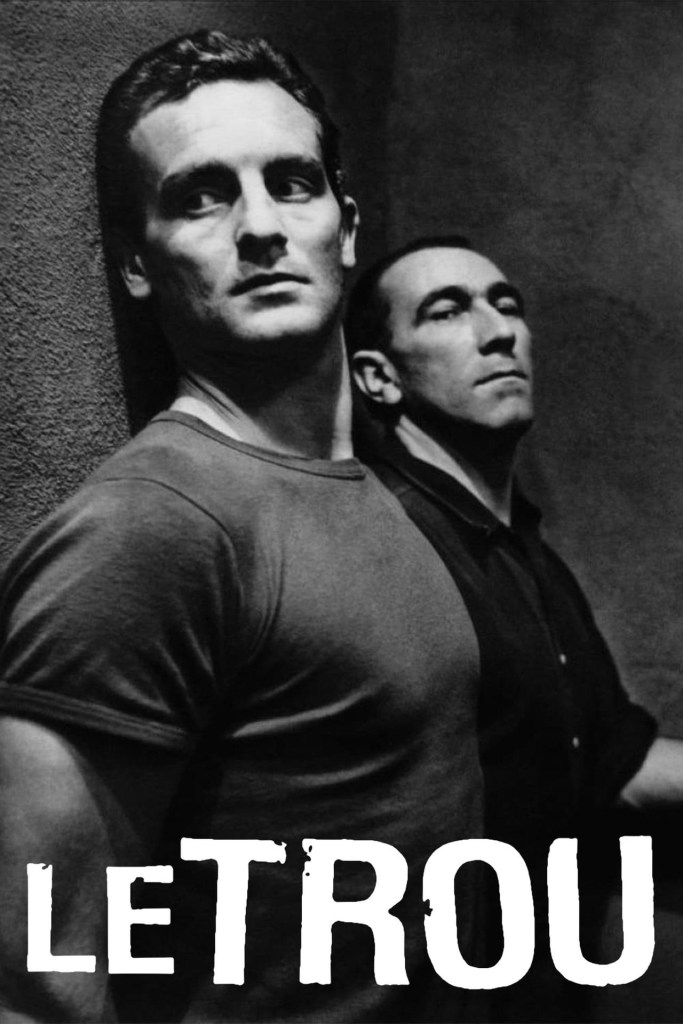
Le Trou (“The Hole”) is a fascinating film behind the camera, but let’s start with in front of it. Gaspard is in prison, charged with the attempted murder of his wife, and he gets put in a full cell with 4 other men, all of whom look like career hardened criminals compared to the wide-eyed younger Gaspard. He quickly ingratiates with them though, with his cool, easy personality, and since he’s in the small room with them and they have basically no choice, they bring him into their scheme: they are planning an escape. Once they tell Gaspard that his crime will net him 20 years at least, he is ready and willing to join in their feat. Prison escape films are a dime-a-dozen, but this one is a cut above the rest. For starters, we see their painstaking chiseling through the concrete floor, filing through bars, and working around obstacles, which takes place over weeks or months, but which is blended together so that the passage of time goes almost unnoticed by the viewer (much different for the jailed, I’m sure!). Through it all, there is always the very real fear that an unplanned search and toss by the guards will bring ruin to them all, so there’s tension for almost all of the movie that never really lets up. It’s an old-school thriller, one without scares, but no less intense. And if all that isn’t great enough, know what’s even better? It’s all true. As we are told in the beginning, it is based on a real-life jail escape, and the person who did it plays one of the characters in the film. I’m often not a fan of non-professional actors in films, but I didn’t even notice in this one, and everything is perfect. Great film, and it was also director Jacques Becker’s last— he died before it was released. ★★★★½
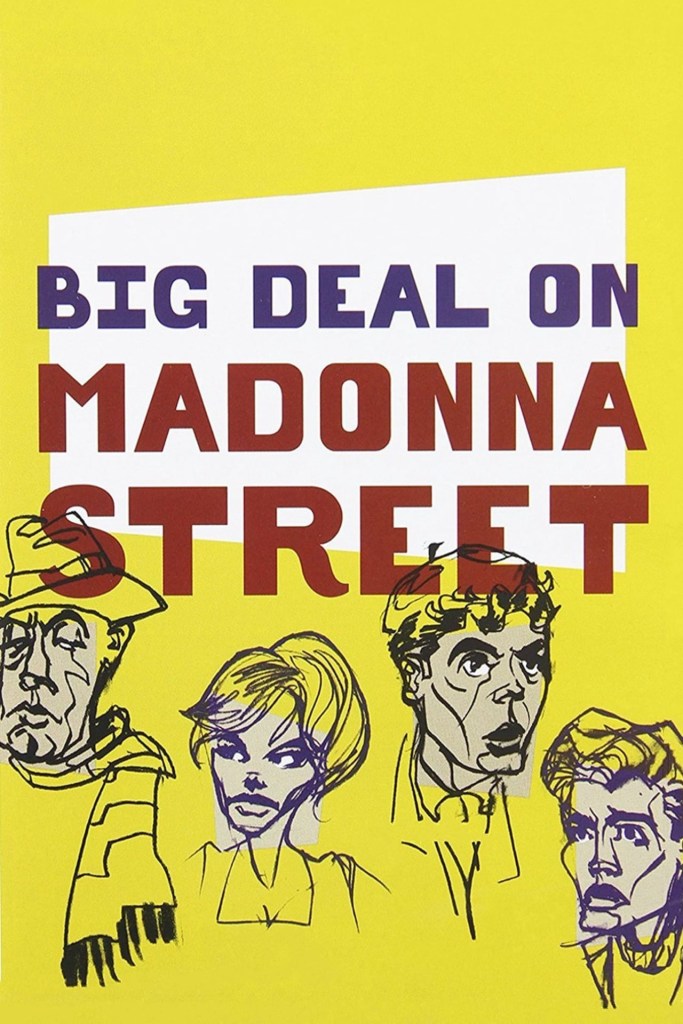
After so many heavy movies, I was in the mood for some lighter fare, so next up was a comedy, Big Deal on Madonna Street. It’s sort of like Ocean’s 11, if the team was made up of a bunch of bumbling idiots. In the opening scene, a couple crooks are trying to steal a car, but make a mess of it and one of them is arrested trying to flee. He’s fine doing his time until he hears of a possible easy robbery target with a limited window, so he needs out. First, he has to find someone to take the fall for this car thing, so he tasks a buddy to pay off someone willing to sit in jail for a couple months. Of course, in the circles they run, everyone has a record, so their time would be a lot more than 3 months. When they finally find a patsy, our original criminal ends up stuck in jail longer anyway, due to an unsympathetic judge! While he’s in, all the fools that were approached about doing time in his place band together to pull off the job on their own. It involves tunneling through an empty apartment to a pawn shop and cracking its safe. Nothing goes right from the beginning, such as a couple spinsters moving into the “empty” apartment, and even when the would-be robbers get into the apartment, they drill through the wrong wall! There’s lots of slapstick style comedy, with a recognizable cast including one of Italy’s all-time greats, Marcello Mastroianni. Very funny movie, as the crooks can’t ever seen to get out of their own ways. ★★★½
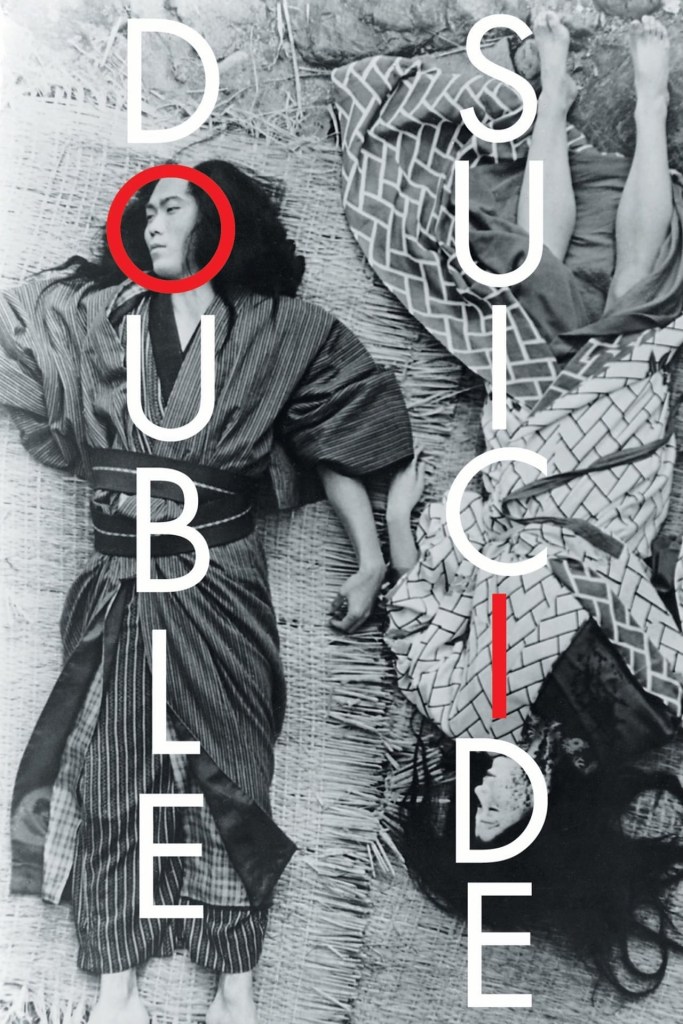
For awhile there I was watching a lot of old Japanese black-and-white films, but it seems like it has been a long time. Double Suicide is a great one, and it is told in a very interesting way. The movie is based on an 18th century bunraki, a traditional Japanese puppet theater play, and the film opens with puppets getting set up. We soon realize that the movie, though using human actors, is set up as a puppet show; some people dressed all in black act as stage hands, and will manipulate characters or scenery here and there, and every now and then, a narrator relates some kind of background tidbit or recounts a scene or something, so we are definitely being told a story. It is thus: Jihei is a paper merchant with a wife and child at home, but he has been seeing a prostate, Koharu, for a year. He is too poor to buy out her 5 year contract at the brothel, and another man, the rich Tahei, has been eyeing her too. Jihei and Koharu make a pact to kill themselves should it come to that, before Tahei or someone else can take Koharu away. All seems well and good, but Jihei’s wife, brother, and father-in-law will have something to say about it before all is done. It’s an extremely engrossing film, I was at the edge of my seat for a lot of it. Lots of tension, and the characters dressed all in black that move stuff around seem to come out at the most tension-filled times, adding suspense. Black-shrouded figures moving clandestinely around tends to do that! And they’ll draw your attention to things that you may not have noticed, not to mention that, like a puppet show, it sometimes seems Jihei has no power over his situation, that someone else is “pulling all the strings,” leaving him powerless. And did you notice the same actress plays both the mistress and the wife? What does that intend to say about Jihei? Great stuff. ★★★★★
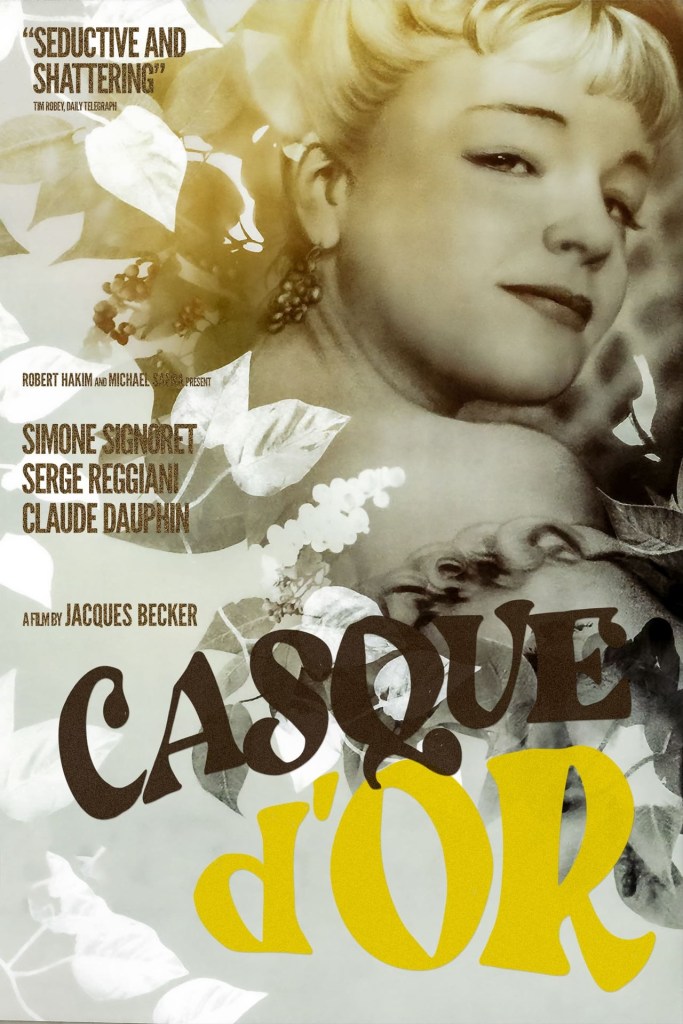
Was going to stop at 5 films, but I enjoyed Le Trou so much that I grabbed another from director Jacques Becker. Casque d’Or is supposed to be one of his more heralded films, but I couldn’t get into this one. The film opens on a river as a group of men, with their girlfriends in tow, are boating down and pulling up on the banks of a quaint outdoor restaurant and dance floor. Any idea that this is a routine outing are dashed when we learn that the men have just robbed a bank, and they are now celebrating. One man in the gang is Roland, a brute who likes to slap around his girlfriend Marie, the prettiest woman of the bunch. Their trip to the restaurant is ill-fated though, as Marie falls head over heels with newcomer Manda. Manda is friends with another man in the gang’s troupe, having done time with him years past, but Manda has since turned his life around and is working as a carpenter, with a fiancee at home. Marie, though, is used to getting her way, and she latches on to Manda. When Roland tries to intervene, Manda slaps him around and leaves. This will eventually lead to a knife fight between Manda and Roland, with Manda coming out on top again. You’d think that’d be the end of it, but the head of the gang, Leca, also has eyes for the beautiful Marie, and is willing to set Manda up to get his way. There’s so many twists going on that my head spun, and some weird plot elements end up going nowhere (what ever happened to Manda’s fiancee?!). And as they would have said back in the 50s when this movie was made, all this over a dame? ★★
- TV series recently watched: Disclaimer (series), Star Trek Next Generation (season 4), The Devil’s Hour (season 1)
- Book currently reading: The Battle of Corrin by Herbert & Anderson

 Jons Movie Takes