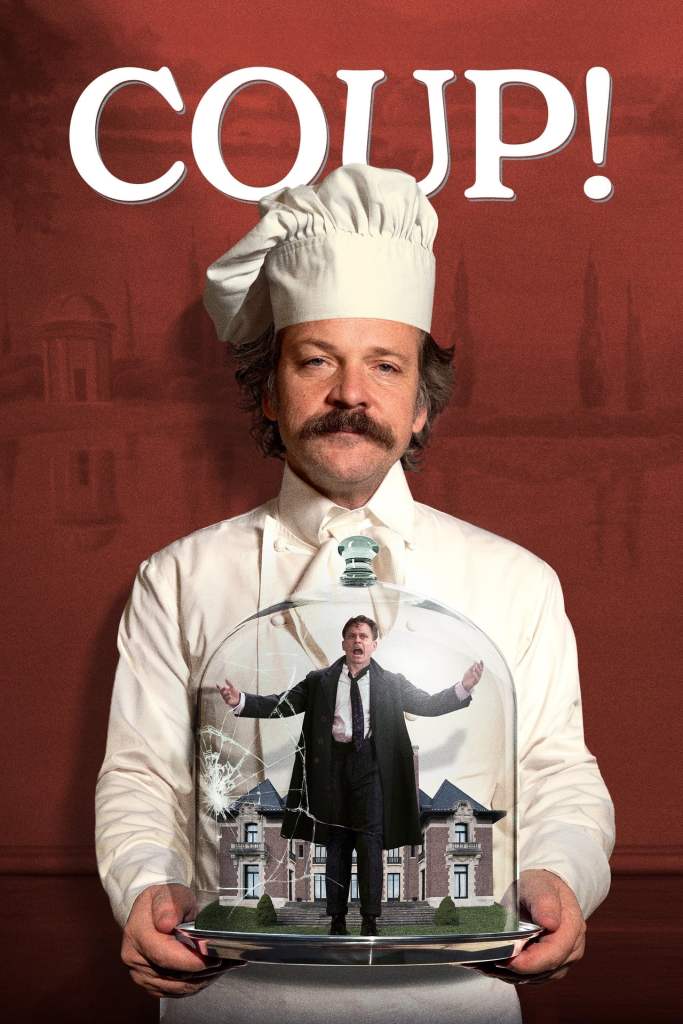
Coup! is a sort-of-fun film about class warfare, taking place on a remote island mansion in 1918. With the Spanish Flu running rampant, the owner of the mansion, JC Horton, has to buckle down with his wife and servants, as no one can come to or leave the island; all boat traffic is halted. Unfortunately for JC, his new cook, Floyd (Peter Sarsgaard) has an agenda. The film opened with Floyd taking on the persona of the cook who was supposed to come to the island; we see the cook dead on the boat, victim of a gunshot, and Floyd doing his best to look like the dead man. Now in JC’s employ, Floyd immediately starts flexing his muscles, getting the staff to negotiate for better pay and living conditions, while making JC look weaker in his family’s view. JC, a celebrated journalist, has always written about being progressive and fighting for the common man (his personal hero is Upton Sinclair), but it is easy to see that he loves his large home and the status that comes from his wealth and privilege. It isn’t hard for Floyd to poke holes in JC’s paper-thin veneer as an every-man. There’s some funny moments and a couple light thrills by the end, when Floyd has really turned the screws on JC, but the whole thing seems to abandon its main purpose before the conclusion comes, leaving me to wonder if it was really just a light comedy that tricked us (viewers) into thinking it was more. ★★½
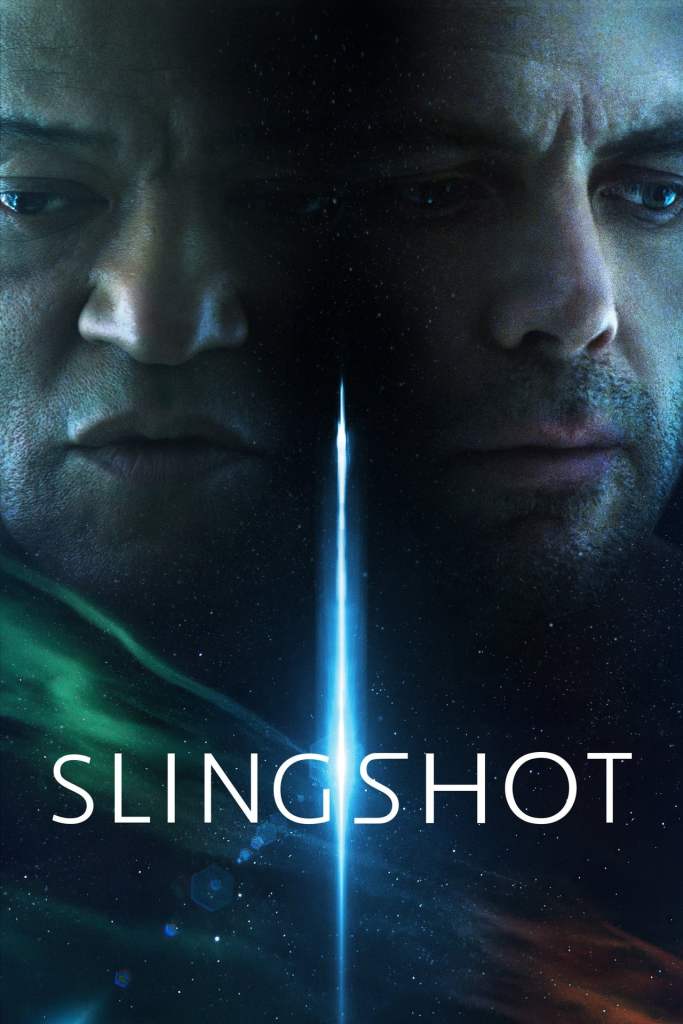
I saw Slingshot despite the poor reviews, because, A) it’s a space movie and I’m a sucker for those, and B) it has Casey Affleck in the lead and he’s (usually) pretty good. Not this time, unfortunately. He plays John, one of 3 astronauts on a deep space mission to Saturn’s moon Titan, to collect natural resources to help Earth deal with its climate change problem. To make the long trip shorter, the team first heads to Jupiter, where the spacecraft will use the large planet’s gravity to slingshot around towards Saturn, building speed along the way. To pass time, each member goes into hibernation for 3 months at a time on the years-long trip. However, as the computer reminds them each time they wake up, the meds used to induce deep sleep have side effects, such as confusion, hallucinations, and paranoia. As the trip goes along, John has a harder and harder time each time he wakes up. He starts hearing voices, and seeing visions of the girl he left back on Earth. He isn’t the only one, as another astronaut, Nash (Tomer Capone) starts talking about how the ship wasn’t built well and they need to turn around before they all die, while mission lead Franks (Laurence Fishburne) begins threatening John and Nash with violence if they don’t stick to the mission. What should be a head-trippy space drama is bogged down by absolutely terrible acting, which is somewhat expected from Fishburne and Capone, but bad from Affleck too, who just gives the same tired, dull, depressed performance that he so often does in his movies, and this time it seems like he doesn’t want to be there. Neither did I, by the end. ★½
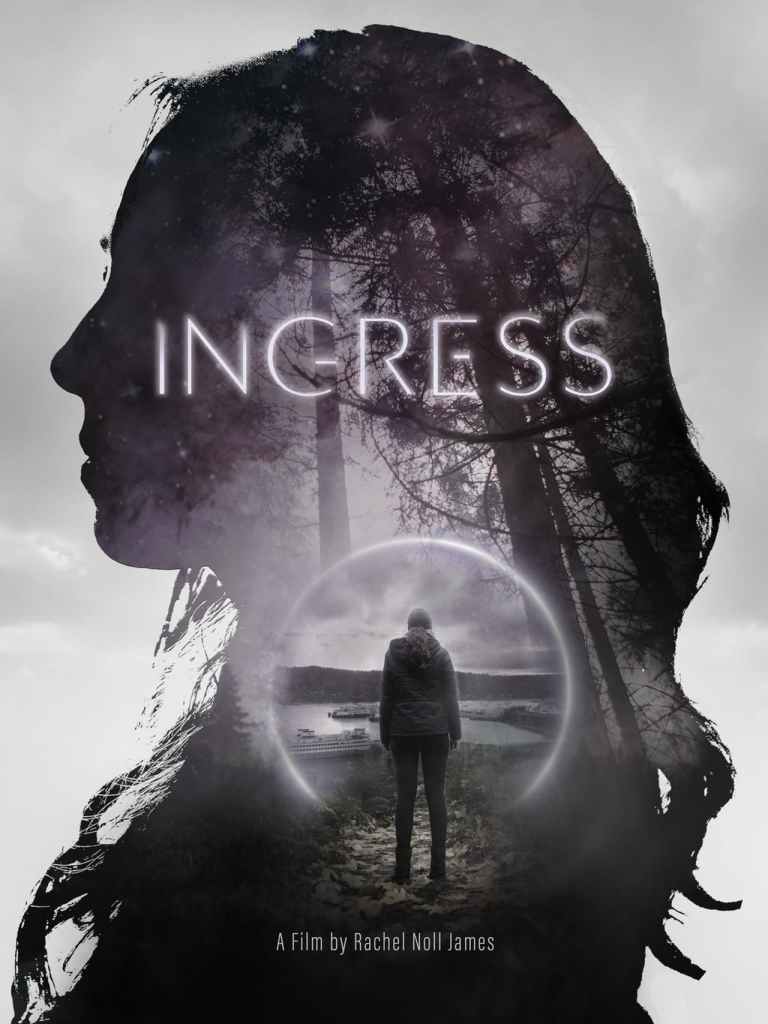
Ingress is one of those low budget indie films that starts with a great idea and is able to do just enough with it to warrant looking past some of its obvious shortcomings. Written and directed by Rachel Noll James, who also stars as lead character Riley, it is about a woman who seems to be phasing in and out of her reality, especially when she becomes upset over thoughts of her recently deceased husband, Toby. Riley is intrigued when she learns of a motivational speaker/author named Daniel who talks about communicating with other beings who can converse through time and space. Riley approaches him at a book signing and states her case: since childhood, she has been cursed with the ability to slip through the various multiverses. Whenever it happens, and she has been unable to control it thus far, it will take her a few minutes to get her bearing, but then “new” memories would replace the old ones, so that she used to be unaware of the changes that were made. However, after teenage hood, she kept her original memories as well as her new ones, so that now, as an adult, she remembers various conflicts such as her parents still being alive (they are dead in her current existence) and her husband still being alive too. These conflicting memories have made her life very hard, to the point that a therapist has helped her stay grounded in this, her current, reality, and she hasn’t phased to a new multiverse in awhile. Riley is hoping Daniel can use his abilities to talk to these beings and find a way for her to permanently return to an existence where Toby is still alive. Daniel too has struggled his whole life; when you are a child talking about hearing voices, obviously society wants to send you to get help and load you up on medications. Together, the two start to work through their baggage, even as Daniel starts having visions himself of a life spent with Riley, where they are married and have children. It’s a great basis of story, but the execution isn’t always there. Director/actor Rachel James is quite good in the lead as Riley, perhaps because it is her characters and story to tell, but everyone else seems to be lifted from the local theater shop, and none are very good. The film was obviously shot on a low budget so the camera work suffers, but there’s just enough there to be entertaining throughout. ★★★

Amerikatsi (“American” in Armenian) is another indie film where the writer and director is the lead, and this one was a surprisingly refreshing picture. After a brief intro in which a young boy is smuggled out of Armenia in 1911 during the Armenian genocide by the Ottoman Empire, we fast forward to 1948. The USSR has been luring former Armenian citizens back to the country in a repopulation effort, and Charlie, now a grown man raised in America, took the bait. He isn’t there a day before he is arrested by the Communist controlled regime for making the sign of the cross (religious propaganda) and wearing an expensive tie (capitalism and worshipping western ideology), and sentenced to 10 years hard labor. Before being shipped to Siberia though, a stone wall at his Armenian prison falls during an earthquake, and the prisoners are tasked with rebuilding it, which ends up taking through the winter. To pass the time in the evenings, Charlie looks out the window of his cell, allowing him to see into the house across the street (with the missing wall no longer obstructing his view) and he sees a man and woman living together. Turns out the man, a guard in the prison, is only working for the Communists as a way to get by, but he too seems to be (secretly, of course) religious, and is a former painter before his art landed him in hot water with the Communists. Charlie lives vicariously through watching the guard across the way, crying with him when his wife leaves him, and rejoicing when she later returns. The movie starts out as a quasi-comedy; even though Charlie goes through some bad stuff, much of it happens because he doesn’t speak a lick of the language and only knows English. However, it is definitely a heartfelt drama by the end, by when Charlie has endeared himself to the guards and fellow prisoners. A wonderful film if you don’t mind the frequent subtitles from Armenian and Russian languages throughout. ★★★★
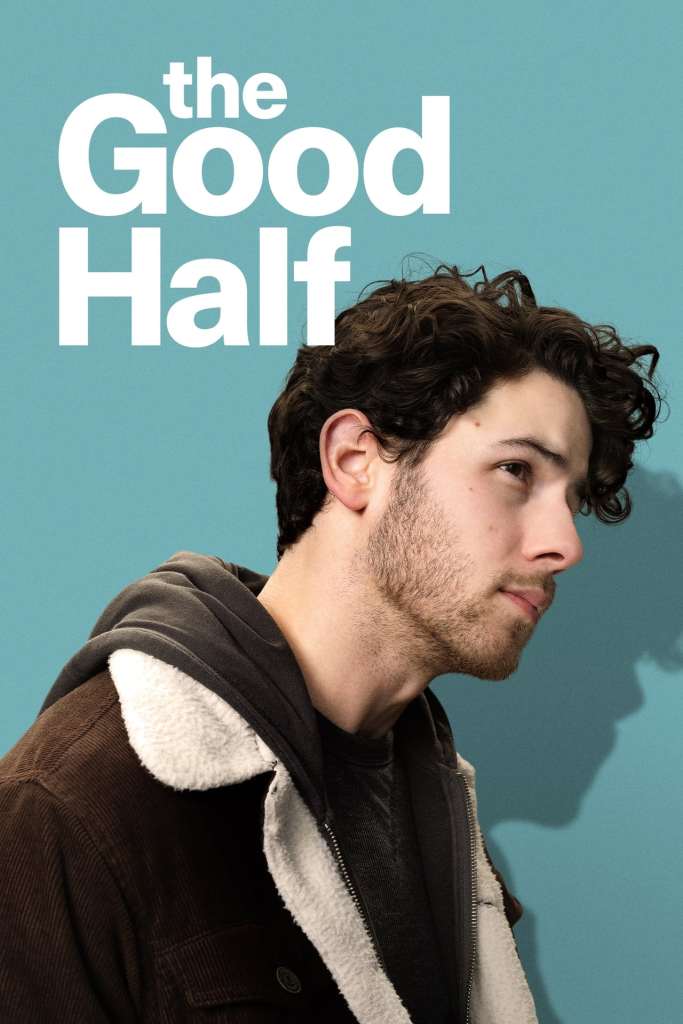
The Good Half stars Nick Jonas as Renn, a middling 20-something who, like a whole lot of people in his generation, is a bit aimless and goalless in life. His mother Lily (Elizabeth Shue) has recently died after a long battle with cancer, and Renn has put off returning home, so he was not there when she died. He can’t stay away now though, as funeral plans move forward. Renn’s sister Leigh (Brittany Snow) is doing most of the work, with a little help from their father Matt (Matt Walsh) as well as some unwanted help from their stepfather (Lily’s second husband) Rick (David Arquette). As Renn gets acclimated to Cleveland, he wonders why his free-spirited mom never left this town as he did. At the same time, he has flashbacks to his younger life and interactions with his mom, who maybe wasn’t the great mother that he wants to remember her as, and we get an explanation as to why he stayed away at the end of her life. As a Gen-X’er, I wanted to yell at Renn to stop moping around and do something with his life and face his guilt, but I’m sure the film will speak more to those viewers younger than myself. Still, not a bad film, even if it comes off as a not-as-good Garden State (which definitely is my generation). ★★★½
- TV series recently watched: Cheers (seasons 1-2), The Penguin (series)
- Book currently reading: Breaking the Dark by Lisa Jewell

 Jons Movie Takes