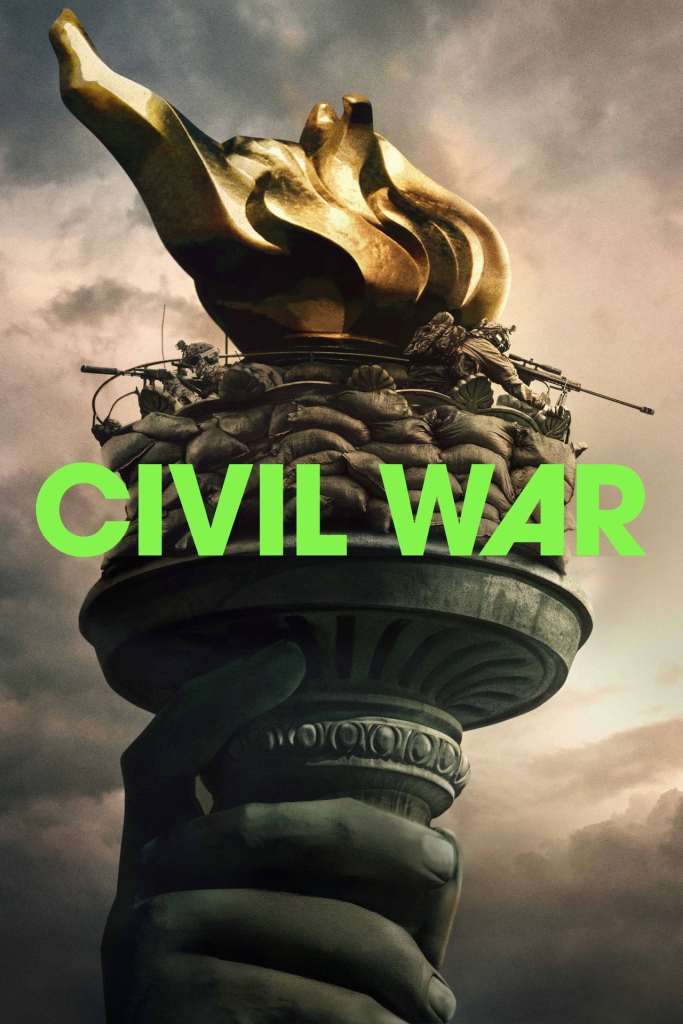
One thing writer/director Alex Garland does is think outside the box. From his breakout a decade ago in Ex Machina to Annihilation to Men, his films are unique. He continues with Civil War, built on an idea that is certainly not new in today’s politically polarizing landscape, but seeing it play out in front of you is jarring. When the film starts, the second American civil war has already been playing out. The unnamed President of the United States (Nick Offerman) has been unpopular for awhile, now on his third term, implying a dictatorship of some kind allowing him to do so. It’s not just the south and the north this time, as several secessions have happened, with a Florida Alliance in the south, the Western Forces (Texas and California), and the New People’s Army in the northwest. The Western Forces are the most powerful and their armies are in spitting distance of Washington DC. Everyone knows Washington will fall soon, but before it does, reporters Lee Smith (Kirsten Dunst) and Joel (Wagner Moura) want to get there and let the President give a final interview for posterity’s sake. They set out from New York City, along with young wannabe photojournalist Jessie (Cailee Spaeny), who is a big fan of Lee, and older reporter Sammy (Stephen McKinley Henderson) in tow. On their journey, we see everything from communities trying to pretend nothing has changed to complete lawlessness on the streets. Though they are supposed to be protected from harm as the press, they will face danger at every corner, especially from bad apples in the USA’s military who know their time is up. Though it is one thing to see war films take place in other countries, or even a movie like Olympus Has Fallen where, while we do see an attack on the White House, it still feels like fiction. This movie feels real, and provides a dark glimpse at a possibility which, hopefully, despite the rhetoric from the fringes, no one would really want to see. The images of our capital under attack stuck with me, and when one of the reporters asks the military unit they are trailing, “What is the plan when you get to the president?” and the answer is, “No capture. Just kill,” it sent a chill up my spine. To top it off, Oscar-worthy acting from everyone, including Dunst as a legend in her field who, after a lifetime covering wars, has become numb to its travesties, or Spaeny, who will become her hero by the end. ★★★★★
*I wrote this on Saturday morning, before the assassination attempt on former President Trump. No matter your politics, violence is not the answer, and to do it in a crowd with families around is even worse. Whether you believe the right is a bunch of a fascists or the left is too woke, vote with a pen and not a weapon. And to those condemning the attack while also posting memes on social media (on both sides), know that your posts only stir people up, making you more of the problem than the solution.
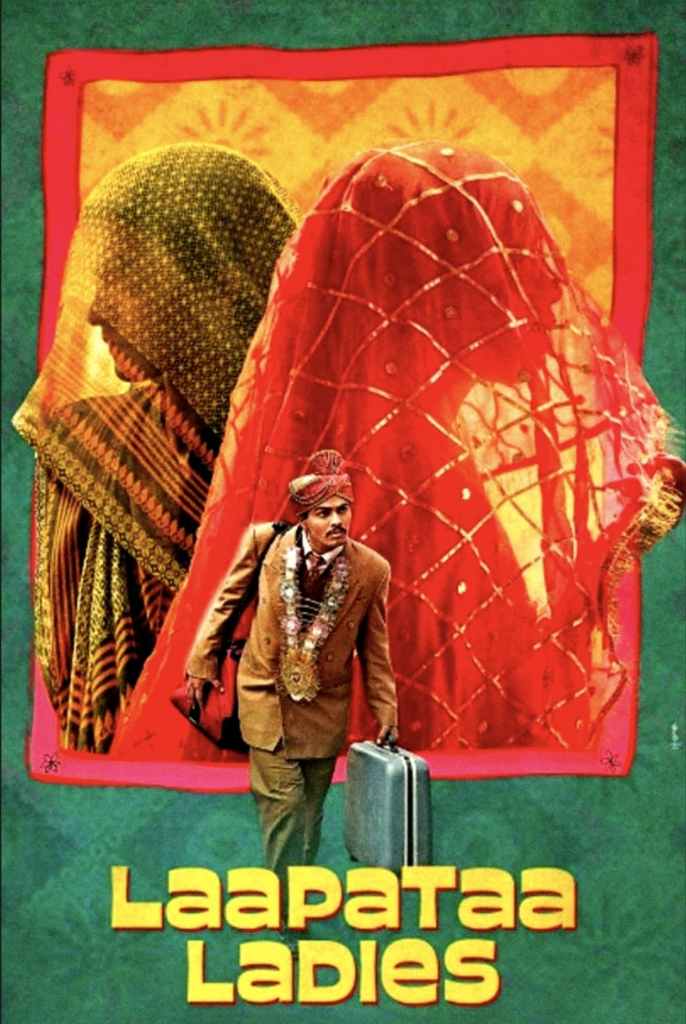
Laapataa Ladies (English: Lost Ladies) is a charming comedy/drama out of India. Just after their wedding, Deepak and Phool are traveling from her village to his. In keeping with local tradition, Phool is veiled and can’t see a thing, relying on her new husband to guide her around the hustle and bustle of boats, buses, and trains. During the long trip, the couple fall asleep sitting up on the train, and Deepak wakes just as the train is getting ready to depart where they are supposed to get off. He grabs his veiled wife’s hand to wake her, they successfully disembark, and hop on a bike to travel the couple miles to his family’s house. Unfortunately, when they arrive, they discover Deepak has grabbed the wrong bride. This bride, Pushpa, was confused at first, but later kept her mouth shut, as we learn that she was forced into marriage with a greedy man who just wanted her dowry. She does not want to return to him. Meanwhile, back on the train, Phool wakes up to find herself at the wrong train stop. She’s from a sheltered village and was raised to be a proper wife (can handle the kitchen and keep a house, but knows nothing of the outside world) so she has no way to communicate where she came from or where she’s supposed to be. Deepak sets out to find his missing wife, with Pushpa trying to evade the authorities (who’d ultimately want to return her to her husband) while Phool finds new friends in a new city, willing to help her in whatever way they can. Lots of laughs, lots of emotion, and beautiful cinematography in the bright and colorful Indian countryside. ★★★★
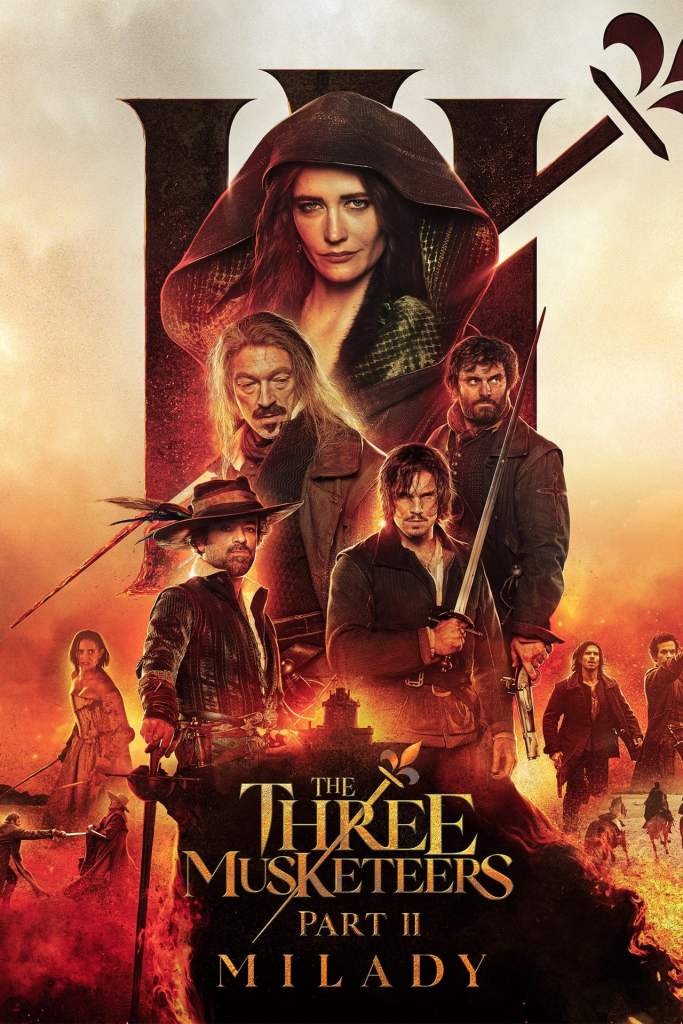
The Three Musketeers: Milady is the sequel (or, actually, feels like the second half of a one long film) to D’Artagnan, a film I very much enjoyed. This film picks up right at the end of part 1. Constance was just kidnapped, and D’Artagnan wakes to find himself captured and ready to be killed to keep his silence. He is able to escape, and while wandering around the castle, finds Milady, who was also being held there. D’Artagnan reluctantly frees her and the two are able to escape the castle together, ultimately making their way back to the French army. Meanwhile, King Louis XIII, having survived the attempt on his life in the last film, has decided to send his army to attack La Rochelle, a fortified castle held by the Protestants. The Musketeers are tasked to sneak in under cover of darkness in preparation of a full attack, but they are ambushed and most of the party is killed. Obviously someone in the government is playing both sides, but while that plays out, D’Artagnan leaves to continue his search for Constance, which takes him all over northern France and up into England. The film is packing in action with swordfights and battles both hand-to-hand and in large scale, and while it is exciting from start to finish, it doesn’t always clearly state what all is happening politically. There’s some double-crossing going on, some political machinations that, frankly, surprised me, because I didn’t always catch what was happening. Just as exciting as the first film, but I feel like they could have made this movie just a bit longer (maybe 2 1/2 hours instead of just 2) and fleshed out some of those plot points, in order to make more sense of it all. Still, very enjoyable, and one of the “biggest” films to come out of France in a long time. ★★★★
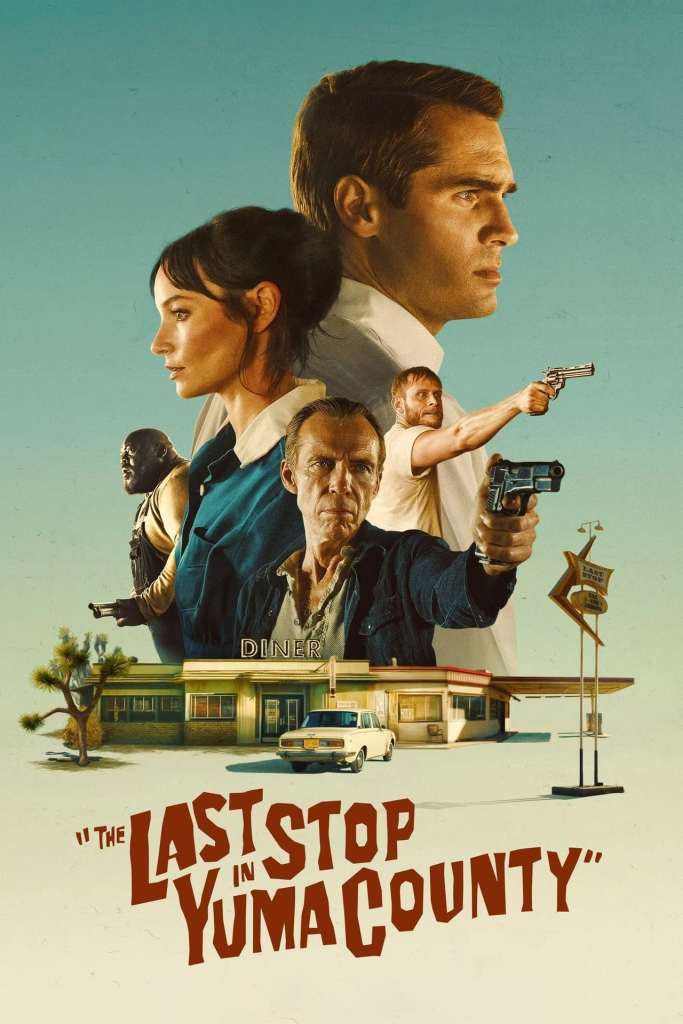
You ever wonder if the critics are just watching a different movie than everyone else? The Last Stop in Yuma County seems universally loved, but man is it a bad movie. Vernon, a mild mannered traveling salesman, pulls up to a remote gas station in rural Arizona in the 1970s, but the station is out of gas and awaiting a tanker delivery. He goes next door to the diner and sits down to wait for the gas and strikes up a conversation with the only worker, waitress Charlotte. As they are talking, two more men come in, also waiting for gas. These two, Travis and Beau, have just robbed a bank and have $700k in their trunk, so they are hot-to-trot to hit the road. The robbers confront Vernon and Charlotte and tell them to just play it cool and they’ll be ok. Their plan is steal the first car that stops that has gas, and make their way out. Other guests do come in, but they are all in the same situation, needing gas, so the bad guys continue to wait as the afternoon drags on. It does lead to a big climax, but unfortunately that comes with about 30 minutes left in the movie, and then it takes a weird left turn before we get to the actual end of the film. The only thing it really has going for it is style: it looks slick and cool and the camerawork is quite good for such an (obviously) low budget film, but the acting is subpar, the story is anything but unique, and you will be waiting for the end long before it actually comes. ★½
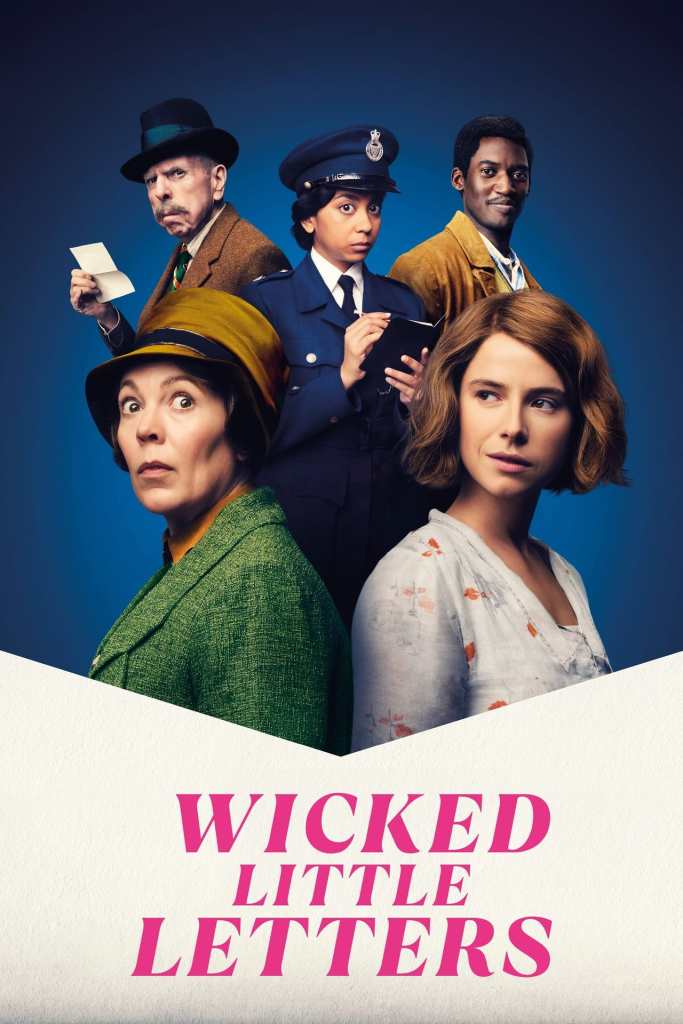
Wicked Little Letters is a cute little movie, supposedly based on a true story, about a scandal that rocked a community in England in the early 20th century. Edith Swan (Olivia Colman) is a cultured and religious woman who never married, living with her elderly parents in Littlehampton. Their neighbor is Rose Gooding (the always entertaining Jessie Buckley), an Irish woman and single mother who lost her husband in The Great War. The polar opposite of the refined Edith, Rose cusses like a sailor and drinks and smokes at the local bar, so when Edith starts getting vile poison pen letters in the mail, sent anonymously, Rose becomes the first suspect, despite Edith and Rose seeming to be on good terms. Eventually their friendship sours, so Edith implicates Rose to the police, and Rose is arrested. As it turns out, a couple women in the area actually believe Rose didn’t do it, one of whom is lady constable Gladys Moss, but she being a woman in 1920, the male officers don’t believe her. Before too long, we learn who the real sender is: none other than Edith herself, venting out pent up frustrations with her spinster life. Since she can’t out herself, she continues to accuse Rose, leading to a trial, so Gladys must find proof that Edith is the culprit before Rose is sent to jail and loses her daughter. Some mild laughs, mostly just because of hearing filthy language in English and Irish accents that scandalizes everyone around, but otherwise nothing too groundbreaking, but it is an overall fun movie, worthy of an afternoon watch. ★★½
- TV series recently watched: The Chosen (season 4), Star Wars: The Acolyte (season 1)
- Book currently reading: Star Wars Aftermath by Chuck Wendig

 Jons Movie Takes
You are right about the comment after the first movie, Civil War … And I was going to make a quirky comment about me having to see it for more fodder for my tin-hat philosophies … But then your insert after Trump’s shooting, I have begun really thinking about what I post. Most political posts I do, are in “retaliation” for posts from friends with opposite views… Kinda like me getting back at them. I am going to start re-evaluating what I post politically, and unfollow those friends who get under my skin with their posts. I won’t delete them from my friends, as I am truly interested in them (other than their politics!). 🤣
LikeLike
Try not to unfriend. The problem with cutting off conversation from those that believe differently is we end up only talking to/reading about things we already believe in, which just “fuels the fire” and gives you a sense that you are supremely correct in your views (because you aren’t reading anything different) and thus “everyone else is wrong.” It is what is stoking the hard rights and the hard lefts, people who refuse to compromise.
LikeLike