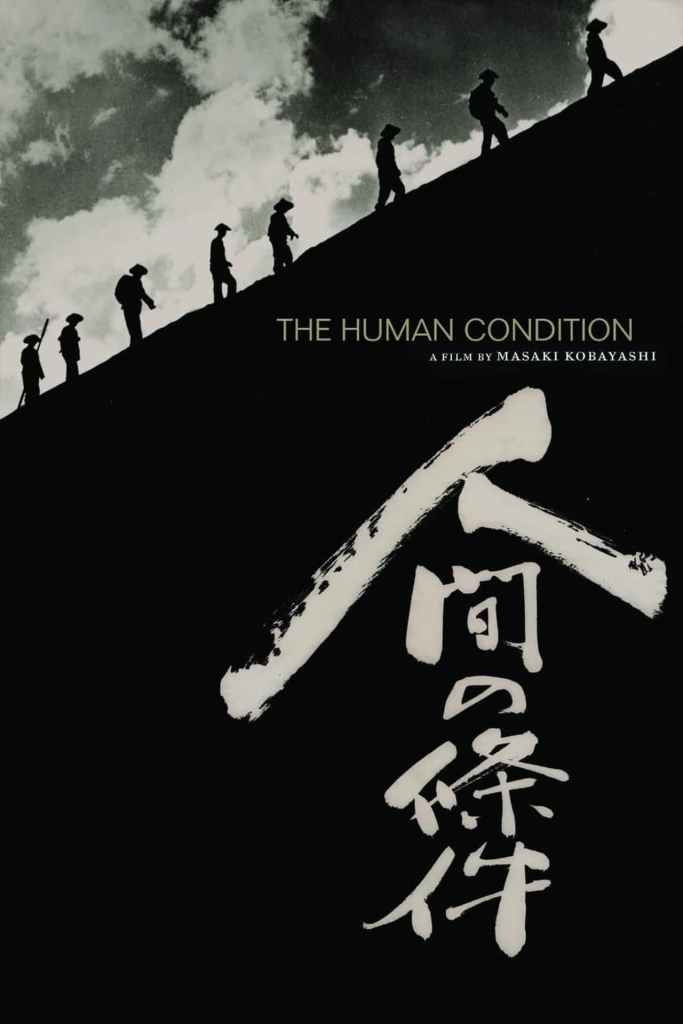
I had originally intended to do a whole series of Japanese films (been awhile since I last did), but the first film on my list was Masaki Kobayashi’s The Human Condition. When I saw it clocked in at nearly 10 hours, I decided to split this one up! Originally released in 3 parts over 3 years between 1959-61, it is based on a 6 part epic novel. Because it is a 3 part, there will be spoilers obviously in the first two synopses.
The first part, subtitled No Greater Love, begins during World War II and introduces us to main character Kaji. An idealist and socialist, he is at odds with the powers-at-be during Imperial Japan. He’s in love with Michiko, but refuses to marry her and make her a widow if he gets drafted to fight in the war. He finds a way out though when he hears of a job at a in Manchuria, China, where Japan has annexed the area and is using it as POW forced labor camp. Helping the government in this way, he won’t be drafted (thus, marrying Michiko), and he hopes to make the lives better for the Chinese prisoners. Kaji quickly finds out that his ideals are at odds with how the camp is run. The overseers at the mines are brutal with the Chinese detainees, whipping them and withholding food as punishment, however, Kaji does have the backing of the camp administrator, who is open to any ideas to increase productivity. Kaji is able to win over a handful of Japanese coworkers at the camp, but most stay vehemently opposed, and the prisoners don’t help. They see Kaji as nothing more as the latest puppet of Japan’s government, a government which hates the Chinese people. To make matters worse, a few Chinese men are able to escape, and when Kaji leans of how they are doing it, he doesn’t tell his supervisors. This will come back to haunt him, when an overseer who has been skimming off the top targets Kaji to get him out of the way. When a group of prisoners are wrongfully accused of an escape attempt and the military comes down hard with a verdict of execution by beheading, Kaji attempts to stick up for the Chinese and sets himself right in the military’s crosshairs. They revoke his special status, and the first part ends as Kaji is drafted and being sent to war.
Part 2 (Road to Eternity) picks up there. Kaji is at basic training and is excelling at soldier duties, earning high marks for marksmanship and duty work, but the rumors that he is “a red” are keeping him from advancing. He also has a propensity for helping those who need it, aiding one recruit in particular, Obara, who is always targeted by superiors for his physical weakness and poor “soldier skills.” When the hazing gets too rough, Obara takes his own life. The brass are going to look the other way, blaming Obara for his own deficiencies, so Kaji takes it upon himself to right those wrongs. He keeps needling the officer who led the poor treatment of Obara, even after the two of them are transferred to the front. There, Kaji fights to be given his own platoon to train, with respect rather than brute force, and his men love him for it. But when the war finally comes to their doorstep, with Russian tanks and soldiers indiscriminately killing, Kaji will have to see if his ideals hold up to the brutality of war. I found this section wasn’t as great as the first, with some slow sections that honestly felt repetitive and even a bit like filler, but am hoping for a rebound in the upcoming final film.
The last film, A Soldier’s Prayer, starts immediately where the previous ends. Kaji and two other soldiers are in a land overrun by Russian soldiers, their unit having just been slaughtered in the previous battle. Kaji is facing an existential crisis, trying to reconcile his beliefs in the good of humanity while now considering himself a murderer. Kaji is filled with self loathing, to the point that he stops caring for anything or anyone. He and his fellow soldiers set out across the countryside, picking up a group of ragtag displaced citizens and other lost soldiers along the way, in search of food and shelter. The journey is hard, and people fall dead along the way from starvation, exhaustion, or suicide when they’ve lost hope, and that is before the group starts facing off with Chinese farmers who’ve been armed by the Soviets. When they get in a skirmish and the Chinese kill a woman who was traveling with Kaji’s group, he decides to stop running and start fighting. The very Chinese people that Kaji defended in the first film become his target. On his journey south, Kaji will see all of the ravages of war: Chinese villages plundered by Japanese, Japanese settlements living in fear as the countryside has turned against them, and women and wives who have turned to prostitution to survive. There’s also the growing fear of civil war in the area, with Russian-backed Communists forming up against the current government, backed by the Americans. Though the nation of Japan has long since surrendered, the war for Kaji is far from over. Eventually they are captured and put to work in a Soviet work camp. Until now, Kaji has praised the Soviets, even when they were enemies, for their socialist platform as being good for the common man, but he finds that working in their camps is no different than how the Chinese were treated in Japanese camps in the beginning of the film. Through all of this, Kaji’s thoughts often turn to his wife Michiko, wondering if he will see her again, and if he does, if he is still worthy of her for the things he has done. As a harsh winter sets in, you start to realize that Kaji is never making it home. All in all, a very moving film, though definitely feels long and paced at times. It’s a bleak look at humanity at its worst, and makes you consider a lot of things. ★★★★
- TV series recently watched: Masters of the Air (series)
- Book currently reading: North and South by Elizabeth Gaskell

 Jons Movie Takes
One thought on “A bleak look at mankind in The Human Condition”