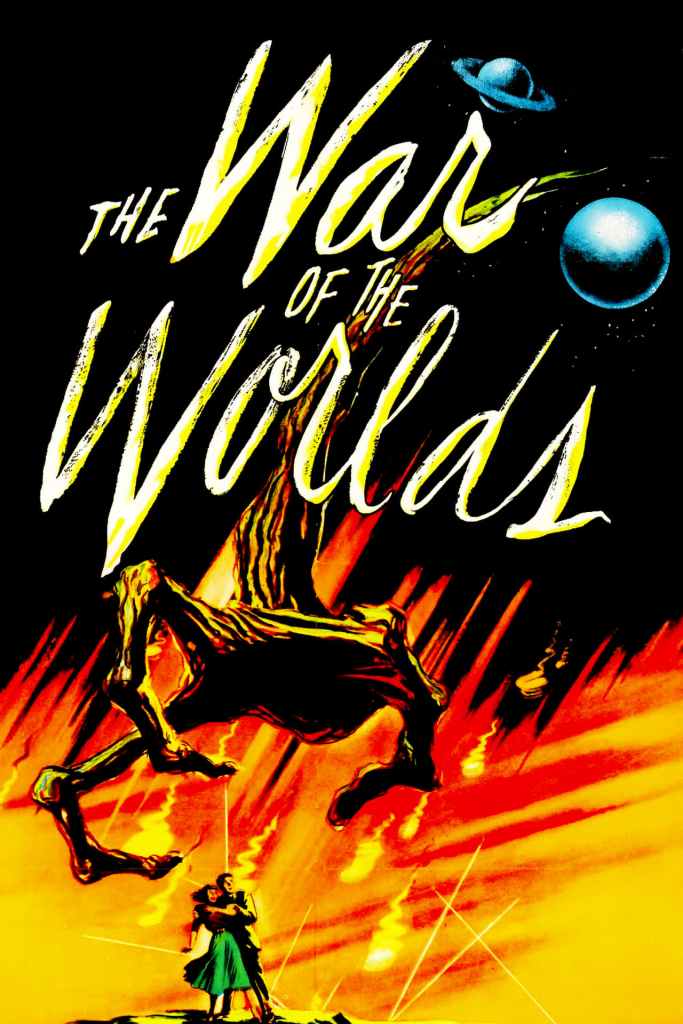
Up today is a set of classic 1950’s American films, starting with 1953’s The War of the Worlds. I think most people know the story, so I won’t rehash it, but will say that it differs from the book quite a bit, especially in the end. The author of the book, HG Wells, didn’t think much of religion for much of his life, and it tells in the book, but this film, releasing when it did, obviously has a much different view. In fact, though the aliens still die from Earth’s bacteria and their lack of immunity to it, they conspicuously do so right after attacking a church. For 1953, I think the film looks great (it won the Oscar for Best Visual Effects) and is still engaging today for fans of classic films. For me personally, this is my first time watching this movie since I was a kid. There was a TV series in the late 80s that came at a time when I, as a child, loved all things space, and the series was developed as a sequel to this film, so I had watched it then. Obviously I didn’t remember all the nuance of the movie, but so many of its visuals were still tucked away in my brain. ★★★★
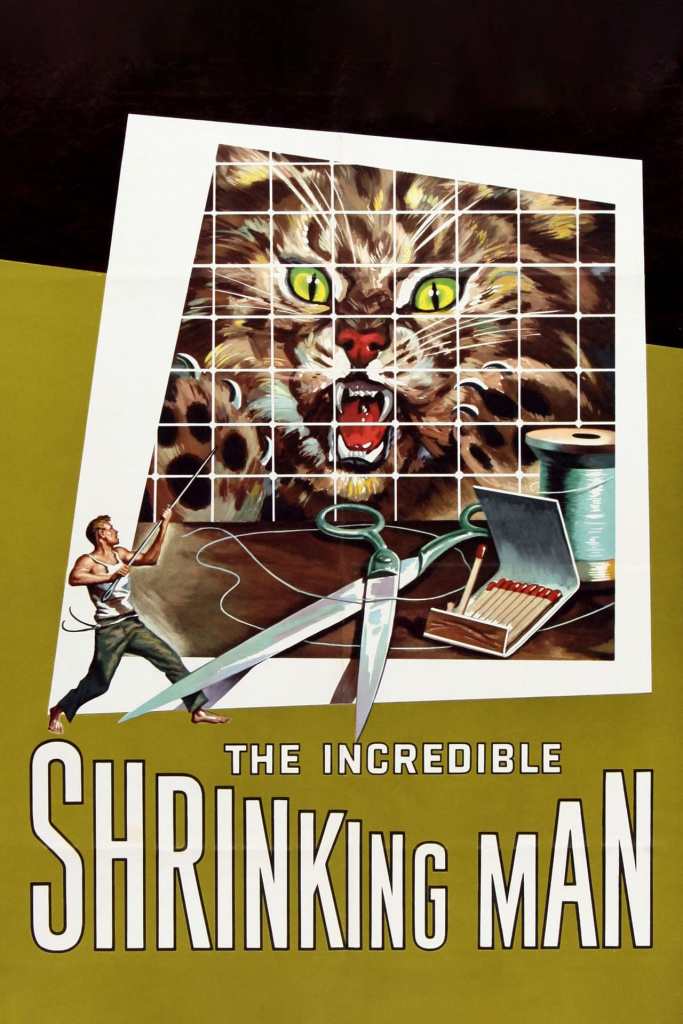
The Incredible Shrinking Man, released in 1957, comes from director Jack Arnold, known for many sci-fi films of the 50s like Creature from the Black Lagoon and It Came from Outer Space, though I’ve never seen any of them myself. If they are as good as this one, I’ll need to look them up. The movie follows Scott, a tall good looking man who runs afoul of some radiation one day, which causes him to start shrinking in size. He first notices when his wife no longer has to step on her toes to kiss him. The doctors run a gamut of tests until they discover the reason for his shrinking, and then spend awhile trying to find a cure. When the cure finally comes, he’s down to 3 feet tall. The cure does halt his shrinking, and after Scott meets a little person traveling with a circus, he realizes he can still lead a good life, until, that is, he starts shrinking again. And this time, he gets down to doll size, with no end in sight. At that size, he becomes prey for animals, and as he gets smaller still, for insects, and dangers lurk everywhere. Through it all, Scott narrates to us his thoughts and emotions during his ordeal. He struggles with his sense of self and place in the universe. A very fun film for people who like sci-fi films that offer more than just visual pleasures, but also make you think. ★★★★½
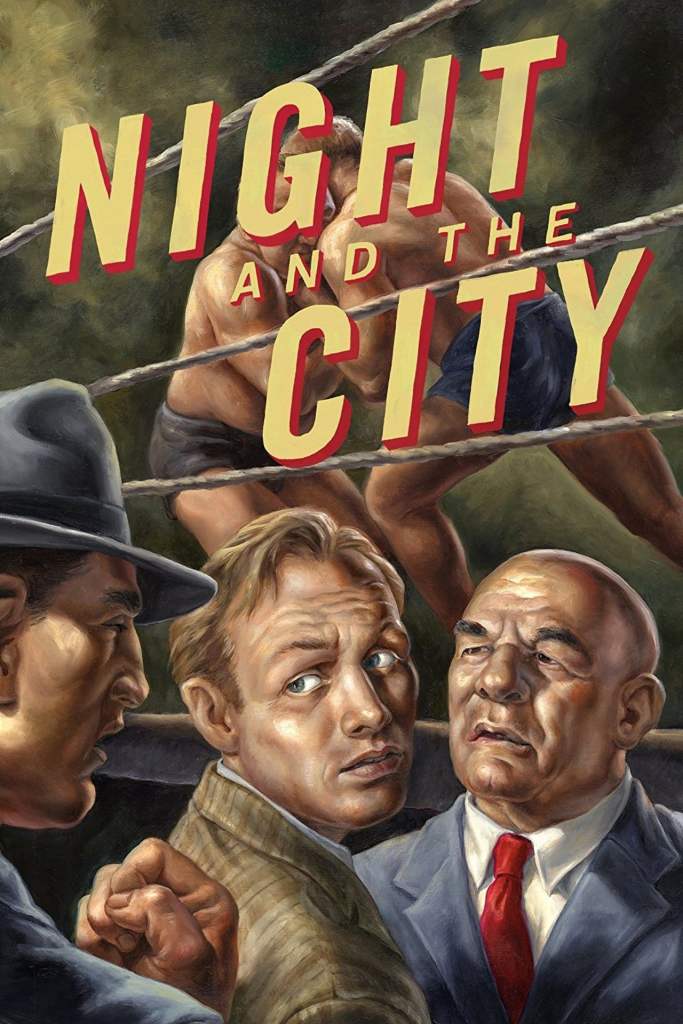
Can’t have a set of 50s films and not throw in a film noir, so my pick was Night and the City by the great director Jules Dassin*. The film follows a conman named Harry Fabian over the course of one long night in London. Harry is always working on a get-rich-quick scheme, none of which ever turn out, and everyone knows it except for him. He’s got quite the reputation in the underbelly of the city but his good nature keeps him plenty of friends. Harry’s latest plan involves getting in on the wrestling circuit, by backing a veteran Greek wrestler named Gregorious and Gregorious’s protege. But as is always the case in Harry’s life, his best laid plans go awry, and he spends most of the movie chasing the ever-elusive final piece of the puzzle that will make everything right for him. Harry’s not the only character in the movie though: we’ve got a corrupt night club owner named Phil, Phil’s scheming wife Helen, Gregorious’s son and crime lord Kristo, and a half dozen other minor characters in the bowels of the city, including forgers, thugs, thieves, hit men, and smugglers. If you are looking for a good guy in this film, you’ll be looking for a long time, and part of that is what makes this film so great. It’s hard to make a good picture where there isn’t anyone to really root for, but Dassin pulls it off with an intriguing and completely engrossing film about the city’s seediest. Fantastic cinematography too, with so much texture that you forget the film is in black and white! ★★★★½
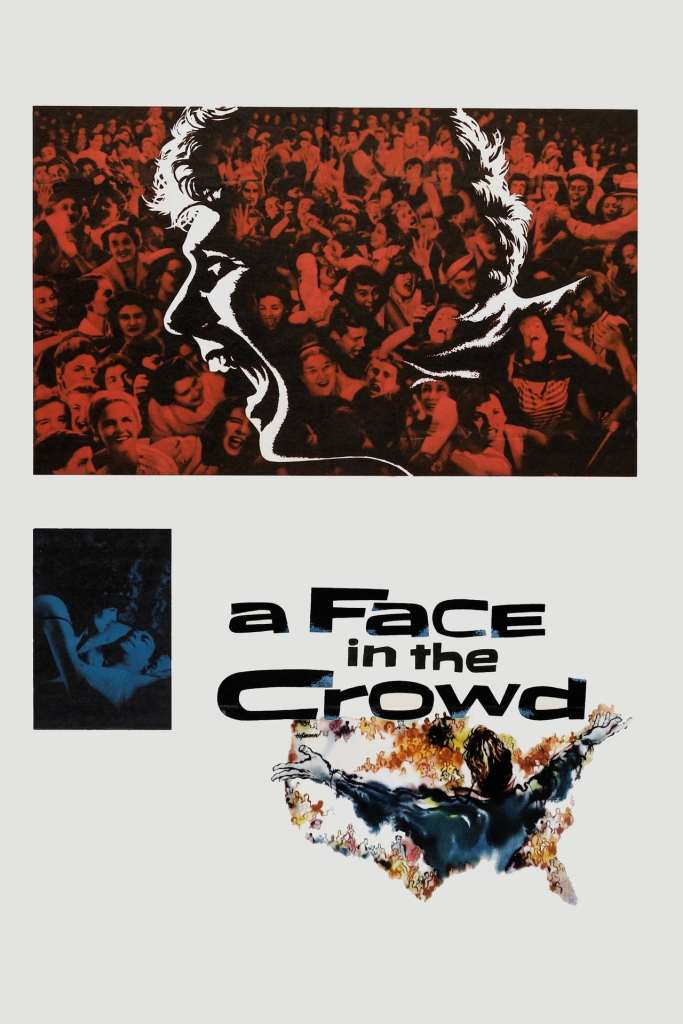
A Face in the Crowd, from 1957 and directed by one of the best directors of all time in Elia Kazan*, stars a young Andy Griffith in his first film (3 years before the start of his eponymous TV show), in an almost unrecognizable role as compared to the aw-shucks good guys that he’d become famous for later. In fact, his brilliant over-the-top performance is so arresting that I’m reminded of another Kazan film which made a star of its breakout actor: Marlon Brando in A Streetcar Named Desire. Here, Griffith plays Larry “Lonesome” Rhodes, a musician who, in the beginning of the film, is sobering up in a jail cell in Arkansas. There, he is found by radio journalist Marcia Jeffries (Patricia Neal) and interviewed for her local show. Rhodes, a fast talker with a likable personality and a devil-may-care attitude, is an instant hit, and his star shoots for the heavens on a meteoric rise. Building a rabid fan base by presenting as an everyman, his fame grows as he moves to Memphis and, finally, New York, with his own TV show. Marcia sticks by his side throughout, falling in love with him as all the women do, but he only finds time for her when he needs something or has a misstep in his career. Over time, Rhodes morphs into a megalomaniac, womanizer, and swindler, and he has the power to get whatever he wants, yet his fans are none the wiser. Marcia, though, sees him for what he has become, and makes moves to unmask him. In the end, Rhodes is brought down when Marcia keeps his mic on at the end of his TV program, and the audience at home hears his off-color remarks about what he really thinks of people. They turn on him instantly, and he is dropped by his advertisers, his network, his political friends, and everyone else, with a final, almost prescient monologue given by a young Walter Matthau (just his fourth film). These days, our leaders somehow survive these hot mic moments; maybe Americans have just gotten dumber with time, so that we don’t even care anymore if someone is deserving of our allegiance. ★★★★★
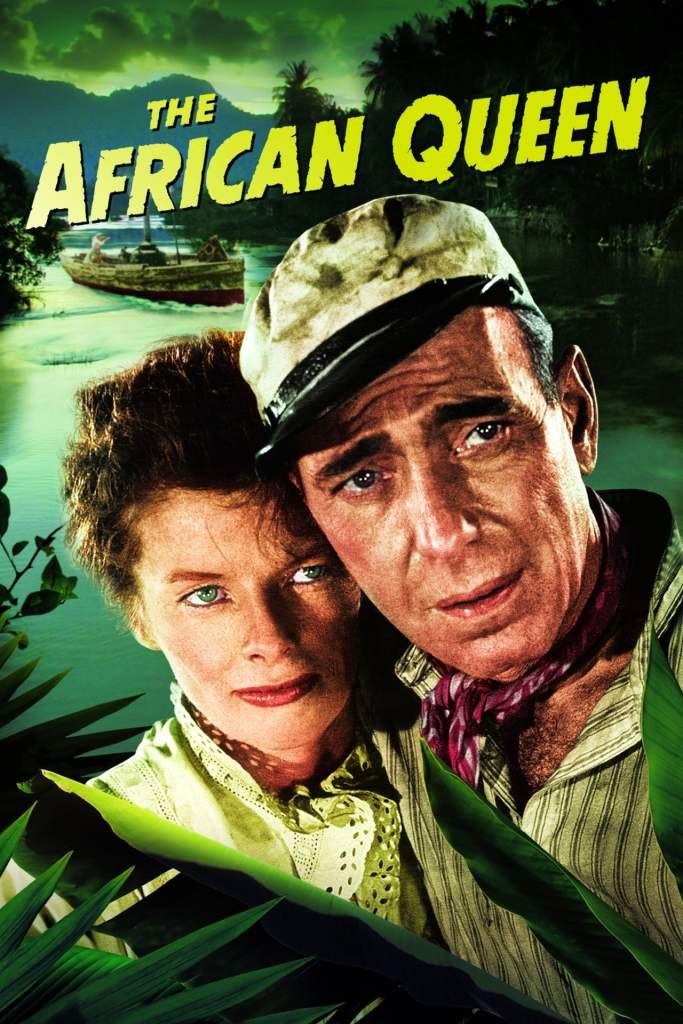
Sometimes I stumble upon a title which I can’t believe I hadn’t seen before, and such is the case with John Huston’s* (like Kazan, also one of the best) The African Queen, starring Humphrey Bogart and Katharine Hepburn. I’ve seen plenty of films from the director and both of the film’s stars, but I have to say, this one didn’t grab me as much as I expected. Don’t get me wrong, very good movie, but it did not blow me away like some of the above pictures. Taking place in east Africa in 1914, Bogart plays Charlie, the driver/captain of a small steamboat with the name of the movie. He brings mail and supplies to the little villages along the river, including the one where British missionaries are teaching English to the locals. The missionaries are preacher Samuel Sayer and his sister Rose (Hepburn). Unbeknownst to them, war has hit Europe, and on his latest visit, Charlie tells them to expect trouble, as Germany controls this area of Africa. Soon after, German troops do indeed sweep through, torching the village. Samuel initially survives but goes made and dies soon after, leaving Rose alone. Charlie finds her like that, and is moved to help her escape the area, taking the dangerous river path down towards a lake and, hopefully, freedom. They must dodge Germans, crocodiles, stinging insects, and crazy storms if they are to survive. It’s a fine adventure film, released in 1951 when many were saying its two leads were past their prime, but they are still on their game here, and the acting is supreme. The movie as a whole though, just not the perfection I was expecting. ★★★½
*Elia Kazan and Jules Dassin fell on opposite ends of the 50s McCarthy era. Dassin was blacklisted and had to make movies in Europe for awhile. Kazan “named names” to the House Committee on Un-American Activities and, while it lost him a lot of friends, he continued to make movies in Hollywood. John Huston survived the era but moved to Ireland, disgusted with the “witch hunt” in his home country.
- TV series recently watched: The Chosen (season 3), Justified (season 3), Foundation (season 1), Hijack (series)
- Book currently reading: The Day of the Tempest by Jean Rabe

 Jons Movie Takes
Seen these as a kid … Remember the titles, but not the actual story lines! Thanks for the reminders!!
LikeLike