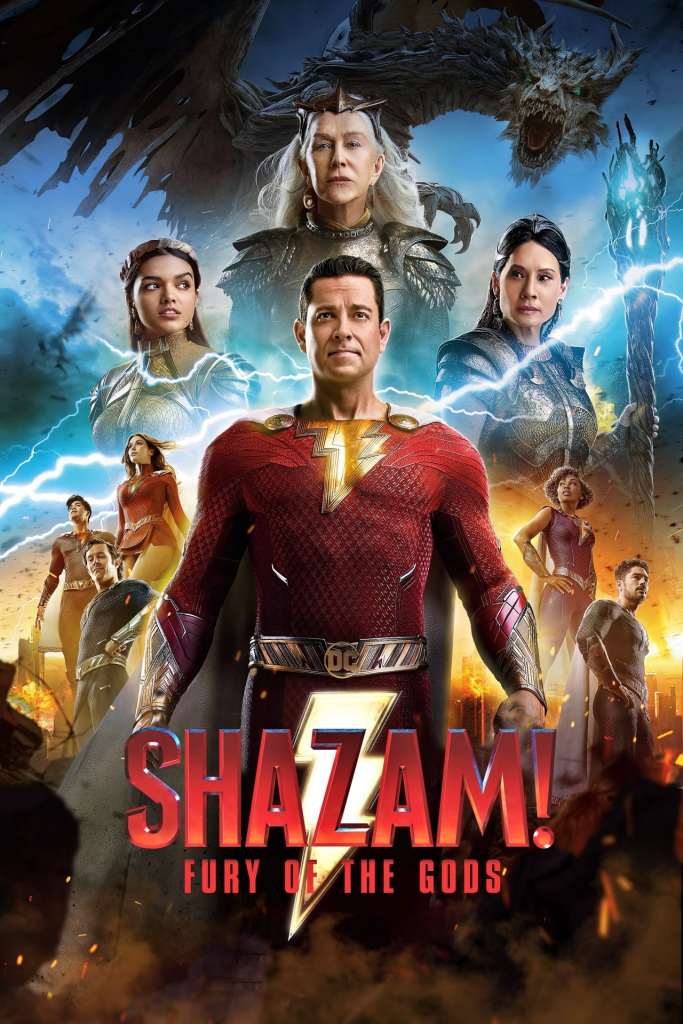
Shazam! Fury of the Gods is the newest in the DC Universe, though if it stays “canon” when the universe is reset here in a couple years is anybody’s guess. It is the sequel to 2019’s surprise hit, which was well received by many (if not me). It takes place 2 years after the events of the first film: the kids have grown a little, and their alter egos as superheroes are starting to build a reputation as saviors or troublemakers, depending on who you ask. Their latest foes are Hespera and Kalypso (a slightly miscast Helen Mirren and Lucy Liu), who were gods millennia ago, and are have recently been freed from their prison. They are seeking to regain all of their powers through the Wizard’s staff, the item which gave Shazam and his crew their own powers, but Kalypso has an ulterior motive too: the destruction of earth as retribution for her imprisonment. Normally invincible (or close to it), Shazam and his team can have their powers stripped away by the ladies and their newly acquired staff, so they face real danger, while trying to keep the world safe too. I felt about the same for this movie as I did the first: it was just OK, and while there are good moments, the whole didn’t feel very cohesive nor entirely engaging. I am, however, eagerly awaiting DC’s The Flash in about a month, so fingers crossed, DC delivers on that one. ★★★
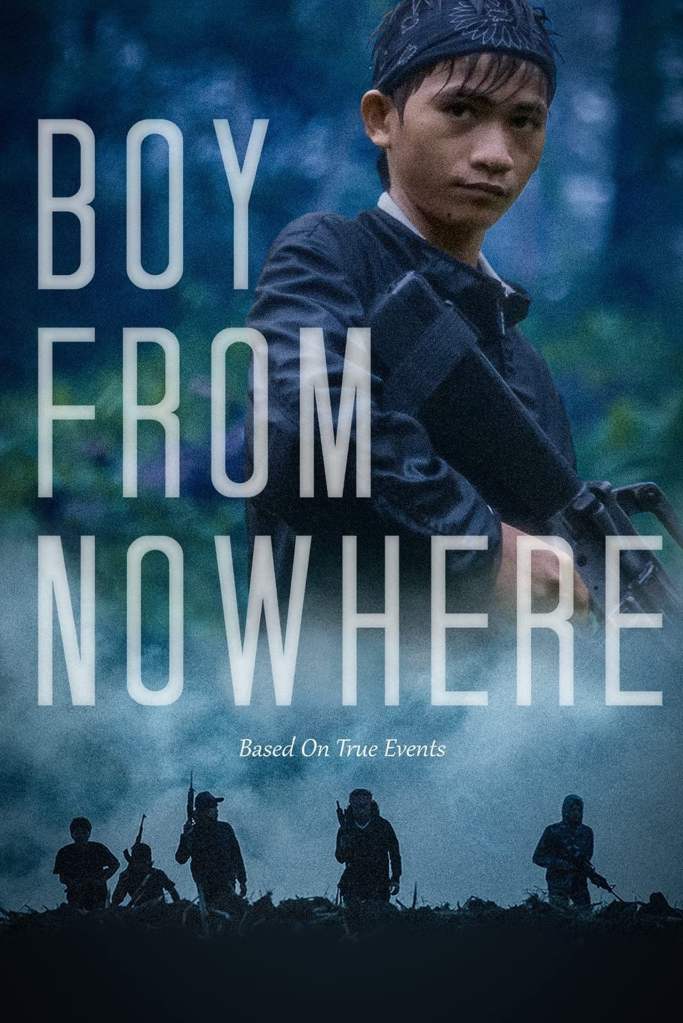
Boy From Nowhere is the directorial debut from young Canadian filmmaker SJ Finlay. Shot on location in the Philippines with local, non-professional actors, the film follows a young boy named Gary. A member of one of the indigenous tribes as a fisherman, Gary’s village is burned down one day by an unknown aggressor, and is left to fend on his own when he becomes separated from his father. With the idea of maybe tracking down his mother’s tribe of farmers (she died when he was young, and he has no recollection of her), Gary heads inland. In one city, Gary falls in with a group of young men who, while up to no good as a city gang, at least provide a protective and welcoming environment, something Gary has never had. A poignant moment comes when they encourage him to sing his favorite song at a karaoke bar, and Gary belts out “Climb Every Mountain” from Sound of Music. Knowing a bit about the basic plot of this movie before going in, I had an idea that this would be a turning point; I didn’t think there’d be many rainbows in Gary’s future. Sure enough, the gang’s leader is involved in a shooting, and to hide out, decides to take his group into the forest and join up with guerrilla fighters who are fighting the government over perceived injustices towards the indigenous peoples. Gary, who looks younger than them all, has a gun put in his hand, and he becomes an outlaw. The film plays out as a simple story, but there are some dense (in a good way) textures to pick apart here. What is good or evil, who is right or wrong, etc. You can tell Finlay is still finding his footing as a director, but there’s promise here, and I’d like to see what he could do in the future with a bigger budget. ★★★

Not sure what to make of Giving Birth to a Butterfly, from another first-time director (Theodore Schaefer), though he was executive producer on last years’s We’re All Going to the World’s Fair (not good…). He so wants this to be a David Lynch kind of surrealist picture, and even pulls out an actress from Eraserhead in the final act, but it never pulled me in and encompassed me like a Lynch film can. Despite some strange, offbeat characters, it starts simple enough: a family of four is dominated by the dad in the house, whose sole ambition is opening a restaurant; he controls family conversations about it and pays little attention to anything else. The son in the family brings home his new girlfriend, Marlene, and introduces her to the family. It is shocking to them that she is very obviously pregnant, but the son says that, while the child is not his, he’s going to raise it as his own, and oh by the way, can they live there in the house. The uncaring father replies, “Sure why not! More the merrier!” without consulting his wife Diane. Diane is the one figure lost in all this, but the film is mostly about her and Marlene. When Diane’s bank account is wiped out by an online firm she’s previously signed up with, she and Marlene head out on a road trip to confront the company. The trip allows the two to get to know each other, divulging hopes and dreams (Diane’s unrealized past, Marlene’s hopeful future). But the film takes a strange turn when they get to the address of the company, which turns out to be an old house with peculiar inhabitants. Thus the Lynch comparisons, but while his endings often lead to introspection and dissection, this one just left me thinking, “huh?” I liked the weird characters in this film, and while it is obviously super low budget, there are familiar faces here for those who watch a lot of film and TV. Better first half than second. ★★½

Free Skate is marketed as a drama about a young athlete (a figure skater in this case) who flees her country (Russia) and tries to start anew with a new nation (Finland), so I had visions of something like Olga, which I really enjoyed. Couldn’t be more different. This movie is just bad, nothing more to say about it. Outside of some emotional abuse (which I’m sure is par for the course in highly competitive athletics the world around), we really don’t know why she fled until near the end. I didn’t mind this so much, other than the fact that it didn’t really add the tension that the filmmakers hoped it would. No, my biggest problem was the completely predictable plot and the horrendous acting. It seemed like a bunch of people play-acting at a high school play, and the lead woman (who was also the writer) can’t act her way out of a paper bag. Stone cold faced no matter what scene she’s in, and dull beyond words. The movie takes a LONG time to get going, and when it does, you don’t know why you wasted your time. ★

I’m starting to think I’m just not into comedies anymore. For all intents and purposes, iMordecai seems to be a charming comedy, but I couldn’t get into it. It is based on real-life experiences of its writer/director Marvin Samel, and stars the always-entertaining Judd Hirsch as Mordecai Samel, an older Jewish man who displays all of the stereotypes you’ve seen and heard before (hey, they’re stereotypes for a reason right?). Mordecai’s old, busted up flip phone, held together by tape and a prayer, is finally replaced by a shiny new iPhone, and Mordecai gets lessons on how to use it from the store’s worker, Nina. Nina takes a liking to Mordecai and his stories, and is particularly moved when talks about losing family to Nazi death camps in World War II. Nina has learned that her grandfather, recently deceased, was a Nazi officer at one of those camps, and she’s carrying around a lot of guilt. There’s a side plot too involving Mordecai’s son Marvin (Sean Astin) who is trying to land a deal for his fledgling cigar company, but to his chagrin, pops keeps screwing up the deal. There’s plenty of laughs (like Mordecai talking to Siri on his phone, and his wife thinking he is cheating on her with another woman), but when the end came, I just shrugged my shoulders and said, “Ok.” I need to stick to dramas and foreign films, my bread and butter. ★★
- TV series recently watched: The Muppets Mayhem (season 1), See (season 1)
- Book currently reading: Killing Floor by Lee Child

 Jons Movie Takes
One thought on “Quick takes on Boy From Nowhere and other films”