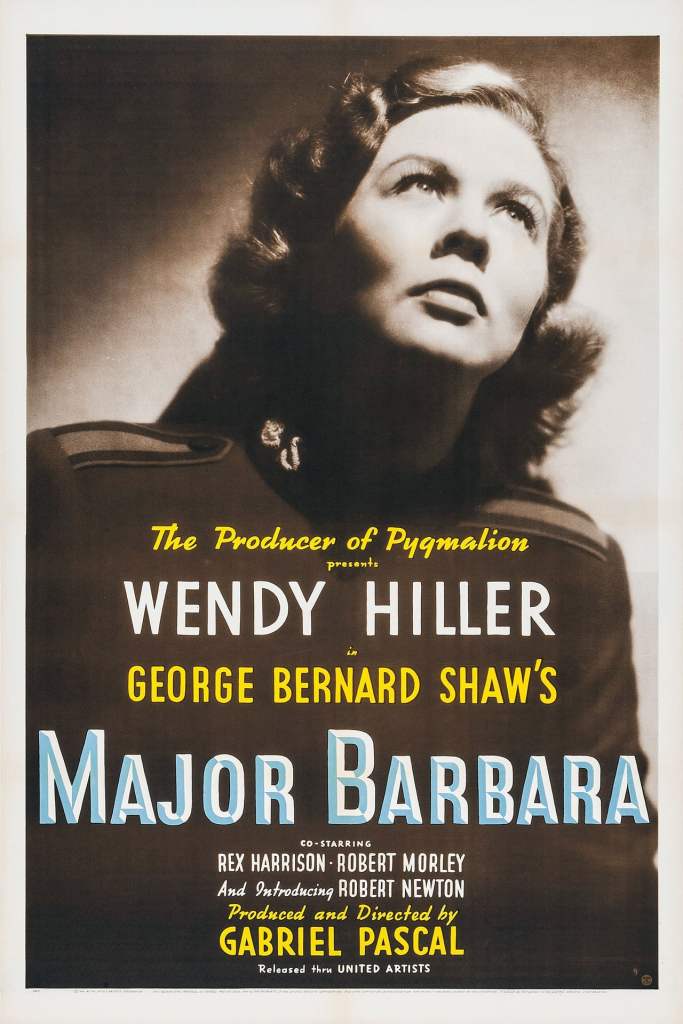
While on a recent vacation, I loaded up a few classics on my laptop to watch while resting and relaxing in the evenings. These are a set of films from WWII era England, starting with Major Barbara, a film adaptation of a George Bernard Shaw play. Despite the military-esque name, it deals with a woman involved in the Salvation Army. Barbara (Wendy Hiller) only cares for saving souls among the poor, but she catches the eye of an agnostic, Adolphus Cusins (Rex Harrison), who joins her group just to get close to her, and it works. Barbara doesn’t question Adolphus’s motives, though he is clear from the beginning that he is there for her and not for God. Thus, he is Barbara’s father’s kind of man. Barbara’s dad is Andrew Undershaft (Robert Morley), who was an illegitimate son born into a wealthy family, and expanded the fortune by producing war machines. He has not been involved in raising his kids, but they obviously live off his wealth, and he hoards it over them. Andrew wants to buy his way into heaven, something that Barbara finds repulsive, but after he makes a sizable contribution to keep the Salvation Army’s doors open, Barbara herself loses faith. The dialogue is funny in an old-timey way for most of the film, but I found the final act to sort of lose focus. For a long time, the movie was about helping the poor rise above their station, but in the end, greed wins out. Plot direction aside, the film just ran off the rails all around and lost my interest. ★★½
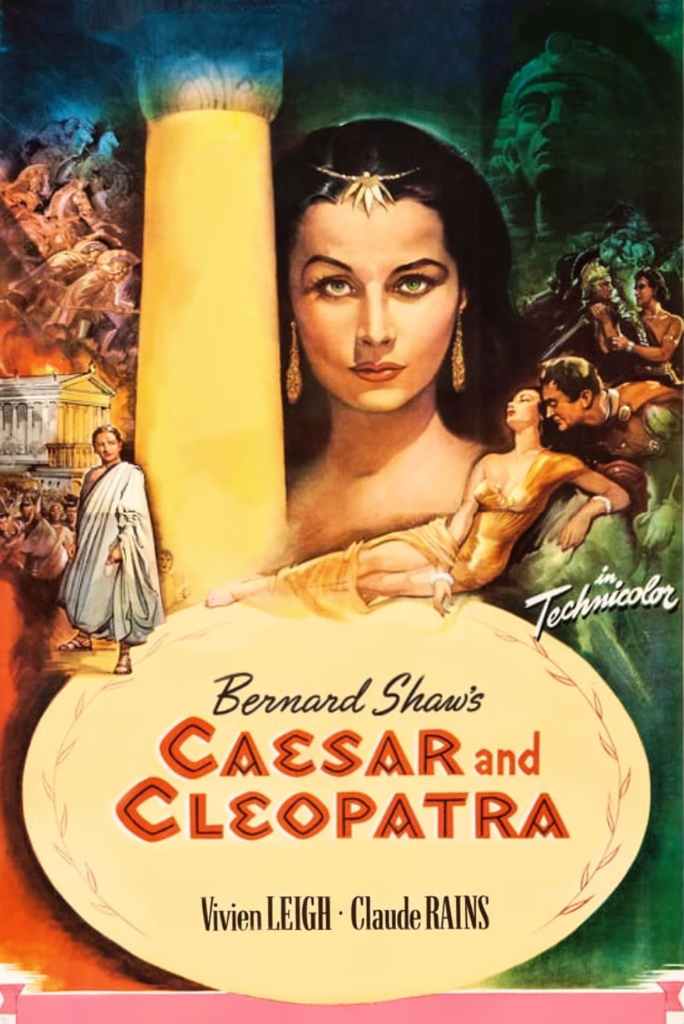
Caesar and Cleopatra , released in 1945, was Vivien Leigh’s followup to That Hamilton Woman, a film I really enjoyed. While this film had some charm, it lacks a certain something that left me wanting. It tells a story of a middle-aged Julius Caesar (Claude Rains) who has come to Egypt to unify the waring city-state under Roman law. Egypt has had infighting between siblings Ptolemy and Cleopatra (Leigh, who received top billing after the successful Gone With the Wind, just 6 years prior), both of whom claim the throne. Caesar, like all men, is captured by Cleopatra’s good looks and takes her on in a fatherly role, but he must first help her shore up her claim. Cleopatra is, at first, portrayed as a young girl who lets her court bully her around. Caesar shows her how to lay down the law and demand people’s faithfulness, but his lessons backfire when, 6 months later, Cleopatra plots to get rid of him and rule her country without Rome’s influence. There’s also political subplots involving seemingly constant uprisings by the masses against unjust leadership, sometimes over what seems like minute perceived transgressions. The film can border on the silly at times, and is just barely held together by Cleopatra’s charm and Caesar’s wit. Unfortunately the film was a flop at the time. For a short time, it was the most expensive film ever made (director Gabriel Pascal had real Egyptian sand brought in for authenticity, and production halted for weeks when Leigh tripped and suffered a miscarriage, triggering a mental breakdown). There’s just enough funny wordplay to keep your attention, but only just. ★★½
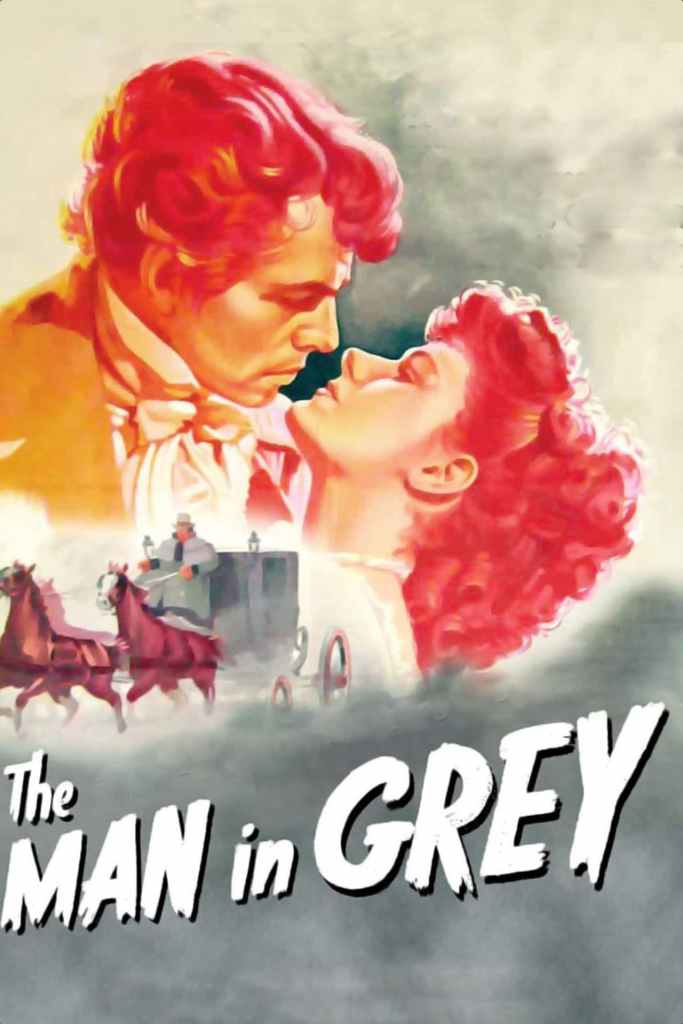
The Man in Grey is a classic melodrama from 1943. After an intro, we see a young Clarissa, beautiful and popular in school, but very innocent in the ways of the world. She befriends Hester, a young outcast whose family has fallen on hard times, a friendship that is portended to lead to evil ends by a traveling fortune teller. When Hester is kicked out of school for going off at night with a boy, Clarissa follows her out the door, and it isn’t long until Clarissa marries Rohan, the man in grey. He is a rascal, but he must marry someone to further his renowned (and rich) lineage. The marriage does not stop Rohan’s philandering ways, and it isn’t long until Clarissa is unhappy. She reunites with Hester when she is found to be a traveling actress; the man she ran off with is long dead. But Rohan sees a like kin in Hester, and gets her to admit that while she is poor and he is rich, they are much more alike in personality. The two begin an affair under Clarissa’s nose, even while Clarissa begins her own romp with an old toy of Hester’s, actor Rokeby. Hester plans Clarissa’s downfall in order to take her place in the wealthy lifestyle, but this being the type of film that it is, you can expect a happy ending before its conclusion. The movie doesn’t break any new ground, but it is an entertaining flick that keeps your attention until the very (predictable) end. ★★★½
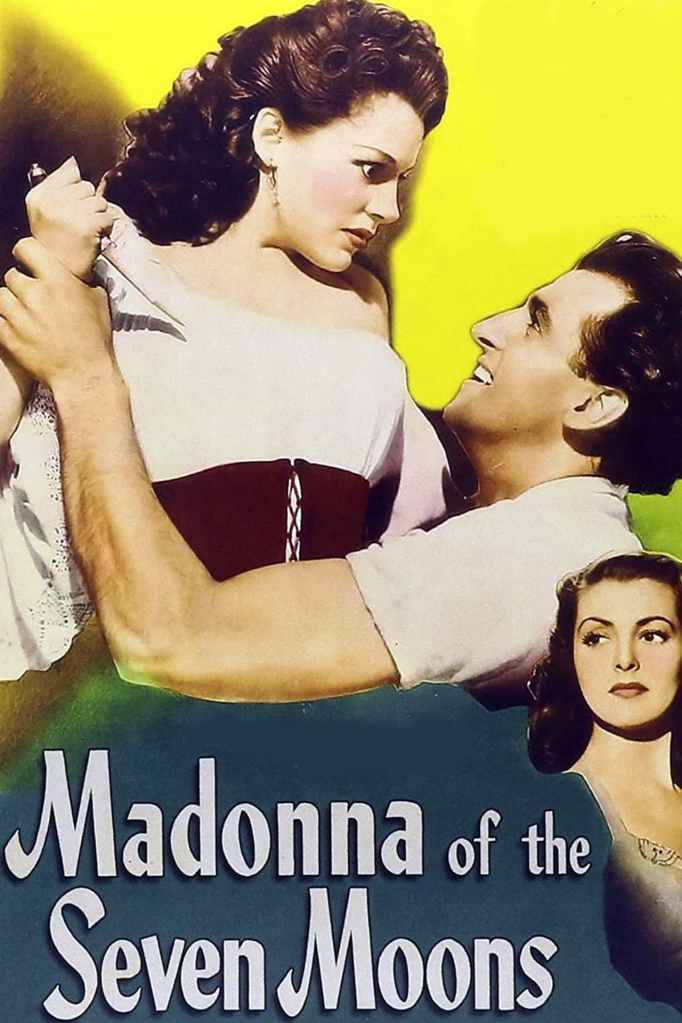
Madonna of the Seven Moons came from the same studio (Gainsborough) 2 years later in 1945. It begins with a very 40’s-esque blurb telling us the following events are true (when they obviously are not), and starts with a tragedy. Young Maddalena is raped one day but finds healing and solace in religion. While she’d rather become a nun, she is instead married to a young man and soon pops out a daughter, Angela. Years later, when the daughter returns home to Rome after 5 years in boarding school in England, she comes as a modern woman and not the pious lady that her mother is. Angela is quickly engaged, and all this change prompts a breakdown for Maddalena. She faints, and awakens as a different person and runs away; turns out Maddalena has a split personality, Rosanna. Maddalena’s husband admits that she hsas disappeared twice before for long stretches of time, but the family is not yet aware of the nature of Maddalena’s illness. Angela goes off to hunt down her mother, even as Rosanna returns to her “other” life in Florence. There’s a lot of moving parts here, as some characters flit in and out of the various circles around Maddalena/Rosanna, but it isn’t hard to keep track of everyone. Like the above film, it’s a solid melodrama, and while the whole dual personality angle is a bit heavy handed in this movie, I’m a sucker for a good story, and had a good time. ★★★
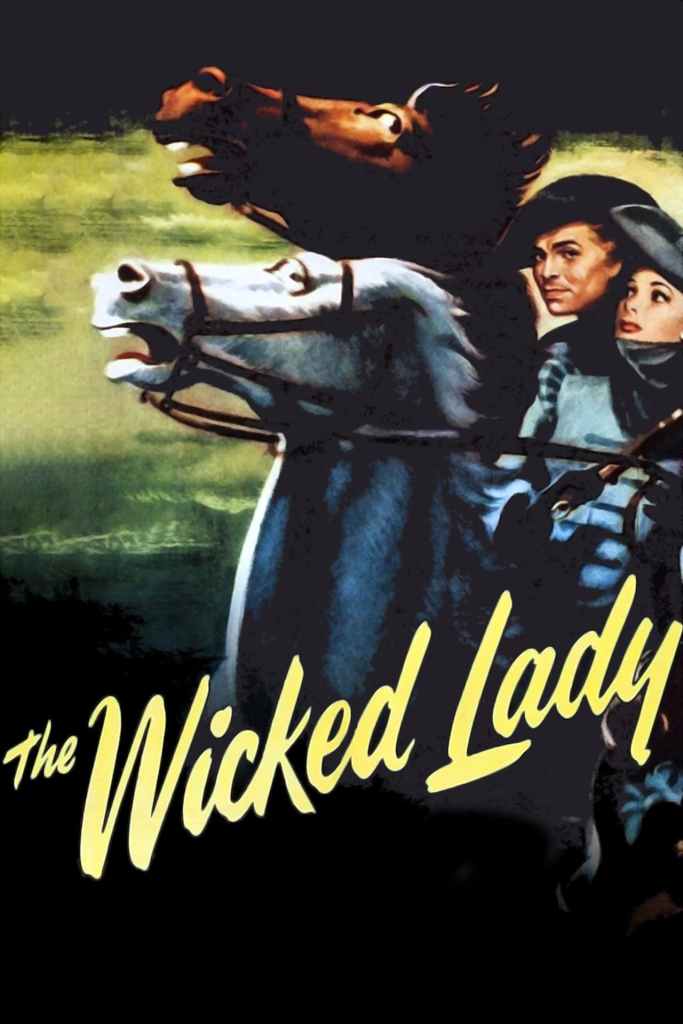
Without looking up other’s reviews, I get the feeling that 1945’s The Wicked Lady isn’t as well thought-of as some of the above pictures, but I enjoyed it a lot more. It’s main protagonist is a bad guy (or girl)! Barbara is a truly diabolical villain, easy to root against and with no redeeming values. Too often today movies give the bad guy a sympathetic story, but not here: we can’t wait to see Barbara get her due. First, she steals away her friend’s husband-to-be, just before the wedding, and even keeps the same wedding day! Then, when she grows bored of him (practically the same night), she becomes a highway robber, masking up in order to take on the identity of a local thief named Captain Jackson. When the real Jackson stumbles across her one night, the two see a like mind in each other and become lovers. While all this is going on, Barbara’s original friend is still in love with the man stolen from her, and he begins to realize the mistake he made. Things will get murkier before they clear up in the end, and Barbara will sink a lot lower than thievery and affairs when all is said and done. Margaret Lockwood is fantastic as the conniving Barbara and James Mason equally fiendish as Captain Jackson. ★★★★
- TV series recently watched: none, I was on vacation!
- Books recently read: D&D HaT: The Druid’s Call by EK Johnston, One Hundred Years of Solitude by Gabriel García Márquez, The Shadow Rising by Robert Jordan

 Jons Movie Takes
I would watch Cleopatra, simply because of Vivien Leigh!
LikeLiked by 1 person