
Triangle of Sadness is the newest from Swedish director Ruben Östlund; for my tastes, his last two films included a hit (Force Majeure) and a miss (The Square). This one is another satire, which seems to be his work of choice. This one points an eye at the gap between the wealthy and the workin class. The film begins with Carl and Yaya, a young, beautiful couple. He is model, she is a social influencer. They fight a lot, mostly over money, because Yaya likes to feel taken care of (expecting Carl to pay for meals), but she also makes a lot more money than him. She later admits that their relationship is more for show than anything, as it helps her image to be with a good looking guy. I have to admit, I wasn’t laughing at this dark comedy much during this introduction, but when the scene shifts to a luxury cruise yacht, the laughs finally come. The ridiculousness that takes place on this boat, with a bunch of entitled rich assholes and the yacht’s crew who have to deal with them, is hilarious. The highlight occurs when the alcoholic captain (Woody Harrelson), a socialist, gets into a debate with a Russian capitalist on board. When a storm sets the boat to rocking during dinner, when the hoity-toity guests are being served high class food that doesn’t exactly look super appetizing, a barf-o-rama sets off, and I laughed often and hard. But that’s not the end; pirates hit the yacht and the survivors are left stranded on a island. When the rich can’t look after themselves, one of the ship’s crew, a woman who was wiping up their vomit the night before, steps up to make a fire and fish for food. She becomes the new leader, subjugating the others to the bottom rung. Despite the slow beginning, this is a great film, and one that you can watch multiple times to catch all the mockery Östlund is throwing at us. ★★★★

Bruiser is a little indie film from first-time writer/director Miles Warren. It follows a middle class family struggling to send their son, Darius, to a private school. Home for the summer, Darius gets in arguments with his mom and step-dad, Malcolm, who is the only father he has ever known. While loafing around the area, Darius runs into a homeless man named Porter, who says he was friends with Darius’s parents way back when. Isn’t too long until we learn that Porter is Darius’s biological father, and he and Malcolm have a rocky history. Porter has done jail time, and it is hinted that Malcolm was involved but never caught. Darius is drawn to Porter’s carefree nature and Porter definitely plays the roll of “cool dad,” much to Malcolm’s chagrin. It leads to an altercation that may change everything for Darius and his family. What should be a tense drama is hampered by shoddy acting by several of the cast, and a story that heralds its surprises far too often. And while I don’t mind a low budget drama (some of my favorites are), I couldn’t shake the feeling that I was watching amateurs playing at making a movie. ★½
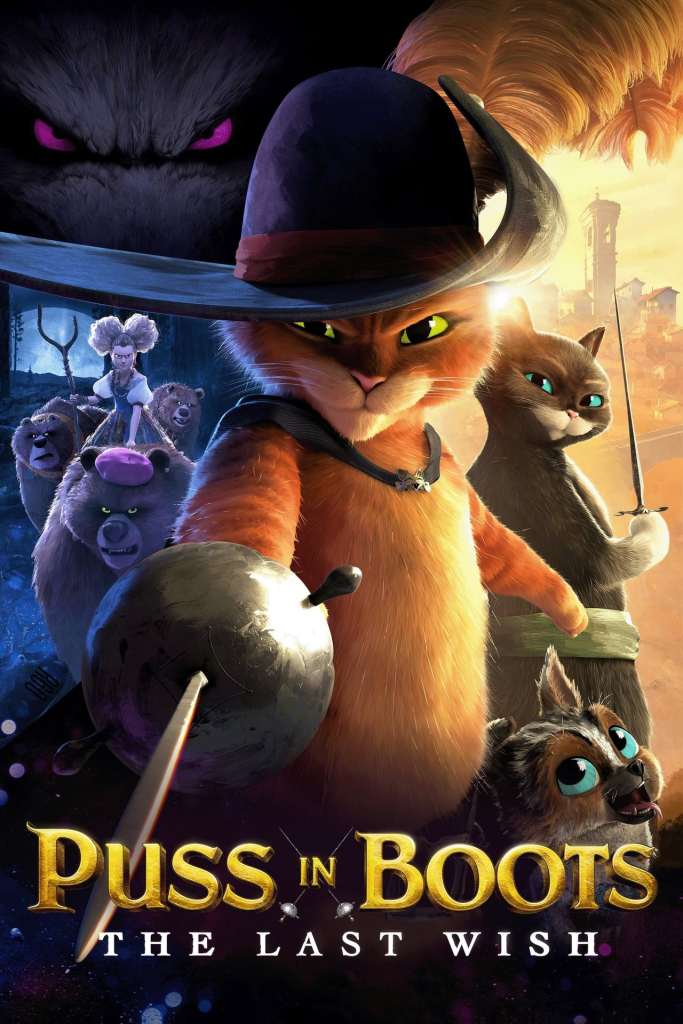
Puss in Boots: The Last Wish is the latest from the Shrek universe and the second movie to focus on the popular Zorro-like character. Puss, always one for adventure, has lived a carefree life, but unfortunately this lifestyle has used up 8 of his 9 lives. Death, in the form of a black-cowled white wolf, has long sought Puss, and his prize is now right in front of him. For the first time in his life, Puss in scared, and he flees, running to a stereotypical single woman with a house full of cats, in order to disappear from the public. Puss meets a lonely dog with a sad story, named Perrito, and is also recruited by a crime family (Goldi and Mama, Papa, and Baby Bear). The Three Bears are hunting a treasure map to the fabled Last Wish. Puss sees an opportunity to get that wish for himself and wish for more lives, but he’ll need to race The Bears, a new villain (“Little” Jack Horner, all grown up), and team up with a past flame (Kitty Softpaws) in order to get there. All with Death still on his trail. The first half of the film in particular is both fun and funny, with Shrek-style laughs at the various kids’ tales (when The Bears are roughing up a witness, Mama Bear is too lenient, Papa Bear is too rough, Baby Bear is just right), but some of the jokes do get stale by the end. By the third or fourth time we saw a close-up of Puss’s hairs stand on end, I could only roll my eyes; yes, we get it, he’s scared again. The animation is beautiful, but also a little jarring at times. After the popularity of Sony’s Spider-Verse film a couple years ago, a couple films have copied its comic-like animation style, and while it works in that film, it felt off-putting in this movie. Still, in typical Shrek fashion, there’s plenty to like here for both the young and young-at-heart. ★★★½

Vicky Krieps stars as Empress Elisabeth of Austria in her latest film, Corsage. The film begins with Elisabeth (“Sisi”) donning her “corsage” (corset), and wanting it made ever-tighter and tighter. Married to Emperor Joseph at an early age (her early life is depicted in the highly recommended Netflix series “The Empress”), she is now 40 years old and struggling to hold on to her reputation of a young, slim beauty. As the film goes along, we see Sisi sink into depression. Her husband, who once lavished her with praise and love, is now distant. Though she has attendants who fulfill her every desire, outside of her rooms, she has no power at court. She takes to visiting hospitals, both for the sick and the mentally ill, but we don’t know for what purpose. Does she visit these places because she feels a kinship with those held against their will, or does she enjoy how all the inmates still call her beautiful, when those at court whisper about her age and waistline? After she survives a suicide attempt, Sisi takes a lover and spends time at his estate, but even there, she realizes that she is little more than a trophy. I don’t see a good ending for her, and knowing a bit about what is to come, it made the film very depressing. I’ve seen a handful of films about this time period, so I knew that the son she dotes over will come suicide at Mayerling, and that she herself will be assassinated. Wonderful performance by Krieps and it should be in the running for awards for best design and costume, but only watch if you want to feel worse at the end of it. ★★★

Women Talking is the kind of movie that critics adore, but most others may struggle to get through. I did get through it, but I did have to focus to not let my attention waver. It really is women talking, with no “action” to break it up, but this isn’t a campfire chat catching up on the day’s events. The setting is a rural farming community, and at first, you think it takes place 150 years ago. There’s no technology, the women are dressed plainly, and they don’t know how to read or write, serving their husbands with religious zeal. But something has been happening to the women for a long time: they’ve been waking up in the mornings with bruises on their inner thighs and spotty blood on the bedsheets. It turns out, some of the men have been drugging and raping them. Finally found out when the act was witnessed by a girl snooping around one night, the one man who was caught (the other men aren’t talking) has been arrested in the nearby town’s jail, a full day’s journey away. All of the men in the community set out to the jail to bail their brother out, and since they’ll all be gone for 2 days, the women of the community come together to decide their own fate. They take a vote, and since none can read or write, they can only tally votes with an “X” on whether to do nothing, stay and fight, or leave. When votes are counted, options 2 and 3 are tied, so the women leaders of the community spend the full night in a barn, to decide the fate of everyone. Over the course of the night, little nuggets are dropped (a woman who walked to a “clinic” in town, and finally, we see a car drive through) until we realize that this is present day, and it is a religious community in which the men have suppressed the women. The film asks a lot of questions about what is freedom, what is choice, and it doesn’t always provide the answers, to the viewer or to itself. The women are presented a problem with no real solutions. It is easy to say all the women should just leave, but they’d be going to an unknown world with no easily transferable skills. It could also easily be said they should stay and fight, but against a system that is set up to keep them down? Stellar cast including Rooney Mara, Jessie Buckley, Claire Foy, Ben Whishaw (as the one man who stays behind with the women, as he is a quasi-outcast from the rest of the men, for being world-educated at a university; he is allowed in the community to teach the young men), and Frances McDormand in a small but vital role. Still, this group of all-stars can’t hide some glaring holes in the telling, and an uneven hand from director Sarah Polley. Not a film that really left a lasting impression on me, as it probably should have. ★★½
- TV series recently watched: Its Always Sunny (seasons 7-9), This is Going to Hurt (miniseries), Hell on Wheels (season 4), The Reluctant Traveler (season 1), The North Water (miniseries)
- Book currently reading: Dune House Atreides by Herbert & Anderson

 Jons Movie Takes
2 thoughts on “Quick takes on the Puss in Boots sequel and other films”