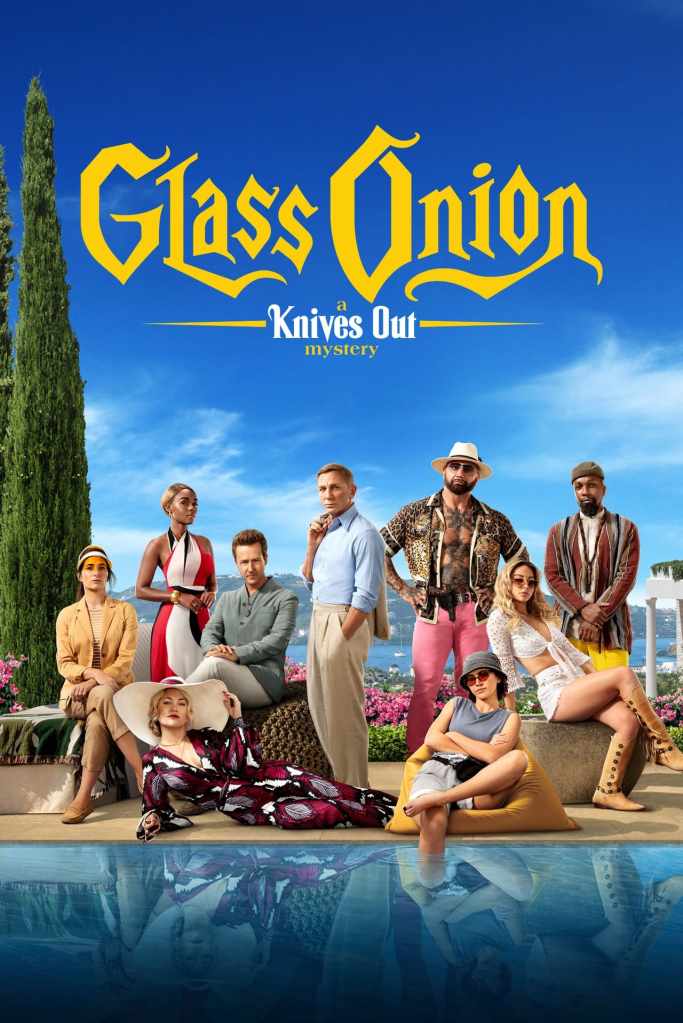
When Knives Out was a huge hit in 2019, you knew a sequel would be on the table, and that sequel finally came out, with Daniel Craig returning as offbeat sleuth Benoit Blanc (similar to Agatha Christie’s famous Poirot character). There are similarities from the first Knives Out film: once again, Blanc doesn’t know who hired him, and once again, he arrives to a rich soiree, though this time, the murder has yet to be completed. Billionaire investor Miles Bron (Edward Norton) has gathered some of the people he is most invested in for a weekend getaway and “murder mystery” dinner on his private island off Greece. Miles has his hooks in each of them, so they each have a reason to hate him, and a real murder is definitely in the cards; good thing Blanc is there to solve it. The film is highly entertaining (like the first film, an all star cast helps, this time including Janelle Monáe, Leslie Odom Jr, Kathryn Hahn, Dave Bautista, Kate Hudson, and more), and the twists keep coming to keep you on your toes. Unfortunately, as a whole, the twists sometimes feel forced, like director/write Ryan Johnson is doing his damnedest to one-up the first film. I thought that one was nearly perfect (didn’t help my feeling for this sequel that I recently rewatched the first and was reminded of its brilliance); according to my review, I gave it 4 1/2, so I have knock this one down a notch to ★★★★
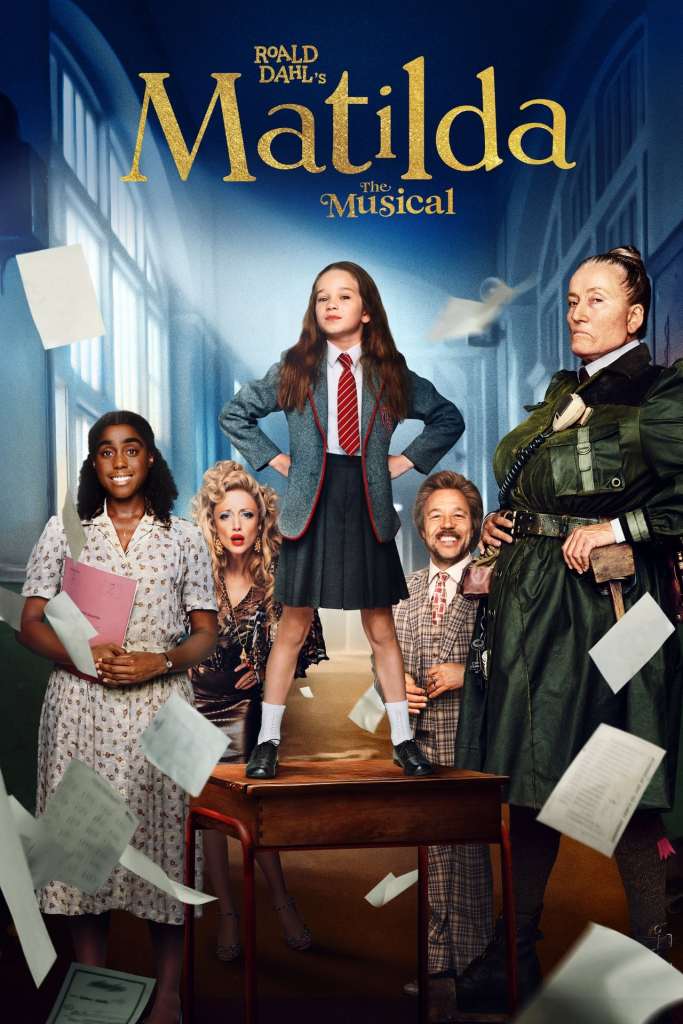
Roald Dahl’s Matilda the Musical (don’t let the wordy title scare you off) is a film adaptation of the popular musical, itself based on the popular child’s book. I saw the touring production of the musical at St Louis’s Fox Theater a few years ago, not knowing anything about it at the time (never read the book as a kid), and really enjoyed it. The film version is solid too. The story revolves around Mathilda, a young girl born to parents who, not only don’t appreciate her, they downright loathe her (her dad always refers to her as “a boy” since that’s what he wanted, to humorous effect in the film but which obviously bothers Mathilda). Her only escape is through books, and she reads everything she can get her hands on, and makes up her own stories when she doesn’t have something to read. Mathilda’s life changes when the local authorities realize she’s never been in school; her parents didn’t bother enough to send her. Mathilda starts school with dreams of learning new things, but those dreams too are dashed when she meets the school’s headmistress, Agatha Trunchbull. Ms Trunchbull calls the children at her school maggots, and rules with an authoritarian iron fist. Laughs and smiles are all-but forbidden. Mathilda’s only bright spot is her teacher, Ms Honey, who loves her kids and inspires them. There’s a secret at this school between Trunchbull and Honey, a secret that Mathilda will unravel as the film goes along. The movie starts great, with catchy songs, bright colors, and a fun atmosphere despite the dreary life Mathilda lives. The spunky Alisha Weir makes the most of her opportunity as Mathilda, portraying it with zest and a don’t-quit attitude, but it is Emma Thompson’s completely unrecognizable turn as Agatha Trunchbull that steals the show. How can the likable and attractive Thompson transform to such a despicable person?! If she doesn’t net an award or two this season, it’s a travesty. A lot of the jokes are for adults, but I think kids will like this one the most, with its memorable soundtrack sticking with them. ★★★½
White Noise is the newest film from writer/director Noah Baumbach, whose last picture, Marriage Story, was my favorite film of 2019. I read the book this film is based on back in 2016, and enjoyed its quirky and off-beat comedic style. This movie, recently released on Netflix, is getting middling reviews, but I like the director, I liked the book, so of course I was going to watch it. And thankfully, it’s a fairly faithful adaptation (big change at the end, but it works in the movie). The only knock is that the book is written from main character Jack’s perspective, so as a film, we obviously can’t get in his head. Even so, Adam Driver does a great job of giving Jack Gladney’s mannerisms life. If you’d like the gist (with some spoilers, so maybe only read the first half), read my review of the book. My thoughts on the movie: The comedy is definitely absurdist, as it was in the book. This may turn some viewers off if you aren’t expecting it, because other elements of the film (drama, even some thrills when the “Airborne Toxic Event” throws the town into a very real fear of impending death) don’t always mesh with the laugh-out-loud comedy, but it all comes straight from the pages of the book, and Baumbach expertly handles it all. Driver is the star; how he hasn’t won a major award yet is beyond me. Baumbach’s wife Greta Gerwig plays wife Babette Gladney, and she’s serviceable, though in my opinion she’s always been a better writer/director in her own right than an actor (and we’re all looking forward to her film Barbie coming out this year). I really enjoyed this film, but I can say with confidence that the majority of watchers will absolutely hate it. To each his own. ★★★★
Despite not doing well at the theaters, critics have been high on TÁR since its release, and it seems to be a dark horse favorite for multiple awards this season. I have to be honest, it takes awhile to build, and a good 30 minutes in, I was wondering if it was all hype, but stick it out and you will be rewarded. Cate Blanchett gives a tour-de-force performance as Lydia Tár, a world renowned conductor and composer, in a field that has traditionally been dominated by men. The film opens as she is being interviewed, and her list of accomplishments is staggering. Upcoming is a live recording of her conducting of Mahler’s 5th Symphony, which is generating lots of hype in music circles. Outwardly, she has everything, but as the film goes along, her carefully crafted persona begins to crumble, entirely through her own fault. First, a former protégé commits suicide, and immediately, whispers begin that the young woman was groomed and later cast off by the powerful Lydia Tár. At home, Lydia butts heads with her wife Nina, who also happens to be lead violinist/concertmaster in the orchestra, because Nina sees that Lydia is already eyeing her next fling, a young and brilliant cellist from Russia, new to the orchestra. There’s also the ousting of the group’s assistant conductor, a move orchestrated by Lydia, due to a perceived infraction, and when Lydia’s longtime assistant Francesca doesn’t get the job, more sparks flare. The narcissistic and power-hungry Lydia Tár refuses to see the cracks in her world, until by the end, those cracks are gaping chasms. It’s a brilliant film, made more interesting because, for myself coming from a musical background, I could definitely see characteristics of some of the musicians and the egos involved, and applaud the meticulous amount of research that went into making this film authentic. It’s a sharp look at how a person in a powerful position can use that capacity to bulldoze others, but how that way of life may finally be coming to an end in today’s post- #metoo world. ★★★★★
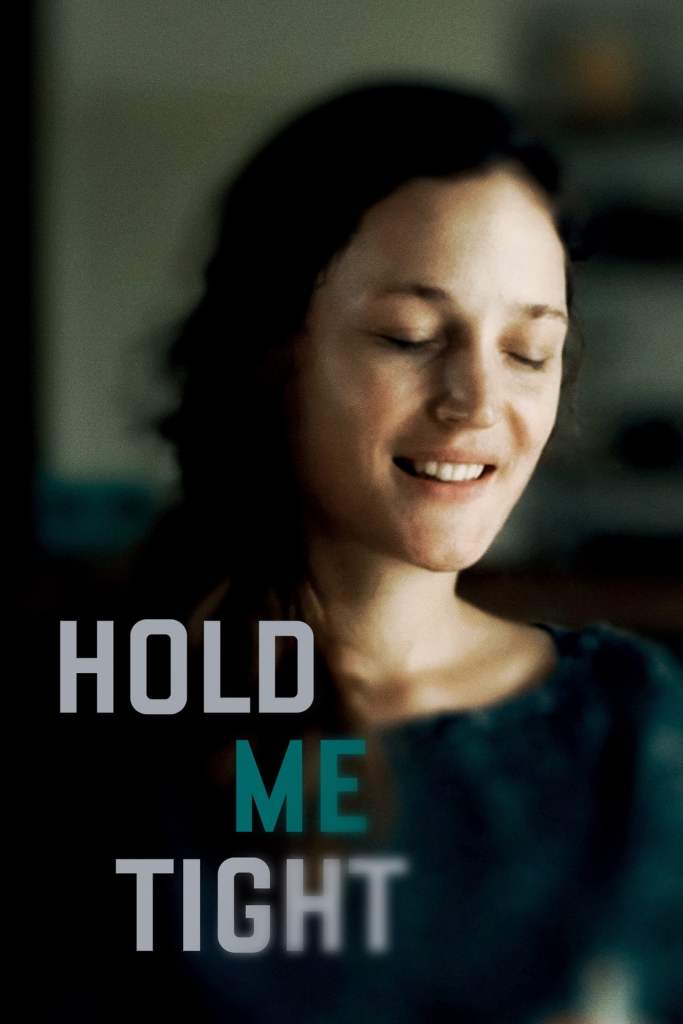
Another great film today; I can’t remember the last time I had some many good ones in a row! Hold Me Tight is not a film you’ll find easily, as it is an indie French film from 2021 that seems to have flown under the radar. I can’t talk about the movie at all without giving away a couple spoilers, so I urge you to stop here and go find it to watch. Those who don’t care to read subtitles can continue on. This film follows a woman named Clarisse who, in the beginning of the film, abandons her husband and two kids for an unknown reason. As the film progresses, we see Clarisse out on the road, while her husband Marc raises Lucie and Paul on his own. However, Clarisse has conversations with them from afar, in her head, and they answer back, and it takes awhile to know what exactly is going on. Much is explained 30 minutes in, when we learn that the family was vacationing in the French Alps one winter, when Marc took the kids out, and they were overtaken by a series of avalanches. With that particular area snow-covered now, the authorities have to wait until spring to retrieve the bodies. The whole movie so far, and the rest from here on out, is a fabrication in Clarisse’s head. Unable to confront her family’s death, she has concocted this notion that it was she that left them, so in her mind, she can pretend they are still alive at home, and their lives are continuing without her. The movie blends past and present, with scenes cutting between reality and Clarisse’s fiction, all on a dime, so you’ve really got to pay attention to keep up. And don’t forget to notice that the actors playing her kids change at one point too, and not just because they are getting older in the “years” that have gone by while Clarisse is away. It’s a beautiful and often heart-breaking film about grief and trouble letting go, and though the big surprise comes at that 30 minute mark, there’s still plenty to unwrap before the end. ★★★★★
- TV recently watched: The Witcher: Blood Origin (miniseries), The Empress (season 1), Guillermo del Toro’s Cabinet of Curiosities (season 1)
- Book currently reading: The Dragon Reborn by Robert Jordan

 Jons Movie Takes
One thought on “Quick takes on TÁR and other films”