I’m late to the game on this one, as $2 billion worth of people have already seen Avatar: The Way of the Water. But I did finally have an opportunity to see it this weekend. Once one of the more highly anticipated sequels, when it finally came, it seems there were a lot of people wondering if it could duplicate the success of the first one (highest grossing film of all time, and adjusted for inflation, # 2 behind only Gone With the Wind). Those fears (by the studio, I’m sure, with its budget of $460 million, the highest for any film ever) have been put to rest; as of this writing, its total stands just over $2.1 billion, good for # 4 all time worldwide. But with all that money in the bank, does it live up to the hype? Mostly yes, but with some caveats.
The film takes place 16 years after Avatar, when the Na’vi, led by Jake Sully, repelled the Earthlings off their planet. In the intervening time, Jake and his wife Neytiri have raised a family, with two natural-born sons (Neteyam and Lo’ak) and a daughter (Tuk), and an adopted daughter (Kiri) born to Grace Augustine’s hibernating Avatar, left after she died. They’ve also taken in “a stray,” a human boy named Spider, who was left with the humans left the planet (babies cannot be put into hyper sleep for the trip back to earth). We soon learn that Spider was the late Colonel Miles Quaritch’s son, and he has been raised mostly unaware of the evil his father did.
Jake’s idyllic world comes to an end when the humans return. With Earth dying (its pollution was hinted at in the previous film), humans want to do more than just mine Pandora now, and they are looking to settle on it. And they brought new muscle to tame the Na’vi. They’ve grown new avatars, and implanted the memories of trained soldiers into those bodies, including Colonel Quaritch’s. Quaritch makes it his goal to capture Jake, seeing him as the key to taking the fight out of the Na’vi, since it was he who united the tribes to win the last war. After a close call, where Quaritch captures a couple of Jake’s kids and they barely escape, Jake decides to take his family far away, and relocates to an island village, inhabited by the Metkayina people. Despite still being Na’vi, the Metkayina are a different people. Living with the sea has brought evolutionary changes, and their entire way of life is strange to Jake and his family. While they are learning the new ways, Quaritch is not content to let his prize get away, and sets his brutal tactics to anyone who may give him information. Aided by his estranged and reluctant son Spider, Quaritch hunts Jake.
The film is long, at 192 minutes (a half hour longer than the first, which was already a long movie). Despite 3+ hours, it really didn’t feel long. That is in part to being such an incredibly beautiful film. In this day and age with every film chuck full of CGI, it’s hard to impress me, but this movie did. It is gorgeous throughout and creates a sense of wonder that you never lose. Having said that, the movie does suffer from, at times, being a bit too similar to the first entry. Jake (and this time, his whole family) has to learn the ways of the local people, in order to use those skills to fight off the bad guys. And at the end, director Cameron pulls out another old plot element from his past films (you’ll know when you see it), and it started to make me think that he only has a couple ideas floating around in his head. If, in the next sequel, Jake has to take his family to the volcano people and learn their way of life too, while a killer robot from the future travels back in time to hunt Jake Sully, I’ll really start to second guess this director’s bag of tricks. Still, looking at this film by itself, it’s solid, and worthy of more exploration. ★★★½
She Said is the based-on-a-true story about the two New York Times reporters, Megan Twohey (Carey Mulligan) and Jodi Kantor (Zoe Kazan) who were pivotal players in ushering in the #metoo movement. The film follows them as they research and build a case against Hollywood mogul Harvey Weinstein. Rumors have been rampant in the movie industry for decades about his behavior towards young women, but finally pieces start falling into place when Megan and Jodi start pulling at threads. If you followed the news about him, the movie won’t show anything really new, but the information is given in an emotionally charged way that will disgust you, as was the intent. Unfortunately there’s so much information to give that it bombards the viewer in an overwhelming way. The two reporters are constantly going to this or that person, making this or that phone call, in a breakneck speed, that little room is left for either actress to show her acting chops. I do think Kazan is a bit miscast, because I’ve always enjoyed her more in her quirky roles, and obviously there’s none of that here. There’s some emotional moments, as to be expected from the source material (an interview with Weinstein’s once-assistant Zelda Perkins, portrayed by Samantha Morton, will boil your blood; she’s amazing in everything she’s ever been in), but often the movie is just data/information overload. I don’t dispute the movie is important, and the result of the true-life revelations of these two reporters is paramount, but a movie is probably not the best way to do it (this film is based on a book, which I have not read, which is probably a better medium). ★★★
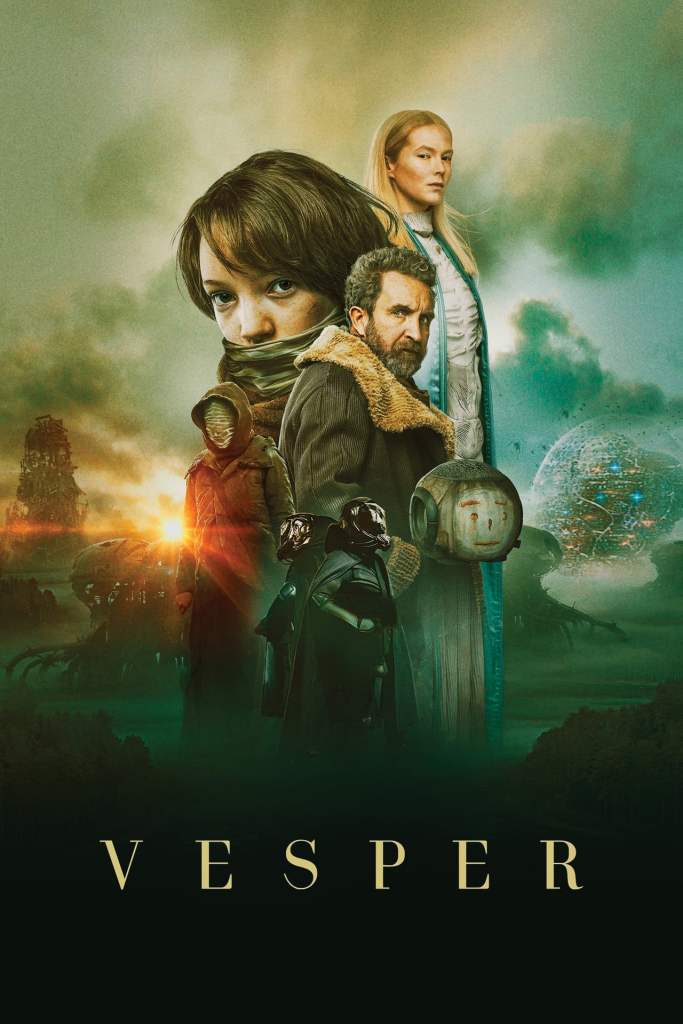
The extremely dark and morbid existence of the survivors in the post-apocalyptic world of Vesper is set with the opening title sequence: typography tells us that the world is living in a “new dark age.” In the far distant future and facing an ecological crisis, humans turned to genetic technology for its survival, but engineered viruses backfired, wiping out all edible plants and animals. Now, the elite few live in technologically advanced cities called citadels (which we never see), and the rest are scraping by as they can in the mud. The film’s main character is Vesper, a 13-year-old girl living alone with her paralyzed father. Her father is bed-ridden and can only communicate through a flying drone that follows Vesper around, which her father can talk through. Vesper, a brilliant young girl, has a lab where she is trying to break down the code in the wild (and often dangerous) plant life that now thrives in the world, hoping to make something edible again. Vesper’s mom left them a few years ago, to become a “pilgrim,” a mysterious group that salvages junk to build massive structures in a very cult-like way. The only other family around is Vesper’s uncle Jonas, who is the only person who can communicate with the citadels with his transceiver, and he trades his children’s blood for food with them (and wonders why they want young blood). However, the food he does get is very limited; food seeds given by the citadel have been engineered to only yield a single harvest, thus everyone is dependent on the citadel in perpetuity. Jonas is very much a bad guy, wanting Vesper to join his clan, as she is nearing fertility and he can use her to get more young to increase his riches. Into this volatile environment comes Camellia. She was traveling in a saucer from the citadel when it crashed, and Vesper, against her father’s wishes, nurses her back to health. Camellia has a secret though, one that will put them all in danger, and one that Jonas can use to further his ambition. This is a remarkable movie for its ideas and visual presentation, and while I thought it was really good, it could have been really great. Unfortunately it is one of those where its reach exceeds its grasp. It brings amazing, thought-provoking ideas to the table, but with a fairly thin plot, it doesn’t reach the awe-inspiring moments that it desperately wants. I feel like it could have been a genre-defining Matrix-like movie in the right hands, but it never gets there. ★★★½
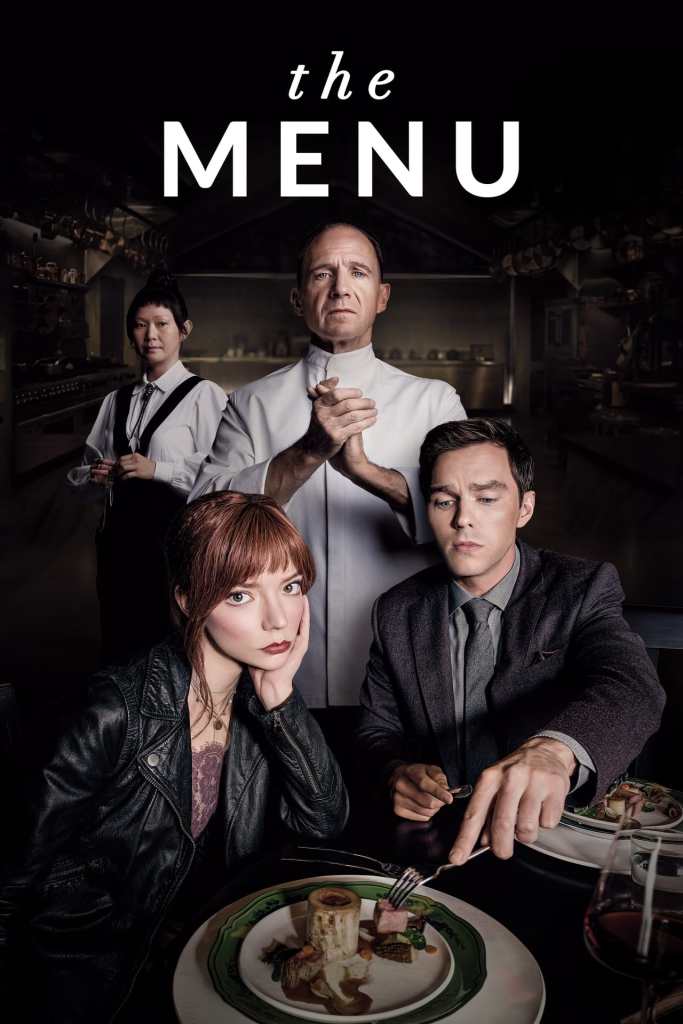
The Menu is one of those quirky genre-bending films that is hard to define, with equal parts horror and dark, almost absurdist, comedy. The premise is simple: an elite chef, Chef Slowik, hosts the powerful and rich at his exclusive island restaurant, charging $1250 a person for the privilege of being served his premium cuisine. The cooks serving under Slowik are completely obedient and follow his strict regimen: they sleep together in a barracks, rise early to harvest the local fauna and edible flora for the evening’s meal, and begin meal prep. On this particular evening, the guests include the food critic who first discovered Slowik many years ago, a has-been actor still holding onto delusions of grandeur, a trio of privileged businessmen, an older couple who are regulars at Slowik’s island, and Tyler, a food lover and sycophant of Slowik’s. Tyler has brought his (seemingly) new girlfriend, Margot, who is just along for the ride. They all are in for a night they’ll never forget, if they survive it, because Slowik has a new “menu” prepared for these particular guests. Each of the guests, all expected by Slowik because of his reservation system, has a terrible secret or unfortunate event in their past, and Slowik will confront them tonight, with gruesome results. Each guest that is, except Margot, who replaced the woman Tyler was supposed to have brought. She is the one wrinkle in Slowik’s dastardly plans. The film is hilarious in its depiction of a high cuisine: when Slowik serves a bread-less bread plate for the second course (various sauces for bread dipping, with no bread), Tyler calls it a genius method of deconstructing the idea of bread as a meal, whereas others obviously think it is a joke. But the real joke on them comes when one of the cooks under Slowik kills himself in front of them, and his body is offered as a course. And even then, the night is still young. Never very scary but always very funny, this movie is engaging to the end, and you can’t help but laugh at the over-the-top machinations of Slowik and his team. Great cast too, including Ralph Fiennes, Anya Taylor-Joy, Nicholas Hoult, John Lequizamo, Judith Light, among others. ★★★★
Till is one of those movies which is based on an important moment in history, but which doesn’t translate well to a full motion picture. The film follows Mamie Till, mother of 14-year-old Emmett Till, who was lynched in Mississippi in 1955. Raised in Chicago and unaccustomed to the way of life in the south, Emmett was visiting family in Mississippi when he whistled at a white woman one day. This led to a few men showing up at his uncle’s door one night, pulling Emmett out of bed, and driving away with him. Emmett’s body was found in the water a couple days later, bludgeoned beyond recognition and shot in the head. His body was sent back to Chicago, and to make the world aware of the persecutions of black people in the south, his mother Mamie held an open casket funeral, with pictures of Emmett’s disfigured face splashed across newspapers across the country. The film continues from there, with the trial of his murderers and aftermath regarding the civil rights movement. It was definitely a turning point in civil rights and Emmett’s story should be known and taught, but as much as it pains me to say, the movie was just ok. It’s more of a feature for Danielle Deadwyler’s considerable talents in the lead as Mamie, and she is remarkable, but the movie goes on a bit too long, and the climax comes halfway through rather than the end. Skip the movie, and instead, go do some research on Emmitt Till, Mamie Till-Mobley, and Medgar Evers. ★★½
Lighting Up the Stars is a lovely film out of China, and one of the quiet, unassuming kinds of films that often come out of that country, though it has a bit more humor than I was expecting, which was nice too. The film follows a young man named San, who is set to inherit the family business, a mortuary. He doesn’t care for the business, just as it seems he doesn’t care for his old and frail dad (there’s mutual animosity there, which will get explored as the movie goes along), but San does want to get the business so he can sell it and move on. Those plans are put on hold from his latest “client.” A woman dies in her sleep, leaving an orphan, her granddaughter Xiaowen. Little Xiaowen, no more than 5 or 6 years old, is supposed to go to her uncle, supposedly her only living relative, but the man’s wife (a bit of a shrew) initially refuses. Xiaowen chases down San, demanding to see her grandmother. The brusque San doesn’t handle Xiaowen well, but he’s her last tie to her grandmother, so she refuses to go away. San ends up taking her in, and the two develop a bond. San helps Xiaowen deal with her grief, even as the girl helps him in turn mend his relationship with his father. But will it all come apart when Xiaowen’s mother, long thought dead, turns up? At turns hilarious and heart breaking, this is a lovely film for families (if your kids can handle the subtitles) and one that will leave you feeling all warm and fuzzy. Having recently spent a whole lot of time with my granddaughter (babysitting, while her parents were in the hospital for a few days having my second grandchild), I laughed hard at her antics and cried when she was upset. I’m usually not a fan of child actors, but the tiny Yang Enyou is a revelation. ★★★★½
TV series recently watched: The Boys (season 3), Reacher (season 1), Willow (season 1), Handmaid’s Tale (season 5), Hell on Wheels (season 1)
Book currently reading: The Second Generation by Weis & Hickman
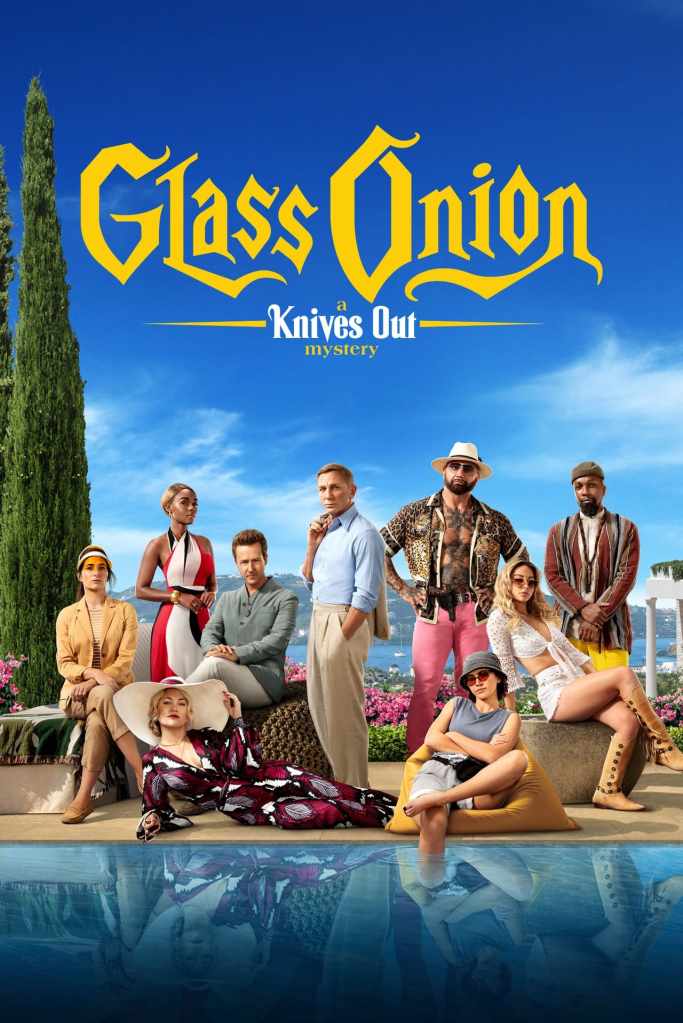
When Knives Out was a huge hit in 2019, you knew a sequel would be on the table, and that sequel finally came out, with Daniel Craig returning as offbeat sleuth Benoit Blanc (similar to Agatha Christie’s famous Poirot character). There are similarities from the first Knives Out film: once again, Blanc doesn’t know who hired him, and once again, he arrives to a rich soiree, though this time, the murder has yet to be completed. Billionaire investor Miles Bron (Edward Norton) has gathered some of the people he is most invested in for a weekend getaway and “murder mystery” dinner on his private island off Greece. Miles has his hooks in each of them, so they each have a reason to hate him, and a real murder is definitely in the cards; good thing Blanc is there to solve it. The film is highly entertaining (like the first film, an all star cast helps, this time including Janelle Monáe, Leslie Odom Jr, Kathryn Hahn, Dave Bautista, Kate Hudson, and more), and the twists keep coming to keep you on your toes. Unfortunately, as a whole, the twists sometimes feel forced, like director/write Ryan Johnson is doing his damnedest to one-up the first film. I thought that one was nearly perfect (didn’t help my feeling for this sequel that I recently rewatched the first and was reminded of its brilliance); according to my review, I gave it 4 1/2, so I have knock this one down a notch to ★★★★
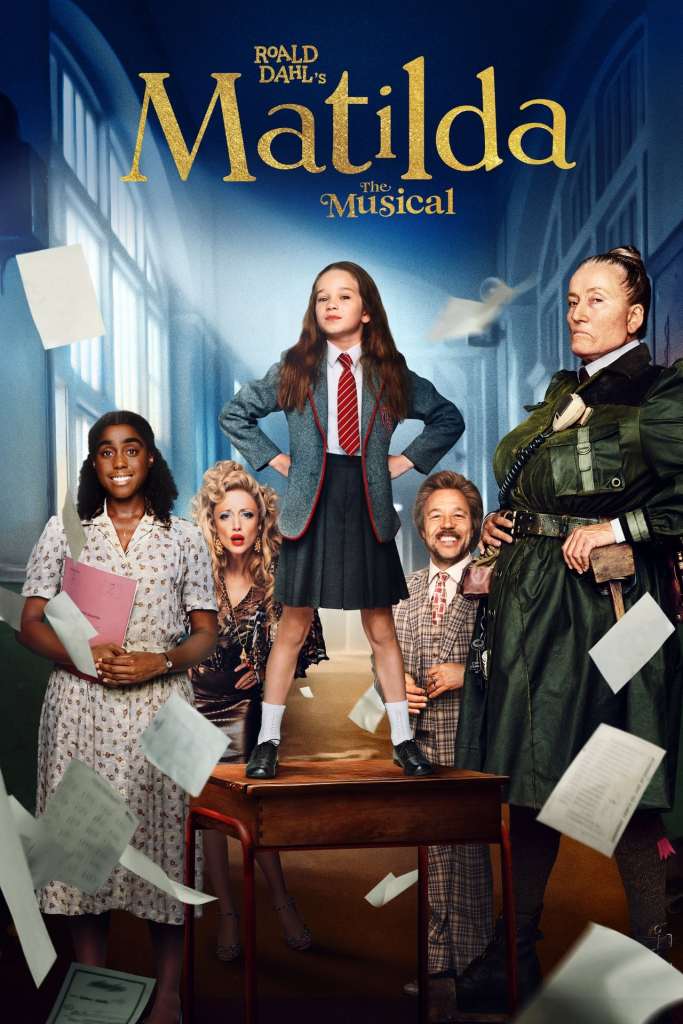
Roald Dahl’s Matilda the Musical (don’t let the wordy title scare you off) is a film adaptation of the popular musical, itself based on the popular child’s book. I saw the touring production of the musical at St Louis’s Fox Theater a few years ago, not knowing anything about it at the time (never read the book as a kid), and really enjoyed it. The film version is solid too. The story revolves around Mathilda, a young girl born to parents who, not only don’t appreciate her, they downright loathe her (her dad always refers to her as “a boy” since that’s what he wanted, to humorous effect in the film but which obviously bothers Mathilda). Her only escape is through books, and she reads everything she can get her hands on, and makes up her own stories when she doesn’t have something to read. Mathilda’s life changes when the local authorities realize she’s never been in school; her parents didn’t bother enough to send her. Mathilda starts school with dreams of learning new things, but those dreams too are dashed when she meets the school’s headmistress, Agatha Trunchbull. Ms Trunchbull calls the children at her school maggots, and rules with an authoritarian iron fist. Laughs and smiles are all-but forbidden. Mathilda’s only bright spot is her teacher, Ms Honey, who loves her kids and inspires them. There’s a secret at this school between Trunchbull and Honey, a secret that Mathilda will unravel as the film goes along. The movie starts great, with catchy songs, bright colors, and a fun atmosphere despite the dreary life Mathilda lives. The spunky Alisha Weir makes the most of her opportunity as Mathilda, portraying it with zest and a don’t-quit attitude, but it is Emma Thompson’s completely unrecognizable turn as Agatha Trunchbull that steals the show. How can the likable and attractive Thompson transform to such a despicable person?! If she doesn’t net an award or two this season, it’s a travesty. A lot of the jokes are for adults, but I think kids will like this one the most, with its memorable soundtrack sticking with them. ★★★½
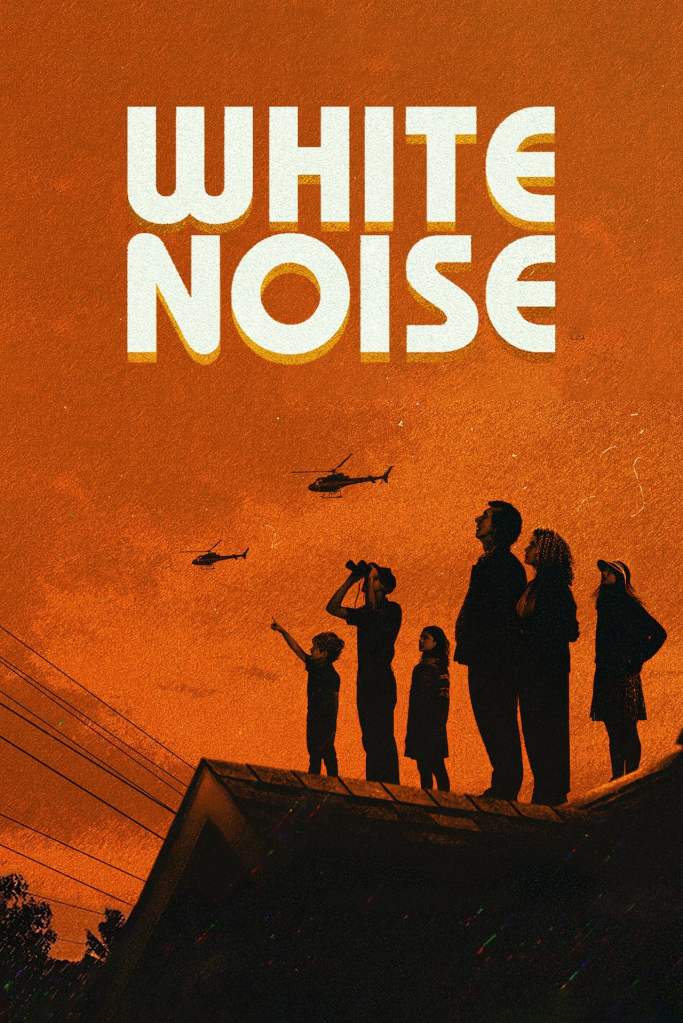
White Noise is the newest film from writer/director Noah Baumbach, whose last picture, Marriage Story, was my favorite film of 2019. I read the book this film is based on back in 2016, and enjoyed its quirky and off-beat comedic style. This movie, recently released on Netflix, is getting middling reviews, but I like the director, I liked the book, so of course I was going to watch it. And thankfully, it’s a fairly faithful adaptation (big change at the end, but it works in the movie). The only knock is that the book is written from main character Jack’s perspective, so as a film, we obviously can’t get in his head. Even so, Adam Driver does a great job of giving Jack Gladney’s mannerisms life. If you’d like the gist (with some spoilers, so maybe only read the first half), read my review of the book. My thoughts on the movie: The comedy is definitely absurdist, as it was in the book. This may turn some viewers off if you aren’t expecting it, because other elements of the film (drama, even some thrills when the “Airborne Toxic Event” throws the town into a very real fear of impending death) don’t always mesh with the laugh-out-loud comedy, but it all comes straight from the pages of the book, and Baumbach expertly handles it all. Driver is the star; how he hasn’t won a major award yet is beyond me. Baumbach’s wife Greta Gerwig plays wife Babette Gladney, and she’s serviceable, though in my opinion she’s always been a better writer/director in her own right than an actor (and we’re all looking forward to her film Barbie coming out this year). I really enjoyed this film, but I can say with confidence that the majority of watchers will absolutely hate it. To each his own. ★★★★
Despite not doing well at the theaters, critics have been high on TÁR since its release, and it seems to be a dark horse favorite for multiple awards this season. I have to be honest, it takes awhile to build, and a good 30 minutes in, I was wondering if it was all hype, but stick it out and you will be rewarded. Cate Blanchett gives a tour-de-force performance as Lydia Tár, a world renowned conductor and composer, in a field that has traditionally been dominated by men. The film opens as she is being interviewed, and her list of accomplishments is staggering. Upcoming is a live recording of her conducting of Mahler’s 5th Symphony, which is generating lots of hype in music circles. Outwardly, she has everything, but as the film goes along, her carefully crafted persona begins to crumble, entirely through her own fault. First, a former protégé commits suicide, and immediately, whispers begin that the young woman was groomed and later cast off by the powerful Lydia Tár. At home, Lydia butts heads with her wife Nina, who also happens to be lead violinist/concertmaster in the orchestra, because Nina sees that Lydia is already eyeing her next fling, a young and brilliant cellist from Russia, new to the orchestra. There’s also the ousting of the group’s assistant conductor, a move orchestrated by Lydia, due to a perceived infraction, and when Lydia’s longtime assistant Francesca doesn’t get the job, more sparks flare. The narcissistic and power-hungry Lydia Tár refuses to see the cracks in her world, until by the end, those cracks are gaping chasms. It’s a brilliant film, made more interesting because, for myself coming from a musical background, I could definitely see characteristics of some of the musicians and the egos involved, and applaud the meticulous amount of research that went into making this film authentic. It’s a sharp look at how a person in a powerful position can use that capacity to bulldoze others, but how that way of life may finally be coming to an end in today’s post- #metoo world. ★★★★★
Another great film today; I can’t remember the last time I had some many good ones in a row! Hold Me Tight is not a film you’ll find easily, as it is an indie French film from 2021 that seems to have flown under the radar. I can’t talk about the movie at all without giving away a couple spoilers, so I urge you to stop here and go find it to watch. Those who don’t care to read subtitles can continue on. This film follows a woman named Clarisse who, in the beginning of the film, abandons her husband and two kids for an unknown reason. As the film progresses, we see Clarisse out on the road, while her husband Marc raises Lucie and Paul on his own. However, Clarisse has conversations with them from afar, in her head, and they answer back, and it takes awhile to know what exactly is going on. Much is explained 30 minutes in, when we learn that the family was vacationing in the French Alps one winter, when Marc took the kids out, and they were overtaken by a series of avalanches. With that particular area snow-covered now, the authorities have to wait until spring to retrieve the bodies. The whole movie so far, and the rest from here on out, is a fabrication in Clarisse’s head. Unable to confront her family’s death, she has concocted this notion that it was she that left them, so in her mind, she can pretend they are still alive at home, and their lives are continuing without her. The movie blends past and present, with scenes cutting between reality and Clarisse’s fiction, all on a dime, so you’ve really got to pay attention to keep up. And don’t forget to notice that the actors playing her kids change at one point too, and not just because they are getting older in the “years” that have gone by while Clarisse is away. It’s a beautiful and often heart-breaking film about grief and trouble letting go, and though the big surprise comes at that 30 minute mark, there’s still plenty to unwrap before the end. ★★★★★
TV recently watched: The Witcher: Blood Origin (miniseries), The Empress (season 1), Guillermo del Toro’s Cabinet of Curiosities (season 1)
Book currently reading: The Dragon Reborn by Robert Jordan
When my blog switched over from reviewing books to movies, I never envisioned that movies would become my passion. In 2019, I was super excited when I watched over 365 movies in one year; little did I know at the time that this would become the norm for me. According to my Letterboxd, I saw 401 in 2020, 380 in 2021, and 410 in 2022. That’s a lot of movies. Unfortunately, lately, it has started to seem like work, always feeling like there’s more to watch and “keep up on.” Having said that, it is time to take a “small” step back. I’m not going to disappear (in fact, I’ve already got a couple movies in the bag that I need to sit down and put thoughts to and post), but I’m definitely going to start 2023 watching less. I’ve got my second grandchild coming in January, and spending more time with them as well as re-visiting my own childhood by playing a couple video games that have been sitting on my shelf for a few years (yes, actual discs!) will give me a chance to reset. Please subscribe to my blog if you stumble across here, as I will still be posting a couple times a month, but I may watch half my “average” yearly total of films in 2023. I hope everyone has a good year!
And, as I always finish my blog posting what I’ve been watching/reading, here’s what I’ve been up to in the last week (had a lot of holiday time off!).
TV series recently watched: Jack Ryan (season 3), Dahmer-Monster (miniseries), Wednesday (season 1), Squid Game (season 1), Peaky Blinders (seasons 5+6)
Book currently reading: The Dragon Reborn by Robert Jordan






 Jons Movie Takes