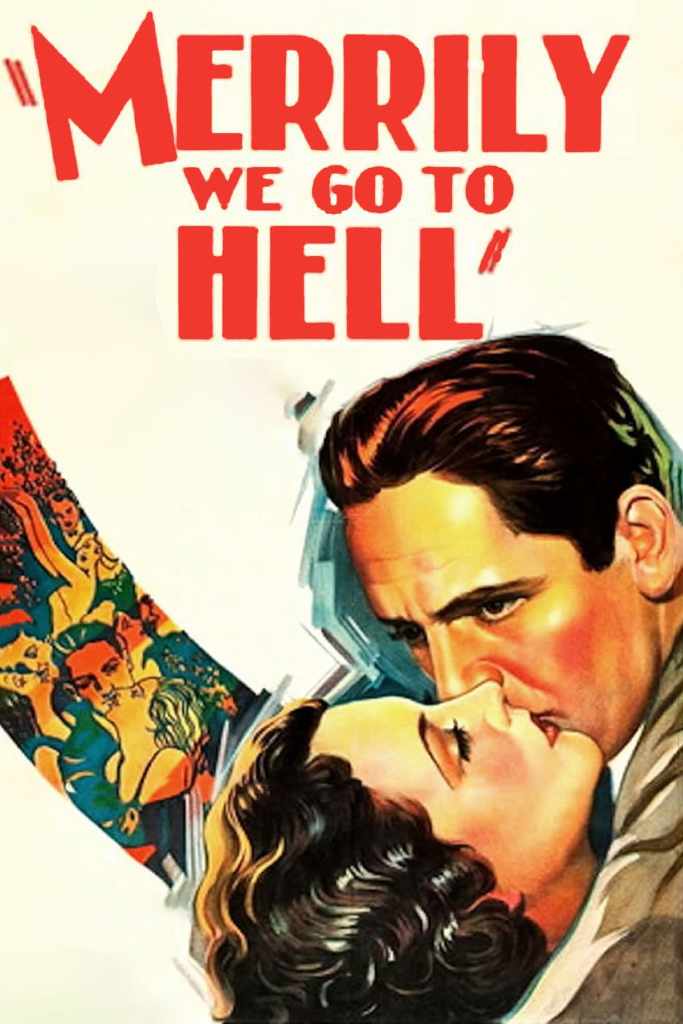
I’ve got an eclectic mix of 1930s American films today, including a couple pre-code movies and a couple musicals, including one with Fred Astaire and Ginger Rogers. We’ll begin with 1932’s Merrily We Go to Hell. Pre-code refers to a short window of movies made from 1929 (the introduction of sound in film) until 1934, when the “Hays Code” became standard, after which a whole lot of stuff couldn’t be shown (or even hinted at) on screen, because it wasn’t proper (i.e. went against our Christian values). Even the title of this film wouldn’t have passed, much less its content! Jerry Corbett is a Chicago reporter by day, an alcoholic by night, but he’s a “fun drunk,” and thus catches the eye of Joan Prentice, an heiress to a tin-can manufacturing company. Joan is swept off her feet by the dashing and good-natured Jerry, and while he stops drinking after their marriage, he begins again after awhile, which leads to problems. When Jerry reunites with an old flame, a stage actress who inspires Jerry to write a new play, the two begin an affair. Not to be outdone, Joan announces that if it’s good for the goose, it’s good for the gander, and she too begins going to parties and hanging around other men. This open marriage may be good with Jerry, always in his bottle anyway, but it’s a front that Joan can’t keep up, as she does truly love her husband. Portraying drunken partying and infidelity, this movie wouldn’t have been made a couple years later, but it’s a fun comedy with a serious side, made well ahead of its time. ★★★½
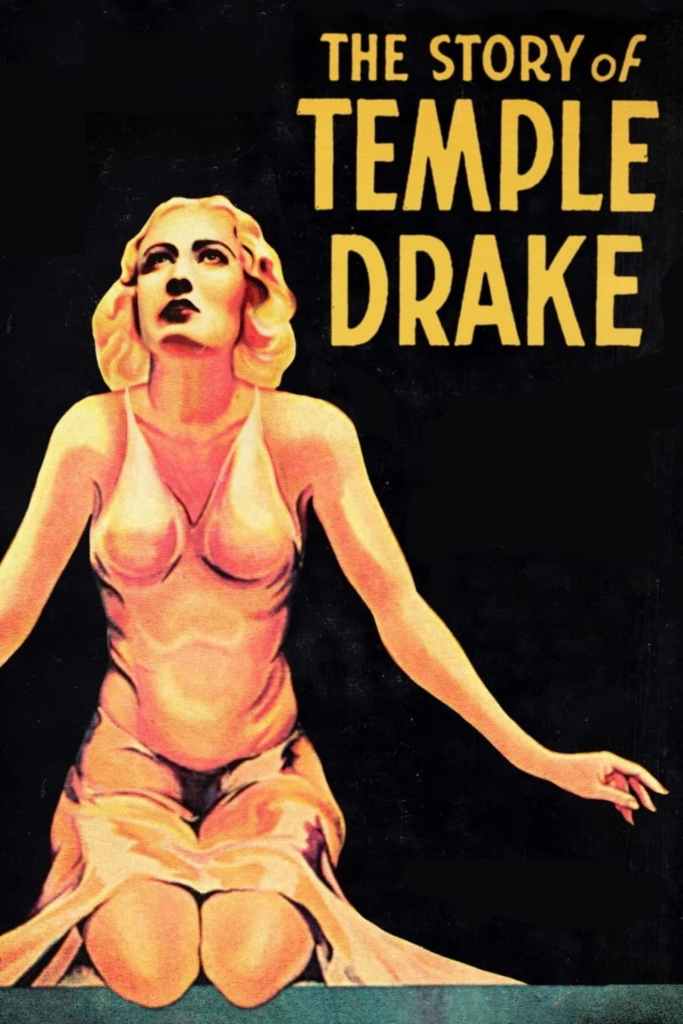
The above film may have been considered racy for its day, but it’s got nothing on 1933’s The Story of Temple Drake, based on the William Faulkner book Sanctuary. Temple (portrayed by Miriam Hopkins) is a partying woman and the current black sheep of the family, her grandfather being a prominent judge. The judge wants to see her settle down and marry her boyfriend, lawyer Stephen Benbow, but Temple isn’t ready to stop having a good time just yet. At a party, she leaves with another man, a drunk named Toddy Gowan, but the couple crash his car out in the boons, and stumble upon an old farmhouse, currently being run as a speakeasy. The place is full of surly types, and Temple is afraid for her life, but a kindly woman there tells her to sleep in the barn for safety, and sets a simple minded man, Tommy, to guard her sleep. Unfortunately for both, a gangster named Trigger will have his way; he shoots Tommy and then rapes Temple, taking her back to Chicago as his woman. It isn’t until her old boyfriend Stephen, investigating Tommy’s death (another man has been wrongly accused, but fears implicating Trigger to put his own life in danger), comes knocking that Temple is able to get away. But can she tell her story, knowing it will ruin her? A scandalous film upon its release, it is said that it spurred Will H Hays to hurry along his attempts to enforce the motion picture code that would stay in place until the 1950s. It’s a dark film to watch for sure, but well acted, and shows Temple coming through her ordeals as a strong woman, fighting her way out on her own. ★★★★

1936’s Show Boat, based on the musical of the same name and starring several of the original Broadway cast members in their roles, shows the interconnected lives of the performers on the eponymous boat, working its way up and down the Mississippi to delighted crowds along the way. With book and lyrics written by Oscar Hammerstein (and music by Jerome Kern), I thought I’d be in for a treat, but it doesn’t quite hit the mark, and unfortunately is extremely dated. It begins as the boat sets up shop at a small town in the south, and trouble is immediate. First, the boat owner’s daughter, Nola (Magnolia), falls for a no-good gambler named Gaylord. Nola’s mom wants to keep them apart, but after the show’s two stars, married couple Julie and Steve, have to quickly flee (it is revealed that Julie is “passing” for white, as she had one white parent and one black, and at the time, any ounce of “black” blood means you are black, and thus illegal to marry a white man), Nola and Gaylord are thrust onto the stage as the new stars. Eventually they get married and head off to Chicago to start a new life, but Nola finds it is not what was promised. Gaylord continues his ways, finally leaving Nola and their daughter Kim. Over the ensuing years, Nola carves a path for herself, becoming a famous stage singer and performer, as does Kim when she grows up. The whole story takes place over several decades obviously, which should leave the viewer feeling a sense of epic time and progression, but it was lost on me. The beginning is quite good, with the better songs too (including the show’s one big hit, Ol’ Man River, sung by Paul Robeson), but the second half is rushed and a bit of a mess. The film is chuck full of unfortunate racial stereotypes (including Julie in blackface in one performance; though obviously we later learn than she is multiracial, but still comes off poor). I’m not one to “cancel” a whole slew of films though, just because of when they were made. A film can acknowledge the racism of the day; doesn’t mean it is a racist film. And Show Boat does do a lot of things right: it was the first racially integrated musical, and had a whole black chorus for the first time, and the marriage between Julie and Steve shows a true interracial relationship, a rough notion to sell in 1936. From a personal note, I enjoyed seeing Hattie McDaniel and her bubbling personality, 3 years before her Oscar-winning performance in Gone With the Wind. ★★
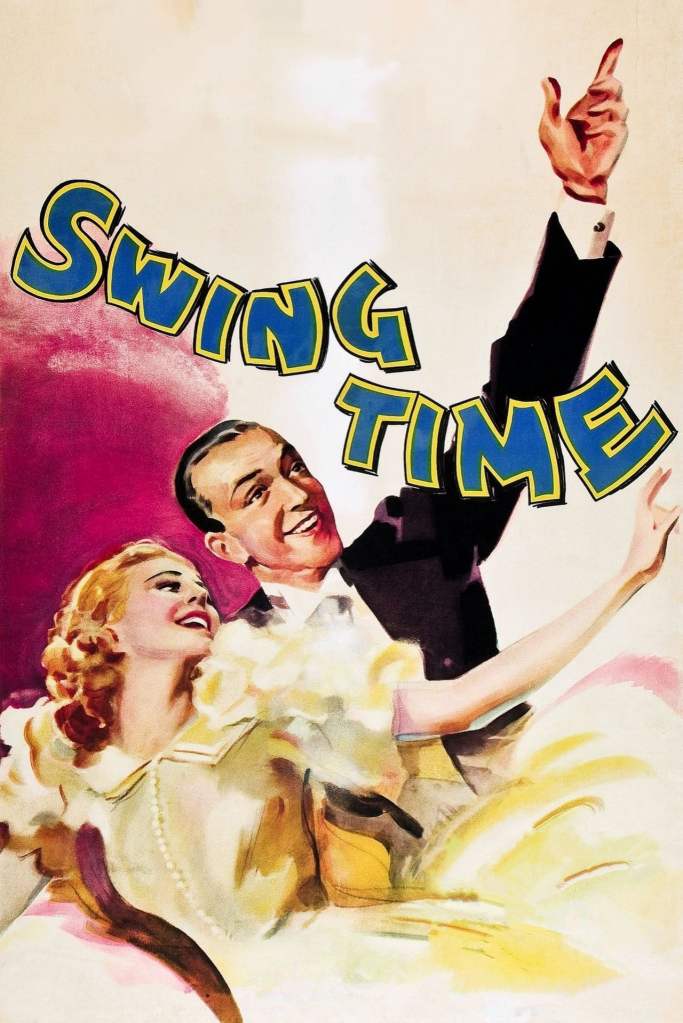
How can I watch some 30s American films without including one with Astaire and Rogers? In Swing Time, John “Lucky” Garnett is an established dancer with a penchant for gambling away every penny he makes (that is more true than you can guess, as we soon see). He even gambles away his marriage, as he loses track of time while betting with this friends and is late to his own wedding. The bride’s father says he will now only allow this marriage if John can show that he can save some money and be respectable. John and his sidekick Pop (along for the ride for his comedic value) head to New York with just John’s lucky quarter in his pocket, and upon landing, they run into Penelope “Penny” Carroll (“Lucky” and “Penny”…). Penny is a dance instructor, and John pretends to not know how to dance to get in with her. They develop a relationship, but John’s gambling problem may still come between them before the end, as may that fiancee he left back in his hometown. The story is solid, the comedy funny, and the dance numbers are absolutely incredible. One rough moment when Astaire comes out in blackface (again with the blackface) for a performance, though in the movie, he’s doing it out of respect to honor the famous Bojangles, or Bill Robinson. ★★★★½
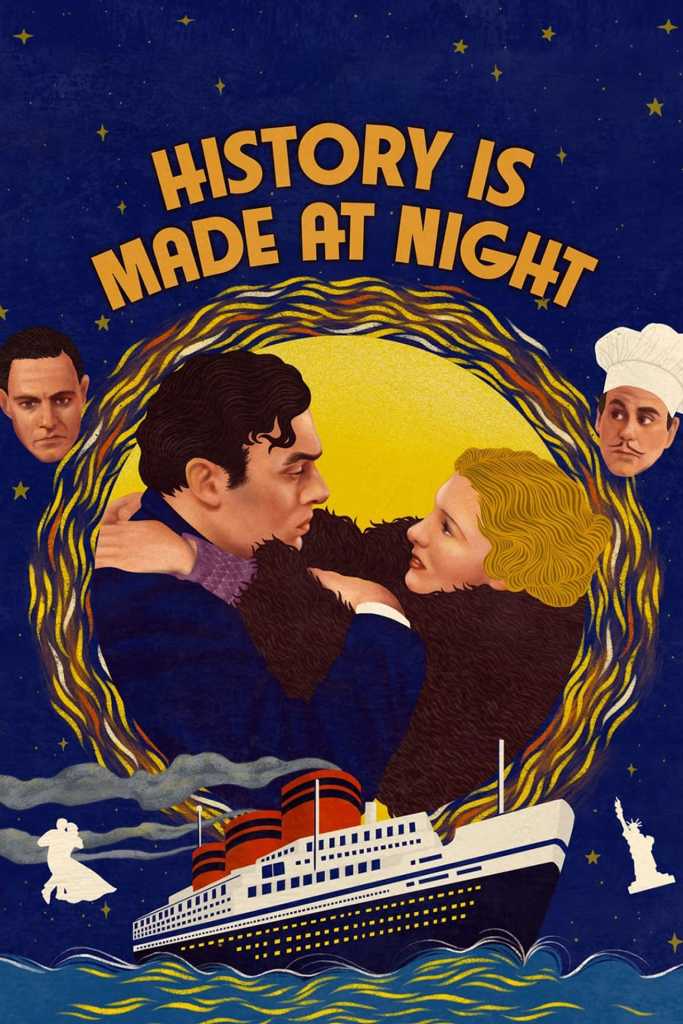
Finally, a romance/comedy/drama, the type that was hugely popular in this era. This one feels a bit different though. History is Made at Night stars Jean Arthur as Mrs Irene Vail, who desperately wants out of her marriage with controlling and jealous husband Bruce, a shipping magnate. Bruce has, for years, been falsely accusing Irene of infidelity, and she’s tired of it. While in Paris, Bruce even hires a man to pretend to be her boyfriend, in order to invalidate her intended divorce proceedings (some weird French law). While the man is in her apartment attacking her though, a passerby, a French head waiter named Paul Dumond (the dashing Charles Boyer), steps in and saves Irene by hitting the man over the head. When Bruce shows up, Paul pretends to be robbing Irene and then “kidnaps” her. When Bruce’s thug wakes up, Bruce kills the man, in order to tap Paul as the killer. After Irene and Paul’s one night out, in which they basically fall in love right away, Bruce finds her and bribes her to return to America with him, or he’ll get Paul arrested and executed for murder. Paul later learns the couple returned to America, but not knowing why, he follows her there, and concocts a plot to finally separate the couple and win Irene over for good. But Bruce, who obviously didn’t stop at murder, will do anything to get his wife back and keep her. The final act is a bit too sensational and jumps the shark a bit (err… an iceberg that is…), but the rest of the movie is near perfection. It’s just different enough from all the other “woman leaves a bad marriage for a better man” stories to stand out on its own. ★★★★½
- TV series currently watching: Cobra Kai (season 5)
- Book currently reading: All the Light We Cannot See by Anthony Doerr

 Jons Movie Takes