Up today are a few films from Japanese director Mikio Naruse, who had a long career spanning some of the biggest names in the biz (Ozu and Mizoguchi to name a couple), but who doesn’t get mentioned in the same reverence as those for some reason. I’ve got 4 of his silent films from the 30’s, and a later film from 1960.

No Blood Relation is about a woman, Tamae, who, 5 years ago, abandoned her husband and infant daughter to pursue an acting career in the United States. She has had a successful run, but has always missed her daughter Shigeko, and has now returned to Japan to try to pick up the pieces. However, her ex-husband, Atsumi, has remarried, and his wife Masako is the only mother Shigeko has ever known. The viewer doesn’t think there’s any way Tamae will find an in, until Atsumi’s business lands in bankruptcy. Unable to pay his debts, Atsumi is jailed, and his mother, Kishiyo, who has always lived in luxury, will do anything to stay away from the slums. Kishiyo approaches Tamae about reuniting her with Shigeko, in exchange for a better lifestyle for herself. Tamae, however, refuses to see the bonds Shigeko has developed with Masako. I tend to prefer silent film comedies, but as dramas go, this one is decent enough. ★★½

Apart From You packs a much harder emotional wallop. The film has 3 central characters: Kikue, an aging geisha who is hanging on, trying to keep working until her son graduates high school; the son, Yoshio, who resents his mother for her occupation and has fallen into a local gang; and Terugiku, who is a younger geisha working with Kikue, but who is like a sister to Yoshio. Kikue knows her time is just about up, as she fights gray hairs and a diminishing supply of interested men at work, where she has to compete with much younger coworkers. She’s never liked her profession, but does it to support Yoshio. Terugiku also hates the job, but she has a different reason for staying at it: her drunkard father has plans to send Terugiku’s younger sister off to be a geisha too, and Terugiku refuses to see that happen. She’ll work all the harder to make sure the family has money enough to not have to send her sister. And in the middle is Yoshio. He seems to look past Terugiku’s work but can’t do the same for his mother. This film is rapturous from the get-go and kept me spellbound until the very end. If Naruse has more films like this one coming up, how come he’s not more well known?! ★★★★

Every-Night Dreams is about a single mother, Omitsu, raising her young son on her own. Omitsu is barely scraping by and relying on help from her neighbors to watch Fumio while she works at a bar. Her husband abandoned her years ago, but one day, he just shows up at her door. Mizuhara admits that he was a coward, but that he has missed his son and wants to start fresh. Omitsu denies him at first, but finally allows it, as long as he gets a job and supports them. Finding work in the Great Depression era is difficult though, and Mizuhara is unable to find work. Desperate, he’ll turn to anything to get money for his family, but will Omitsu accept ill-gotten money? Pretty straight forward film, and short at just a couple minutes over an hour, but, like Apart From You, it is very emotional in the end. ★★★½
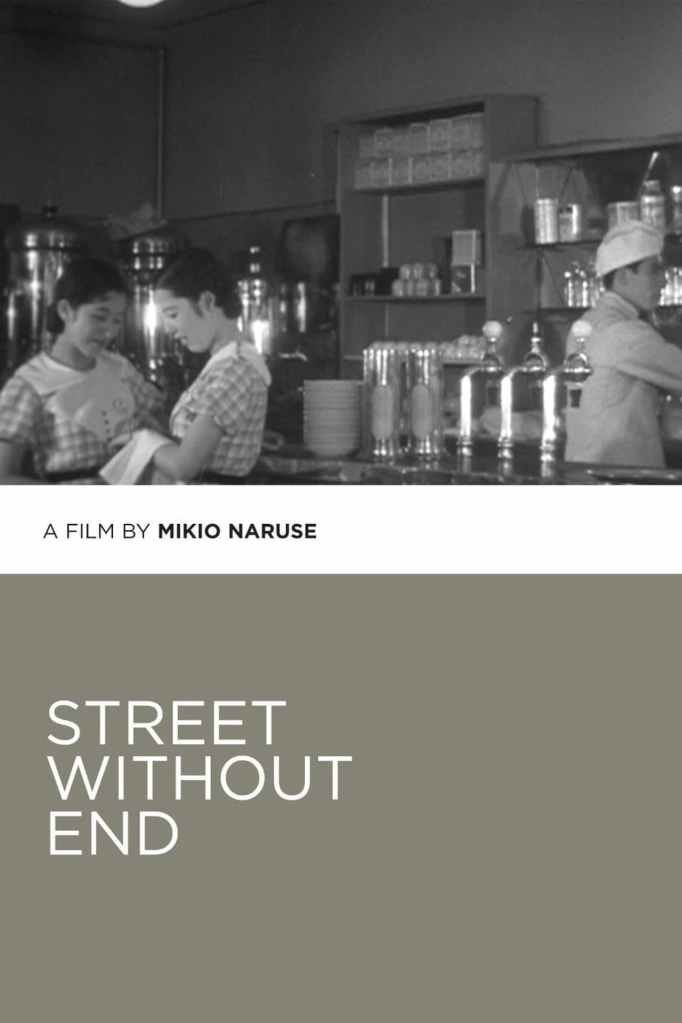
Street Without End continues the trend of focusing on woman protagonists, this time following a cafe waitress named Sugiko. At the beginning of the film, she has a lot of prospects: a boyfriend ready to propose, and a chance to become an actress after a scout sees her at work. However, those plans all float away when she is struck by a car one day. Her fiancé leaves and the acting job goes to another girl at her work. At first, fortune seems to smile on Sugiko, because the person who hit her, Hiroshi, is a wealthy man who becomes smitten by her charm. Hiroshi marries her, much to the consternation of his mother and sister, who believe Sugiko is beneath their station. This leads to snide remarks and open hostility at home, driving Hiroshi to drink and enter a spiral that will be his downfall. Through it all, Sugiko remains strong. I liked the overall plot in this one, but, especially in the beginning, it felt a bit too “all over the place” and didn’t really settle down until the second half. The abrupt ending also snuck up on me. ★★½
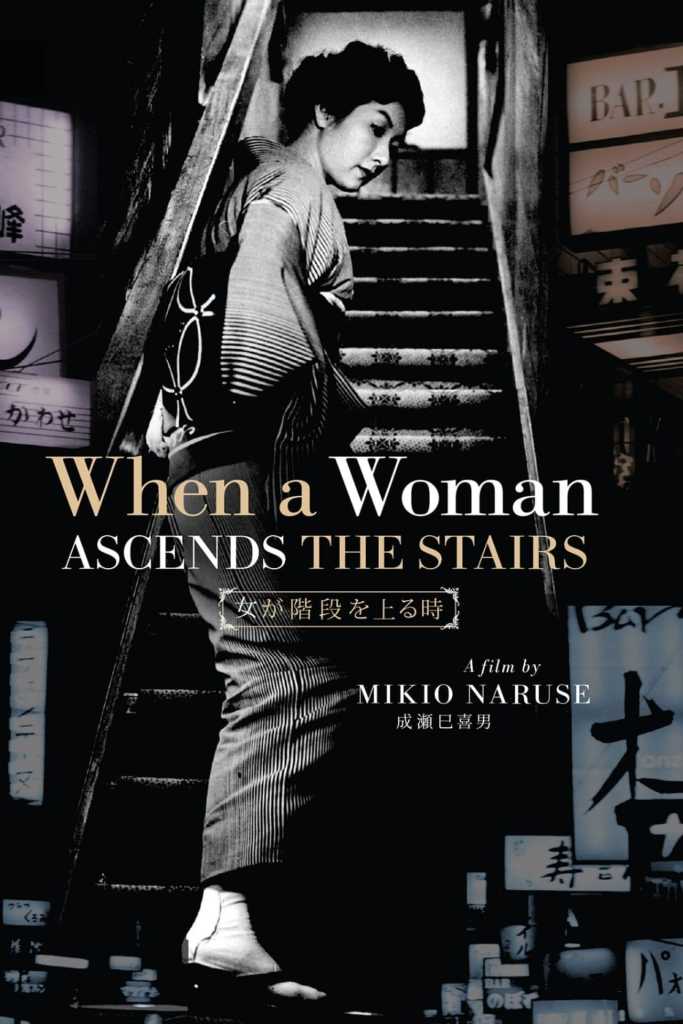
Jumping well out of the silent era, up next is 1960’s When a Woman Ascends the Stairs. An absolutely brilliant film, it is about a woman named Keiko, affectionally called “mama” by her patrons. Keiko runs a bar in the hopping Ginza district. Only 30 years old, she is already a widow, and is supporting her mother, her no-good brother, and his son, who is confined to crutches after having polio. Keiko hates her job, but at her age, she knows she’s getting too old to get a proper husband, so she’s consigned to it. The first half of the film follows her daily activities and interactions at work, and we get to know her well. Keiko knows the ins and outs of running a bar and how to deal with its patrons, every one of which Keiko makes feel comfortable and important. She sees employees come and go, including one who opens her own bar as competition, but who flames out when she goes into debt. At every turn, whenever anything opens up that may better Keiko’s situation (the chance to open her own bar, rather than work for someone else, or to actually get married so she can give it up), something happens to knock her back down. The one constant, the one time in her life when she’s alone to think, is the climb up those stairs to the bar every day. Beautifully acted by Hideko Takamine in the lead, it’s a heart-wrenching film that will stick with you when its over. ★★★★½
- TV series currently watching: Mayans M.C. (season 4)
- Book currently reading: Dragons of Spring Dawning by Weis & Hickman

 Jons Movie Takes