
These are a trio of Mexican-born directors who are among the most popular of the country’s directors today (I’d obviously put Alfonso Cuarón here too, but I think I’ve seen all of his films already). I’m starting with Guillermo del Toro. I’ve seen everything he’s made since Hellboy in 2004, but today I’m going back to his first three films, starting with 1993’s Cronos. After an introduction setting up the invention of a mechanism by an alchemist in 1536, an item which made the guy immortal until his house collapsed on him in 1937, we see that the mechanism was lost to the world until it showed up in Jesús Gris’ antiquities shop in the late 90s. Jesús stumbles upon the item completely by accident, but when he starts playing with it, tiny pincers emerge and stab into his hand, freaking out his young granddaughter Aurora. Jesús pulls it off and throws it in a box. The next day, getting ready for work, Jesús notices in the mirror that he looks quite a bit younger than the day before. Knowing now the secrets of the item, he guards it, even as a sickly rich man, who has long sought this mythical item, sends his goons after it. Unfortunately for Jesús, long life isn’t the only gift given by the gold piece; he also begins to crave blood. This modern reimagining of the Dracula story is quite good. It is low budget, but well acted (with actors including Ron Perlman, beginning his long relationship with del Toro, and Claudio Brook, who was extremely prolific in his career) and engaging to the end. Even in this first film, del Toro knew how to set a scene. ★★★½

Del Toro followed with Mimic, a Hollywood film (everyone needs to make money, right?) that spurred a series of sequels. As I learned in The Shape of Water, not everything del Toro touches turns to gold, but Mimic may be the worst. In New York, cockroaches are spreading a sickness that is killing and maiming children. Hotshot scientist Susan Tyler (Mira Sorvino) develops a genetically mutated roach which she dubs the “judas breed,” which is meant to go into roach hives and release an enzyme which will kill the colonies. This new breed is supposed to be sterile and die out in 6 months, but 3 years later, Susan will learn that things have gone very bad. It takes awhile to get there, but eventually, we learn that the ol’ roaches have learned to mimic their next prey: humans. Human-sized roaches are ready to kill! While del Toro still sets a great mood for his scenes, this movie is pure schlock. Events take too long to develop, and the whole thing is way too predictable and boring for a horror film. Save your time, watch almost anything else from this director. ★
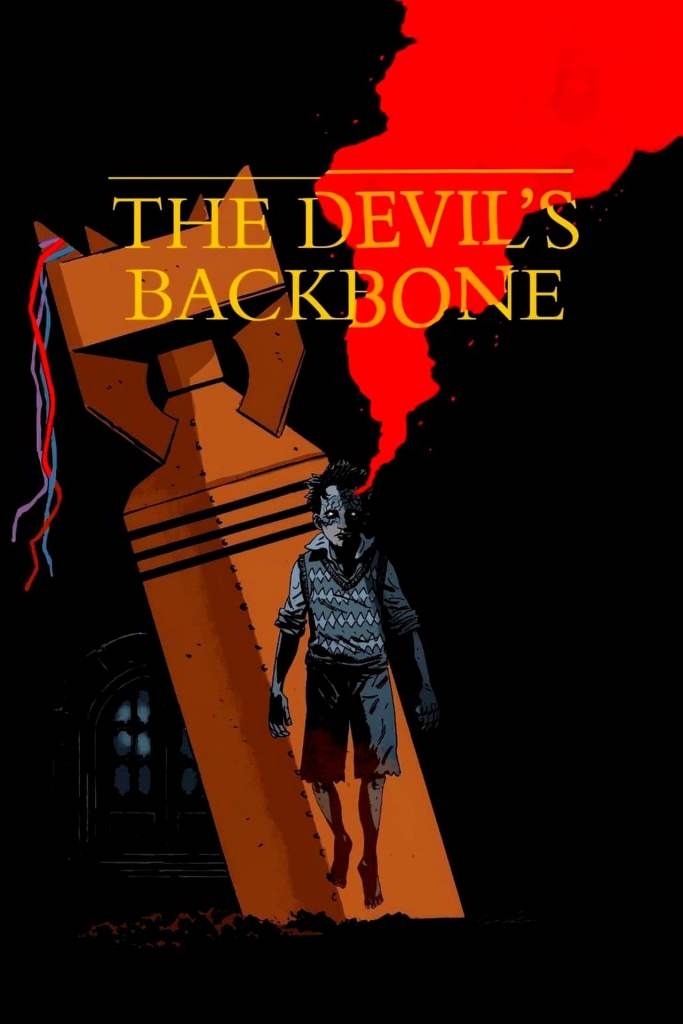
The Devil’s Backbone takes that style and, thankfully, adds substance. Filmed in Spain and taking place during the Spanish Civil War, the film follows Carlos, a young boy newly orphaned, who is left at a remote orphanage by his parents’ former employees. The orphanage is run by Casares, a doctor, and Carmen, a duo who are secretly supporting the Republicans against Franco’s Nationalists. As it is looking increasingly likely that Franco is going to win this war, their position is tenuous at best, but they are currently scraping by, getting just enough food to keep the boys from starving. The only staff members are the groundskeeper, Jacinto, who has a mean streak, and his fiancée Irene. Carlos is thrust into this setting, and he quickly learns the building is housing a secret: a young ghost. The other boys talk openly about the ghost, though the adults seem to be unaware. Upon Carlos’ arrival, the ghost immediately seems to be reaching out to him, trying to tell him something. Can Carlos overcome his fear to listen? And what happens when the war comes to their doorstep? This movie is creepy (downright scary at times), and has a compelling story in one of Spain’s darkest days. I was chilled, exhilarated, and moved. ★★★★½

Up next is Alejandro González Iñárritu. Again, I’ve seen most of his stuff (Birdman was one of my favorite films of 2014), but not his debut, 2000’s Amores perros (“Love’s a Bitch”). The movie starts in the middle, so to say, with Octavio and his buddy fleeing in a car. In the back seat, their big black dog, Cofi, is bleeding out. The chase ends in a disastrous wreck, and then we rewind to see how we got here, and the movie is divided in three parts. In the first, Octavio is in love with his brother’s wife; Ramiro and Susana married when she became pregnant, but don’t seem to have much love for each other. Ramiro is out having affairs and his only source of income is robbing drug stores. Octavio decides to make some money and run away with Susana; to do so, he enters their dog into the local dogfighting ring. Cofi does well, but once the money starts coming in, Ramiro wants his cut, not to mention Cofi’s success puts a damper on a rival dogfighter’s pen, the same man who is chasing Octavio at the beginning of the film. At the same time, the movie is also following an older man as he tries to reconnect with this estranged adult daughter, after the daughter’s mom (man’s ex-wife) dies. A third storyline revolves around a businessman having an affair. The film plays out for an hour before we “catch up” to that opening scene. From there, we get the other 2 parts, which follow the businessman and his affair, and finally, the vagrant and his story around his daughter. All of their lives intersect the day of the car wreck. I generally liked Octavio’s storyline the most, and the film started to drag in the second half, but still, there are a lot of sublime moments, and not just because you are connecting dots along the way. Very well acted across the board (including by Gael Garcia Bernal, as Octavio, in his first leading role). ★★★½

Lesser known by most but with a lot of acclaim in film circles is Carlos Reygadas. His debut feature film, Japón, was released in 2002, and from the outset, I could tell this was going to be a beautifully shot movie. Talk about some gorgeous vistas! With a 2:88 aspect ratio, the ultra widescreen shows off some impressive landscapes in the barren Mexico countryside. The movie follows an unnamed man who walks with a severe limp, who has come to a remote, Godforsaken land, in order to commit suicide. He stumbles upon a tiny town in the mountains and asks for a place to stay for a couple days. The villagers point him to an old widow’s shack halfway up the mountain. She lives alone and has an empty barn, which our traveler finds will be perfect for his needs. All he wants is a quiet place to contemplate and set things right in his head before he does the deed. Unfortunately for him, he grows fond of the widow, who has to fight nature and her own family (her nephew wants to tear down the barn to reuse its stone, though the lack of the barn will expose her shack to devastating winds down the mountain) just to survive. It’s meant to be very contemplative, but I was bored out of my mind. It all seemed sort of pretentious, and, yes, it is a beautifully made film, but be prepared to fight to keep your eyes open. ★½

Reygadas’ third film, and probably his most heralded, is Silent Light. Filmed in Mexico but revolving around a Mennonite community there, it is in the Plautdietsch language. The film follows Johan, a man struggling with balancing his deeply religious upbringing/life and a newfound love of a woman outside of his marriage. Johan has long been married to Esther, who has given him a house full of children, but he is now attracted to Marianne. Esther is aware of the affair, but her love for her husband and faith that things will turn out well in the end is keeping her silent. Johan does not know what to do: follow his faith or follow his heart. This is a slow-moving, deeply introspective film, and by the ending, if you have the patience to go along for the entire ride, a profoundly moving one as well. The director lets the scenes breathe, and nothing is rushed, so many may grow bored. Somehow I avoided the fate of Japón, and was entranced. The payoff in the end is worth waiting for. Rushing to the end would not have left much of an impact. ★★★★
- TV series currently watching: Batwoman (season 3)
- Book currently reading: Watching You by Lisa Jewell

 Jons Movie Takes