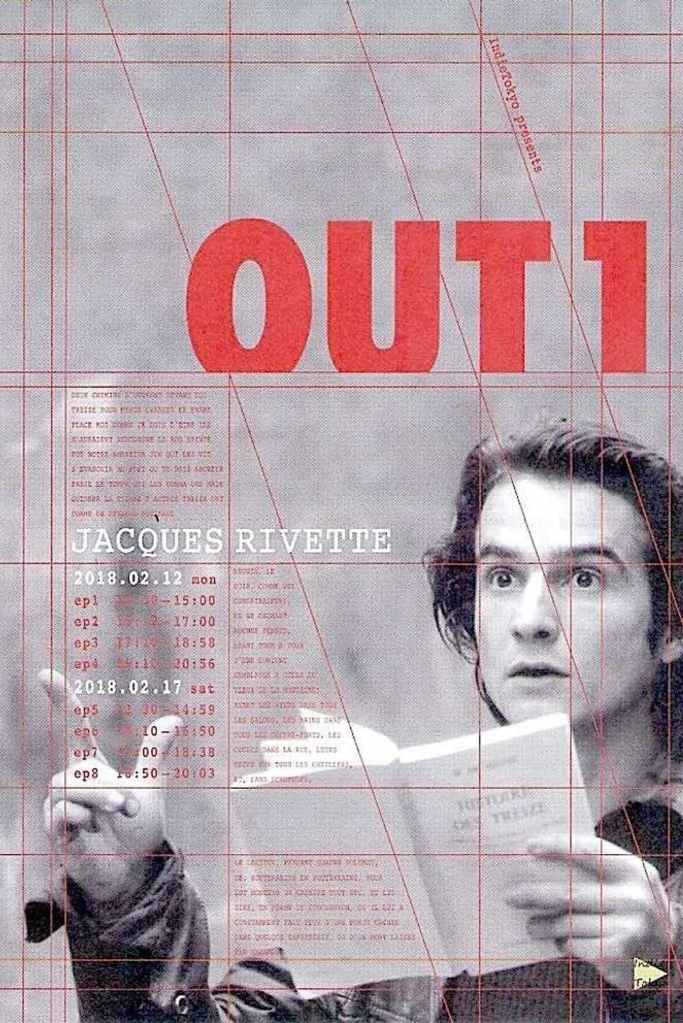
Back in January I dipped my toes into director Jacques Rivette’s films. I liked a couple very much, but others didn’t do a thing for me. Longtime readers of my blog know I love a good, long film, and Rivette has one of the longest. His Out 1: Noli Me Tangere clocks in at nearly 13 hours long, broken up into 8 feature-length episodes. This film is not for the easily distracted, but if you invest into it, it is an ultimately rewarding experience.
If a 90 minute film takes 20 minutes to introduce the characters and “set the table” so to speak, imagine how long that takes in a 13 hour film? For Out 1, it takes over 3 hours before I started to get a sense of where we were going. Even then, when real plot elements start developing, I mostly came up with more questions than answers. To begin, we are introduced to two theater/acting troupes (one led by a lady named Lili, the other by a man named Thomas), each prepping a performance of different plays by Greek playwright Aeschylus. Each play is very esoteric, full of almost-improved moments, and frankly very out-there takes. Much of the first two episodes are made up of these rehearsals, which seem to have little to do any kind of overarching plot, but, I think, very necessary to getting to know the various characters. If you are paying attention, you really get a sense of the personalities of the various characters (and there are a lot in this film).
Two other characters, not involved in the acting, are also introduced, in short scenes early on, but with bigger roles as the film progresses. Frédérique cons men out of money to get by in her bohemian lifestyle, and Colin plays deaf and dumb to beg money from diners at local cafés. One afternoon though, Colin receives a mysterious letter under his door, referencing published works by Lewis Carroll and Honoré de Balzac; specifically, Colin begins to believe there is a secret group in the city known as “the thirteen” who have some unknown goal in mind. Colin sets out to find this clandestine group. This mystery continues to build through the fourth episode, when Colin believes he has found at least one member of the thirteen, a shopowner named Pauline. As the viewer knows, but Colin does not, there are connections between Pauline and at least one of the actors in the two troupes.
As the film plays out, other connections between various characters are discovered, and subtle mystery is sometimes abandoned for real suspense. For example, a chance encounter between Frédérique and her latest target nets her a pile of old letters, stolen from his armoire. She reads them, and sees they are full of plots to do harm to the city (the man is also a member of the thirteen). When Frédérique contacts a person on the return address of several letters, in an attempt at blackmail for money, it turns out to be Lucie, a lawyer who had previously been in contact with Lili from one of the above acting troupes. Frédérique’s and Lucie’s interaction on a rooftop presents the first very real sense of danger and intrigue to the viewer; Lucie throws some not-so-subtle threats at Frédérique and tells her she is in way over her head, before walking off with the letters without paying.
In the 6th episode, this tightening of circles between the various characters becomes more transparent, and we see there are a whole lot of connecting lines between these dots. I don’t think many will sit down for a 13 hour film, but in case you do, I don’t want to say any more, to ruin some of the great surprises that come in the final 2 episodes.
Ultimately what this long film boils down to is human connection, and the lengths people go to to be “part of the group.” The Thirteen, the two acting troupes, etc., are all just just reasons to get together, to feel a part of something. I enjoyed the journey for the most part, and applaud the scope of the project, even if at times there seemed to be a lot of filler. ★★★½
- TV series currently watching: Servant (season 3)
- Book currently reading: Before the Fall by Noah Hawley

 Jons Movie Takes