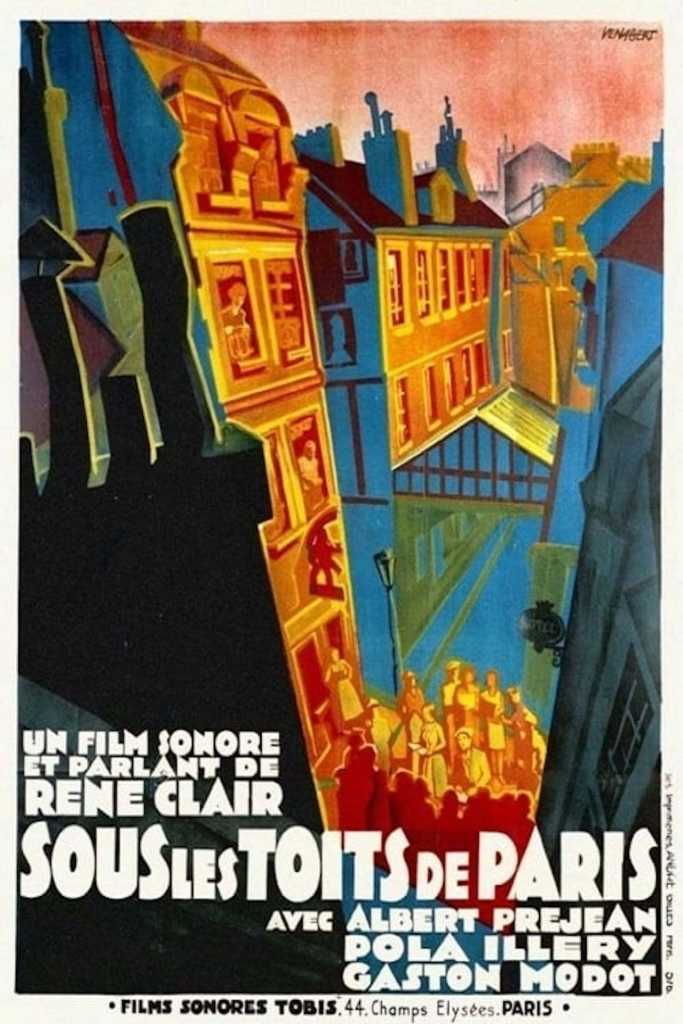
Today I’ll be reviewing five films from French director René Clair, whose career spanned the silent to sound era. Up first is Sous les toits de Paris (Under the Roofs of Paris), from 1930. An early sound film, it features a lot of music over most of the film, interspersed with scenes of dialogue here and there; an experienced director getting his feet wet in a new medium. The film follows Albert, a street singer whose only income is selling sheet music to accompany him for ten cents a sheet. Albert has a good heart, and stops a thief from plying his trade on Albert’s unsuspecting customers. One of the would-be targets is the attractive young Pola, who, unfortunately for Albert, already has a boyfriend, Fred. Fred though is a womanizer and a brute, and Pola soon leaves him. She won’t let Albert get fresh though, making him sleep on the floor as she takes his bed while hiding from her ex. The aforementioned thief isn’t done with Albert either though, and sets him up to get arrested, all a ploy by Fred to get Pola back. It’s a cute enough film, though a bit dated obviously in its views about women (Pola is expected to swoon over any man who gives her an eye). ★★½

À nous la liberté (Freedom For Us) followed in 1931, and is more of a straight-forward comedy. While it still has a lot of music, it is also more of a “normal” talkie, more dialogue-driven than just accompanying sound. And it’s very funny, from the opening scene, when we see a toy production assembly and are led to believe it is a toy worker’s shop, until the camera zooms out on the workers and we see they are prisoners. Émile and Louis are friends in jail but have a plot to get out. On the night of their escape, Émile sacrifices his chance to get out to make sure Louis gets free. Louis makes the most of it, scamming his way into a company and working his way up to president, becoming wealthy in the process. A few years later, Émile is free and begins working at the phonograph factory Louis owns (in a much-the-same assembly line that hearkens back to his prison time; I couldn’t help but see comparisons between these industrialized shots to Chaplin’s Modern Times, which was still a couple years into the future). The two old buddies run into each other and instantly connect again, but it all may come to an end when other former criminals recognize Louis and threaten to unmask him to the police. Lots of sight gags, so if that’s your type of humor, you’ll have plenty to enjoy. ★★★

The above films had plenty of music, but Le Million (1931) is what I would consider a “true” musical, with tunes sung by the actors (not just background) which advance or enhance the story. In the film Michel is an artist buried in debt; he owes everyone from merchants to neighbors. He wants to marry his neighbor Beatrice, but has no money to do so. Just as things are at their bleakest, Michel sees in the paper that a local resident has won the Dutch lottery for millions of francs. Michel is obviously elated to see his life changed, but first he has to get that lottery ticket back. You see, he put it in an old jacket pocket, which Beatrice had. But she gave the jacket to an old man dodging the police, who sold it to an opera singer looking for just such a prop for his latest role as a Bohemian, and so it goes. Aiding Michel in his hunt for the jacket is his best friend Prosper, but the two “friends” will do anything to get that ticket and keep from having to share it with the other. Everyone is involved, from homeless to criminals to cops. Lots of laughs, some decent tunes (though nothing really catchy enough to sing later), and overall a fun little film. Definitely feels more modern than the prior two pieces, which had more of an old-timey feel to their production/presentation. ★★★½

After awhile Clair found himself in America, where he made a handful of pictures, including 1942’s I Married a Witch. The film starts off in 17th century Salem, where Jennifer and her father Daniel have just been burned at the stake as witches, with their spirits confined to an oak tree planted on the spot. As a spirit, Jennifer curses the man who put her there, Jonathan Wooley. The curse states that he and all of his descendants will be unhappy in love, and we see through a quick montage that the curse has held up, all the way to present day. Wallace Wooley is on the cusp of becoming governor, but like his fathers, cannot find love. He is to be married to a beautiful but shrewish woman whose father has been one of Wallace’s political backers. On the eve of the wedding, a lightning strike hits the oak, freeing Jennifer and Daniel. Jennifer hatches a diabolical plan to further wreak havoc on the Wooley family: if unloving marriages aren’t bad enough, what if Wallace was enticed to marry herself, a witch, for the ultimate revenge? Unfortunately for Jennifer, she is the one who mistakenly partakes of the love potion, putting a kink into her plans. There’s some good chuckles here and there, but ultimately this isn’t the kind of movie you are going to remember for long once the credits roll. It’s very typical of the films of this era, which means decent, but nothing really stands out about it. ★★
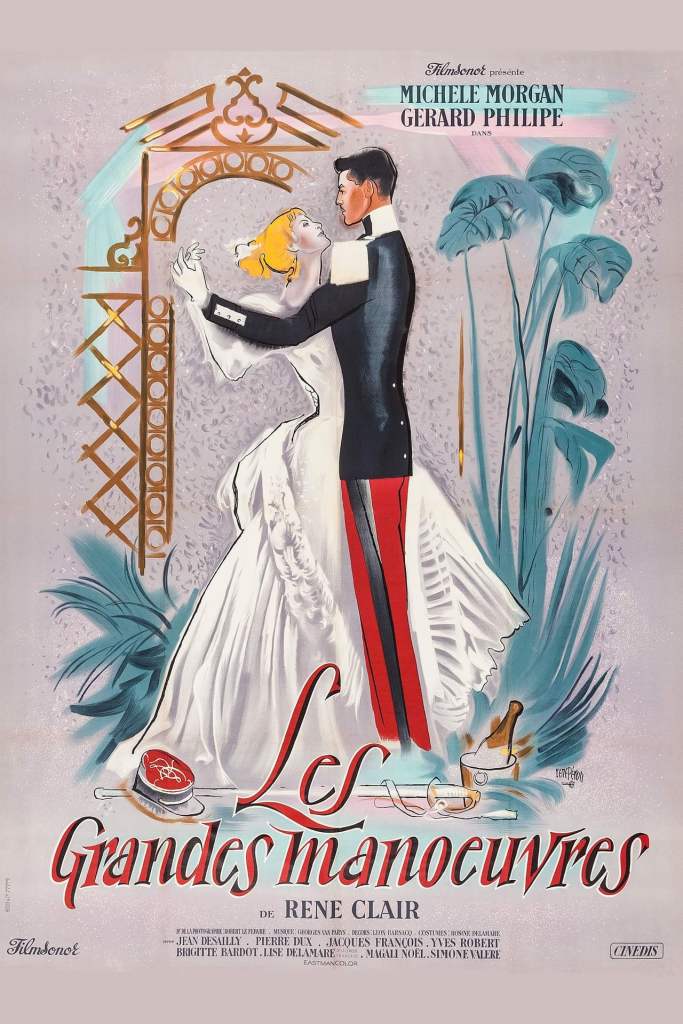
Les Grandes Manœuvres (The Grand Maneuver) came a few years later, in 1955, and was Clair’s first color picture. This is a delightful film about a French officer who makes a bet he can’t win. Armand is your typical Don Juan character, wooing ladies and strutting around town with quite the scandalous reputation. Thinking he can’t lose, he takes a bet with a group of men that he can “obtain the favors” of any woman chosen at random, and within the next 30 days before military training maneuvers take him out of town. The random woman ends up being Marie-Louise, a Parisian new to the area who is already whispered behind her back, A) for being divorced, and B) for possibly being a “kept woman” to the respectable Victor Duverger. The rumors are false; Victor does want to marry her, but there is no hanky panky going on. What Armand doesn’t account for is his actually falling in love with Marie-Louise. Unfortunately for him, anytime she starts to reciprocate those feelings, she hears a new rumor of the sordid past of her admirer, and all the while, Victor is waiting in the wings to take her away. It’s not a very original story, but it is a very fun (and funny) movie, with some cute subplots (like Armand’s friend trying to use Armand’s tried-and-true techniques on a woman of his own), and absolutely gorgeous sets and costumes. Highly recommended. ★★★★½
- TV series currently watching: Star Wars Rebels (season 4)
- Book currently reading: The Eye of the World by Robert Jordan

 Jons Movie Takes