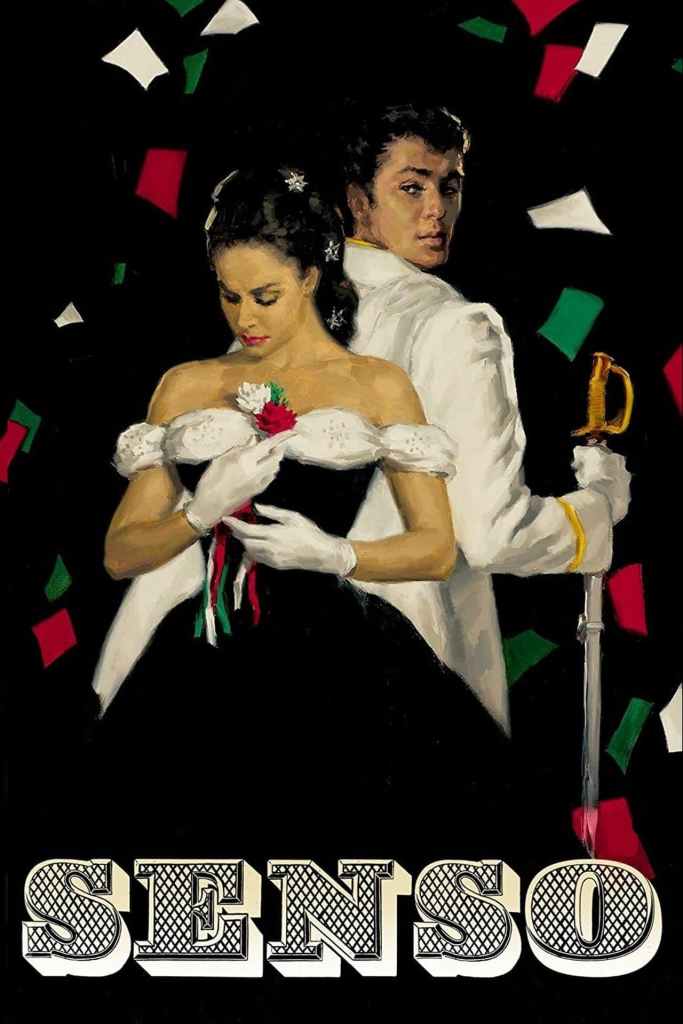
After recently watching some Francesco Rosi films, an Italian director known for gritty realistic and political films, I thought about going for the opposite side of the spectrum. Another Italian, Luchino Visconti, is known for his lavish, often historical, dramas. I’m starting with Senso, which takes place at a time in the mid-19th Century when Italy was occupied by an Austrian army. At the opera house, we meet the movie’s centerpiece, Livia Serpieri. A countess married to an older man, Livia is immediately attracted to the young dashing Franz Mahler. Unfortunately Franz is on the wrong side; he’s a soldier in the Austrian army. As Livia’s cousin Roberto protests against the Austrian occupation (which gets him sent off in exile), Livia can’t help herself; the viewer knows Franz is playing her for her money and doesn’t really care for her, but she is all in. Even when he disappears for weeks at a time, she takes him back. We get to ride along with the train wreck as Livia continually follows after Franz like a little school girl. I enjoyed it while watching it, but I’m not sure it is going to be all that memorable. Nothing really stuck with me once it was over. ★★★
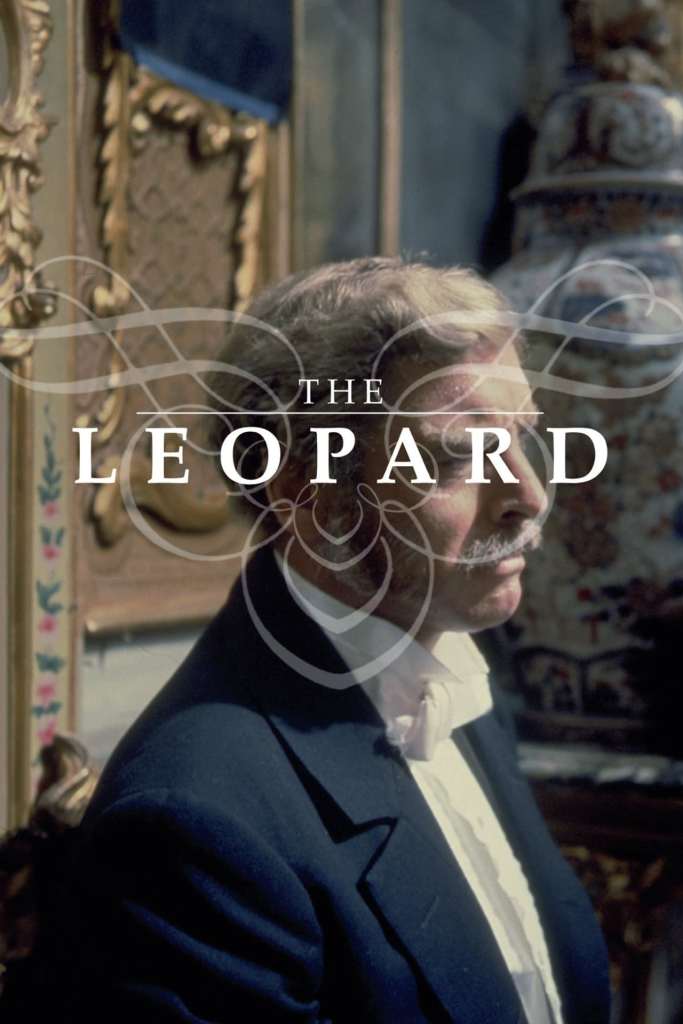
The Leopard is an old school historical drama, taking place in mid-19th Century Sicily. The Prince of Salina (Burt Lancaster) looks over a vast estate, a castle so large that there are rooms no one living has visited. Salina enjoys the comforts of his ancestral position, but times are changing. A war is about to break out between the current King and a revolutionary named Garibaldi. Salina is old enough, and wise enough, to think that whoever wins really won’t change his lifestyle; rulers come and go, but things always have settled back to norm in the past. Salina dotes on his nephew, Tancredi (Alain Delon), who is joining up with Garibaldi’s rebellion. As the film goes along though, we see that Tancredi is definitely of the “new class,” and doesn’t hold any real ideals, joining whatever group will provide him the better comfort in the future. Salina will also see before the end of the movie that this time, there is no returning to the way things have held for generations. People of “new money” coming to balls are changing societal norms, and there are more people like Tancredi, who are ambitious and will do anything to get ahead, than like Salina, who likes to go with the flow and not change the status quo. It has a very Gone With the Wind-like feel; a way of life is leaving forever. The movie is long (3 hours), but I didn’t see a lot of extra fat. Every scene and every conversation lends to character development and/or overall feel. And to say it is gorgeous is an understatement. Beautiful costumes, shot on location in Palermo, the whole movie is a joy to watch. ★★★★
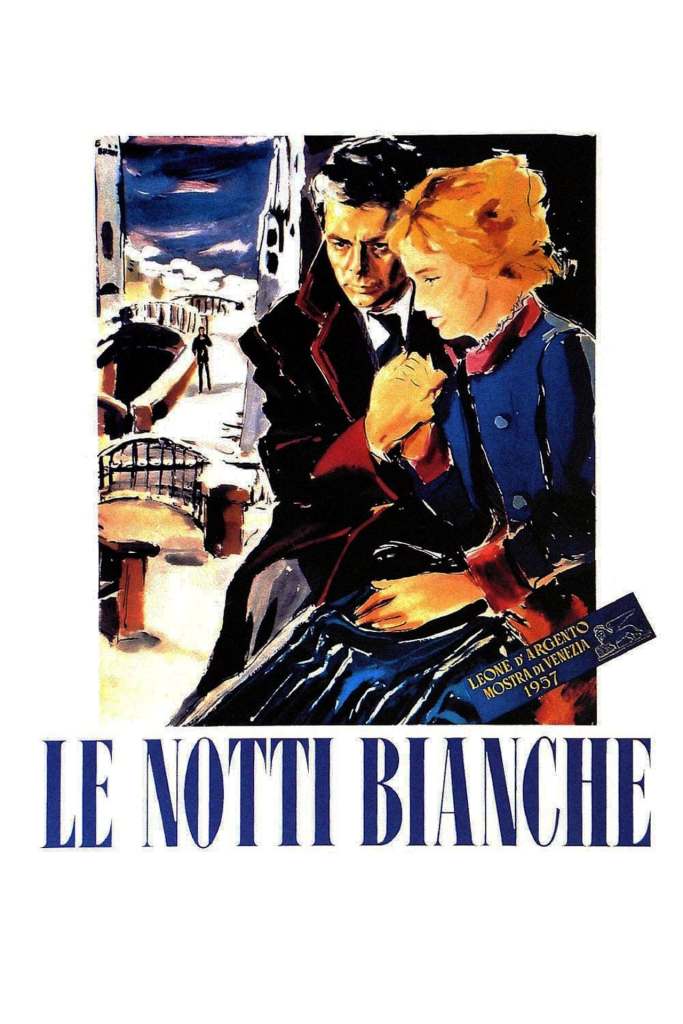
I usually review these films in chronological order, but since this director made so many historical pieces, and wanting to split them up a bit, I watched The Leopard (1963) before Le notti bianche (White Nights, 1957). Based on a story by Fyodor Dostoevsky (I’ve read a couple of his major works, but not this one), it tells the tale of a man, Mario (the great Marcello Mastroianni), who is wandering the streets late one night. He happens upon a woman crying, who is receiving unwanted attention from some drunk men. Mario chases them off and meets the girl, Natalia (an adorable Maria Schell). Mario is instantly smitten, and while Natalia seems to like him too, she is reserved. Mario soon learns her story: raised in an extremely conservative household by an overbearing grandmother, Natalia fell in love with the first man who came along, a lodger in their household. However, he owed the wrong people some money, and told Natalia he needed to disappear. He promised to reunite with her in one year at the bridge where Mario found her waiting. With the anniversary here, Natalia has been returning to the bridge every night, waiting for her “true love.” Mario can’t believe what he is hearing: here’s a smart and attractive young woman who has put her life on hold for a year for someone who Mario is sure is never returning. Despite a cute little story, solid acting, and outstanding cinematography in the smoky nights, I didn’t get into this one. Natalia was so cute she was nauseating after awhile; Mario wasn’t the only one who was ready to bang his head against the wall over her antics. ★★

You ever get that feeling that you watched a completely different movie than everyone else? Visconti received a lot of attention for The Damned, but I thought it was downright awful. Taking place in 1930s Germany, it follows an aristocratic family, the Essenbecks, who run a steel business. The patriarch, Baron Joachim von Essenbeck, does not like Hitler, but some of his kids and grandkids see opportunity in backing Hitler’s new regime. One night, the Baron is murdered in his own bed, but the man charged in the crime has been set up by other family members, because of his outspoken criticism of the Nazi party. As the power struggle for governing control of the company ramps up, each family member will stop at nothing to make sure he (or she) comes out on top. Sounds great, but this movie was far too over the top. The actors are continually hamming it up in every scene. You don’t even have to listen to the dialogue to know if someone is up to no good, just look for a caricature-like evil grin on their lips and you’ll know. Wild camera work, with extreme close-ups, doesn’t help. And I didn’t even mention that its runtime approaches 3 hours. I’ll give it a single star because I actually made it through and didn’t quit, but I’ll never watch this one again. ★
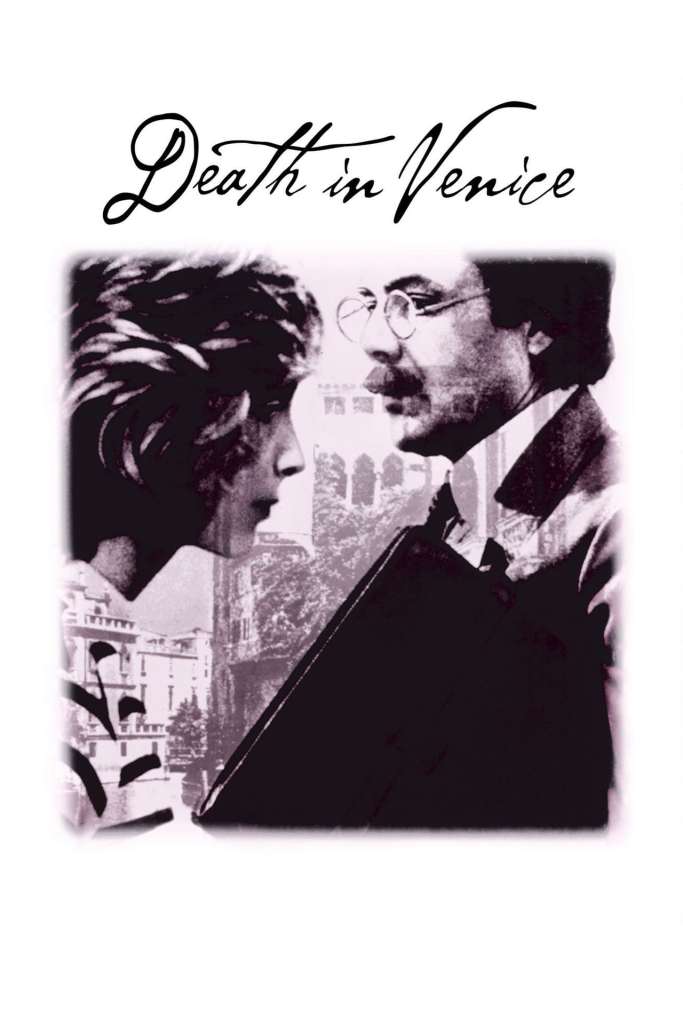
Sometimes filmmakers will make a movie that is purposefully abhorrent, just to elicit a reaction. Death in Venice is such a film. Based on a book by the renowned author Thomas Mann, and following in the wake of The Damned and continuing down a similar vein (the repugnant behavior of the elite class), this film follows a successful composer, Gustav von Aschenbach, as he vacations in Venice. Gustav is dying of some unknown illness, and goes around in a foul mood. He is arrogant and quite frankly, an asshole, as he makes demands upon baggage handlers, hotel staff, etc. However, he starts to enjoy himself when he becomes smitten by an effeminate boy, who can be no more than 12 or 13 years old. The boy, Tadzio, is at the resort with his family, and Gustav takes any opportunity to lear at him on the beach or in the community dining room. Almost wanting to keep himself miserable, Gustav decides to leave and return home, but his luggage is inadvertently shipped to the wrong place, and Gustav returns to the hotel in Venice. The scene of him on the boat back to the resort, where is so giddy that he can’t sit still, with sweeping happy music playing over, all because Gustav can return to Tadzio, is as creepster as it gets, and will leave you feeling dirty. Back in Venice, Gustav continues his leering, but also begins to notice other dire events around the city. There are rumors going around of a sickness, and Gustav sees city workers spreading disinfectant around the streets. The hotel staff says nothing is wrong, but obviously something is going on. There’s an obvious correlation between the rampant disease in the city, Gustav’s own decaying body, as well as his sinister thoughts and urges, so while the material is repulsive, I found it to be a much better film than The Damned. ★★★
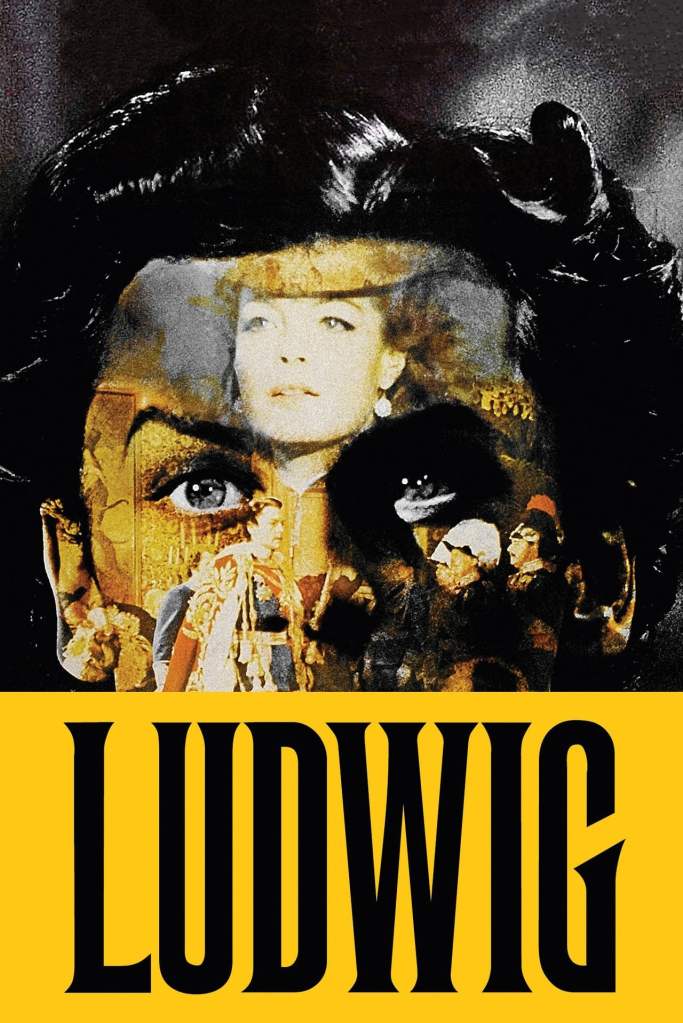
Finishing up today with Visconti’s full, original version of 1973’s Ludwig. Often edited down to smaller lengths over the years, I went for the 4 hour version, in Italian rather than English. After the overall unevenness I experienced with Visconti’s films leading up to this, maybe I’m a glutton for punishment, but thankfully I enjoyed this one. It tells the life and death of King Ludwig II of Bavaria, starting with his coronation at age 18 in 1864. Ludwig immediately finds himself in the crosshairs of the aristocracy; he spends lavishly with no regard to what the nobles want, and seems to take little interest in governmental affairs. Whether it is financing Richard Wagner’s latest opera and paying off Wagner’s substantial debts, or barely supporting his country’s involvement in the Austro-Prussian War, Ludwig is certainly not making any friends at court. He mother and confidents urge him to marry and produce an heir, but Ludwig only has eyes for his cousin Elizabeth, who is already married. In a moment of inspiration, she tells Ludwig to look inward and find that he doesn’t really want her at all, and that he should marry her sister Sophie instead, as she will at least be a good, faithful wife. In a moment of self-reflection, Ludwig finds what Elizabeth was alluding to, that he is gay. Devoutly Catholic, he prays to be released from his homosexual urges, and announces that he will indeed marry Sophie.
The second half of the film slows down a bit. Ludwig keeps delaying his wedding to Sophie, until he ends up cancelling it altogether. He begins spending even more lavishly than before, and removes himself from state affairs until he is lonely, unkept, and surrounded solely by young men and sycophants. He is abandoned by Wagner, who really was just into it for the money, and when Ludwig tries to pull in actors or other artists to be close confidants/friends, they betray him as well, leaving him very much alone. When the government has had enough with his ways, they decide to take him out, and get a doctor to declare him medically unfit to rule. As his family has a history of mental illness, it is very believable (even the viewer is unsure). His short 22 year reign ends unceremoniously, when he dies in a shallow lake. Whether it was suicide or murder, remains a mystery to this day. I thoroughly enjoyed the first half to 2/3’rds of the movie, and while it did slow towards the conclusion, it’s still an overall very engaging film. Helmut Berger is tremendous as Ludwig II, and he did win Italy’s version of an Oscar for the role. ★★★½
- TV series currently watching: Peacemaker (season 1)
- Book currently reading: Relentless by RA Salvatore

 Jons Movie Takes