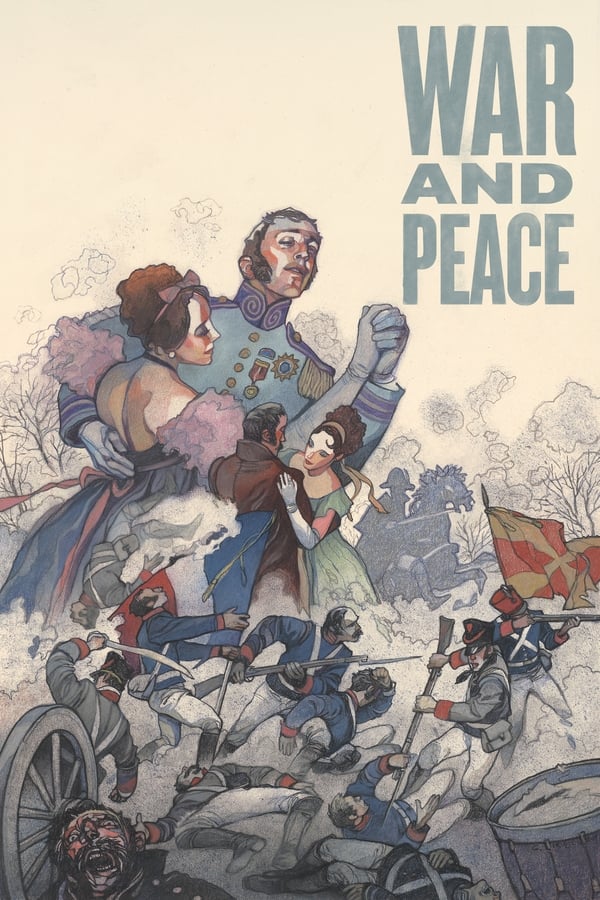
When I read through my 100 books list, it was lacking quite a few classics, because it only focused on 20th Century reads. In the last couple years since finishing that goal, I’ve gone on to read some of the great Russian classics by Dostoevsky and Tolstoy, including his War and Peace. Loved it, so of course I needed to find a film version. Many point to the Soviet era film series, directed by Sergei Bondarchuk, as the best of them. A 4 parter, totaling over 7 hours in length, it is considered one of the grandest epics ever produced, on a scale that could not be duplicated today (or ever). Filmed from 1961 – 1967, and aired between ’66-67, it even had the Soviet army offering over 10,000 soldiers as extras played in the battle scenes. At the height of the Cold War, they wanted to prove they could outdo Hollywood. So let’s get to this grandeur!
Obviously it was going to be hard to translate 1000 pages to film. The first thing I noticed is, while there is some voice over/narration to hear some thoughts from the characters, we don’t get to really see what makes each individual tick, like the book does. All well and good, as it still does its best to stay as faithful to the source as possible. The film opens by introducing the setting: Russia is getting ready to go to war in eastern Europe against Napolean. Some of the main players are introduced. Pierre, the illegitimate son of Count Bezuhkov, is partying it up, even as his father lies on his deathbed. When Pierre’s father dies and Pierre’s claim to his fortune is legitimized (a lengthy section of the book detailing others’ attempts to get that fortune is left out), he does not go to war. Pierre’s friend Andrei Bolkonsky does though, leaving behind his pregnant wife in the care of his stern father and loving sister. We see a couple huge battles involving Russia, Austria, and France, made all the more glorious since there are no (ahem.. Middle Earth style) CGI combatants to fill the screen: there are thousands of real people fighting across a sweeping landscape. Russia is losing the battle, but thanks to the bravery of a single detachment holding the line, the army is able to withdraw without being wiped out. Andrei is knocked out and feared dead, but he is able to make it home in time to see his wife die in childbirth. Meanwhile, Pierre is tricked into marrying the beautiful Hélène, who only wants him for his money, and proceeds to cheat on him right away with womanizer Fyodor Dolokhov. Pierre challenges Fyodor to a duel and wounds him. Pierre fights with Hélène, who says she will only divorce him if he leaves her a fortune; he yells at her to get out.
In part 2, 4 years later, the war has ended and Russia is at peace. This part focuses mostly on Natasha Rostova. Only a girl in the first part, she is now a beautiful young woman and looking to marry (the movie glosses over her clandestine childhood promise to marry her cousin). At her first ball, Pierre introduces her to Andrei and they fall instantly in love. After a short courtship, he proposes, but instantly regrets it, seeing that he loved the idea of her more than Natasha herself. He gives himself some time by proposing they postpone their nuptials by one year, giving her time to grow and see if she still loves him. They will even keep their engagement a secret from society. Over that year, Natasha is wooed by Hélèna’s brother Anatole, who is as rotten as she. He only sees Natasha privately, and makes promises to her that he cannot keep; unbeknownst to her and only whispered in private circles, Anatole is already married to a poor girl back west. On the night that Anatole and Natasha are supposed to elope, thankfully news gets out, and Pierre is able to swoop in and prevent her from making a huge mistake. He confesses to Natasha that he loves her too, and if not for his marriage, he would care for her. The episode ends with another outbreak of war, as Napolean’s army invades Russia.
The third part is the shortest at 80 minutes, and deals mostly with the Battle of Borodino in 1812. After a short introduction where we see Andrei’s father die, leaving his unmarried sister Maria as “head of house” in Andrei’s absence (unlike the book, the movie doesn’t delve into that weird relationship between Maria/Andrei/Prince Bolkonsky). Then we get to the battle. Pierre has had enough watching from the sidelines, and with the battle pitched so close to Moscow, he goes to see if he can help in some way. While the soldiers initially laugh at him in his dinner coat and top hat, he ends up buoying their spirits when the fighting gets tough. While Pierre finds himself at a redoubt holding the French at bay all day and night, Andrei’s unit, held in reserve throughout the day but never sent it, ends up wounded when an artillery shell hits nearby. In the medical tent, Andrei sees Anatole, and wonders why this man who seemed to have no honor is there fighting. Anatole ends up having a leg amputated. While both sides suffer terrible losses, the Russian army is forced to retreat, leaving Moscow unprotected, which is how part 4 opens up. If you have time, look up this battle, as it is a fascinating turn in Napolean’s empire, and one of the bloodiest, with over 100,000 troops on each side. It is a classic example of “winning the battle, but losing the war.” Napoleon never recovered from the losses in his Russian campaign. Combined with the stretching of his supply lines so far into Russia, and with winter approaching, it was the beginning of the end of Napoleon’s reign.
I’ll leave the final episode for you to view if you are interested to see how it all ends. What becomes of Pierre when he stays behind in Moscow while the French burn and pillage it, and afterwards, with the news of Hélène’s death? Does Andrei recover from his wounds, and what of Natasha? Inasmuch as a film, even a 7-hour-long one, can cover such a huge novel, this one does a very good job. On its own accord, it is fantastic cinema, with a monumental scope. Necessarily it focuses on the above mentioned characters, relegating a host of others (the book has one of the largest cast of any novel I’ve ever read) to periphery status, or not mentioned at all. The book still reigns supreme, but the movie is good on its own. ★★★★

 Jons Movie Takes
One thought on “A quick film review of War and Peace”