
Charulata (aka The Lonely Wife) brings back Madhabi Mukherjee, who I loved in Ray’s The Big City and Coward. She plays Charu, the wife of a wealthy newspaper publisher named Bhupati. Bhupati’s biggest love is his paper, leaving Charu to languish at home, bored out of her mind. Knowing he has neglected her, Bhupati invites family to come stay with them, in hopes of cheering Charu up. His brother, with his vapid wife, do nothing to liven the intelligent and thoughtful Charu, but she does take an instant liking to Bhupati’s younger cousin Amal. Amal is much closer in age to the young and beautiful Charu than her older husband, and he’s also into the arts, wanting to become a writer, especially of poetry. Charu also enjoys writing, and a bond develops between these two. The big twist in this film, and there is one, doesn’t come from the leads, but out of left field. The ending is not what you’d expect, but in a good way. Wonderful film, with a shining Mukherjee again in the lead. ★★★★½

Nayak (The Hero) is about a famous actor, Arindam, who must take a passenger train overnight to Delhi. Instantly recognizable, the people on the train treat him with everything from reverence (his fans) to contempt (an older man, due to Arindam’s drinking and loose lifestyle). Arindam takes it all with an air of confidence, and while pleasant to others, he does come off a bit egotistic. He meets his match in a young woman named Aditi, an editor for a modern women’s magazine. Aditi isn’t star-crossed, in fact, she seems to have a very slight opinion of Arindam’s career and lifestyle, but she does see an opportunity for an interview to help boost her magazine’s readership. At first, Arindam tries to give the stock responses to her questions, but Aditi digs for more, wanting more than just the kind of fluff interview Arindam has already given a million times. Through the course of the film, told in flashbacks and even a couple dreams, we learn about Arindam’s upbringing and what makes him tick, and that Arindam’s cockiness is really just a front. He fears failure as much as the next guy, maybe even more so, knowing that 3 film flops in a row would kill his career for good. Arindam survives intense anxiety by drinking, and puts on a facade whenever he’s in the public eye, which is nearly always. Though it doesn’t start out as such, by the end, it comes together as a heartfelt film, exactly what you’d expect from Ray, who seems so good and looking at the inner workings of humanity. ★★★★

Ghare Baire (The Home and the World) takes a look at the chaotic times in India in the early 20th century. The main focus of the film is Bimala, the beautiful bride of a local maharaja, Nickilesh. There’s been a brewing animosity between Hindu and Muslim Indians, and Nickilesh has been resistant to calls for boycotting foreign imports in favor of buying goods made in India. He does this in order to look out for the poor people who live on this land, mostly Muslims and the targets of racism by the Hindu Indians; Nickilesh knows that the imports from neighboring countries are cheaper than the homegrown equivalents, and the poor cannot afford to make that change. Nickilesh is being persuaded to change his views by an old friend, Sandip. Sandip is a vocal leader of the boycotters, called the Swadeshi movement. Against this backdrop comes Bimala. Bimala is a traditional woman, and in fact, since her marriage to Nickilesh, she has not left the inner apartments of their compound. She was married to him as a girl, and except for some servants, she has never even seen another man. Nickilesh is forward thinking, and pays to have Bimala taught by an English tutor, learning piano and western singing, etc. He coaxes her out into the world, and introduces her to Sandip. Big mistake. Bimala is swept off her feet by the charismatic Sandip, to potentially devastating effect before the end. As far as I can recall, this was the first color film of Ray’s that I’d seen, and I think his black and white pictures show better. The coloring is nice, but Ray’s stark black and white films really pop in my experience. That aside, the story is nice, though not unexpected, and I did enjoy the knot Nickilesh puts himself in. He wants to keep Bimala to himself, but knows that she must come to him on her own terms for her to truly choose him over Sandip. ★★★½
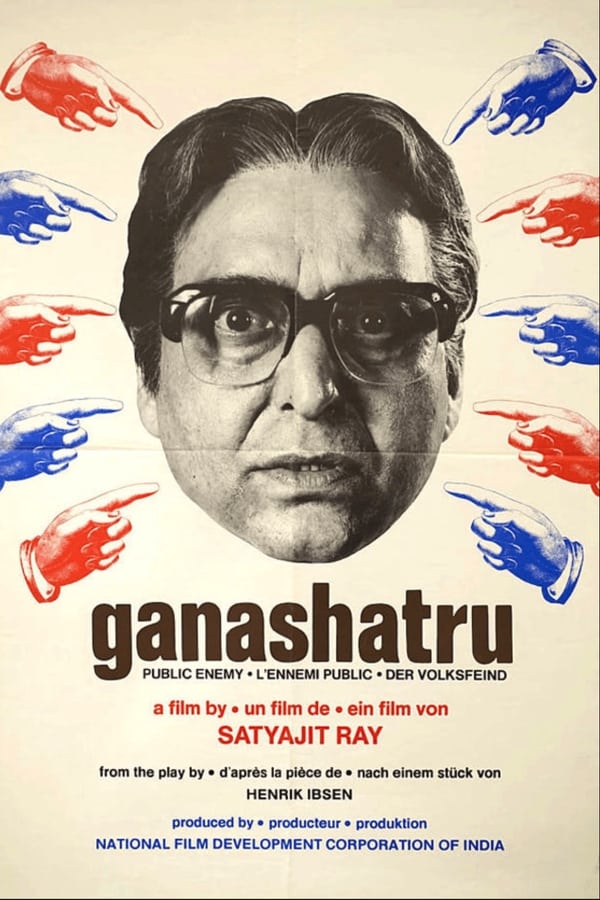
Ganashatru (An Enemy of the People) is the first real dud that I’ve seen from this director. It is about a doctor, Ashok Gupta, who finds that water being drawn in a populated area of the town of Chandipur is contaminated, leading to a rise in cases of jaundice among its inhabitants. He is able to narrow it down to water being drunk at the holy temple in town, which happens to be the town’s biggest attraction. The solution is to dig up the pipes under the temple and replace them, but the temple is not too old, and Gupta faces opposition from the local politicians, lead by none other that Gupta’s younger brother, who was a driving force in getting the temple built. The brother and others start a crusade to paint Gupta as anti-religious, and start to turn the townspeople against him. The whole thing is really nothing more than a bad tv movie. It’s a very simple plot, full of soap-opera like long takes and overly dramatic behaviors and exclamations. It’s hard to see any of Ray’s touch in this movie. Everyone has a bad day here and there. ★½

Agantuk (The Stranger) was Ray’s last film, released in 1991, a year before his death, and a more fitting final film there couldn’t be. A well-off family in Calcutta receives a letter from a man claiming to be Anila’s long-lost uncle. The uncle, Manomohan, left the family 35 years ago when Anila was just a small girl, and he never returned. The letter states that he is coming back, and Anila and her husband, Sudhindra, have to wonder why, after all this time. When Manomohan arrives, he regales the family with tales of his adventures, traveling the world and seeing sites and cultures all over. Sudhindra and Anila’s son, Satyaki, is particularly enamored with stories of the tribes of Africa and South America. Anila wants to believe that Manomohan is who he says he is, but Sudhindra is dubious. The family invites friends over to grill Manomohan over his stories, but the man is extremely intelligent and passes with flying colors. The “why” of his sudden arrival becomes clear when Anila realizes that her grandfather may have left him a large inheritance when he died 20 years ago, and perhaps Manomohan is now here to claim it. This revelation spurs Sudhindra’s suspicions. Is Manomohan really who he says he is, but more important maybe, does it really matter? A wonderful film about family love, and hidden within its conversations, the question of what makes a civilization, and are “cultured” people any better than “barbaric” tribes. As mentioned, this was Ray’s final film. He died in 1992, a month after accepting a lifetime achievement honorary Oscar award. ★★★★
- TV series currently watching: The Night Of
- Book currently reading: The Elfstones of Shannara by Terry Brooks

 Jons Movie Takes