About a year ago, I watched a few films from Polish director Krzysztof Kieślowski, and enjoyed them. Today I’m biting into his Dekalog, a 1988 TV series, which is sort of a modern take on the Biblical Ten Commandments. 10 episodes, each an hour in length, tackling a new philosophical approach to each commandment. Each episode stands alone. The only shared aspect is the setting, as they all take place in the same apartment/housing complex.
Going in order, the first episode deals with the first commandment. In it, a man is teaching his son to have faith only in facts and science. Everything is measurable and definable, and the boy, who is very bright, enjoys solving equations on one of the family computers. When the boy has questions about what happens after death, the dad is very matter-of-fact, saying there is nothing after death, but the boy gets very different answers from his aunt, a devout Catholic. In the end, we learn that science can’t always predict everything. The second episode focuses on the power of human words and their affect on people. A woman begs a doctor for his opinion on if her ailing husband will live or die. She’s become pregnant by another man, and at her age, she has a decision to make: keep it and alienate her husband, or abort, possibly her last chance to have a child. If she loved one man more than the other, the decision would be easier, but she admits she loves them equally. The doctor however refuses to say; he’s seen miracles too often to make a decision.
Instead of the Sabbath, the third episode focuses on the importance of a single day, Christmas Eve. Janusz is a taxi driver returning home on Christmas Eve, first dressed up as Santa for his kids, and then in a private toast with his wife and mother-in-law. At midnight mass, he spots Ewa, his former mistress who broke up with him 3 years ago when they were caught red handed by her husband Edward. Ewa approaches Janusz for help, saying her husband never returned home that day. Janusz makes up a lame excuse to his wife and heads out with Ewa to try to find Edward, and they spend the entire night until morning in doing so, but Janusz starts to suspect more is at play. The fourth episode deals with the relationship between a father and his daughter. Anka is a college student living with her single father Michal, and he is going out of town for a few days for work. While he’s away, she finds a sealed envelope in his desk with directions not to open until his death. Morbidly curious, she opens it, and finds inside a letter from her mother, who died just after giving birth to her. Anka learns the family secret: that Michal is not her biological father, but that he would raise her as such. Michal is hurt that she learned this while he is still alive, but Anka flips it on him, saying that she has always been remotely attracted to him but kept her feelings buried, knowing they were wrong since he was her father. He admits much the same. But the real truth isn’t revealed until the very end (or is it?).
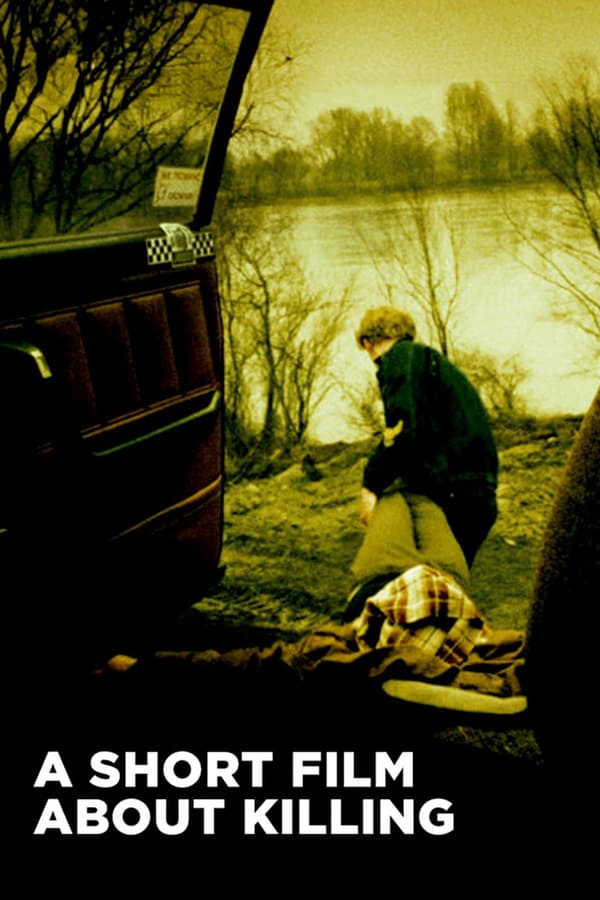
Part of Kieślowski’s deal to make this series was to make longer cuts of 2 of the episodes, and turn them into feature films for theater release. The first of these was the fifth episode, and after a little research, I heard the consensus is that the film is basically just a longer version. So instead of the 1 hour episode, I watched the film, A Short Film About Killing (for the fifth commandment). Three main characters here: a jerk taxi driver named Waldemar who creeps on young woman, an idealist young lawyer fresh off his bar exam named Piotr, and a sadist named Jacek. Jacek derives pleasure from pushing rocks onto cars from overpasses, pushing guys into urinals in public bathrooms, and shooing away pigeons when an old lady is trying to feed them. But he has more sinister plans: carrying around rope and a metal rod in his backpack, he sets his sights on a murder. Waldemar is the unlucky guy when he picks Jacek up, and the gruesome murder does ensue. However, Jacek seems to not enjoy it as much as he thought he would, and in the next scene, taking place a year later when he has been caught, tried, convicted, and sentenced to death, he appears truly contrite. His lawyer was Piotr, who anguishes over not being able to save Jacek from his fate. You would think that the whole “thou shalt not kill” would focus on Jacek’s crime, but instead, the film comes off as an inditement against the death penalty. Whether you believe that Jacek should be punished for his brutal crime this way or not, the film does argue that there was a human being worthy of redemption inside the killer that was Jacek’s body. Great, suspenseful film, with a message that is still timely.
I’ll return to the second film later, because I hear it is actually much different than its counterpart in the Dekalog series, so for now, I’m going back to episode 6. Instead of focusing on adultery, the director chooses to go the heart of the matter: love. Tomek is a 19-year-old living with his friend’s mother while the friend is away. He’s a bright student, but is obsessed with a mid-to-late 30’s woman who lives in the apartment across the way from his. Using a telescope, he spies on her every night, calls her to hear her voice (never answering her “hello”), and finds ways to get her to come to his place of work, the post office. He even gets a second job as a milk deliveryman in order to visit her apartment regularly. She is unaware of the spying until he is forced to admit it during one of the ploys to get her to his job. She is rightfully angry at first, but it isn’t long until his innocence turns her head. She’s had a jaded outlook on love and sex for years, and is now drawn to Tomek’s innocent love.
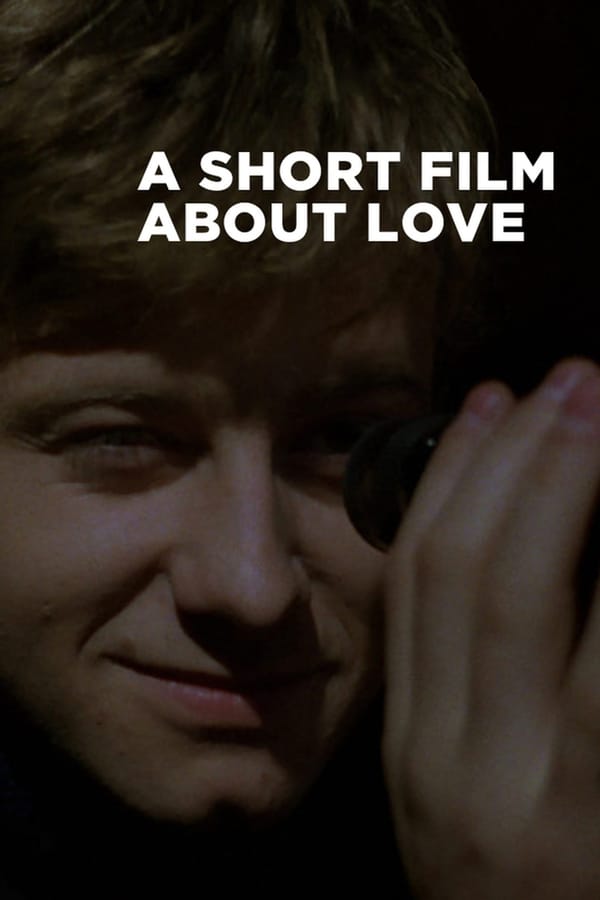
(By the way, I did go back and watch the longer version, A Short Film About Love, later. It is definitely a much different film than the episode. It paints Tomek more as a calculated figure, portraying his rituals in voyeurism leading up the events in the shorter TV version. There’s an expanded beginning, more time devoted to the lady Tomek lives with and her love and caring for him, and the end is a much different, happier ending.)
Episode 7 gives a twist on “thou shalt not steal.” In this one, Majka kidnaps her sister Ania, only to reveal that Ania isn’t her sister; it is her daughter. Impregnated at 16 by a teacher at school (where her mother was the headmistress), Majka agreed to let her mother raise the girl as her own. But it didn’t turn out as Majka wished, as she grew jealous in not being able to raise Ania the way she wished. Now in her early 20s, she has plans to take Ania to Canada and start a new life. Lots of things were stolen here, Majka’s chance to be a mother not the least of them. The eighth episode is all about truth. Elżbieta is a younger woman visiting Poland from the USA. She’s friends with Zofia, an older woman who teaches ethics at the university. Zofia and Elżbieta have been professional friends for awhile, but share a connection of which Zofia is unaware. Elżbieta sits in on one of Zofia’s lectures, where students propose ethics questions for discussion. One student submits the problem from Dekalog 2. Elżbieta submits her own. She says that during World War II, a young Jewish girl was brought to a Catholic family for hiding, but that he family, a husband and wife, had changed their minds and turned the child away at the door. As it turns out, Zofia was the wife, and Elżbieta was the girl. Elżbieta has known this for some time, but never told Zofia when they’d met in the past.
Episode 9 deals with faithfulness in marriage. Roman has just received a diagnosis of impotence from his doctor, that he will no longer be able to maintain an erection. He goes home to his younger, beautiful wife, Hanka, and tells her that she should be satisfied, and has his permission to end their marriage and find a lover. She assures him that sex is not that important, that she loves him and will not stray. However, Roman begins to suspect that she already has a young lover on the side, and his jealousy gets the better of him. The final episode focuses on greed. Two adult brothers come together for their estranged father’s funeral. After his burial, they go to his flat and find that he had a multi-million dollar stamp collection. Rather than bringing them together, this event opens up schisms of paranoia between them.
I really enjoyed this series. For one, it is extremely even, meaning, I don’t think there were any “bad” episodes. I have my favorites (4, 5, and 7), but I think if you asked 10 viewers, you’ll get different answers based on how each episode speaks to you. There’s the overall theme of the episode, but also a lot of subtle things going on that you can spend time thinking about later on. Overall, I found them to be only lightly based on the Ten Commandments, and instead, more of a philosophical approach to the underlying meanings of those commandments (adultery boiling down to loving your spouse, coveting goods more to being content with what you have). Though not overtly religious, there is a cool moment in nearly every episode involving a non-speaking character, the only character who runs throughout the series, who looks on, often at an important junction for the main character of that episode. Is it an angel? A conscience? The characters definitely have different reactions to him, depending on their motives. Great stuff. ★★★★
- TV series currently watching: Gotham (season 2)
- Book currently reading: Wolves of the Calla by Stephen King

 Jons Movie Takes